A Big Supreme Court Win for Reality over Transgender Ideology
Written by Dan McLaughlin
The Court declined to blind itself to sex differences, to how medical practice works, or to the uncertain science in this area.
Share this story
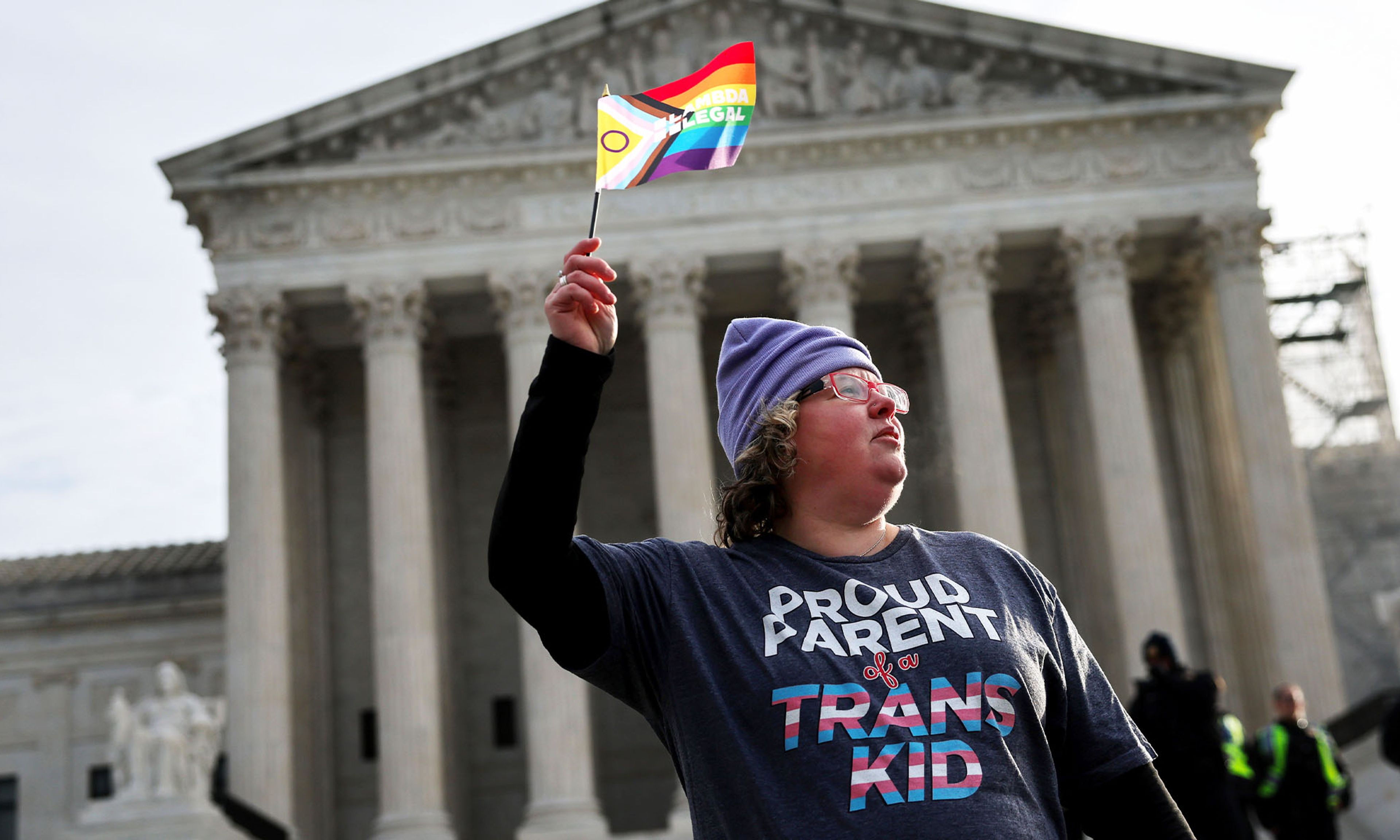
A transgender rights supporter rallies outside the U.S. Supreme Court in Washington, D.C., December 4, 2024.
The Supreme Court handed down this morning the most closely watched case of this term, United States v. Skrmetti, affirming a Tennessee law banning “gender-affirming” treatments for minors such as puberty blockers and hormone therapy for gender dysphoria. The Court’s 6–3 opinion, written by Chief Justice John Roberts over the dissents of the three liberals, concluded that Tennessee’s law did not discriminate on the basis of sex or transgenderism and therefore needed to satisfy only “rational basis” review — which it did.
Justices Amy Coney Barrett, Samuel Alito, and Clarence Thomas would have gone further to agree with the Sixth Circuit that transgenderism is not a suspect classification at all, and therefore all laws dealing with transgender issues need pass only the lenient rational-basis test. Roberts and the majority left that question open for another day, befitting the chief justice’s preference for judicial minimalism and incrementalism but encouraging further litigation of these issues. Thomas also added a blistering attack on the effort by Justice Sonia Sotomayor’s dissent to shut down democratic lawmaking in this area on the say-so of “experts.”
The decision is a win for realism over ideology. The Court declined to blind itself to sex differences, to how medical practice works in this or other areas, or to the uncertain science in this area, and it refused to subordinate itself to any unelected expert class.
The Stakes
Skrmetti arose out of lawsuits by three transgender minors, their parents, and a doctor — joined by the Biden administration — against a 2023 Tennessee law, SB 1. The Trump administration reversed the government’s course on the case after it came to office, but it had already been argued and the Court found that the individual challengers had standing to sue, so the about-face by the solicitor general due to the change of administrations didn’t formally affect the outcome. Whether some of the justices read the tea leaves from the election on transgender issues is anybody’s guess.
Even discussing transgender controversies presents thorny issues of language. The Court’s opinion began by discussing how people “identify as transgender, meaning that their gender identity does not align with their biological sex,” but also “some transgender individuals suffer from gender dysphoria, a medical condition characterized by persistent, clinically significant distress resulting from an incongruence between gender identity and biological sex. Left untreated, gender dysphoria may result in severe physical and psychological harms.” Of course, whether transgenderism is an identity or a medical condition is a crucial definitional question.
Roberts went on to walk through the history of how global health groups first restricted hormonal and surgical gender-change treatments to adults in 1979, then loosened that guidance in “rare circumstances” in 1998, then further relaxed the guidance, which continued to evolve. European countries have significantly reassessed their views since 2020. SB 1 responded to similar concerns about irreversible treatments, banning surgeries or puberty blockers for minors, but allowing such treatments for adults. The Court emphasized that it was hesitant to set a constitutional rule in stone while the science remained fluid, noting the 2024 Cass report from England’s National Health Service as a reason why: “Recent developments only underscore the need for legislative flexibility in this area” in light of “open questions regarding basic factual issues before medical authorities and other regulatory bodies.”
Because none of the plaintiffs had standing to challenge SB 1’s ban on surgeries, that part of the law dropped out of the case and was not enjoined by the district court. But the ban on hormonal therapies exempted the use of hormones “to treat a minor’s congenital defect, precocious (or early) puberty, disease, or physical injury.” That exemption was the focus of the case as it came to the Court.
Reality Is Not Unconstitutional
As Roberts reminded the reader, quoting Justice Anthony Kennedy in Romer v. Evans (1996), drawing distinctions is the essence of lawmaking: “Most legislation classifies for one purpose or another, with resulting disadvantage to various groups or persons.” Thus, “if a law neither burdens a fundamental right nor targets a suspect class, we will uphold the legislative classification so long as it bears a rational relation to some legitimate end.” The Court had no trouble upholding SB 1’s age-based distinctions, noting that “classifications that turn on age or medical use are subject to only rational basis review.”
The Court has long placed gender classifications in an intermediate class, applying heightened scrutiny to laws that may rely on stereotypes or generalizations, but also recognizing the fundamental reality that sex differences are real, and that the law must reflect reality. As National Review’s editorial on the case noted back in December:
The people who wrote and ratified the [14th] amendment at the noontide of the Victorian age would have been baffled by the claim that they were creating a constitutional right for children who are confused about their sex to take drugs that make irreversible changes to their bodies. If the Court takes seriously the original public meaning of the equal protection clause, this case is no contest.
Unlike Title VII of the Civil Rights Act of 1964, which was at issue in Bostock [v. Clayton County], the equal protection clause says nothing about sex discrimination. It has long been read to bar irrational distinctions on the basis of sex, for reasons similar to why it bars racial classifications. But while legal distinctions on the basis of race are irrational in all but a few very narrowly circumscribed situations, the courts have long recognized the commonsense reality that was obvious in 1868 and remains obvious to most Americans today: Sex differences are real. They have important consequences and never more so than in matters of biology, medicine, and reproduction. Humanity could not exist without those differences.
As today’s decision illustrates, there are still dissenters from reality, but they are a minority on this Court. Roberts, who noted that the Court in 1974 had allowed insurance programs to give different treatment to pregnancy-related disabilities even though “only biological women can become pregnant,” was having none of it:
This Court has never suggested that mere reference to sex is sufficient to trigger heightened scrutiny. . . . Such an approach, moreover, would be especially inappropriate in the medical context. Some medical treatments and procedures are uniquely bound up in sex. The Food and Drug Administration itself recognizes that research has shown that biological differences between men and women (differences due to sex chromosome or sex hormones) may contribute to variations seen in the safety and efficacy of drugs, biologics, and medical devices. . . . Indeed, the agency frequently approves drugs for use by only one sex [such as breast cancer and HIV treatments]. . . . In the medical context, the mere use of sex-based language does not sweep a statute within the reach of heightened scrutiny. [Quotations and citations omitted.]
The exception to the hormone-therapy ban was used by the plaintiffs to claim gender discrimination: They argued that banning drugs for one purpose but not another is invidious discrimination based on the gender of the patient. That was always a narrow needle to thread: Biden Solicitor General Elizabeth Prelogar conceded at oral argument that Tennessee could ban a drug that was useful only in sex transitioning, because then the state is regulating the treatment, not its purpose. Nothing in the law of medicine supports such a fine splicing of the many ways in which the same or similar drugs or implements can be used for many different purposes. The Court rejected it:
Neither of the . . . classifications turns on sex. Rather, SB1 prohibits healthcare providers from administering puberty blockers and hormones to minors for certain medical uses, regardless of a minor’s sex. . . . The plaintiffs and the dissent contend that an adolescent whose biological sex is female cannot receive puberty blockers or testosterone to live and present as a male, but an adolescent whose biological sex is male can, while an adolescent whose biological sex is male cannot receive puberty blockers or estrogen to live and present as a female, but an adolescent whose biological sex is female can. . . . So conceived, they argue, SB1 prohibits certain treatments for minors of one sex while allowing those same treatments for minors of the opposite sex.
The plaintiffs and the dissent, however, contort the meaning of the term “medical treatment.” Notably absent from their framing is a key aspect of any medical treatment: the underlying medical concern the treatment is intended to address. The [FDA] approves drugs and requires that they be labeled for particular indications—the diseases or conditions that they treat, prevent, mitigate, diagnose, or cure. . . . Different drugs can be used to treat the same thing (would you like Advil or Tylenol for your headache?), and the same drug can treat different things (take DayQuil to ease your cough, fever, sore throat, and/or minor aches and pains). For the term “medical treatment” to make sense of these various combinations, it must necessarily encompass both a given drug and the specific indication for which it is being administered . . .
SB 1 does not mask sex-based classifications. . . . The law does not prohibit conduct for one sex that it permits for the other. Under SB1, no minor may be administered puberty blockers or hormones to treat gender dysphoria, gender identity disorder, or gender incongruence; minors of any sex may be administered puberty blockers or hormones for other purposes. [Quotations and citations omitted.]
It's a sign of the unreality of the dissent that Roberts felt compelled to explain patiently that no, this was not like the law banning interracial marriage at issue in Loving v. Virginia.
Ultimately, because the entire case was about medical treatments, the Court declined to even consider whether, in other contexts, transgenderism might be a protected class. It also concluded (as was probably necessary to get Justice Neil Gorsuch’s vote) that the distinction between treatments made it unnecessary to decide whether the Bostock framework for Title VII claims has any application in equal protection cases:
Under Bostock’s reasoning, an employer who fires a homosexual male employee for being attracted to men while retaining the employee’s straight female colleague has discriminated on the basis of sex because it has penalized the male employee for a trait (attraction to men) that it tolerates in the female employee. . . . Bostock held that, in such a circumstance, sex is the but-for cause of the employer’s decision — change the homosexual male employee’s sex and he becomes a straight female whose attraction to men the employer tolerates.
Not so with SB1. Consider again the minor girl with unwanted facial hair inconsistent with her sex. If she has a diagnosis of hirsutism (male-pattern hair growth), a healthcare provider may, consistent with SB1, prescribe her puberty blockers or hormones. But changing the minor’s sex to male does not automatically change the operation of SB1. If hirsutism is replaced with gender dysphoria, the now-male minor may not receive puberty blockers or hormones; but if hirsutism is replaced with precocious puberty, SB1 does not bar either treatment. Unlike the homosexual male employee whose sexuality automatically switches to straight when his sex is changed from male to female, there is no reason why a female minor’s diagnosis of hirsutism automatically changes to gender dysphoria when her sex is changed from female to male.
Settling the Question
Barrett and Alito each wrote concurring opinions arguing that transgender status is never a suspect class under the 14th Amendment. Barrett noted the “high bar” for adding to the very short list of existing suspect classes based on what groups have “obvious, immutable or distinguishing characteristics” and a historic background of legal discrimination and are a minority or politically powerless. “We have held that the mentally disabled, the elderly, and the poor are not suspect classes,” Barrett wrote: “In fact, as far as I can tell, we have never embraced a new suspect class under this test.”
Barrett walked through the problems with transgenderism as an immutable or discrete class: The trait of transgenderism is not apparent at birth, the onset of gender dysphoria may occur at different ages, some people “detransition,” and even transgender identity is seen by proponents of the ideology as a fluid spectrum. Moreover, constitutionalizing all lawmaking around transgenderism “would require courts to oversee all manner of policy choices normally committed to legislative discretion. . . . The question of how to regulate a medical condition such as gender dysphoria involves a host of policy judgments that legislatures, not courts, are best equipped to make.” To Barrett, deciding the question now would involve more, rather than less, judicial restraint not only in medicine but “other areas of legitimate regulatory policy — ranging from access to restrooms to eligibility for boys’ and girls’ sports teams.” She also countered the plaintiffs’ citation of evidence of historic discrimination by pointing out that the relevant constitutional test is discrimination in the law — and laws in this area are almost all new.
Alito, concurring only in parts of the majority opinion, agreed that SB 1 did not discriminate on the basis of sex, but he thought there was “a strong argument” that SB 1 does discriminate on the basis of transgender status. He would nonetheless have resolved the case by holding (in agreement with Barrett) that such status is not a protected class. Where he departed from Barrett was that he does not think the existing precedents “set out a hard-and-fast test” (which Barrett drew from the famous Carolene Products footnote 4) for identifying suspect classes. He also observed that, while transgender individuals are a small minority, they had not been excluded from politics and if anything, members of the “group have had notable success in convincing many lawmakers to address their problems” given their numbers.
Don’t Trust the ‘Experts’
Thomas, who joined the majority opinion in its entirety as well as joining Barrett’s concurrence, wrote separately to make a few points of his own. While he continues to reject the logic of Bostock, he reiterated his view that its statutory-language analysis simply doesn’t apply to the 14th Amendment’s distinct language, which never mentions sex. But he saved his real fire for the argument advanced by Prelogar and by Justice Sonia Sotomayor’s dissent that the court should, as Thomas put it, “accord outsized credit to claims about medical consensus and expertise”:
There are several problems with appealing and deferring to the authority of the expert class. First, so-called experts have no license to countermand the wisdom, fairness, or logic of legislative choices. . . . Second, . . . there is no medical consensus on how best to treat gender dysphoria in children. Third, notwithstanding the alleged experts’ view that young children can provide informed consent to irreversible sex-transition treatments, whether such consent is possible is a question of medical ethics that States must decide for themselves. Fourth, there are particularly good reasons to question the expert class here, as recent revelations suggest that leading voices in this area have relied on questionable evidence, and have allowed ideology to influence their medical guidance. Taken together, this case serves as a useful reminder that the American people and their representatives are entitled to disagree with those who hold themselves out as experts . . .
Whether “major medical organizations” agree with the result of Tennessee’s democratic process is irrelevant. [Quoting Sotomayor’s dissent] To hold otherwise would permit elite sentiment to distort and stifle democratic debate under the guise of scientific judgment, and would reduce judges to mere spectators in construing our Constitution. [Quotations and citations omitted.]
“In politically contentious debates over matters shrouded in scientific uncertainty,” Thomas concluded, “courts should not assume that self-described experts are correct.”

About the Author
Dan McLaughlin is a senior writer at National Review Online and a fellow at National Review Institute.
Featured Tags
Advertisement
Advertisement





Comments