A Case Study in Economic Self-Harm
Written by Veronique de Rugy
When steel tariffs weaken America’s backbone
Share this story
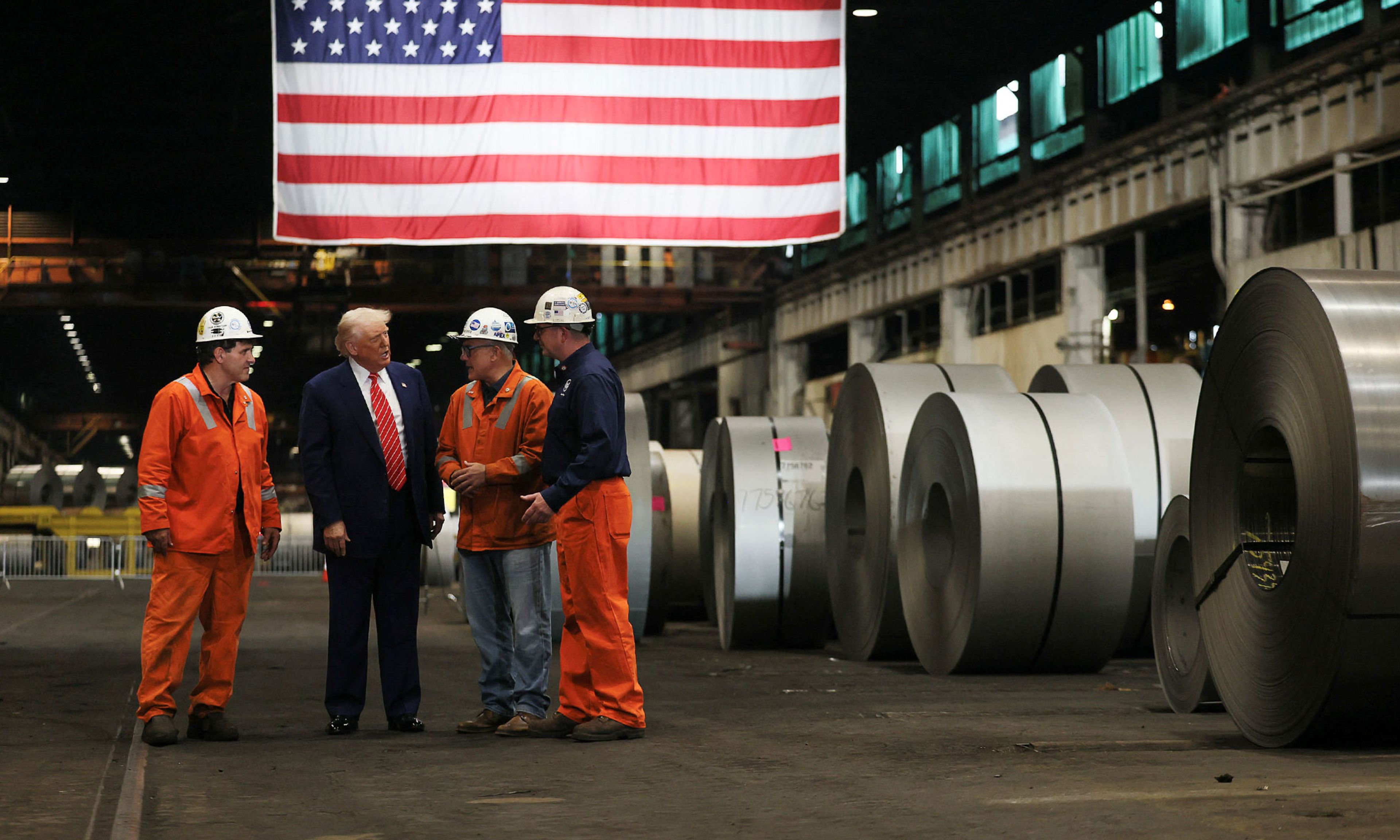
President Donald Trump visits the U.S. Steel Corporation–Irvin Works in West Mifflin, Pa., May 30, 2025.
The United States is once again deep in a tariff experiment. As of June 2025, Washington doubled its Section 232 duties (duties imposed on national security grounds) on most imported steel and aluminum to 50 percent, extending them to hundreds of derivative products like machinery parts and wind-turbine components, but also everyday household goods. Canada and Mexico no longer enjoy exemptions, while the United Kingdom remains temporarily capped at 25 percent under a pending bilateral deal.
The administration justifies the hikes as a bid to “rebuild domestic manufacturing,” echoing the language of 2002 when President George W. Bush imposed his own “safeguard” steel tariffs. But history offers a warning: Those earlier tariffs failed to revive the steel industry and instead crushed thousands of jobs downstream. A new academic study now quantifies just how costly that protectionism turned out to be.
President George W. Bush’s 2002 “safeguard” tariffs on imported steel were billed as a temporary rescue for a struggling domestic industry. They were also a costly lesson in how protectionism hurts far more Americans than it helps.
A new study by economists James Lake and Ding Liu, published in the American Economic Journal: Economic Policy, gives us the clearest academic evidence yet: The Bush steel tariffs didn’t protect steel jobs. Instead, they wiped out thousands of jobs in the industries that rely on steel, and those losses lingered for years after the tariffs were gone.
Lake and Liu use detailed U.S. input-output data and a generalized difference-in-differences model to measure how local employment changed depending on each region’s exposure to the tariffs, both as steel producers and as steel consumers.
Their findings should bury, once and for all, the illusion that tariffs save jobs. The tariffs, which raised import taxes on more than 170 steel products by as much as 30 percent, did not increase employment in steelmaking regions. But they did substantially reduce jobs in steel-using industries (machinery, autos, fabricated metals, transportation equipment), many of which form the core of American manufacturing.
Even worse, those losses persisted for at least five years after the tariffs ended in 2003. Lake and Liu find that local economies dependent on steel inputs experienced a long-term exit of steel-intensive manufacturers. The explanation is classic microeconomics: When firms face large, fixed costs of entry, a temporary shock can force them out, and once gone, they rarely come back.
The authors estimate that the employment hit to steel-consuming regions was about one-quarter as large as the “China shock” that transformed U.S. manufacturing in the 2000s. Even more stunning, steel-heavy manufacturing, nearly three-quarters as large. That’s extraordinary, given that Bush’s tariffs lasted less than two years.
Meanwhile, the steel producers who were supposed to be the beneficiaries of this effort kept shrinking. The industry was already consolidating and shedding labor to improve productivity. But the tariffs accelerated the process by causing bankruptcies and mergers as opposed to a renaissance in steel employment.
So the “safeguard” tariffs safeguarded almost nothing. They raised input costs by up to 60 percent for steel users, drove import prices higher, and distorted investment decisions — all for a protection that vanished when the World Trade Organization ruled it illegal in late 2003.
The political rhetoric that justified Bush’s tariffs sounds eerily familiar today. The Trump tariffs on steel, aluminum, and a wide array of intermediate goods rest on the same fallacy: that government can restore industrial strength by walling off markets. But Lake and Liu’s study, along with similar research on the Trump-era tariffs, shows that tariffs increase input costs, weaken supply chains, and lead to downstream industries shedding jobs.
This isn’t just an accounting problem. It’s an insight into how the American economy works. Modern manufacturing is a web of interdependent producers. Protecting one link with tariffs often corrodes the rest. The damage is local, persistent, and politically invisible until it shows up as shuttered plants and smaller paychecks in communities far from Washington’s spotlight.
The Bush steel episode is now more than 20 years old, but its relevance has never been greater. The authors demonstrate that temporary protection can have permanent costs, especially when firms must pay large up-front costs to reopen or reenter markets. Once factories close because of higher input prices, they’re gone.
If anything, Lake and Liu’s numbers likely understate the harm: Businesses in 2002 knew the tariffs were short-lived, so they held off investment or shifted production abroad. Imagine the damage from tariffs that firms expect to last indefinitely.
For policymakers claiming to champion “American manufacturing,” the evidence is unambiguous: Tariffs on key inputs weaken manufacturing; they don’t revive it. Steel protection under Bush, like under Trump, punished the very industries that make America productive while failing to secure any lasting benefit for steelworkers.
If the goal is genuine industrial strength, the path lies not in protectionism but in openness, competition, and innovation. Those are the conditions that make American firms efficient enough to thrive on the world stage.

About the Author
Veronique de Rugy is a senior research fellow at the Mercatus Center at George Mason University.
Featured Tags
Advertisement
Advertisement

Comments