Share this story
Eric Sailer
At a recent college reunion, I rendezvoused with an old professor, a wise classical liberal who inspired me to pursue a career in journalism. After inquiring about me and my class, he mentioned that he had just celebrated his 43rd wedding anniversary with his wife, who happens to be a Democrat.
I thought, “Fat chance of that today.”
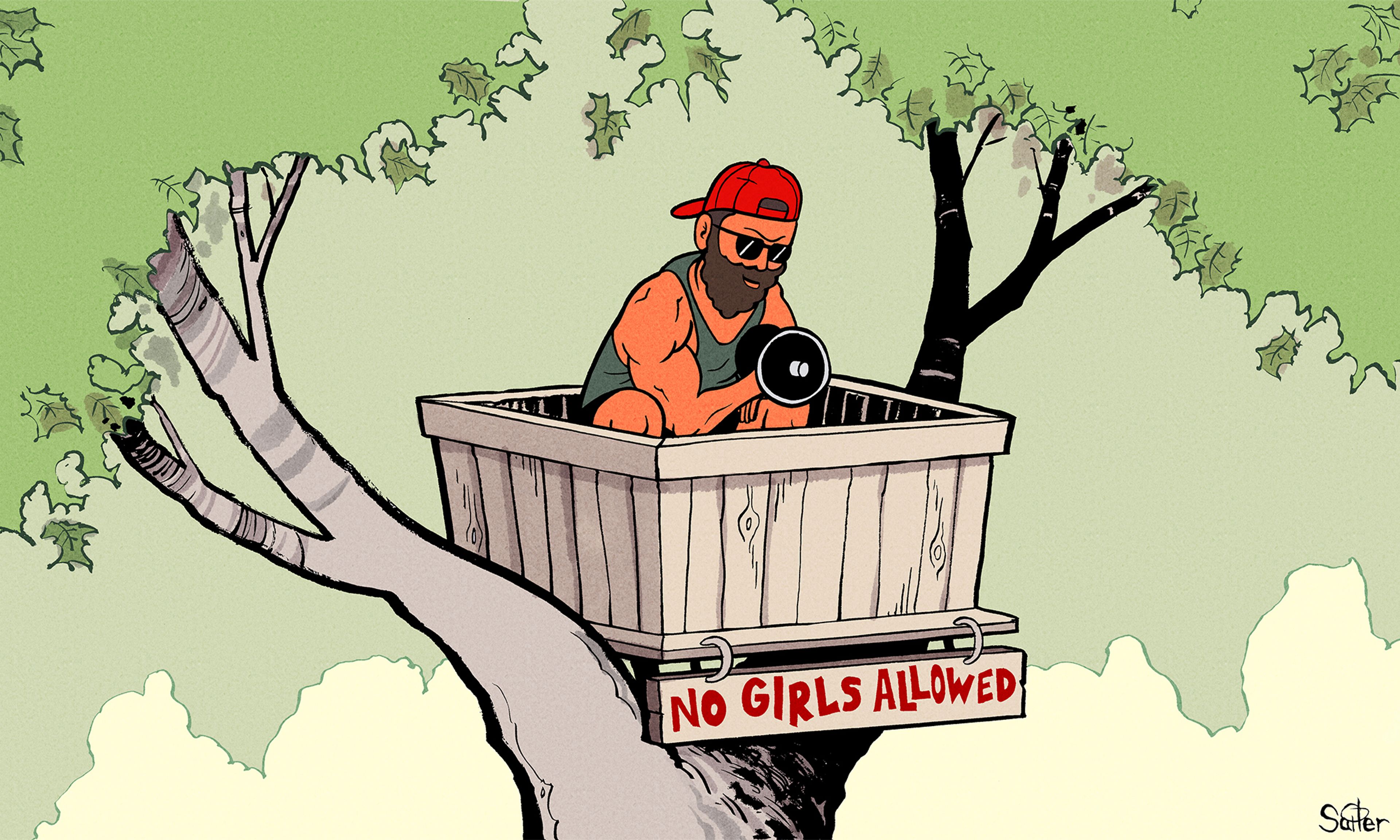
For my generation, Gen Z, reaching such a milestone is hard to fathom, in large part because of the diverging politics of young men and women. In the past 25 years, the gender partisan gap has nearly doubled. Donald Trump turned a predictable rift into a gaping chasm: In the 18-to-29 cohort, he won 56 percent of men but only 40 percent of women. Young men have gradually been ditching the Democrats for the past decade, but they really fled in the last year, a postelection Public Religion Research Institute survey reports, with 38 percent of Gen Z men now more likely to identify as Republican versus 20 percent of Gen Z women.
The widening of the Gen Z partisan gender gap has coincided with the decline of marriage, which young men and women continue to postpone or forgo altogether. The Institute for Family Studies reports that while 85 percent of 25-year-old women and 75 percent of 25-year-old men were married in 1967, just 20 percent and 23 percent respectively are married today.
Unwed women without children have moved toward the Democrats for several years. Without marriage as a financial and emotional anchor, young women have started to view the state as a “back-up husband,” as author Louise Perry has suggested. While young women develop more trust in government as a replacement for a spouse’s support, young men grow more antiestablishment.
Since the GOP victory in November, when young men turned out in droves for President Trump, Democrats have been scratching their heads over young men’s disgust with their party. Tim Walz insists that he’s the bro-whisperer. On the campaign trail, videos featured Kamala Harris’s running mate gallivanting in camo gear and clumsily handling a shotgun during a pheasant hunt -- cringe pandering to young men that proved unpersuasive. Progressive whippersnapper and Democratic National Committee upstart David Hogg is duking it out with veteran strategists over whether the old or new guard connects better with the next generation.
Democratic heavyweights have poured $20 million into an effort, called “Speaking with American Men: A Strategic Plan” (or SAM), to influence the male psyche through ad placements in video games. But when they’re not conducting political reconnaissance on young men, treating them like a dissident group in need of reprogramming rather than voters capable of rationality, they’re in denial. Perhaps, they think, the problem is not their failure to resonate with young men; it’s that they haven’t offered them enough theatrics. Walz’s son says that young men voted for Trump for the entertainment and sports-like camaraderie rather than for policy and a reprieve from cultural shaming.
Democrats are determined to crack the code of young men; it’s crucial for their electoral viability. But they got themselves into this mess by ostracizing young men as the problem. Most recently, the left has decried men’s interest in eating red meat, fitness, and other self-improvement activities as fringe pursuits. But to discover the roots of the disdain, we must go back to the 1970s.
Speaking of the leftward lurch in economics, Milton Friedman once remarked, “We’re all Keynesians now.”
For decades, the culture has said, “We’re all feminists now.”
Though it started with suffrage, equal opportunity, and other advancements of women’s rights, feminism lost the plot around the 1970s, when it told young men to repent for the sins of the patriarchy and then shelve themselves. By the mid-2010s, circa Me Too, mainstream feminism had devolved into an indictment of “toxic masculinity.” Over time, young men began to believe that feminism’s goal was not equality but their displacement and punishment. Today, only 43 percent of Gen Z men identify as feminists compared with 61 percent of Gen Z women, according to the Survey Center on American Life.
Over the years, colleges, awash in DEI and cancel culture, have become pressure cookers for young men. In 2024, young women out-enrolled young men in college by 2.4 million. Gender studies, which teaches that men have privilege to atone for, has become a popular discipline in academia, especially among young women.
President Obama’s Title IX witch hunts against college sexual misconduct dismantled due process for young men and fueled their suspicion of women. While it was important to hold young men accountable for treating women like toys, that too often turned into falsely accusing them of rape. The ripple effects of the Me Too movement can be spotted today in bars across America, where young men no longer approach young women for a conversation, let alone to try to court them. I also speak anecdotally as someone with a twin brother who is romantically jaded in a way our parents were not at his age. Men and women of older generations, even when their political registrations differed, were cut from a similar cloth and shared a mutual respect that’s lost among today’s young adults.
For many young men, the disengagement from society started with negative experiences in K–12 and pediatricians’ offices. There, they’re often judged against girls despite their different nervous systems, leading to overdiagnosis of ADHD and priming them for resentment. Therapy culture and medicine have pathologized young men for being themselves. Tired of being the permanent fall guys, young men craved role models who legitimized their manhood.
Cue: Trump. Brash and bold, he was an archetype of audacity and success that many young men idolized. To be sure, Trump’s arrival on the political scene polarized young men and women, with the gender gap passing ten points in 2017, the year he took office. While many young men saw a mouthpiece for their struggles and a chance of socioeconomic redemption, many young women saw only a philanderer, misogynist, and bigot. But, as with working-class anxiety in “flyover country,” Trump tapped into a discontent that Democrats had overlooked in a demographic they had long forsaken. The grievances of young men found an online home, spawning an entire content universe.
For the past few years, the “manosphere” -- a spectrum of both productive and sinister male digital spaces and personalities -- has given young men a refuge from scapegoating and shifted them rightward. On the destructive end, there’s Andrew Tate and personalities who lobby against monogamy, belittle women, and frame marriage as a trap for young men. On the constructive side, there’s Father Mike Schmitz, Jordan Peterson, and even personal finance guru Dave Ramsey, who urge men to be virtuous, responsible providers and protectors. Amid a Christian revival driven mainly by young men, a mini religious manosphere for social conservatives has emerged as well.
Where there’s an online corner for right-leaning young men, there’s a zone for left-leaning young women. That is: all mainstream female-focused entertainment. From the sex podcast Call Her Daddy to Cosmopolitan magazine, most pop culture spaces for young women reinforce “intersectionality” and “sex positivity.” A few years ago, even the American Girl product line, known for its wholesome historical dolls and stories, introduced a book for young girls that included a transgender pride flag and a section promoting gender ideology. These are the symptoms of radical feminism, which most young women take for granted and scarcely challenge.
But many young women, who report higher rates of anxiety and depression than young men, are in therapy, according to scientific papers published by the National Institutes of Health. While mental health problems are common among Gen Z generally, young women are more likely to receive treatment, according to the CDC. Feminist therapy, rising in popularity, emphasizes to female patients that men are irrelevant and not worth the trouble. Social media abounds with young women who lament that they’re dating narcissists.
The sexual revolution was launched to liberate women from their reproductive nature and unlock greater sexual experiences for both genders, but it has made young men and women view each other as disposable. While young women instinctively crave commitment as the price of sex, modern feminism forfeited that by offering up sex on a silver platter, so long as there’s consent. Departing from courtship, many young adults engage in noncommittal hookup culture made possible by contraception and abortion -- modern feminism’s crown jewels.
And there’s no doubt about it: Crossing the sexual Rubicon corrupted the mating rituals of young people. It killed romance and chivalry and replaced them with dehumanizing habits. For those who are older, it can be difficult to understand the dire straits of the Gen Z dating scene. Young men have no incentive to be gentlemanly -- the licentious culture does not require it, and it might be misconstrued as sexist anyway.
A few years ago, my brother told me a story of how he struck up a conversation with a girl in a bar in New York City. After they exchanged numbers, he wished her well and said he’d be in touch. The girl proceeded to throw a fit because he wouldn’t ask her to go home with him that night, a baffling scenario to anyone born before 1980.
In 2022, a Twitter account went viral for the tweet “Do married people watch gen z dating and feel like they caught the last chopper out of Nam?”
Dating for Gen Z is indeed like dancing in a minefield, where the last few of the traditionally minded without war stories or baggage try to find the other survivors. It’s brutal to navigate this perverse sexual culture and the many souls broken by it. The majority learn the sad lingo that has come to characterize our nihilistic generation: situationship, ghosting, benching, zombieing, cookie-jarring.
Yes, many young men and women have indulged in the libertine zeitgeist. On the campaign trail, Democratic content creators placed crude get-out-the-vote notes at basketball games, above urinals, and in bars that essentially told Gen Z men: You are free to be reprobates under our regime.
“Trump gives girls the ick. Vote Harris, Get Laid,” one card read. Others said, “Republicans Want to Ban OnlyFans. Search Project 2025,” and “Your Girlfriend Isn’t Safe in Donald Trump’s America. Abortion Bans Kill.”
But it wasn’t a compelling pitch to young men, since they aren’t happy on pleasure island. They want meaning and purpose, someone to work and live for. Young women aren’t happy either, most of all progressive women. Gen Z is far more likely to be single than any other generation. Young people are having less sex than their parents’ and grandparents’ generations did, according to the Association for Psychological Science. The sexual interactions they do share are often tainted by pornography and its violent, degrading trends such as choking. Dating apps and other technology have exacerbated the loss of dignity and have destroyed the hope for mutual care among young men and women.
Amid the chaos, some young men have become disciples of Andrew Tate or have disengaged from dating. Young men overall are bitter and disillusioned, but Trump’s reelection has put a pep in their step, probably because of the rollback of DEI and gender ideology in America’s public and private institutions. Indeed, young men may be the group that is most optimistic of all Americans about the next four years. According to a CBS News poll earlier this year, 60 percent of voters said they felt generally optimistic about the new administration, but that figure rose to 67 percent among under-30s.
Young women have doubled down on progressivism. As young men and women move further apart politically, it’s not just the electoral math for both parties that becomes uncertain but the creation of families and therefore -- though this may sound grandiose -- the continuation of our civilization.
The right-wing activist and manosphere figure Charlie Kirk was once asked by a male student at a college event what to do about his girlfriend’s having opposite political beliefs. “Do not marry this girl,” Kirk responded. “Build a life with someone where you have agreement on the macro issues.”
While Kirk is correct that interpolitical marriages, which might have worked among older generations, are going to be less successful now, he misses the fact that many young men don’t have a choice. Many feel that their options are to compromise their values or be lonely forever. For them, finding a woman with a conservative worldview is increasingly like finding a needle in a haystack. And until the Gen Z gender partisan gap is bridged, they’ll be searching for a while longer yet.
As a quip often attributed to Henry Kissinger (though he was probably not its originator) has it, “Nobody will ever win the battle of the sexes, because there’s just too much fraternizing with the enemy.”
It was a cynical quip, but it has turned out to be too optimistic.

About the Author
Caroline Downey is a staff writer for National Review.
Featured Tags
Advertisement
Advertisement




Comments