A Confounding Weekend for the Middle East Experts
Written by Noah Rothman
Anyone who tells you they know for certain what’s going to happen next with Iran is operating under the spell of undue self-confidence.
Share this story
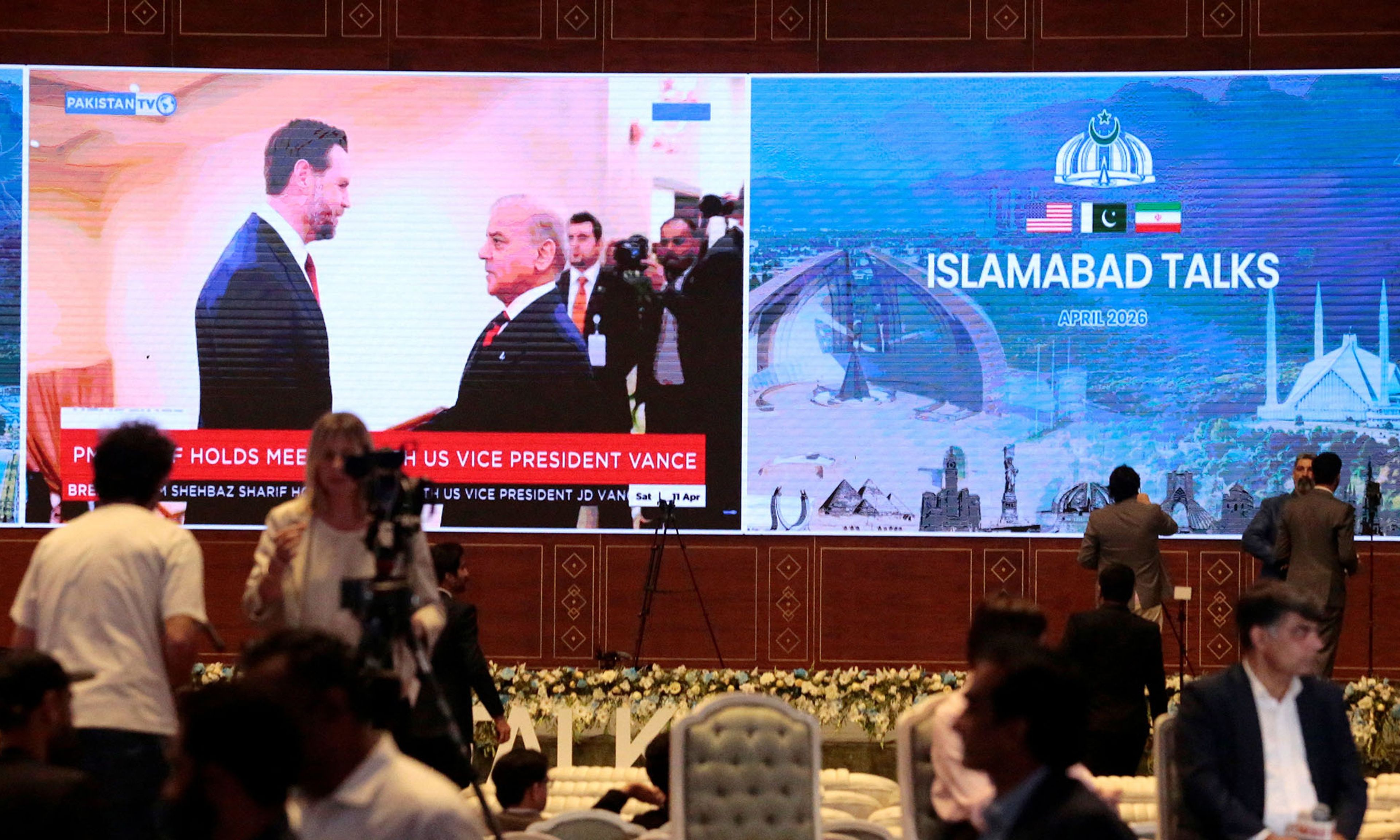
Members of the media watch coverage of U.S.-Iran talks as a screen shows Pakistan’s Prime Minister Shehbaz Sharif meeting with Vice President JD Vance in Islamabad, Pakistan, April 11, 2026.
Americans settled into their weekend on Friday, armed with ample assurances that the U.S.-Israeli war against the Islamic Republic of Iran was over.
What looked increasingly like a unilateral American stand-down in the face of continued Iranian aggression against its Gulf neighbors was likely to persist, you were told, even as Iran reneged on its supposed pledge to reopen the Strait of Hormuz to commerce. Donald Trump was said to be “begging” for an exit ramp from the catastrophic war into which he ignorantly stumbled. The Iranians had “the upper hand,” and they were pressing their advantage. Led, as it was, by the most notorious skeptic of hard power inside the administration, the negotiating team the president sent to Islamabad was certain to give away the store. Even if the consequences for America if the terms of the cease-fire hardened into a durable status quo were grave, Trump was presumed to be either ignorant or contemptuous of them. He was just in too deep, and he wanted out.
The administration’s behavior over the course of a momentous weekend should have inspired a critical reflection on these preconceptions. Rather than confront their misconceptions, the expert class forced events to comport with their unfailing belief that the president is secretly as convinced as they are that the war has been a comprehensive boondoggle.
Trump’s pursuit of diplomacy with the Iranian regime was cast from the start as a capitulatory overture. The expert class summarily dismissed the factors that would, in any other circumstance, have led them to conclude that the U.S. entered those negotiations from a position of strength. Trump was said to have caved to all of Iran’s absurd conditions for a permanent peace, and he was going to apply all the necessary muscle to Israel to force it into a premature disengagement with Iran’s terrorist proxies in Lebanon. That belief seemed to persist even as Israeli strikes on Hezbollah targets intensified, and up to the moment that Trump’s negotiating team gave up on diplomacy late Saturday night.
The president’s desperation was said to be further confirmed by the pressure he exerted on the NATO alliance to secure commitments to facilitate the reopening of the strait. Trump’s unfailingly hostile talk about the Atlantic Alliance appeared to confirm that he would not get the help he sought. That conventional wisdom was impervious to counterevidence. It did not budge when NATO chief Mark Rutte confirmed the alliance’s willingness to facilitate both diplomatic and military measures to reopen the strait, including “pre-positioning some assets” and activating “assets already in the region for when the time comes.”
The absence of any presidential resolve to continue the conflict was not in evidence when, even as talks in Islamabad were ongoing, he ordered two Arleigh Burke–class destroyers (and other relevant assets) to transit the strait for the first time since hostilities commenced in February. “Today, we began the process of establishing a new passage, and we will share this safe pathway with the maritime industry soon to encourage the free flow of commerce,” said CENTCOM commander Brad Cooper of the threat-clearing operations inside the strait -- operations that are likely to continue until the cease-fire expires on April 21, assuming the Iranians don’t break it first.
This unshakable faith in Trump’s pusillanimity was challenged by the president’s Sunday announcement that the U.S. would respond to Iran’s failure to abide by its supposed pledge to reopen the strait by blockading the waterway. That satisfying conviction was swiftly replaced with existential apprehension over the president’s ignorance. He and his thick-headed advisers must not know the havoc they’re playing with the global economy (their sensitivity to global economic disruptions having previously inspired the cease-fire in the first place). Nor do they comprehend the aggressive measures America’s near-peer competitors, like China, would take to secure their economic interests.
“Closing the Strait entirely” would be catastrophic, said one think-tanker in remarks to the drawn faces who report for the Financial Times. But Trump would not close the Strait “entirely.” Rather, he would close it to Iran’s inbound and outbound traffic alone, ensuring that Iran cannot solely benefit from its throttling of the contested waterway. All the while, reports indicate that “U.S. Gulf Coast gasoline” is “moving to Australia,” one energy analyst observed, “and East Coast jet fuel” is “heading to Europe.” All the while, America’s commitment of military assets to the region, including the naval assets the U.S. would need to reopen the strait by force, has increased.
There is plenty to criticize in the Trump administration’s conduct of this war. The Pentagon clearly did not prioritize the strait, and the White House appeared to be surprised by the international market reaction to the throttling of traffic through it, despite Iran’s failure to apply the kind of force that war planners had long anticipated. The president’s rhetoric around this war has been abysmal. He is contemptuous of the notion that he needs to solicit support for the war from America’s allies abroad and from the public at home, thereby complicating his war aims. That has been said and said again, although it apparently cannot be said enough.
And yet, so much of what passes for expert analysis of the war seems not to take the war itself into account. Instead, observers are privy to a parade of preexisting priors from a cavalcade of self-described experts whose expertise is compromised by the fixed position Donald Trump occupies in their minds.
Anyone who tells you they know for certain what’s going to happen next is operating under the spell of undue self-confidence. We can hazard guesses, but that’s all they are. The president almost certainly would like to avert the resumption of hostilities, and Iran’s “toll booth” strategy would have been unsustainable even without a blockade. It is also true that U.S. hegemony would be fatally undermined if the April 8 cease-fire terms were to hold indefinitely. But they did not. Nor did Donald Trump bug out, as so many claimed he would, irrespective of the damage that course of action would do to American prestige.
There’s a lesson there in humility for the expert class if they’re inclined to heed it. But I wouldn’t hold my breath.

About the Author
Noah Rothman is a senior writer at National Review. His third book, Blood and Progress: A Century of Left-Wing Violence, will be published by Hachette in May 2026.
Featured Tags
Advertisement
Advertisement

Comments