Share this story
Matt LaVigne/iStock/Getty Images
‘You know you have a dead deer back there.”
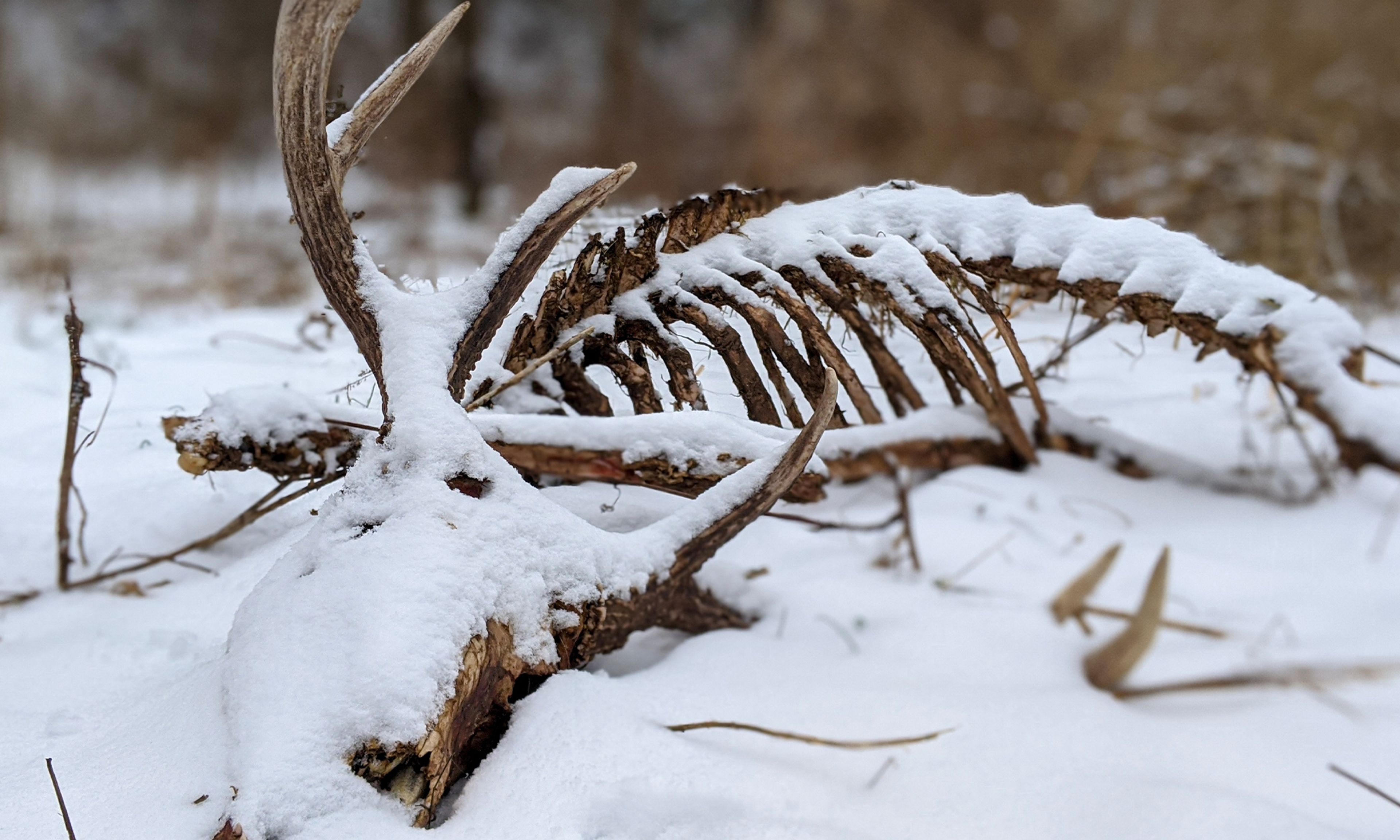
I didn’t. The young man who looks in on the house when we are not there pointed to a shape on the ground behind the carport, dark against the snow still remaining at the end of winter.
The local biweekly newspaper reprints items from local newspapers of the past. One from the late 19th century reported, as a curiosity, that deer were seen on the streets of the area’s big town. Numerous farms and ubiquitous guns had made the creatures a rarity. Not so now. We have learned to recognize their dark winter coats and their light warm-weather ones, their scat, their successful browsing of the lower branches of trees that simply are not there. A few years ago, trading the bosom of nature for reality, we put a deer fence around the corner of our lot where we actually live. It was either that or give up gardening. The fence is not foolproof. Fallen trees make breaches. I once spent what seemed like an hour chasing a successful intruder: me in boots that kept slipping off in the muck, it on fleet feet, around and around until it finally exited by the gate that I had left open for it.
The latest intruder had entered by the driveway gate, left open by some deliverer. (Not through carelessness; the latch is a tricky one.) I could see by the prints pocking the snow on the lawn that a deer must have been there for a while. Or more than one. Possibly it, or they, had gone out and come back in repeatedly.
When I went to look at the remains myself, I could not tell how this deer had died. There was snow all around, but I am neither Leatherstocking nor Holmes; there was no track record that I could read. In fact, there seemed to be hardly any tracks at all. So what had been the killer? Exhaustion? Disease? An injury received elsewhere? Cold case.
The undertakers had been at work, evidently by air. Vultures are common here. From the hammock in the summer you see them circling, scanning the menu of the ground for servings. They have upturned wing tips; hawks don’t. Crows may have helped. The deer’s head was entire, without antlers, so it was a doe, or a buck that had shed. There was gray hair all around, unmoored from skin, which I imagine will find its way into songbird nests. Then there were bones, some still fur-covered, most bare. Ribs stood up like a sketch for the hull of a ship. Poor thing.
[slideshow slideshow="1931972" /]
I asked a neighbor if any removal by humans was possible. She suggested yet another neighbor, “to see if he is willing to cart it out to the road.” “Once by the road, you can call town hall and they will usually send someone from the road crew to remove it, but even that is not guaranteed this time of year, as it’s considered more of a nuisance and health hazard in the warmer months.” She added, “I usually tell people to hope the vultures find it as they can pick it clean in a couple of days.” Since that had already happened, there the matter, and the deer, rests.
I am not a vegetarian. Among the meats I have eaten is venison. So I have no aversion in principle. If I had, it would be futile since, even if Homo sapiens switched to fruits and nuts, the rest of nature would continue to feed. Years ago there was a Japanese man who regularly took out full-page ads in the paper of record, outlining how the world could be made ideal. The last item of his program was to wean all creatures from each other. Good luck.
And yet. In Paradise Lost, Death and his mother Sin follow the path from Hell to the “now fenceless world” opened by their progenitor, Satan, and by our parents’ fall. “I shall not lag behind, nor err / The way,” Death declares, “such a scent I draw / Of carnage . . . from all things there that live.” Then Milton, dropping the hammer to ring the bell, adds in his own voice: “So saying, with delight he snuff’d the smell / Of mortal change on Earth.” The fact that it happens to all of us and to everything makes it bearable. The fact that it happens to all of us and to everything makes it sad.

About the Author
Historian Richard Brookhiser is a senior editor of National Review and a senior fellow at the National Review Institute.
Featured Tags
Advertisement
Advertisement

Comments