Share this story
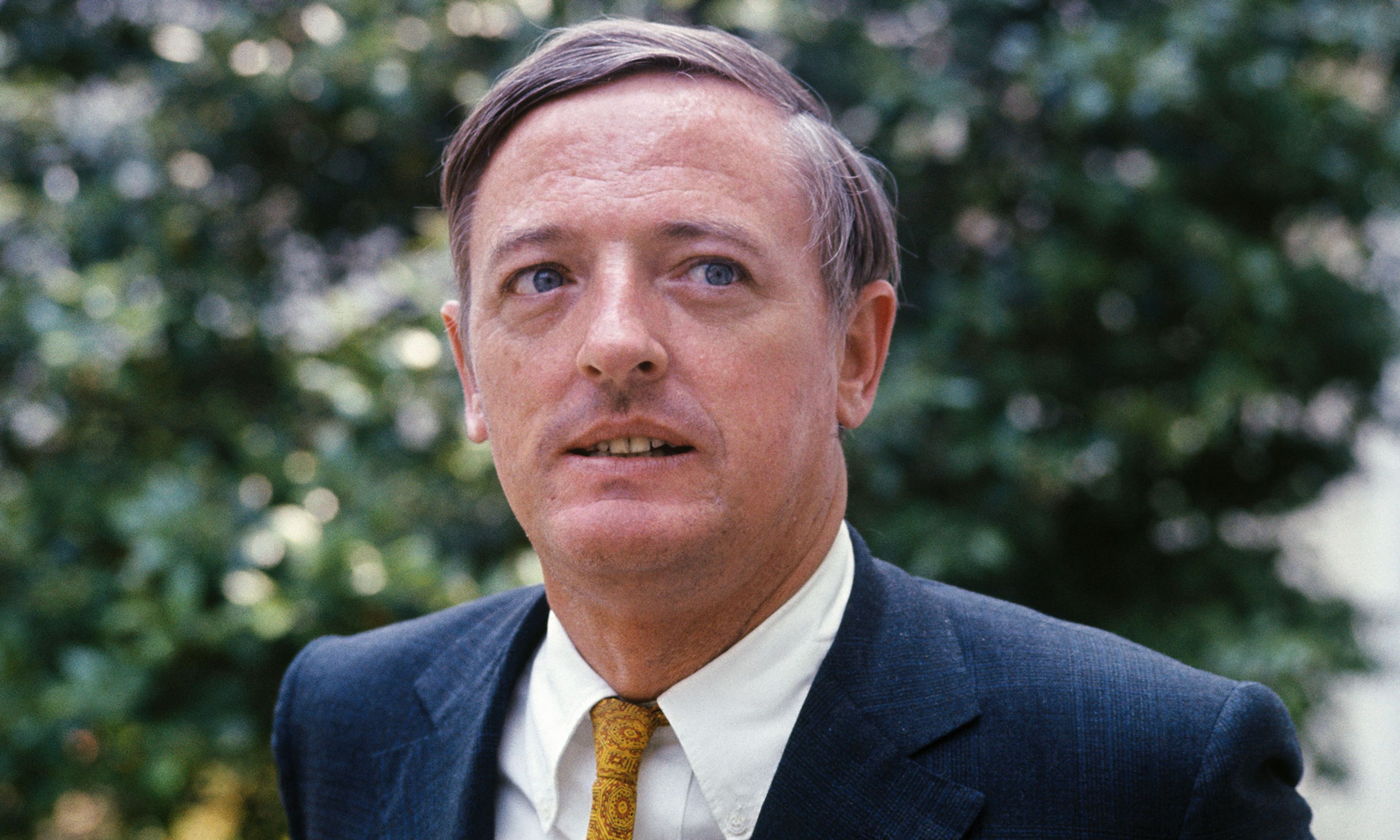
<span style="font-variant:small-caps">National Review</span> founder William F. Buckley Jr. at the White House in 1969
After nearly 30 years, Sam Tanenhaus is finally publishing his biography of William F. Buckley Jr., an epic project to match an epic life. Tanenhaus deserves credit for the care he took in the research and writing, and he brings an exhaustive — and sometimes exhausting — level of detail to his account.
It’s a testament to the extraordinary richness of Buckley’s life that, after a couple of decades and nearly 900 pages, the Tanenhaus book still feels rushed and compressed by the end, and has strange lacunae throughout. It is also blighted by Tanenhaus’s hobbyhorses, which are especially evident in his caviling when promoting his book.
According to Tanenhaus, a center-left writer who pronounced conservatism dead nearly 15 years ago, Buckley was a mere “intellectual entertainer”; he could never finish a planned “big” philosophical book (tentatively titled “The Revolt Against the Masses”) and wasn’t much of a reader. He was “an arguer, not a thinker.”
This represents a false choice. Buckley was a lightning-quick debater, as he demonstrated for decades on TV and on stage, but obviously more than that. He made an indispensable contribution to defining modern conservatism and its principles through his writing and advocacy, his friendship and correspondence with every conservative intellectual worth knowing (all of whom considered him a peer), through his institution building, and through NR then and now.
In the magazine, he gathered heavyweights who spanned the American conservatism, from Russell Kirk and James Burnham to Max Eastman and Frank Meyer.
Certainly, Kirk and Buckley, for instance, had different roles in this broad enterprise, and Buckley was a witty, entertaining public presence, but that doesn’t in any way suggest a lack of depth or seriousness of purpose.
Tanenhaus dwells on the bigoted views of Buckley’s father and Buckley’s editorials in the 1950s favoring segregation. Those editorials were disgracefully wrong, but Buckley had changed by the 1960s, as WFB biographer Alvin Felzenberg has recounted at length and Tanenhaus acknowledges in the book.
Buckley remained opposed to federal civil rights legislation on federalist grounds (before changing his mind on that, too), although he was clear on the underlying matter: “On the single issue of whether a Negro in Alabama should be deprived of the vote simply because of the color of his skin, it seems to me that there cannot be any argument: none moral, and certainly none constitutional.” He was disgusted by George Wallace’s rancid demagoguery.
Tanenhaus expresses disappointment in Buckley’s defense of various right-wing causes and persons that Tanenhaus finds unworthy; the biographer happily agreed with one of his interviewers who called Buckley “a hack.” It shouldn’t be surprising that WFB, a conservative, would have a reflex to defend his fellow conservatives, but he always displayed great independence of mind and worked to purge the right of nuts and haters.
Buckley went his own way on the war on drugs and war in Iraq, among other questions, and marginalized the antisemites (something Tanenhaus barely mentions) and, of course, denounced Robert Welch and the Birchers at considerable commercial risk to this magazine.
Tanenhaus is fond of making, as Barton Swaim of the Wall Street Journal aptly puts it, “vague imputations of dishonesty,” which tend to be loosely supported at best and tell us more about the worldview of the biographer than about the integrity of his subject. Tanenhaus wants to portray Buckley as Richard Nixon’s propagandist, when the fact is he endorsed John Ashbrook in the 1972 Republican primaries and had a large hand in pulling the plug on Nixon’s presidency after Watergate.
Most important, as far as we’re concerned, is that Buckley stood for and advanced ideas that have proved their merit, in victory in the Cold War, in a market economy that has delivered the wealthiest democratic society the world has ever known, and in a system that protects individual rights and democratic consent.
All that said, Tanenhaus grants that Buckley was a “great man,” and he referred to him as “kind of genius” in a recent interview. He recounts the Buckley family’s generosity and Bill Buckley’s own remarkable personal kindness and gift for friendship. This is to the good, but his massive volume still doesn’t manage to do justice to a man who lived a legendary life and changed the 20th century.

About the Author
The Editors comprise the senior editorial staff of the National Review magazine and website.
Featured Tags
Advertisement
Advertisement
Comments