A Good Day’s Work for Grandma Moses and the Smithsonian
Written by Brian T. Allen
Its American art museum interprets a Yankee original, keeping woke hysterics to a minimum.
Share this story
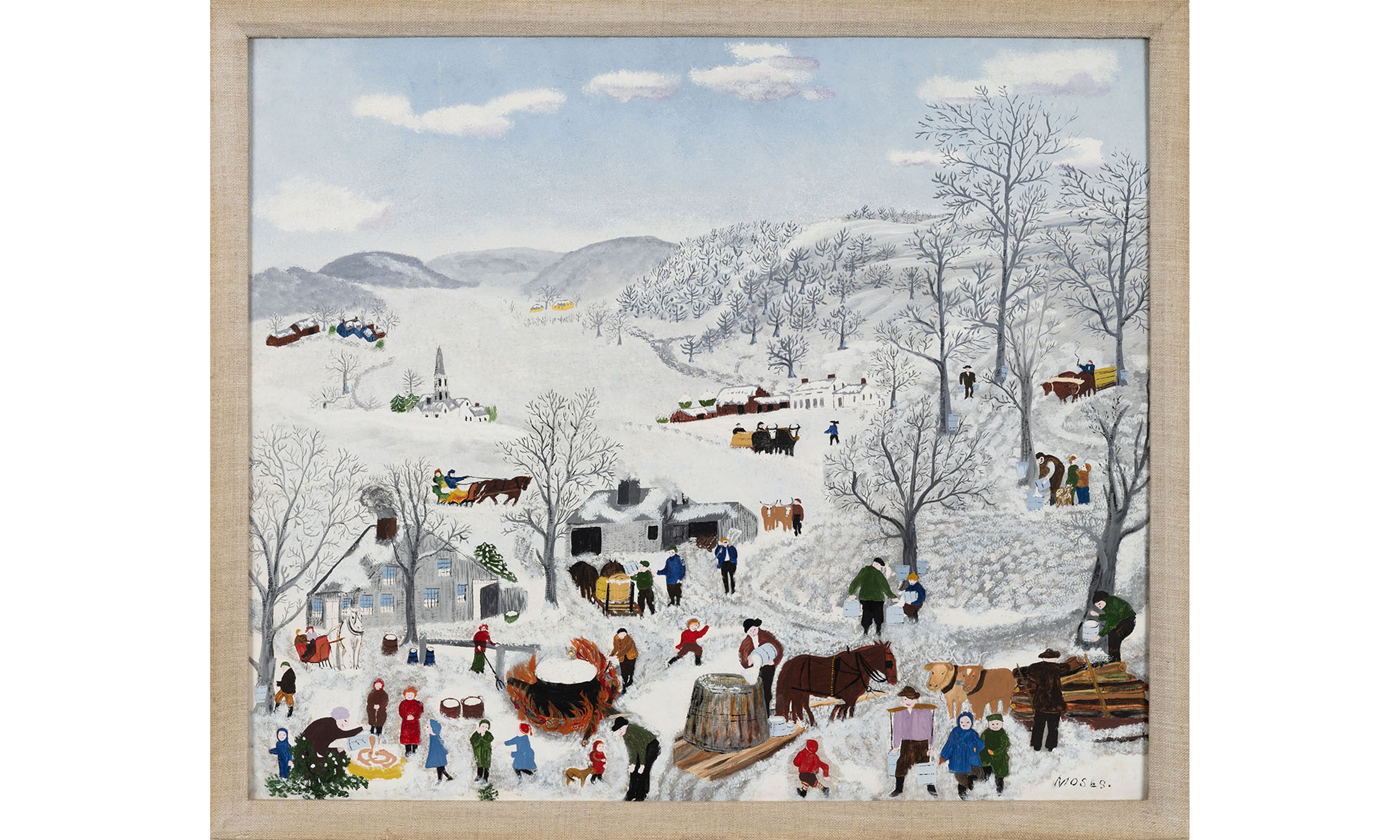
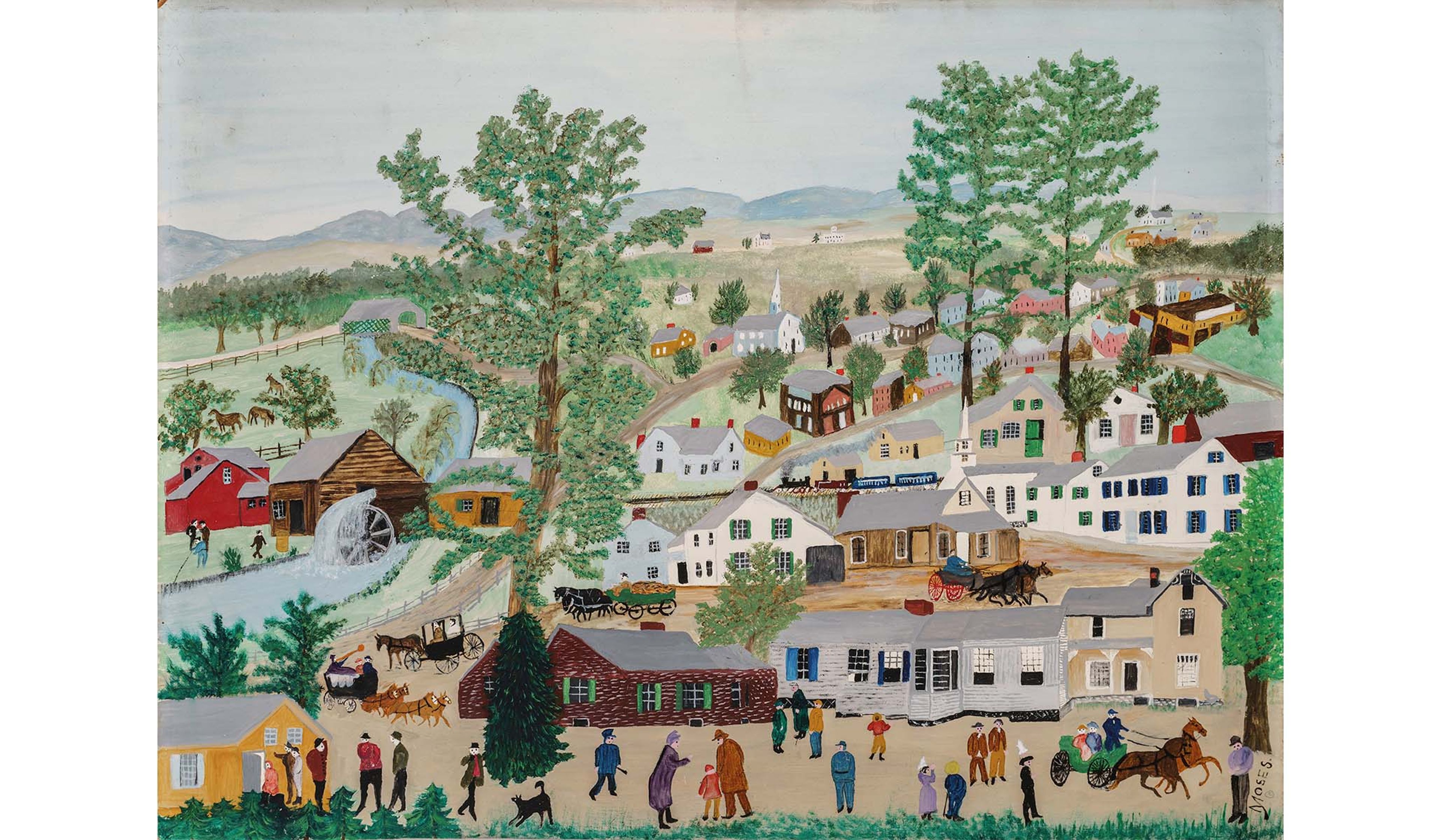
Grandma Moses, <i>Sugaring Off</i>, 1943, oil on board.
The Smithsonian American Art Museum (SAAM) is one of my favorites for its wonderful collection, majestic building, consistently beautiful presentation, and, more often than not, exhibitions that actually mean something. Grandma Moses: A Good Day’s Work is among the best exhibitions I’ve seen there, comforting, of course, but observant, canny, and fresh.
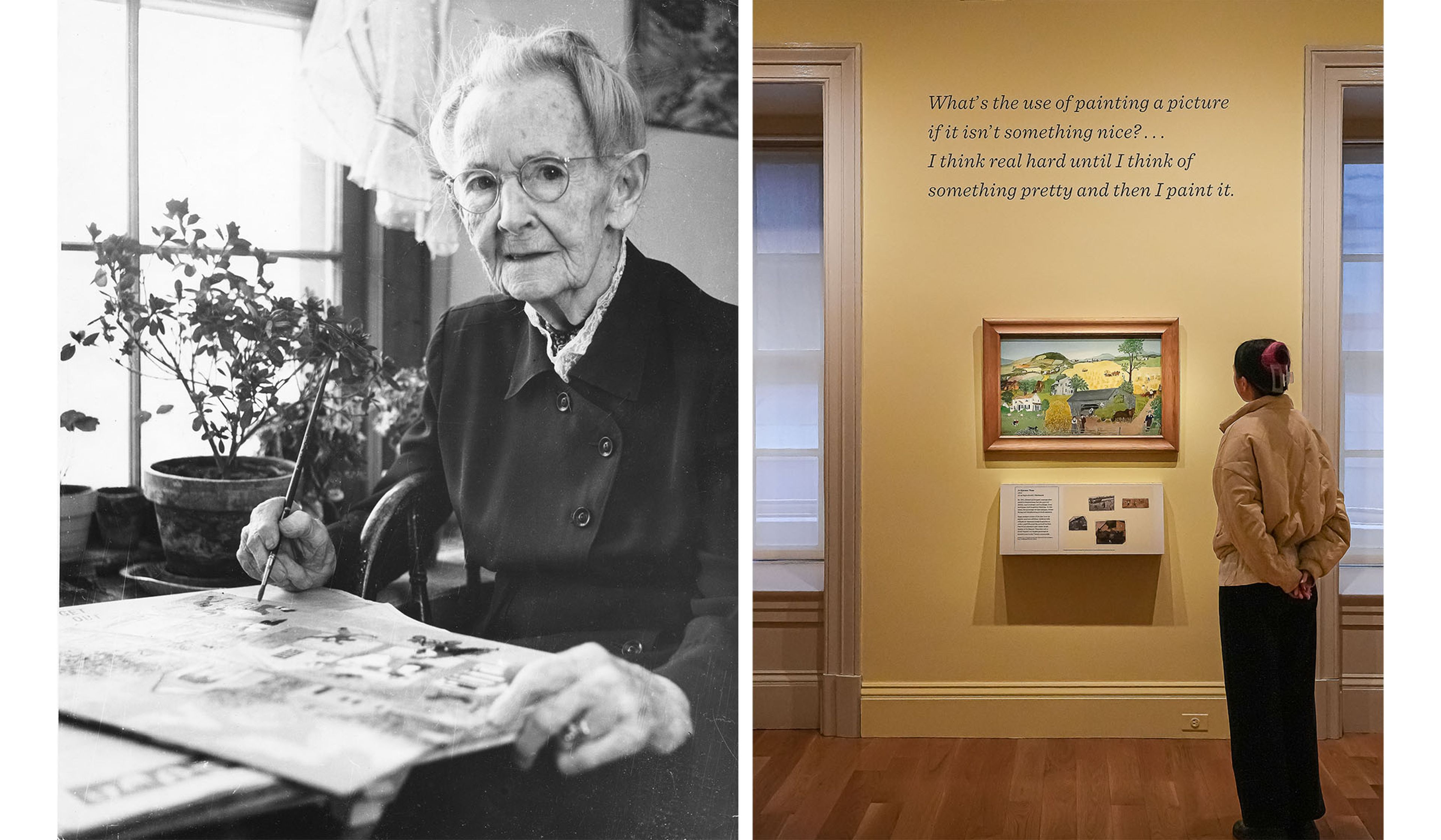
Moses (1860–1961) is, with Robert Frost and Norman Rockwell, the trio of art highfliers that we in southwestern Vermont consider our own. Frost came and went but returned for eternity. Moses’s scenes of country life -- making maple syrup; rolling, green landscapes; sparkling snowfalls; quaint white houses; and hearty, busy farm life -- are quintessential Vermont, too, but, I hate to admit, she lived a smidge across the state line in Eagle Bridge, N.Y. Still, we claim her as ours, as a New England artist, an old Yankee lady, and as much a part of the cult of Vermont as Rockwell’s Four Freedoms and the Green Mountain Boys.
So we Vermonters take pride and ownership in Grandma Moses, so much so that I dreaded what the Smithsonian -- off and on rashly, giddily woke -- would do. Would we get MAGA Moses? Grandma Q-Anon? The Little Old Lady from the KKK? None of the above, I’m happy to say. We see Moses the can-do optimist, the practical farmer, self-taught, the country savant. We see her as a very good artist, too. And, as immersed as I am in Moses the artist and local luminary, I found the show a revelation.
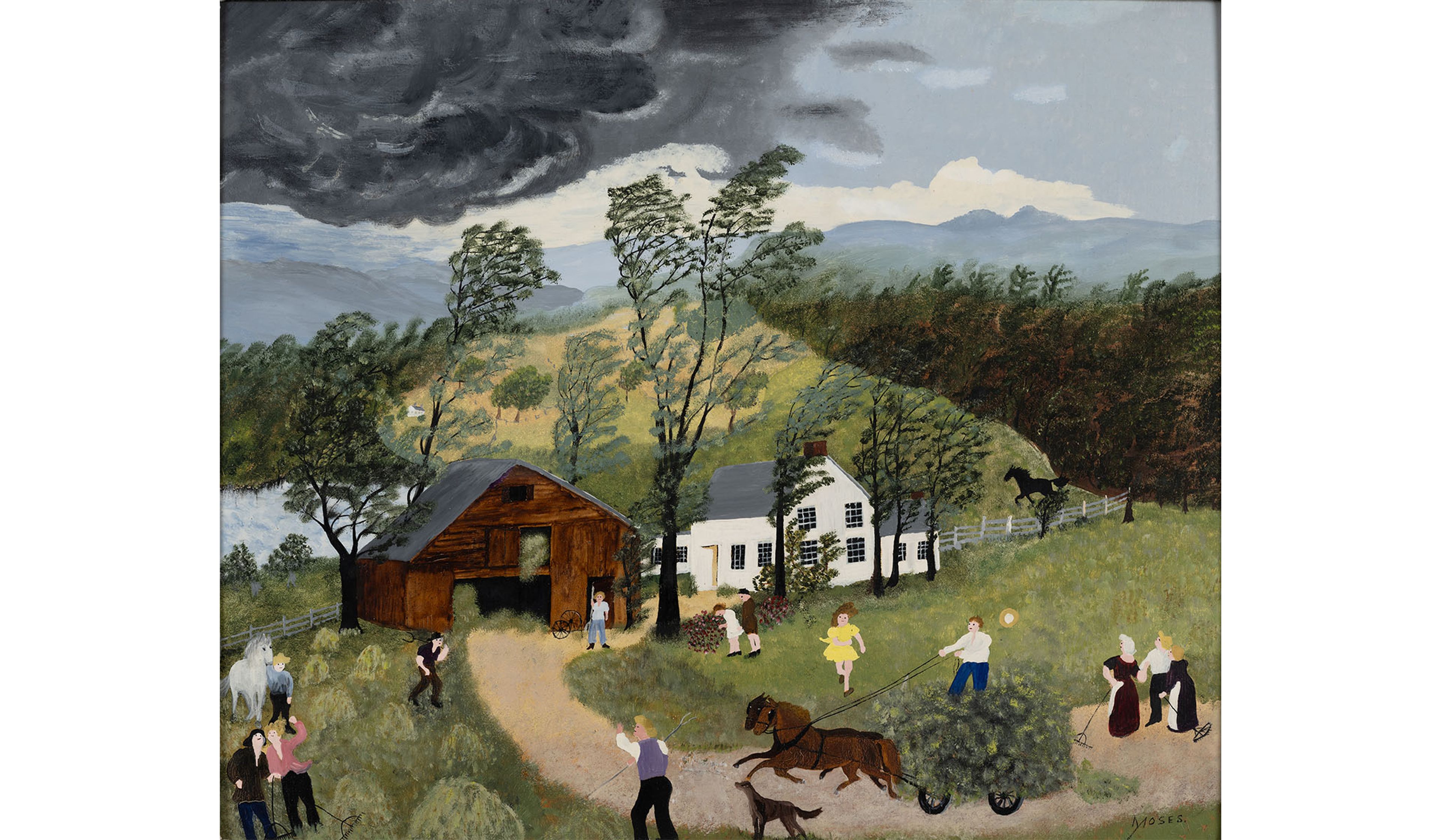
The subtitle A Good Day’s Work comes from her autobiography and the way she saw the totality of her life as well as her art. “I look back on my life as a good day’s work,” she wrote. “It was done and I feel satisfied with it.” Moses -- born a few months before Lincoln was president and dead a few months after we launched our first astronaut into space -- called herself a New Englander and had a frank Yankee sense of self. “I was happy and contented, knew nothing better, and made the best of what life offered.” The primacy of work is central to country life, so this didn’t surprise me, but the first pictures in the show did. They’re not family picnics, harvesting scenes, or skating parties, those old-time, warm and fuzzy moments in rural life. They’re disaster pictures, and convincing ones, too. A coming thunderstorm looking mighty biblical upsets the rhythm of farm life. There’s a group of fire scenes, a wildfire in the woods, a fire approaching a farmhouse and barn, a view of the 1862 Great Fire in Troy -- Troy, N.Y., not Homer’s Troy, but it looks apocalyptic enough. A blizzard, but that’s to be expected. Windstorms strong enough to blow you to Oz.
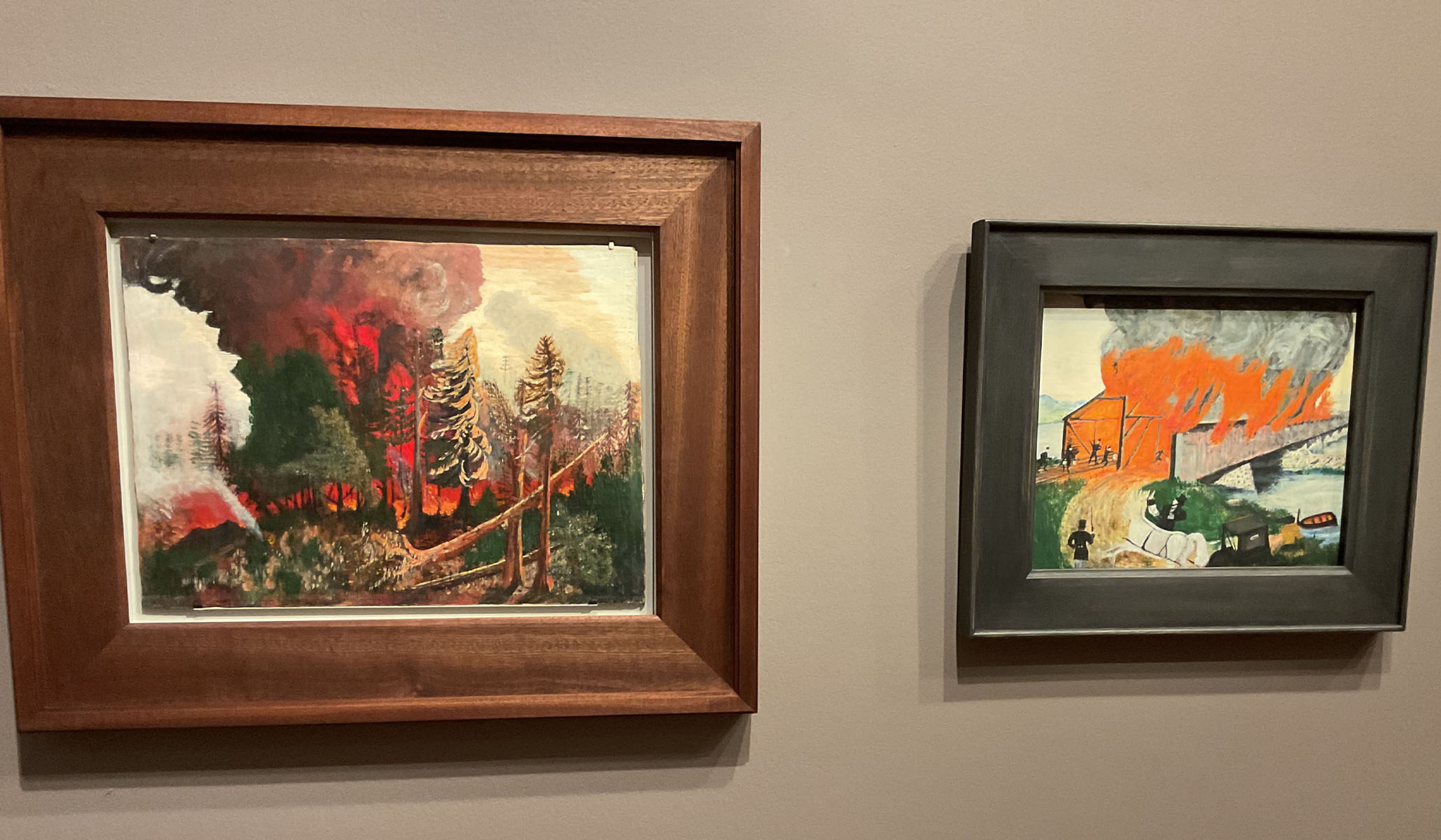
Moses, we see, is very good with fire-engine red. No harmony with nature. As much as some might think of Moses’s world as tame and tidy, she understood that Mother Nature was a fickle lady with a wild side. Growing up on a farm, becoming a farmer’s wife and, then, a widow running a farm, she lived less by mechanical time, city-slicker time, and more by nature’s time -- the seasons and cycles of the sun and moon -- and nature’s upsetments.
The curators want to establish Moses as a polarizing figure. That’s the name of this section. She became, we learn, a Cold War propaganda tool, her pictures sent on tour to tout sturdy American values and American quality of life, with work and leisure in balance. Her work is upbeat, so Reds and rising feminists looked at her with scorn. Highfalutin critics in the 1940s and the ’50s turned their noses up at narrative art. Susan Sontag she would never be.
The curators mostly don’t take the critics’ side, but they do want us to look at Moses’s subjects, her storm scene, for instance, and her gifts for storytelling and composition. The Thunderstorm, from 1948, unfolds like a movie. Horses know that chaos is on the horizon. Some of the cross section of humanity there -- farmer and farm hands -- sound the alarm while a child and mother seem not to have gotten the memo. They’re picking flowers. Moses is a good organizer. Her scenes, apocalyptic or not, have lots of moving parts. The viewer tends to be placed at a distance looking down at a panorama of buildings, buggies, dirt roads, horses, cows, and people, often a water feature, distant hills, and skies with character. Her storm skies are shades of gray.
Moses keeps her cool. Her people tend to be flat with round heads and faces conveyed through two dots for eyes, a dot for a nose, and a minute dash for a mouth. Every element in her pictures -- foreground, middle ground, and distance -- has equal weight. Every element is treated with more or less the same detail. Her scenes are flattened and condensed like a patchwork quilt. Moses was indeed a quilt maker, knitter, and embroiderer. This explains why her paintings have the ever-so-slightly knobby look of textiles. She started painting in the 1930s, when she was in her mid-70s, because arthritis made work with needles, scissors, and cutters too painful.
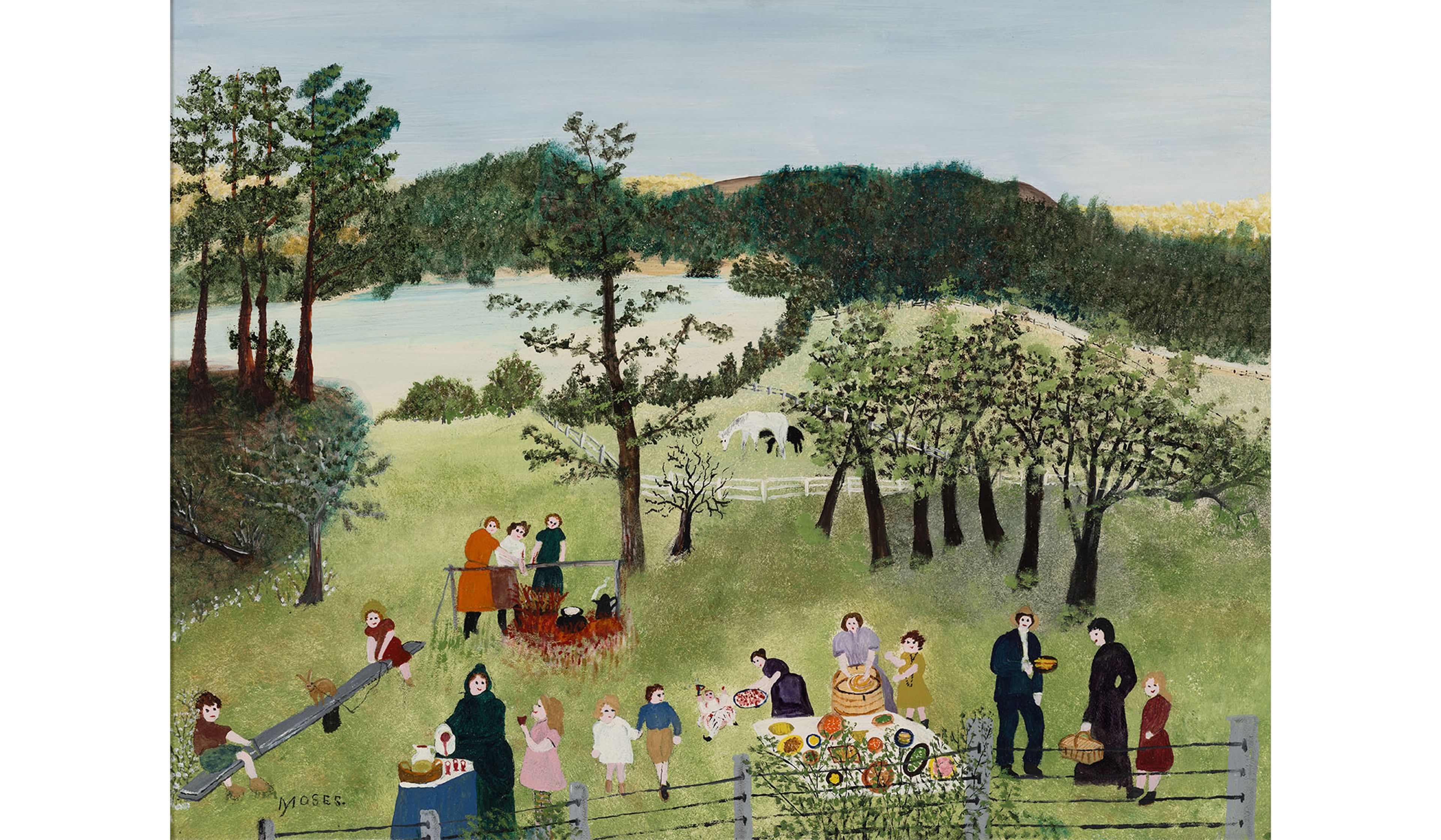
Who is this smiling, petite old lady who always seems dressed for church? Born Anna Mary Robertson into a family of ten children, Moses was very local, born not far from where she died. She went to a one-room schoolhouse, made art as a child and teen, and started working at twelve. She descended from colonial stock. Her father owned a small farm and a flax mill. Her mother was one of eleven children, her grandfather one of 15, her husband, Thomas, one of twelve, and Moses herself had ten. Church, family, work, heritage, and local lore formed her and grounded her. She once itemized features in her character -- good at art, thrift, generosity, and what she called “inventive faculty” as inherited from different branches of her family.
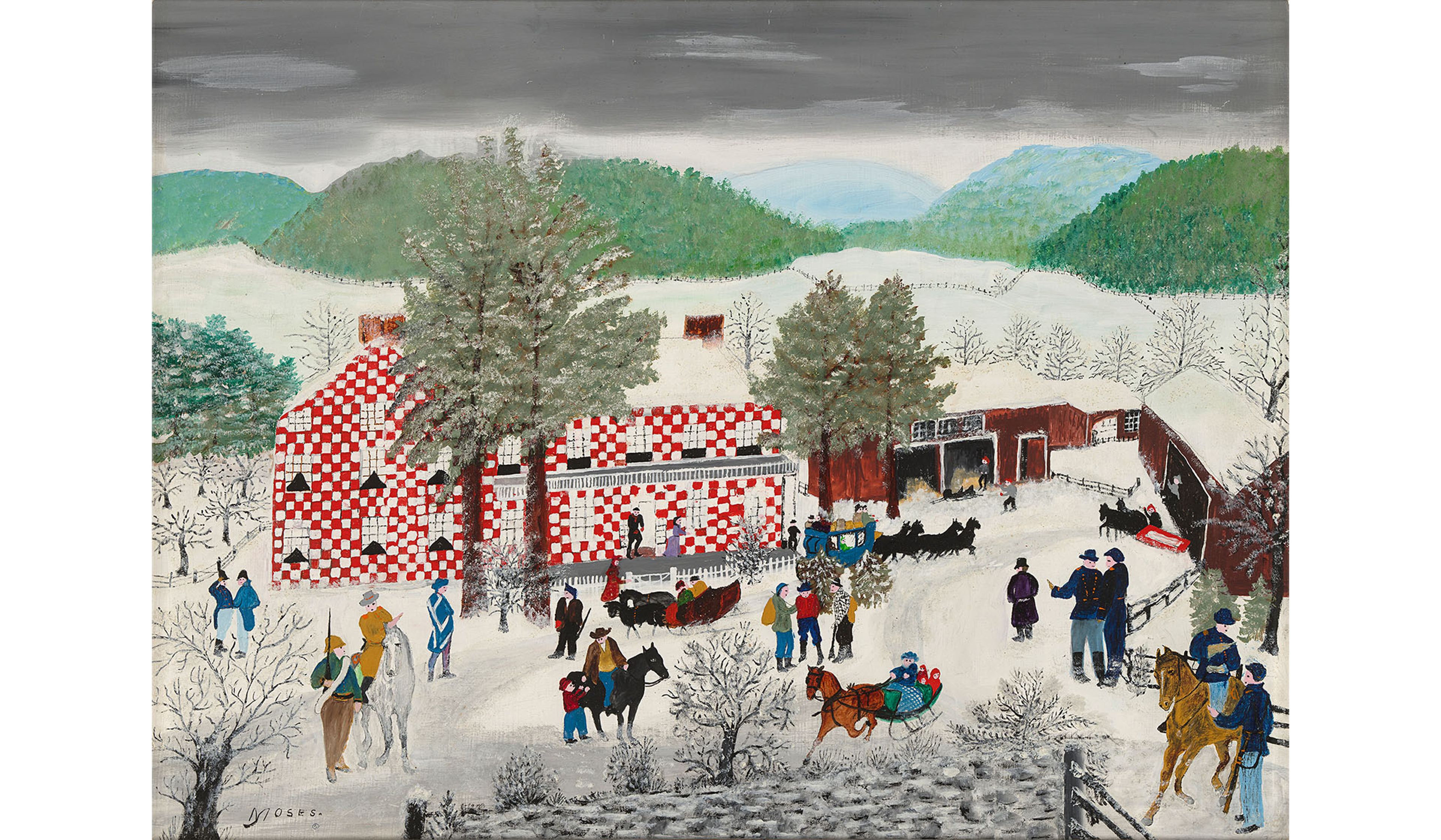
Sometimes Moses painted historical events like the Battle of Bennington, the 1777 local battle that, though small, so debilitated the British that they lost the Battle of Saratoga days later. The Checkered House, a lively, idiosyncratic scene from 1943, shows a house in the next town that burned in 1907 but was well-known by all the locals and well-remembered by Moses. Some are generic scenes that seem far in the past. She painted her childhood home and what she called “landmarks of bygone days.” She painted from memory, with no models, and in her studio rather than by a motif. “Why do you paint old things?” a reporter once asked her. “Because I’m old,” she said.
I knew very little about the nearly 20 years that Moses spent in the Shenandoah Valley in Virginia. A Good Day’s Work cured my ignorance, starting with a massive wall-mural map of the Blue Ridge Mountain counties. In 1887, at 27, having worked at her father’s farm and as a house servant for affluent relatives nearby, Anna married farmhand Thomas Moses, also local, and the new couple went west, southwest, that is, to Virginia. That part of Virginia wasn’t devastated by Civil War battles, but experienced manpower was in short supply. Over their years there, the Moseses lived on five farms, he as an overseer, she as a mother and, before long, an entrepreneur making and selling homemade potato chips and gourmet butter.
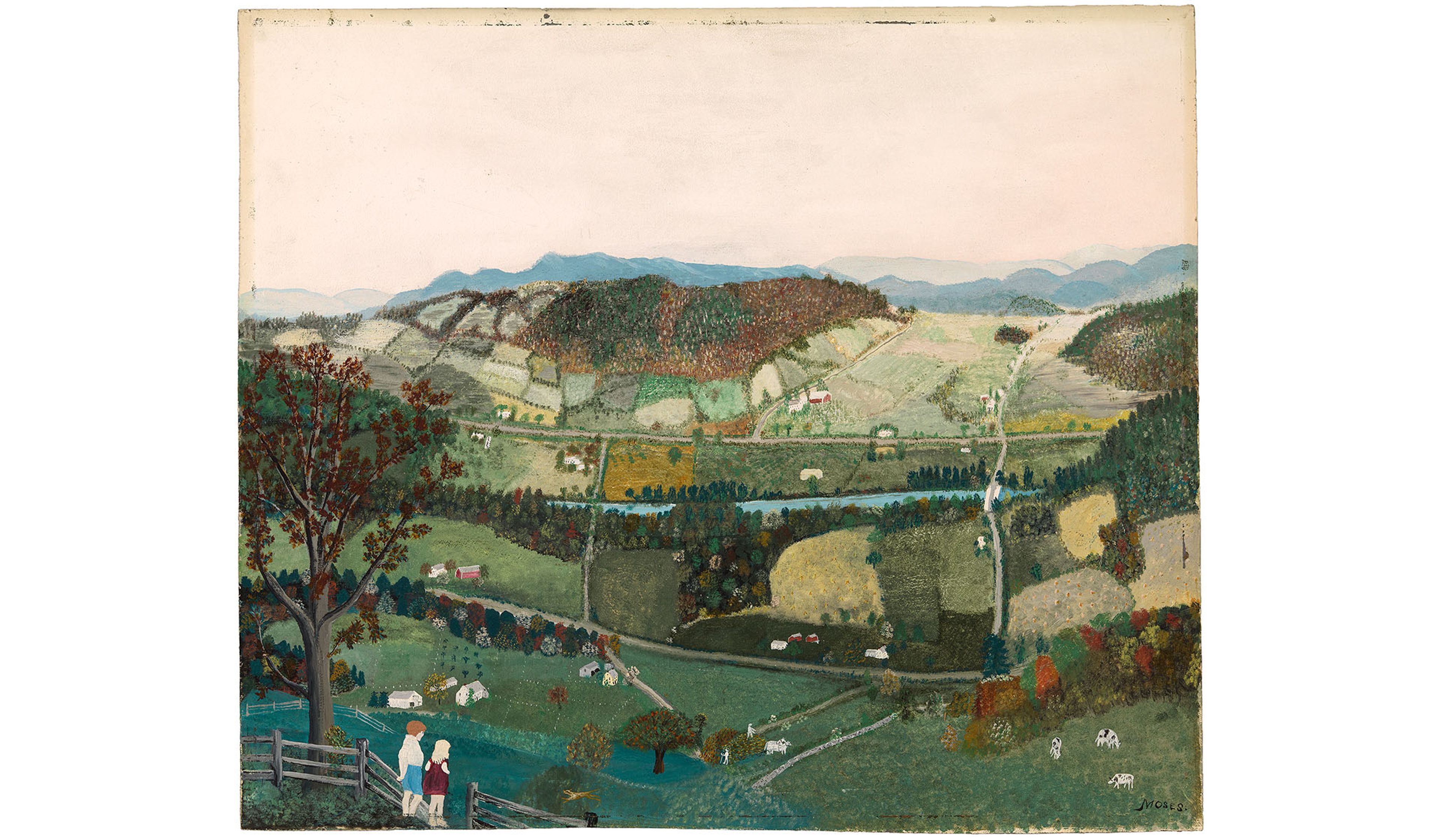
Moses painted about 40 Virginia scenes, a tiny part of her 1,500 works. Apple Butter Making, from 1944 to 1947, visualizes her recipe. All of Moses’s figures are white, and for that, she’s rebuked with a light touch in the galleries but with a bitch slap in the show’s catalogue. She liked living in the mountains. Her New York hometown was in the Cambridge Valley, with the nearby Taconic Mountains at a low point and the Green Mountains 20 miles west. It was her husband who wanted to return north, to New York, and buy his own farm. That they did in 1905.
The Becoming Grandma Moses section of the show tells the story most know, but many don’t. It’s appealing, even magical, to see it unfold, whether you know it or not. After Thomas Moses died in 1927, Grandma Moses, along with her adult sons, ran the farm. She was a wispy, tiny matriarch who embroidered landscapes and scenes of farm life and, starting in the 1930s, painted. She displayed her paintings in the window of a drugstore along with hooked rugs, jelly, and doilies she made. In 1938, Louis Caldor, a New York art collector and tourist, saw her work there, bought everything, jelly included, and showed the paintings to friends who brought them to the attention of curators at the Museum of Modern Art. By 1939, Moses was in a MoMA show. By 1940, she had a New York dealer, and an unlikely one. Otto Kallir, a specialist in modern Austrian art, was a Jewish refugee from Vienna, freshly relocated in New York. He suggested that Moses make herself a presence in promoting her art so her persona and her art could become a package deal.
Jane Kallir, Otto’s granddaughter, ran Galerie St. Etienne, Otto’s business, after he retired. Her catalogue essay on Moses and Kallir is both a good story of life’s twists and turns and a poignant one. Kallir sold Austrian Secession art to Vienna, so he had an eye for outsiders. In New York, his fresh eyes saw something others didn’t. Self-taught artists like Moses might be having a moment as an offshoot of both Regionalism and the New Deal’s new spot for art of the common man -- and woman. Kallir wasn’t a snob. He found quality not in what Jane Kallir calls “isms” -- rigid movements -- or in art-school pedigrees or the critic’s seal of approval. Goodness, he sold Disney animated drawings. He was smitten by Moses as a late-in-life Horatio Alger. And as a refugee, he saw what he called “memory and hope” as eternally good selling points. Kallir did suggest to Moses that she stop sprinkling glitter on her snow scenes. She correctly reminded the cosmopolite Kallir that fresh snow in bright rural sunlight does indeed glitter.
A Good Day’s Work isn’t a small show. Its 88 objects include 33 paintings by Moses belonging to SAAM, most given by Kallir’s family and research foundation. Aside from the Bennington Museum, which is a Moses treasure trove that includes the one-room schoolhouse she attended, SAAM is Moses Central. It has a superb folk-art collection displayed next to the Moses exhibition. Are we fed too much Moses? I feared we would be. There’s a couple of spots needing an edit, but saving Moses even there is her electric palette of red, orange, and yellow, bright, stark white, and human figures so basic that they’re insistent. Men in denim harvest yellow fields. There’s a lot of black on white. Farm architecture is geometric and grabs us.
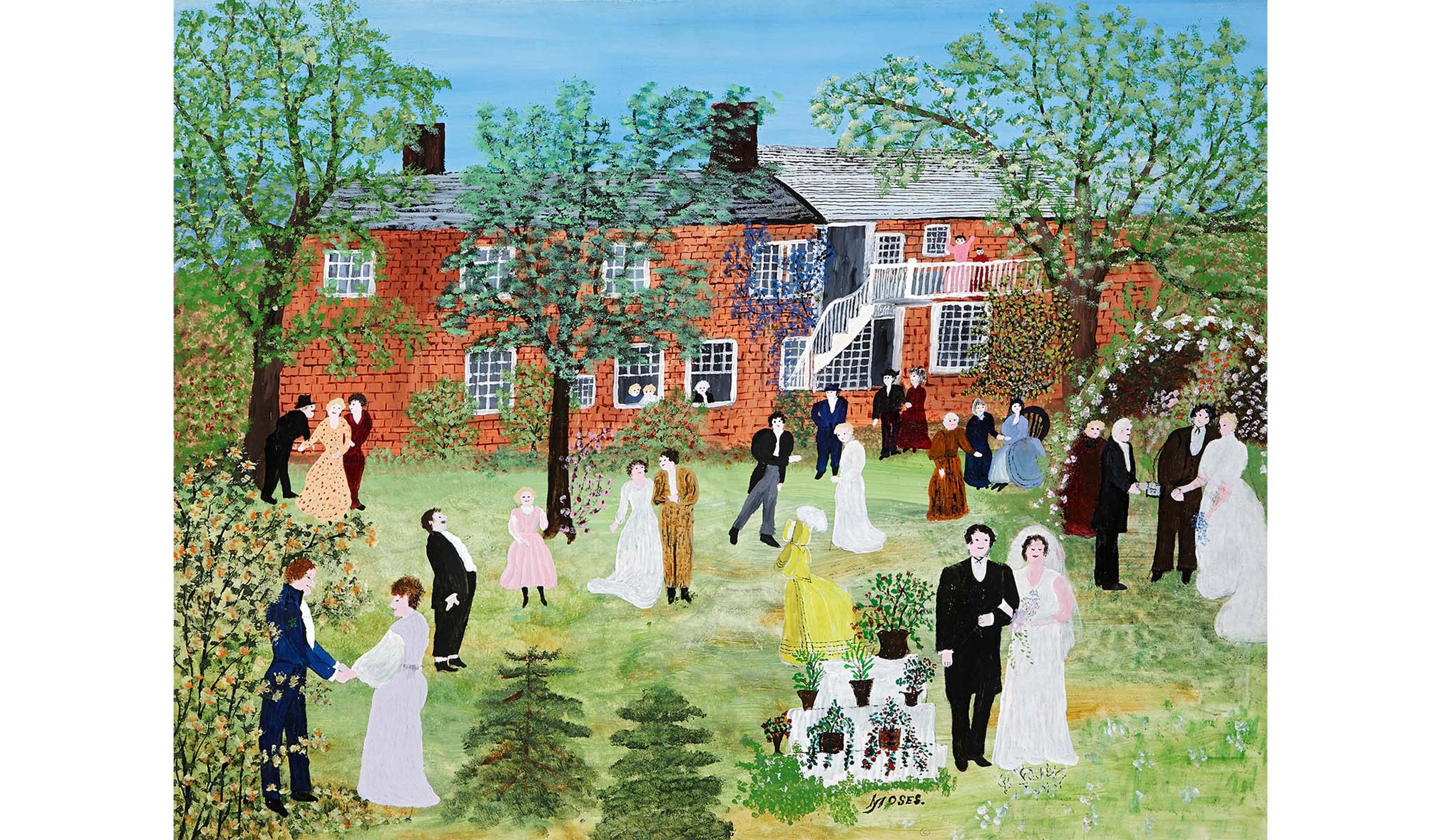
And there’s something to be said about infectious joy. It’s best seen and felt in pictures such as Sugaring Off, from 1955, where lots of people both gather socially and work. The scene brings to mind Bruegel’s winter scenes. Moses does action-packed interior scenes, too. The Quilting Bee, from 1950, is very much a hive but an ordered one. There’s lots of geometry keeping more than two dozen figures, young and old, anchored. I was surprised to see how various Moses is. Four seasons, multiple holidays, animals, children, and farm chores make for endless looks. A section on celebrations -- family picnics, a country wedding, Halloween, and Christmas among them -- shows how timeless and relevant Moses could be.
In the 1950s and up to her death just before Christmas in 1961, Moses was a cultural celebrity. Presidents Truman, Eisenhower, and Kennedy feted her work. She and Ike yucked it up as fellow painters. Bob Hope and Irving Berlin, he who wrote “White Christmas,” owned her work. Moses worked for Hallmark. Far from a stooge, she was a natural self-promoter and had a good sense of irony that’s modern. She knew she was the unlikeliest of art superstars.
Of course, once the art returns to the lenders, the show will be a memory, except for the catalogue, its permanent record. I always read them and consider them part of my review. A Good Day’s Work’s book is hefty -- too tall, in fact, to fit on most bookshelves, thoroughly illustrated, with nice details of work on display.
There are eight essays, too many, I think, but the anchor essays are very good. Curators Leslie Umberger and Stacy Hollander make the case for looking at Moses, the self-taught, old lady, country painter, and storyteller, and her farm-to-fame story. Kallir’s essay is a must-read part of the show.
While the exhibition in the galleries doesn’t pet SAAM’s favorite ogres like race and old-time values, the book does. Here and there, the book uses today’s fixations to make her a polarizing figure. It’s mostly harmless, though -- Moses as a persona and artist is too engaging -- and at times tired and formulaic.
Erika Doss’s essay is uneven. There’s the predictable blah, blah, blah about “sexism, racism, and homophobia generating a toxic climate of intolerance and subordination” in Moses’s time, which runs from the 1860s to the 1960s so this toxic climate is very broad and thin. Then she tackles a fine, rich point. Moses was a one-woman battering ram aimed at a mainstream view of old age as a period of loss of friends, health, income, and status. “Charming, funny, self-assured, and independent,” Doss writes, “Grandma Moses was the antithesis of the ditzy, slow, weak, and needy elder that troubled postwar America.” She stayed busy. “Please stop there,” I thought, but then Doss dives into “Whiteness by Default” with the glee of Esther Williams diving into the pool at MGM. Katherine Jentlesen’s essay on Moses and the Colonial Revival movement seems to battle a straw man. Is Moses’s work “representatively American,” as Otto Kallir and others once said? After all, her work “glosses over our original sins of colonization and enslavement.” So insistent, so laborious, so vapid, so prime for the trash bin.
Of course, Moses is a Colonial Revival artist. I would have done something actually useful and looked at Moses, Robert Frost, Thornton Wilder’s Our Town, and the big-deal 300th-anniversary celebrations in 1920 of the Mayflower’s arrival as opposed to the 400th-anniversary duds, and Wallace Nutting -- all had big moments starting in the 1920s.
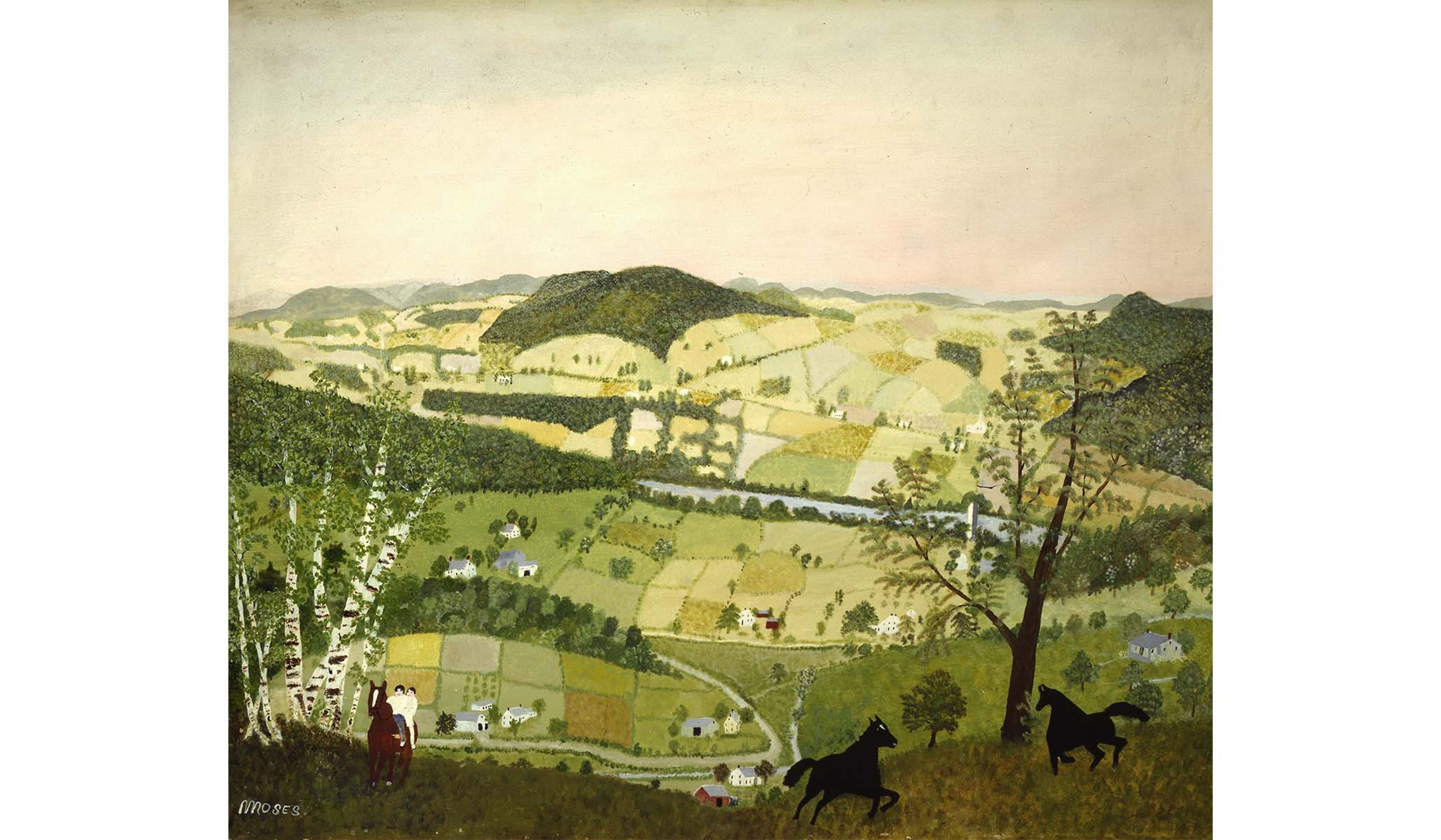
Eleanor Harvey’s short essay on Moses and the American landscape tradition adds nothing except for one lovely vignette. Moses, and this surprised me, is a very good horse painter. She did outlines filled with a single color, but they have oomph. I learned in Harvey’s essay that Moses knew, through anecdote, that her great-grandfather, while serving as a lookout in the days before the Battle of Saratoga, rode one of his two black horses through the tiny settlements east of Saratoga shouting “the British are coming.” His other black horse was killed. In Black Horses, from 1942, two black horses gambol in the picture’s foreground, with a sweeping view of farms and wooded hills in the distance. It’s a moment to ponder since Moses, painting in my lifetime and still a local presence where I live, reaches back to America’s founding. And the two horses, reborn, seem to live happily ever after in a place of peace and prosperity.

About the Author
Brian T. Allen is National Review’s art critic.
Featured Tags
Advertisement
Advertisement


Comments