Share this story
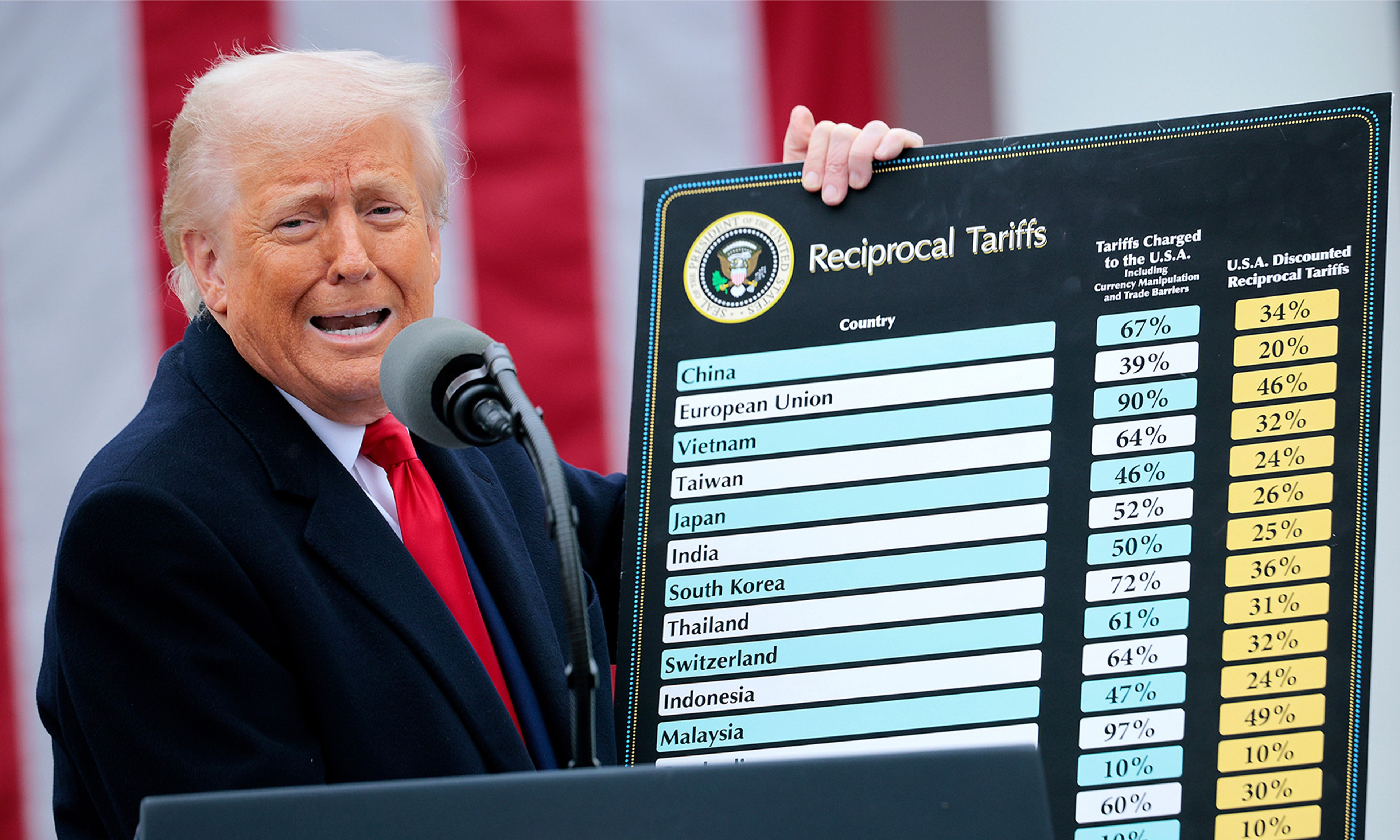
Trump announces ‘Liberation Day,’ April 2, 2025
No one organized a party. There were no cakes, nor were there any celebratory speeches. As birthdays go, it was a very quiet affair. On April 2 one year ago, on the oddly named “liberation day,” President Trump ripped up three decades of globalization, open borders, and freewheeling, mobile capital by announcing the steepest tariffs the United States has imposed on imports since the protectionist heyday of the 1930s. Of course, a year is a very short period of time for judging any policy, especially one as significant as this. Even so, twelve months on from that dramatic day, and despite the endless warnings of breakdown of supply chains, of recession, and of a full-blown trade war, we can clearly see that the tariffs have created a new global trading system — and one that will work better than what it replaced.
If there is one thing we should have learned from the first year of tariffs, it is surely this: Don’t listen to the economic establishment. In the wake of liberation day, there were dire warnings of a 1930s-style crash for which the American president would be held entirely responsible. Goldman Sachs put the odds of a full-blown recession at 45 percent. The Nobel Prize–winner Paul Krugman argued that “the biggest trade shock in history” meant that “a recession seems likely.” Of course, there are no laboratory-controlled experiments in macroeconomics, and the Chicken Littles point out that President Trump “chickened out” and reduced many of the tariffs. While there is some truth in that, the fact remains that the bulk of the profession forecast both rising inflation and collapsing growth rates. And most of the world listened to the leading “experts.” The U.S. stock market fell by 20 percent, while the big asset managers moved their investors’ money into Europe to escape the chaos unleashed on their side of the Atlantic.
It has not, however, played out the way they predicted. Instead, the U.S. economy grew by 2.1 percent in 2025, slightly down from 2024, but far from the “recession” we were told was inevitable. Inflation briefly touched 3 percent last September but fell back to 2.7 percent by the end of the year. It was hardly the spiral we were warned about. And of course, all that was happening at a time when the U.S. was also reducing net immigration to zero, another policy the Econ 101 crowd lectured us would collapse growth and send prices spiraling upward. And yet, despite it all, the economy performed well, and the stock market hit record highs. Meanwhile, the “pivot” to Europe didn’t work as well as forecast, with Germany, France, and Britain recording growth rates of 0.2 percent, 0.7 percent, and 1.4 percent, respectively. In China, in many ways the main target of the tariffs, the economy kept on expanding, with growth last year of 5 percent, while its new export champions, such as the automaker BYD, started to become powerful global brands in their own right. Its overall exports rose by 5.5 percent, measured in dollar terms, while its trade surplus rose above $1 trillion, an all-time record.
Let’s put this politely. Compared with what we were told, both the American and global economy pulled through in remarkably good shape.
What has actually happened is something far more interesting. For all the furious condemnation from European and Asian leaders, and for all the fretful elegies for the fading “rules-based order” that padded out the panel sessions at Davos, the world has accepted what might be termed “the Trump trade order.” Just take a look at a few examples. The European Union, far from standing up to Washington, has quietly dropped most of its tariffs on American goods. Under the “Turnberry agreement,” the European Commission President Ursula von der Leyen agreed to reduce the tariffs on American automobiles from 10 percent to zero and even open up its market to products such as seafood and soybeans. Within Europe, France — quelle horreur — is softening agricultural protection; and Germany, as it spends billions re-equipping its armed forces in the face of Russian aggression, is buying American military equipment (around 8 percent of the extra money will be spent on U.S. equipment, including F-35 fighter jets, the P-8A Poseidon maritime-patrol aircraft for the German navy, and Tomahawk cruise missiles). In Britain, the state-run National Health Service has finally decided to pay something closer to the market price for American pharmaceuticals. Similarly, in Asia, Japan is opening up its market to American rice, while South Korea has reduced tariffs on American products to 15 percent and agreed to invest $350 billion in the United States.
None of those are minor tweaks. They have induced a fundamental shift in trading relationships, a shift that previous administrations spent decades trying and yet failing to achieve. At the same time, there has been a flood of inward investment as multinationals relocate manufacturing to the U.S., creating jobs and re-shoring supply lines, while huge sums of extra tax revenue, most of it paid by foreign firms, have started to flow into the Treasury; more than $250 billion was raised by the end of 2025, a significant sum even for an administration that spends as wildly as this one.
Trump’s trade revolution, if we can call it that, entails a fundamental reevaluation of American trade policy. It starts from the premise that trade relationships should be mutually beneficial, not just efficient in some abstract sense; that American workers are stakeholders whose interests deserve consideration; that leverage matters and should be used; and that the existing system badly needed reform. Sure, that makes the foreign policy establishment deeply uncomfortable. It challenges decades of conventional wisdom. But the results are starting to speak for themselves. European and Asian governments are making major concessions. Trade relationships are being restructured, and while the outrage continues, it is by now largely performative, as global trade has been rewired.
Of course, no one would deny that there have been problems along the way. The introduction of the tariffs was chaotic, with rates changing at bewildering speeds, and with some insignificant countries singled out for punitive rates. Lesotho was probably not such a threat to American jobs that it warranted a 50 percent rate, and it was hard to work out why the Heard and McDonald Islands were hit with tariffs, since no one lives on them. The Supreme Court judgment in February that the president had exceeded his powers was a setback, which meant the rates had to be revised all over again. Both the White House and Congress desperately need new legislation governing tariffs to replace the 1970s or even 1930s legislation relied on until now; the executive instead of the legislature should set tariffs, but it needs a clear legal basis for doing so. Perhaps most important, it was a mistake to launch a real war (against Iran) before the trade war was won. As any general will tell you, it is impossible to fight on two fronts. It makes both wars harder to win and risks losing both of them.
Even so, the apocalyptic warnings from the economic, financial-markets, and big-business establishment of a deep recession, soaring inflation, and a stock market crash have proven to be wrong. Instead, after twelve months, the world has reshaped itself around a more robustly self-interested trade policy.
What does the Trump trade order — the TTO for short — look like? It has three core features. To start with, it is far more resilient. At the high point of hyper-globalization, supply chains were ridiculously stretched; your local Walmart was stocked with products from the farthest-flung corners of the world. Parts were shipped from one hemisphere to a factory where they were slotted into components from the other hemisphere before being sent over an ocean for final finishing and then back again for delivery. On a McKinsey PowerPoint, it all probably made perfect sense. And yet it was also intensely fragile. It took only a minor disruption somewhere along the chain to crash the whole system. We first saw that during the Covid pandemic, and we’ve been witnessing it all over again with the closure of the Strait of Hormuz. By bringing a lot of production back home, the TTO is shifting us back to an economy in which countries are far more reliant on domestic production. A “supply shock” is something you might read about in the paper, but you won’t see it at the local mall.
Next, the TTO is more egalitarian. The hyper-globalized trading system, in fairness, lifted global living standards very significantly. The trouble was, the average global income didn’t necessarily mean a lot to someone who had lost his job in Illinois. Marine Le Pen, the leader of France’s right-wing National Rally party, memorably put it this way: “Globalization means using slaves to manufacture products that are then sold to the unemployed.” Her rhetoric may be inflammatory, but it’s hard to deny that there’s a kernel of truth in her observation. While the Wall Street class benefited hugely from the globalized system, with rising incomes and expanding career opportunities, ordinary workers struggled as industries were gutted and jobs moved overseas. In essence, the TTO slightly shifts the balance back toward blue-collar, and away from white-collar, labor.
Finally, and perhaps most important, the TTO stands up to China. There is no question which nation benefited most from hyper-globalization. It was the Middle Kingdom. Just take a look at the figures. If you take the foundation of the World Trade Organization on January 1, 1995, as the starting point (although China did not join until 2001), China’s GDP has grown 25-fold over those three decades, compared with just 3.7 times for the United States. Sure, to some extent that was just China catching up with the industrialized, free-market West. And yet the leadership in Beijing was also clearly gaming the system. Other markets were open to cheap, often subsidized, Chinese goods, while China’s markets were mostly closed, at least unless it wanted a few foreign factories to steal some technology from. We won’t see it right away, but under the TTO it will be harder for China to become the world’s largest economy, and indeed it may never happen now.
The global economy will be more robust, blue-collar workers will have a larger share of the wealth it generates, and the liberal democracies will be strengthened against the Marxist party officials in Beijing. If those are the main features of the Trump trade order, it is hard to see what is so terrible about it. We are not going to go back to a 1950s world when most production was domestic, when the U.S. reigned supreme, and when a factory job allowed you to raise a family in a big house in the suburbs on a single income. Even if we wanted to conjure that world back into existence, too much has changed since then to make it possible. But it will be a modest, incremental improvement of the kind that conservatives should support — and that is quite an achievement for its first year.

About the Author
Matthew Lynn is an author, a columnist for the Washington Post and the Daily Telegraph, and the founder of Lume Books.
Featured Tags
Advertisement
Advertisement

Comments