A Reader’s Guide to the Sam Tanenhaus Biography of William F. Buckley Jr.
Written by Neal B. Freeman
This book is long, self-indulgently long. But in one sense it’s not nearly long enough.
Share this story
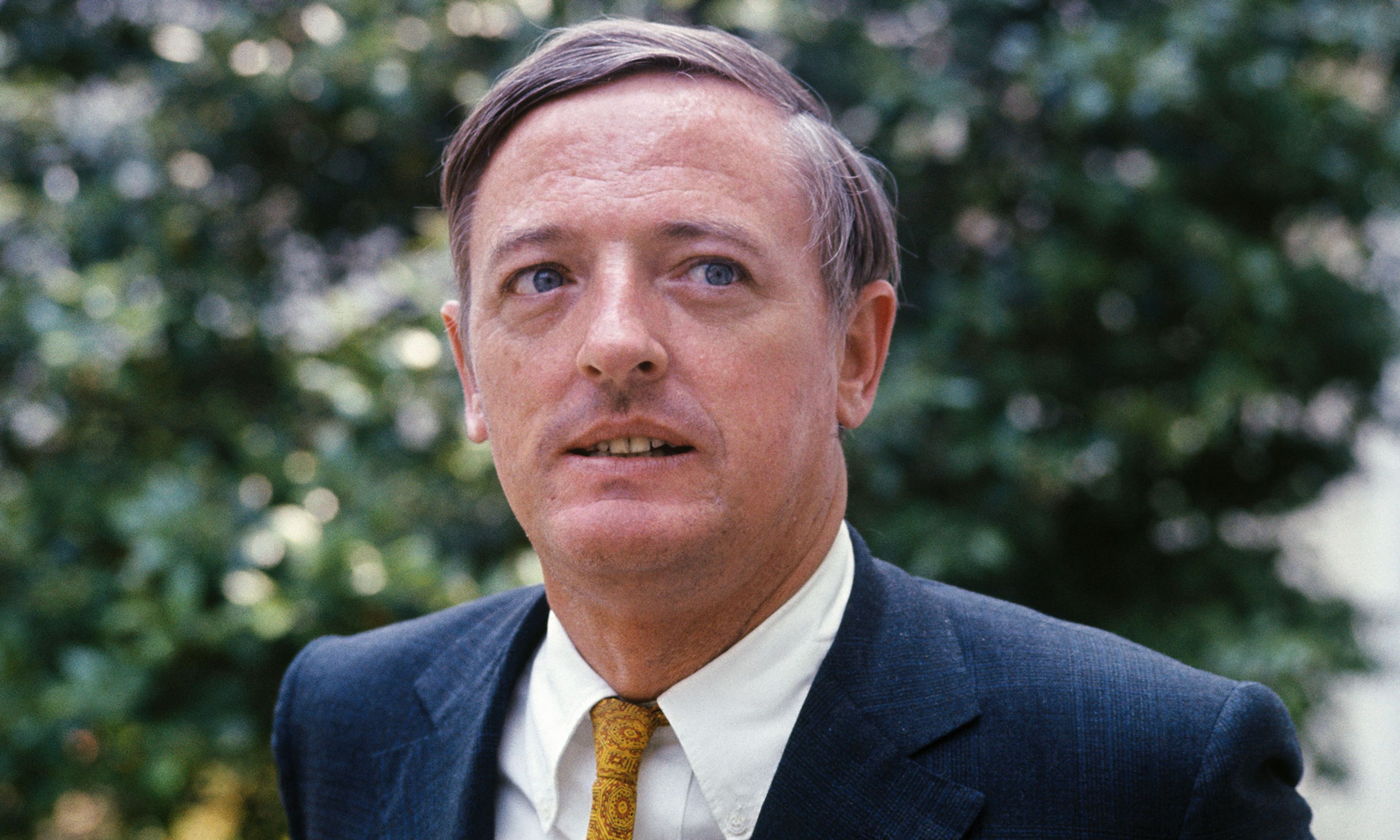
<span style="font-variant:small-caps">National Review</span> founder William F. Buckley Jr. at the White House in 1969
I first heard about this book in the late Nineties. Yes, that would have been in the previous century. After one of Patsy Buckley’s fabulous dinners at the New York maisonette -- great conversation, great food, bargain wine -- WFB signaled a few of us to stay after the other guests had departed: Joseph Donner, a philanthropist and the senior member of the National Review, Inc. board; Evan Galbraith, Reagan’s ambassador to France who had been close to WFB since their days together at Yale; William Rusher, the publisher of National Review magazine; and me, the head of a television production company and a member of the NR board for more than 30 years, my tenure being almost as long as the others’.
The four of us had served National Review over the years as a kind of volunteer fire department. Every time NR’s finances burst into flames, which happened more often than you might think, we convened instantaneously, each of us lugging as many water buckets as we could manage.
After that dinner in 1998, WFB had settled us back into the living room, postprandial brandy warming in our hands. He then passed around some good cigars -- rumored to be the handiwork of skilled Caribbean Communists -- and began his pitch. It was always fun to be on the receiving end of a pitch from WFB. Any old pitch. As the great M. Stanton Evans once observed: “It was like sex -- even when it was bad, it was pretty good.”
The headline of the evening was that, after years of false hopes and crushed expectations, WFB had finally selected the author to write his authorized biography. The winner, WFB announced with unfeigned delight, was Sam Tanenhaus and he had won the sweepstakes for two reasons: First, he had written a book about Whittaker Chambers that WFB had admired. And second, Tanenhaus had come highly recommended by WFB’s son, Christopher. Check and check. Sam, as we were nudged to call him, was prepared to start immediately, and WFB had promised him full access. (By this point, WFB was almost dancing in his chair.) WFB had also promised him, uhhhhhh, that the four of us would sit for interviews and open our own files.
Joe Donner and Van Galbraith, two of the world’s most agreeable men, quickly agreed. It was WFB’s life and WFB’s book and it should be WFB’s call. Bill Rusher quibbled. Of course he did. One of Rusher’s weightier responsibilities at NR was to subject WFB’s midnight enthusiasms to morning-after scrutiny. I was blandly noncommittal. I didn’t want to douse WFB’s campfire, but my inner voice was mouthing a flat “No.” I had been a fringe player in the resolution of some of NR’s highly charged legal battles, a few of them downright ugly. And even thicker than my notes on bitter endings were my files on hopeful beginnings. WFB was an antsy entrepreneur, both intellectual and financial, and I had been his junior partner in launching numerous ventures.
Some of those initiatives had gone swimmingly: the syndication of his newspaper column; his campaign for mayor of New York City; and the production and distribution of his television series, Firing Line, to name three. Some of them had not. To cite just one example from my yellowing files, WFB had for a season been abuzz with ambition for a small manufacturing business. The company proposed to introduce an innovative product . . . an inflatable house. I know. What could possibly go wrong? To ask me, as either a businessman or a journalist, to open my files to a stranger was to ask me to perform an unnatural act. I didn’t feel obligated to share every garment in the hamper with a biographer, no matter how comprehensively he may have been authorized.
It was a big day in the publishing world when Random House signed Sam to do the big book on William F. Buckley Jr. At the time, WFB was still a hot property and the industry grapevine guesstimated Sam’s advance at $500,000, an arrestingly high number for a writer who had never written a big-selling book. The day before the signing, Sam Tanenhaus had been a promising young writer; by the day after, he had become an established author. For Sam Tanenhaus, it was a life-changing day, and the agent of that change had been William F. Buckley Jr.
This June 3, after 27 years in gestation, Random House will publish Sam’s Buckley: The Life and the Revolution That Changed America. That will be a life-changing day for WFB. There have already been a dozen books about WFB, all of them more or less positive and several of them hagiographically so, but it will be this book, the one for which WFB himself chose the author, that is most likely to seal his legacy.
As you will appreciate, there are challenges unique to a book 27 years in the making. To begin with, it will be the work of multiple authors. In this case, the initial writer was Sam the grateful youngster getting his shot at the bigtime; after which, there was Sam the cultural overlord (by 2004 he had become editor of the New York Times Book Review); followed, finally, by Sam the elder statesman of the lit-set establishment. As I worked my way through the book -- and at roughly 900 pages, it is an oaken door-stopper that involves some manual labor -- I couldn’t help but look for the seams between the various authors. You may find yourself wondering: Who wrote the passage I am now attempting to parse?
The other challenge for the long-awaited author is to maintain the interest of those importantly involved -- the publisher, the promoters, the intended audience and, most especially, the subject of the book himself. During a catch-up session with WFB in 2006, I made the mistake of mentioning the book. His disappointment was raw. He was, as he diagnosed his physical condition, beginning to “decompose.” He feared that he would never see the book, that Sam might be waiting for him to die before publishing. Left unstated was any concern that Sam might be writing a book other than the one WFB had been eagerly anticipating.
(I remember attempting a levity that day. I told WFB that we had to appreciate Sam’s brass. As editor of the NYTBR, he had life-or-death power over Random House books every week of the year. Random’s lawyers were never going to claw back his advance with their customary ferocity. Sam, I suggested, may have committed the perfect literary crime. That jest, I also remembered, had not been well received. WFB was inconsolable.)
Before turning to the text itself, let me state clearly that, from my vantage point, Sam was never less than diligent. When I first sat for a formal interview, he was well prepared and thoroughly professional. As we emailed over the years, he proved himself to be deeply informed about obscure corners of Buckley World. The last time I saw him in person was at the Harvard Club in New York City. I was chairing a fundraising dinner and as I sat at the head table reviewing my notes for the program about to begin, I sensed somebody behind my right shoulder. I cocked my head to one side, expecting to hear something like, “For your entrée, sir, would you prefer the sirloin steak or the Chilean seabass?” Instead, I heard a rat-a-tat series of questions about some arcane incident at National Review. I pivoted in my chair and said, “Oh, it’s you, Sam. I wonder if we could do this some other time.”
Now, to the text and a few bones that need picking. Up front and then again at least twice in the body of the book, Sam repeats the canard that the best writers National Review ever produced were Garry Wills, Joan Didion, and John Leonard. This is a red flag, snapping in the ideological breeze.
I knew them. I respected -- and liked -- all three of them. But not one of them moved the needle at either the magazine or the cause it served. They did their best work, and earned their professional esteem, only after they had left NR. They won places at the high table of the cultural Left after devoted service to causes very different from NR’s. (For those of you keeping score at home, the best writers at National Review were Keith Mano, Brent Bozell, George Will, Bill Buckley, Arlene Croce, John Coyne, Joe Sobran, and Rick Brookhiser. This list, as they say, is still in formation. The current staff bristles with young talent.)
Then there is Sam’s sense of proportion, or rather, his lack thereof. To rely on this book, you might think that some of WFB’s most important professional associates were named E. Howard Hunt, Peter Starr, General Edwin Walker, George Wallace, Gore Vidal, and Edgar Smith. Barrels of perfectly good ink are spilled over these colorful characters as if they had played important roles in either WFB’s life or his revolution (to borrow the dubious distinction from Sam’s subtitle). They had not. They were, for WFB, either occasional distractions or, some of them, nagging but marginal problems. What they had in common was that they all had dragged WFB through noisy and unflattering public relations dustups. (Clarification: Peter Starr, who had met WFB while working on one of his boats, became president of Starr Broadcasting, WFB’s chain of broadcast stations. After early promise, the company ran into financial and then legal difficulties, culminating in a formal contention between Chairman Buckley and the Securities and Exchange Commission. The original plan for the company had been to call it Freeman Broadcasting with me as chief executive. I withdrew not because I had spotted a flaw in the business plan but because the company was to be headquartered in Omaha. I had fallen for a New York girl and was waging a 24/7 campaign to win her hand. Omaha could wait.) After exploring these troubled relationships in encyclopedic detail, and in the process giving short shrift to the scores of compatriots who had served honorably and well in WFB’s revolution, Sam renders this judgment: WFB “was not always careful about the company he kept.” Really, Sam.
There’s one thing you learn early in entrepreneurial activity that, it would appear, can escape the dragnet of 27 years of intensive research. When you start a company and you need, say, somebody to run the finance department, you do not have your pick of the sharpest managing directors at Goldman Sachs. You have your pick of the people who couldn’t land an interview at Goldman Sachs. (In my own long experience, exigent circumstance -- urgent and unpredicted start-up moments, for example -- can leave you with the pick of people who are categorically unemployable.)
Here and there explicitly, and almost everywhere implicitly, Sam refers to Buckley ventures as “get-rich-quick schemes.” I think I speak for a unanimous business community when I say that, among this country’s vast array of entrepreneurial possibilities, the building of a national political movement would be ranked as the single least nubile. Working seven days a week, it took even WFB 33 years -- from the publication of God and Man at Yale in 1951 to the 1984 Reagan landslide validating Buckley conservatism as the country’s governing philosophy -- to consolidate his revolution.
Now and again, almost miraculously when you think of the cruising speed of his subject, not to mention the audacity of his quest, Sam’s tale slows . . . to . . . a . . . crawl. Perhaps sensing the problem, Sam then stands on the accelerator with an asseveration from nowhere. Like this one: WFB had “entrusted [Young Americans for Freedom’s] management to Marvin Liebman and Bill Rusher. Both were delighted to be in charge -- not least because both were gay and never happier than when in the presence of young men.” Say what? I knew both men. You didn’t need a CSI unit to detect Marvin’s sexual preference. He was flamboyantly out. He wrote a book about his gay life in the conservative movement. Bill Rusher was a different story. I worked closely with him. I travelled with him. I drank with him. Not once in those 40 years was there an awkward conversation, an embarrassing revelation, a boundary crossing of any kind. Joe Donner and Van Galbraith, among many others within our circle, had the same experience. If Bill Rusher was a closeted gay man, he was tucked back there in the far corner, next to his grandfather’s golf clubs. For Sam Tanenhaus to out Bill Rusher 14 years after his death, with no supporting evidence and to no narrative purpose, is wholly gratuitous. But it’s more than that. If Sam is wrong, his journalistic sin is unpardonable. If he’s right, he dishonors what must have been an heroic discipline on Bill Rusher’s part those many years.
This book is long, self-indulgently long. But in one sense it’s not nearly long enough. What I missed most is the story promised on the book’s cover. You know, the revolution that changed America. I knew as much as anybody about some parts of that story, but I wanted to know about the other parts, and how they all fit together. I wanted to feel again, if only vicariously, the thrill of WFB’s epic chase. I wanted another glimpse of the pure joy of his high-purposed life.
My old sparring partner Christopher Hitchens, the Anglo-American essayist, once described his own heady days in a surging political movement this way: “If you have never yourself had the experience of feeling that you are yoked to the great steam engine of history, then allow me to inform you that the conviction is a very intoxicating one.” Any trace of that conviction, which we happy few were privileged to experience in full measure, is missing here, too.

About the Author
Neal B. Freeman, businessman and journalist, was a director of National Review Inc. for 38 years.
Featured Tags
Advertisement
Advertisement
Comments