A Survivor’s Guide to <i>Wicked: For Good</i>
Written by Armond White
This sequel doesn’t improve on what was irredeemable, but at least it’s shorter.
Share this story
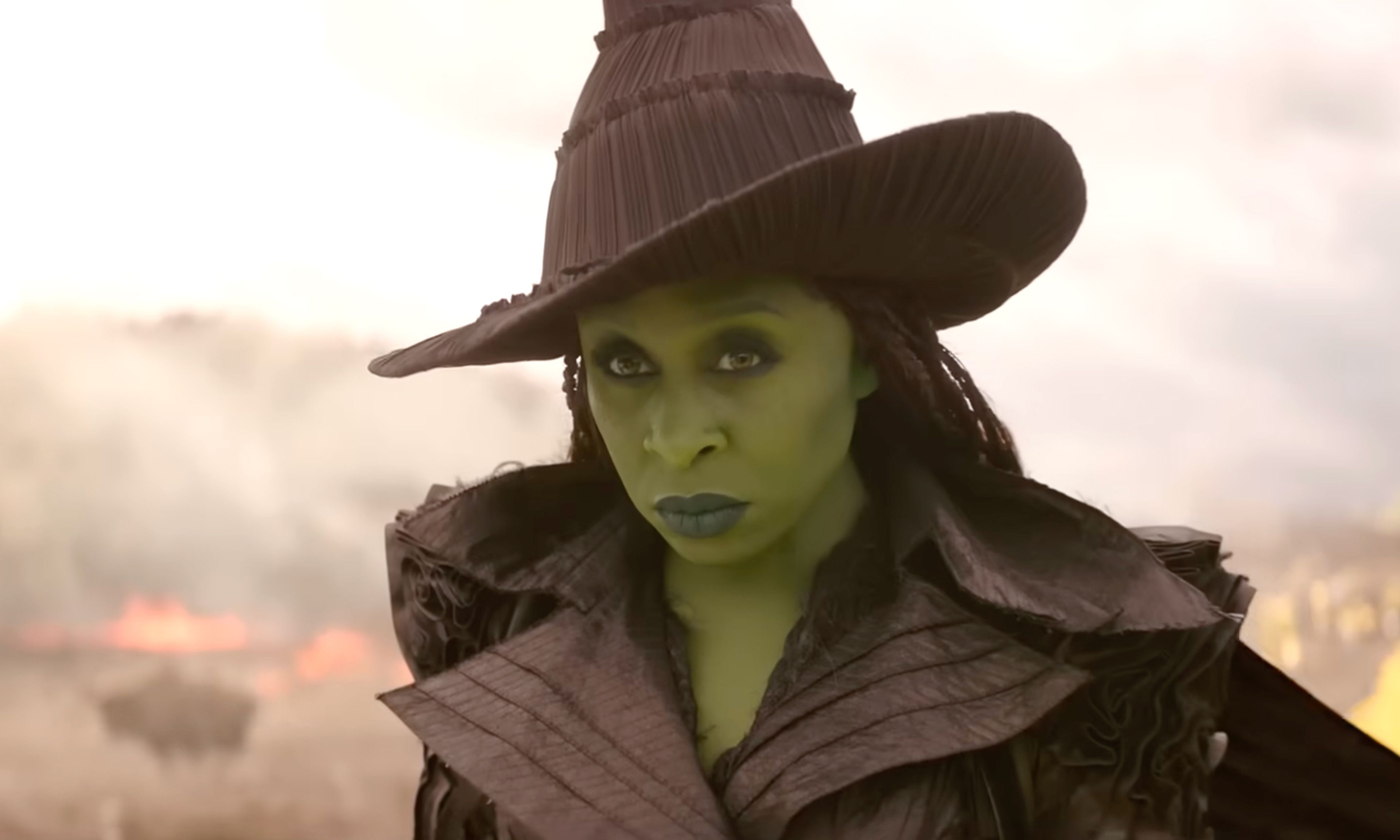
Cynthia Erivo as Elphaba in <i>Wicked: For Good</i>
Did you survive last year’s Wicked and its Bizarro World flip redefining good and evil, its normalization of witchcraft, and its exploitation of race and gender identity — plus its slate of utterly mediocre songs? If so, you’re now armed against the sequel, Wicked: For Good.
It is easier to take the quasi-political storyline where Elphaba (Cynthia Erivo) fights back against the hoax that she is a threat to Munchkinland democracy. The jealousy that pits her against Glinda the Good (Ariana Grande) and disabled half sister Nessarose (Marissa Bode) has been simplified to petty school drama and romantic rivalry. This is now merely a clash between dark and light decorative motifs (Elphaba’s broom and pointy black hat vs. Glinda’s “vehicular spherical globe — a bubble”).
This sequel doesn’t improve on what was irredeemable, but at least it’s shorter. And after the forced initiation into blockbuster inanity, it’s easier to accept that there’s hardly any connection to the original Wizard of Oz tale: Dorothy, Scarecrow, Tin Man, and Cowardly Lion make brief appearances, only to quickly vanish. The Wizard (Jeff Goldblum) and Madame Morrible (Michelle Yeoh) are reduced to minor comic foils.
Only shameless commercialism explains converting the Broadway show into a two-part theatrical film blockbuster. (It was never meant for children.) Typical Hollywood liberalism emphasized new themes that abolished race, gender, and moral tradition — minimizing “There’s no place like home” to make civic competition the basic social ideal. “Over the Rainbow” was transformed into a beyond-camp setting of rainbow-colored fields with ally Glinda’s subtle assurance, “You know how much I like rainbows!”
But Wicked: For Good isn’t clever enough to actively enforce its progressive makeover. The troublesome subplot in which Elphaba liberates animals (second-class citizens under the Wizard's prohibitive laws) essentially does away with the hoax that she is “the Wicked Witch of the West.” A Kansas tornado and Dorothy’s house appear but are drop-kicked, like the ruby slippers that become brocade slipper-socks.
These changes negate L. Frank Baum’s moral ambiguities and confirm that there’s no going back to his implicit theology. Angry Tin Man (Ethan Slater) exists to declare, “History is just something everyone agrees on.” But that’s actually the definition of “ideology.” The fact is that Wicked: For Good’s progressive ideology promotes “Looking at a thing [beauty] a different way” and sponsors Elphaba’s complaint “Why do I love this place that never loved me?” Both sound like Michelle Obamaisms.
Dorothy and her anthropomorphic friends were jettisoned in favor of characters representing dead-end social justice issues. Diversity hire Jon M. Chu demonstrates no feel for the emotional exuberance of movie musicals (he quick-cuts shots of guns and weapons as if making a video game). The big number where Elphaba, Glinda, and the Wizard twirl in a rotunda ballroom could be the work of a music video hack. But Chu can barely direct a coherent dialogue scene, so it’s a relief that there are few dance numbers for him to flub. Erivo and Grande both sing with so little personality that their friendship just seems like a tired gimmick. And the Easter egg ending that contradicts the story’s original moral lesson is not happy — it’s just another aspect of the project’s tired and conviction-less propagandizing for Hollywood diversity. Wicked: For Good is not a good time.
Wicked: For Good exemplifies Hollywood’s No Fun dogma. Its racial contrasts and Sapphic pretenses detract from what was truly personal and expressive about William F. Brown and Charlie Smalls’s Seventies R&B Broadway masterpiece The Wiz — the only update and rewrite that the world needed, perfected in its songs “Don’t Nobody Bring Me No Bad News,” “Believe in Yourself,” and Stephanie Mills’s signature song “Home.” Indeed, it is the soul-satisfying beauty of The Wiz that enables us to withstand the dispiriting travesty that is Wicked: For Good for our own well-being.
About the Author
Armond White is National Review’s culture critic and the author of New Position: The Prince Chronicles and Make Spielberg Great Again: The Steven Spielberg Chronicles.
Featured Tags
Advertisement
Advertisement


Comments