Abrego Garcia Not Part of El Salvador’s Agreement to Detain TdA Gang Members
Written by Andrew C. McCarthy
The administration thus contends that it is not in violation of the Supreme Court’s April 7 decision.
Share this story
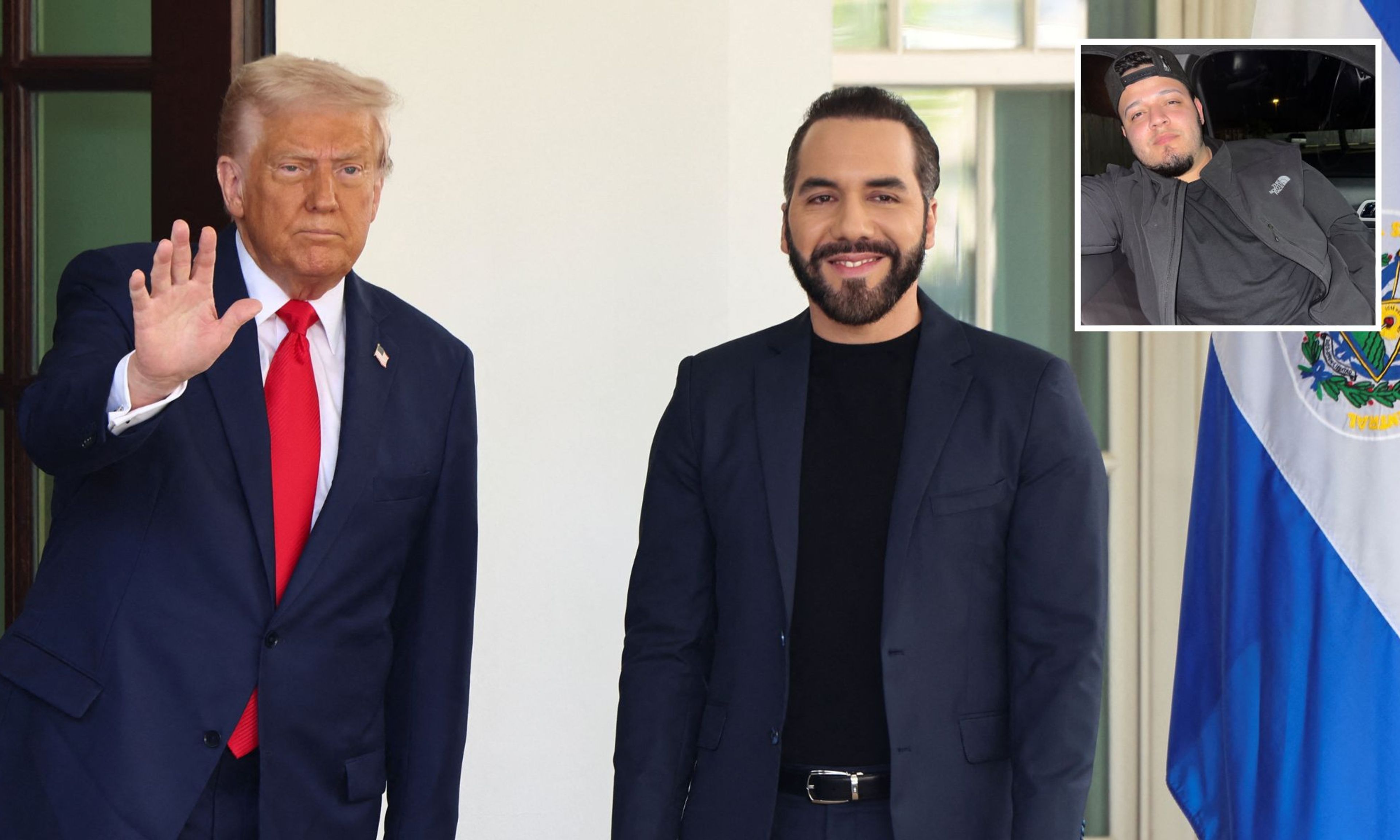
President Donald Trump welcomes El Salvador's President Nayib Bukele at the White House in Washington, D.C., April 14, 2025. Inset: A handout photo of Kilmar Abrego Garcia
The Trump Justice Department has informed the federal judge presiding over the case of Kilmar Abrego Garcia that his deportation to El Salvador is not part of the agreement under which that country agreed to accept aliens deported by the United States.
Instead, (a) that agreement pertains only to Venezuelan aliens whom the Trump administration deems members of Tren de Aragua (TdA), the international criminal gang the administration has designated as a foreign terrorist organization, and about 137 of whose alleged members the administration has summarily deported by invoking the Alien Enemy Act of 1798; and (b) although transferred to El Salvador along with these Venezuelans, Abrego Garcia, who is a Salvadoran national, was deported to his native country, not because of the agreement, but because he was a removable illegal alien -- notwithstanding that his deportation to El Salvador was illegal under a 2019 withholding of removal order issued by an immigration judge (which the Justice Department in the first Trump administration did not appeal).
With these as its premises, the Trump administration contends that it is not in violation of the Supreme Court’s April 7 decision in Noem v. Abrego Garcia, which directed that the government facilitate Abrego Garcia’s “release from custody.”
The assumption of the Supreme Court and the lower courts has been that Abrego Garcia was detained in CECOT, the terrorism mega-prison in El Salvador. This was a reasonable assumption: Salvadoran President Nayib Bukele touted on social media his regime’s detention in CECOT of the aliens the Trump administration deported to El Salvador on March 14–15, which included Abrego Garcia.
Nevertheless, it is unknown whether Abrego Garcia is still in custody. Last week, when he was visited by Senator Chris Van Hollen (D., Md.), the meeting did not take place in the prison and Abrego Garcia appeared to be at liberty. Even if the administration is correct that Abrego Garcia is a member of the MS-13 criminal gang (something that has never been established), mere membership in MS-13 is not a crime in El Salvador. Furthermore, there are no known criminal charges against Abrego Garcia in El Salvador, where he is not believed to have lived or visited since he entered the United States illegally 13 years ago. Hence, there may be no legitimate grounds for him to be in custody, and Bukele’s regime may have released him.
To be clear, due to the withholding of removal order, it was still illegal for the administration to deport Abrego Garcia to El Salvador. That said, what may be done to reverse that law violation probably hinges on whether the administration is willing to lean on Bukele to transfer him back to the United States for additional removal proceedings. If Abrego Garcia’s deportation and possible detention are truly independent of El Salvador’s agreement with the United States to accept and detain prisoners (which I’ll refer to as “the agreement”), then he is not in the position of a detainee being held by a different sovereign at the request of the federal government.
I have maintained that, to understand the status and legal rights of the deportees, it is essential to understand the scope of the agreement. As I noted again in a post on Monday:
According to public statements by Bukele’s own government, El Salvador received $6 million to detain approximately 300 prisoners for one year, with the caveats that, by the end of that year, the United States government would decide the disposition of the detainees, and the agreement could be extended.
The public statements, drawn from a memo written by officials in El Salvador’s Ministry of Public Affairs, were reported by the Associated Press (that’s the link just above). The quotation from the memo described the detainees as “these individuals.” Elsewhere in the report, the AP, which said it had “obtained the memo,” reported that “these individuals” included “alleged members of the Venezuelan Tren de Aragua gang and two alleged members of the MS-13 gang.”
This reporting was the best information we had to go on because, as I’ve noted, the Trump administration had not confirmed the details in the Salvadoran government memo, as reported by the AP. Obviously, even if the AP reporting was accurate, it did not tell us whether Abrego Garcia was one of the two alleged MS-13 members to whom the reporting referred, or whether the agreement included additional suspected MS-13 members (among whom Abrego Garcia might have been included).
In a post on X, my friend Bill Shipley, a former federal prosecutor, pointed out that a court filing today (Tuesday) included the government’s answers to interrogatories posed by lawyers for Abrego Garcia. That filing can be found here. Although the Trump administration is not generally forthcoming with information, claiming that the agreement is privileged information that it is not required to disclose, it did provide the following crimped answer about the agreement:
The United States, through the White House spokesperson, has publicly stated that “approximately $6 million” has been made available to the Government of El Salvador (GOES) to be used by the GOES for its law enforcement needs, including “for the detention of these [Venezuelan] foreign terrorists.” The United States has not provided any specific assistance with respect to the detention of Abrego Garcia or any other Salvadoran national. [Emphasis added; brackets in original.]
The government thus appears to be saying that the agreement applies only to Venezuelan aliens -- i.e., the aliens it alleges are members of TdA. The agreement does not apply to Salvadorans in general or to Abrego Garcia in particular. If this is so, then obviously the AP reporting is wrong to the extent it indicated that the agreement encompassed Salvadoran suspected MS-13 members.
This is why I’ve urged that Judge Paula Xinis, the presiding judge in federal district court in Maryland, should press the Trump administration for the details of the agreement. It is understandable that media reporting would assume Abrego Garcia’s inclusion within the agreement, given the facts that (a) he was suddenly arrested on the street at around the same time the government was transferring Venezuelan detainees to Texas in anticipation of deporting them; (b) he was similarly sent to Texas; (c) he was deported at the same time as the Venezuelans, on one of the three planes that made the trip on March 14–15; and (d) he was, according to press reports, at least initially lodged in CECOT. Indeed, his lawyers have claimed he’s been in custody, and the courts that addressed the issue, including the Supreme Court, spoke of facilitating his release from custody. That is why it was a startling development in the story when he appeared to be at liberty while meeting with Senator Van Hollen (though, of course, we don’t know for sure whether he was actually free or if El Salvador stage-managed the meeting with Van Hollen to make it appear that way).
Bill Shipley closely followed these developments because, to his credit as an experienced prosecutor and defense lawyer, he theorized -- correctly -- that Abrego Garcia was not part of the agreement and that his deportation was a separate transaction. That is, it was simply a repatriation of a deportable illegal alien to his home country that would be unremarkable but for the 2019 withholding of removal order prohibiting deportation to his home country.
This, no doubt, is why administration officials are so adamantly -- though disingenuously -- portraying Abrego Garcia’s situation as one that is out of their control. Naturally, they tend to elide mention of the fact that the administration sent him to El Salvador illegally (as I’ve noted, the Trump Justice Department suspended the government lawyer who honestly informed Judge Xinis that the government had deported Abrego Garcia in violation of the 2019 order). But that aside, if Abrego Garcia is not part of the agreement, then he is not being held by El Salvador at the behest of the United States; he is, instead, a Salvadoran who has been returned to El Salvador (however erroneously) and is now subject to the laws of that country. His presence in El Salvador is the fault of the Trump administration, but it is not under the control of the Trump administration.
Is the administration in violation of the Supreme Court’s order? It insists that it is not, but I don’t believe it’s so cut and dried.
The Court directed the government “to facilitate Abrego Garcia’s release from custody in El Salvador and to ensure that his case is handled as it would have been had he not been improperly sent to El Salvador.”
A number of commentators, myself included, have construed the order to be “to facilitate Abrego Garcia’s return to the United States.” I believe that is a fair construction because it would entail, (a) getting him out of prison, and (b) getting him back to America since, “had he not been improperly sent to El Salvador,” he would be in the United States and vested with rights under American law to fight against being deported to El Salvador.
On the latter score, I assume the government would say that, since the pending removal order followed immigration law removal proceedings, Abrego Garcia had already had due process in 2019 and there was thus no requirement to bring him to court before removing him in 2025. But of course, since the 2019 removal order carried the caveat that he not be deported to El Salvador, due process would have mandated that he be brought to court if the government wanted to send him to El Salvador despite the 2019 order.
In addition, as I explained in the post on Tuesday, while Attorney General Pamela Bondi could seek to reverse the 2019 withholding of removal based on changed circumstances in El Salvador (namely, the reported dismantling of the gang from which Abrego Garcia claimed to fear persecution), the statute governing that procedure would give Abrego Garcia due process rights to challenge that reversal. In my assessment, for what it’s worth, I believe AG Bondi would prevail; yet our immigration law would still entitle Abrego Garcia to litigate the matter. If he were to do that in a manner consistent with handling his case (as the Supreme Court put it) “as it would have been [handled] had he not been improperly sent to El Salvador,” that would mean returning him to the United States.
But it’s not that simple. If Abrego Garcia is not covered by the agreement, the Trump administration would have to ask President Bukele to allow him to be transferred for further U.S. court proceedings; that is, our government is not in a position to require Abrego Garcia’s return pursuant to the agreement. (I am assuming Abrego Garcia still wants to be returned to the United States, although it is almost certain that he’d be in custody here while challenging his deportation, only then to be sent back to El Salvador when he lost the challenge.)
That is how the controversy has now narrowed, I believe. The administration does not want to ask Bukele for such an accommodation because, according to the president and his top advisers, that would be acquiescing in a judicial intrusion on the president’s power to conduct foreign relations -- basically, requiring Trump to negotiate with the Salvadoran regime. By contrast, the courts see the administration as having violated the law (which it undeniably did) and believe it is obliged to take reasonable steps to rectify the situation -- with the understanding that if the administration asks, and Bukele declines to assist, there is nothing more to be done.
Beneath the question of high principle -- how to resolve the tension arising from clashes between the executive’s control over foreign policy, the executive’s obligation to execute the laws faithfully, and the court’s duty to vindicate the rights of litigants -- is brute practical reality: On the one hand, there is no burdensome demand on the president’s foreign policy power because Bukele is beholden to Trump and would do whatever the administration asked him to do; on the other hand, while the Trump administration violated the law, if it had followed the law (including the process for reversing withholding of removal orders), Abrego Garcia would almost certainly have been deported to El Salvador, which is where he is now anyway.
That’s why Trump officials keep saying, “What’s the big deal?” It is a big deal because a normal presidential administration would want to correct its misconduct and avoid a pointless fight with the courts, especially when it will be asking the courts to rule its way in some very tough cases down the road. But this is not a normal presidential administration.

About the Author
Andrew C. McCarthy is a senior fellow at National Review Institute, an NR contributing editor, and author of Ball of Collusion: The Plot to Rig an Election and Destroy a Presidency.
Featured Tags
Advertisement
Advertisement



Comments