After Being Excoriated by Trump-Appointed Judge, Halligan Is Removed by DOJ
Written by Andrew C. McCarthy
Rather than answer their vitriol ‘tit-for-tat,’ Judge Novak turned to, and shredded, ‘the few points’ raised by the DOJ that resembled legal argument.
Share this story
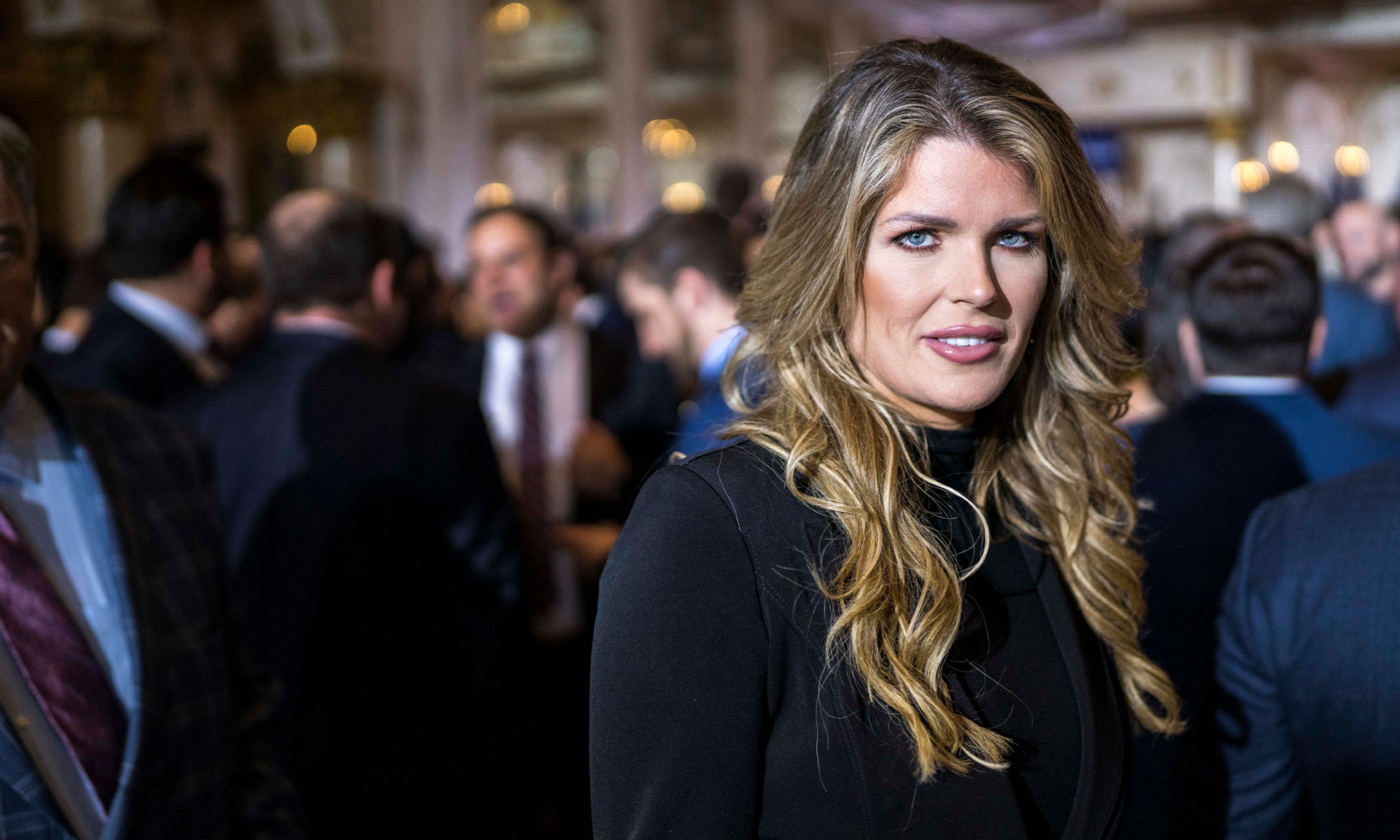
Lawyer Lindsey Halligan at Mar-a-Lago in Palm Beach, Fla., November 15, 2022.
In a scathing 18-page opinion and order, a Trump-appointed judge directed Lindsey Halligan to cease and desist referring to herself as the United States attorney for the Eastern District of Virginia (EDVa), the post to which she’d been illegally appointed by Attorney General Pamela Bondi at the direction of President Trump. When evening fell, Halligan was pushed out by the very Trump DOJ officials who, along with the president, had abetted her defiance of the court.
The order was issued yesterday by Judge David Novak, who was confirmed by the Senate after President Trump nominated him to sit on the EDVa court in 2019. Halligan’s exit was announced last night by Bondi, in an X post in which the attorney general misrepresented the impropriety that led to this spectacle -- the issue having been that Bondi’s interim appointment of Halligan was unlawful from the first, not, as Bondi claimed, that it expired and was then blocked by the intransigence of Senate Democrats.
Halligan, as we’ve noted repeatedly, is a former Florida insurance lawyer and private attorney to Donald Trump. She was working as a staffer in the Trump White House when, in an unhinged social media post (that may not have been intended for public consumption), the president directed Bondi to install her as the EDVa’s interim U.S. attorney.
This was on September 20, 2025, after Trump had forced the resignation of Erik Siebert from the same position. Siebert, an experienced, well-regarded prosecutor who was vigorously pursuing Trump’s legitimate enforcement agenda, had declined to indict two of Trump’s political enemies, former FBI Director James Comey and New York State Attorney General Letitia James -- finding the evidence of wrongdoing to be threadbare.
At the time, Halligan had never been a prosecutor. Indeed, she had no criminal law experience to speak of -- unless you count being dispatched to Mar-a-Lago in the summer of 2022 to be an observer as the FBI executed a search warrant at Trump’s resort home there.
Halligan promptly indicted Comey and James. Not surprisingly, there were significant problems with both cases. The indictments were thrown out by Judge Cameron McGowan Currie because Halligan was not qualified to serve as interim U.S. attorney under the governing statute, Section 546, which provides a single 120-day appointment for filling a district U.S. position on an interim basis. Contrary to Bondi’s post last night, Halligan did not have a 120-day appointment -- and, as Bondi should have known, was not legally eligible to have such an appointment. Rather, as Judge Novak recounted in yesterday’s ruling, by the time Bondi installed Halligan, Siebert had already served the 120-day term (or at least 119 days of it) as Trump’s initial interim appointee.
Moreover, under statutory law implementing the Constitution’s appointments clause, district U.S. attorneys must be nominated by the president and confirmed by the Senate before serving. The interim procedure is a temporary measure, expected to be invoked while the confirmation process goes forward. Halligan was not, as Bondi claims, blocked by Senate intransigence. Rather, in his fit of pique against Siebert for refusing to indict Comey and James, Trump withdrew Siebert’s nomination (he would have been easily confirmed). Trump recently nominated Halligan, but (a) there has not been time to get through the confirmation process; (b) she is not qualified in terms of law enforcement experience; and (c) her mishandling of the cases she oversaw, coupled with the court’s conclusion that she was misrepresenting herself as the district U.S. attorney, would make her practically unconfirmable even if Virginia’s two senators -- Mark Warner and Tim Kaine, both Democrats -- were not in a position to block her nomination under the upper chamber’s rules.
Judge Currie, who ruled that Halligan was not statutorily qualified, sits in the district of South Carolina (DSC). She had been appointed by Chief Judge Albert Diaz of the Fourth Circuit to rule on any issues with respect to Halligan’s qualification to serve. Chief Judge Diaz assigned Currie (a senior Clinton appointee) to decide this issue because all judges of the EDVa -- who must, of course, deal with the district U.S. attorney on many matters -- were deemed to have a conflict of interest. (The EDVa, like DSC, is in the Fourth Circuit.)
Judge Currie held that Halligan was not eligible for the 120-day interim appointment. Because that was her only basis for acting when she appeared in the grand jury to indict Comey and James, those indictments were invalid and had to be dismissed prior to Currie’s decision; quite aware of the defects, Bondi sought to shore up Halligan’s appointment by naming her a “special attorney,” delegating prosecutorial authority to her and trying to backdate the whole arrangement. (See here and here.) All for naught.
To be sure, Bondi had authority to make Halligan a “special attorney” -- “whatever that title may mean,” as Novak sniped in yesterday’s opinion. But a “special attorney” is not the district U.S. attorney, a weighty executive office carrying the Senate confirmation requirement. Yet, Halligan, with the encouragement of Main Justice, continued to represent herself as the EDVa’s U.S. attorney despite Currie’s ruling -- i.e., despite the fact that she has never lawfully held that position (indeed, she has never lawfully been even the interim U.S. attorney). To sum it up, Bondi and Deputy Attorney General Todd Blanche knew they’d be castigated by Trump if they retreated on the Halligan appointment, so they decided defying the law and the court was their best option.
As I’ve previously detailed, Judge Novak directed Halligan to explain why she and the Justice Department were continuing to refer to her as the EDVa’s U.S. attorney. Consistent with the Trump administration’s “best defense is an obnoxious offense” approach, Halligan and her superiors filed a blistering response last week, which was part diatribe against Novak for raising the matter and part incomprehensible parsing of Currie’s ruling.
Judge Noval thus began his ruling with the observation that
Halligan’s response, in which she was joined by both the Attorney General and the Deputy Attorney General, contains a level of vitriol more appropriate for a cable news talk show and falls far beneath the level of advocacy expected from litigants in this Court, particularly the Department of Justice.
Rather than answer their vitriol “tit-for-tat,” Novak turned to, and shredded, “the few points” raised by the DOJ that resembled legal argument.
He concluded that the ratio decidendi -- the reasoning -- of Currie’s dismissal of the Comey and James indictment was plainly the fact that Halligan was not qualified to prosecute under the law. Hence, that rationale could not, as the Justice Department claimed, be separated from the bottom-line rulings dismissing the indictments. Novak easily turned aside the government’s reliance on the Supreme Court’s recent proscription (in Trump v. Casa (June 27, 2025)) against the issuance of “universal” or “nationwide” injunctions by district judge, pointing out that Currie’s ruling applied only to the EDVa (and was not, in any event, an injunction).
Novak also rebuffed the DOJ’s contention that decisions by district judges do not bind other district judges. In the unique posture of this case, the EDVa judges were sidelined from ruling on Halligan’s qualifications because of a conflict; ergo, the superior court, the Fourth Circuit, directed Currie to decide the matter. Currie’s ruling was thus binding on all EDVa judges: Based on the order Chief Judge Diaz had issued in assigning the matter to Currie, no EDVa judge was in a position to countermand her ruling (only the Fourth Circuit or the Supreme Court could do that).
On that point, Novak found it “rather stunning” that Halligan (and Bondi and Blanche, who signed her pleading) did not even mention Diaz’s order, notwithstanding that it is critical to an argument raised by the government. Federal prosecutors are expected to provide the courts with all relevant authority regarding a contested matter, especially including any binding authority that cuts against the government’s position. I should add: No one at the Justice Department is supposed to expect a medal for that; being forthright with the judge is the job. It’s probably worth noting, then, as President Trump himself pointed out when he nominated Novak to be a judge, that Novak was a federal prosecutor in the EDVa for 18 years, including a stint as chief of the office’s criminal division.
Novak also rejected the Justice Department’s absurd claim that he had acted improperly by raising the question of Halligan’s qualification in the absence of a formal disqualification motion by the defendant in the underlying case. As the judge explained (quoting the late, great Justice Antonin Scalia), it is a core part of the judicial office to protect the integrity of judicial proceedings.
Judges routinely raise matters pertinent not only to the qualifications of counsel to appear before the court, but also matters of fact and law that are critical to the lawful determination of a contested issue. Indeed, while Novak did not allude to it, Rule 614 of the Federal Rules of Evidence -- a body of rules Justice Department prosecutors and federal court litigators must know intimately if they are to do their jobs competently -- expressly authorizes the judge in a case to call witnesses and to examine witnesses called by the litigants. It is simply frivolous to claim that a judge may not inquire into a matter which, if left unresolved, could undermine the legitimacy of a court ruling or proceeding.
Novak expressed astonishment that the Justice Department did not perceive the incongruity in falsely representing that Halligan was the U.S. attorney while routinely prosecuting people for making false representations to the government. He lamented that the DOJ “ethos” of subordinating the personal ambitions of individual lawyers to the public interest appears to have “come to an end.” In any event, he concluded that what must also “come to an end” is “this charade of Ms. Halligan masquerading as the United States Attorney for this District in direct defiance of binding orders.”
And by that night, Halligan was gone. Ironically, the last paragraph of Bondi’s announcement about that asserts: “The circumstances that led to this outcome are deeply misguided.” Truer words were never spoken, even if the attorney general did not intend them that way.

About the Author
Andrew C. McCarthy is a senior fellow at National Review Institute, an NR contributing editor, and author of Ball of Collusion: The Plot to Rig an Election and Destroy a Presidency.
Featured Tags
Advertisement
Advertisement


Comments