Share this story
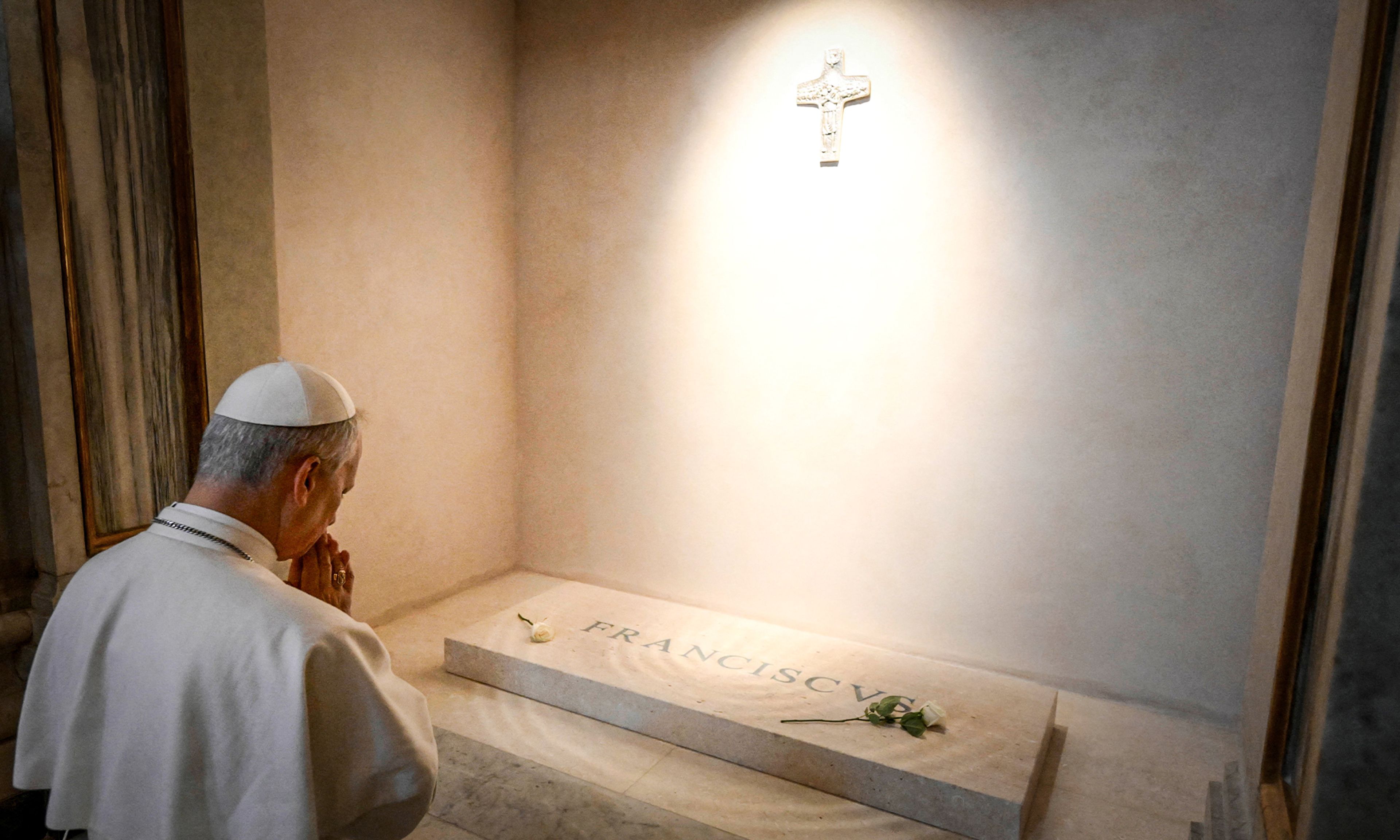
Pope Leo XIV prays in front of a tomb of Pope Francis, as he visits Basilica of Saint Mary Major in Rome, Italy, May 10, 2025.
Pope Francis was a man whose experience of the mercy of God profoundly shaped his entire life and deeply marked his twelve-year pontificate. He desired nothing more than to share with the world what he had found, the joy of the Good News of Jesus Christ. He will always be remembered for his manifest humility, simplicity of life, and tireless love for the poor. Those virtues, however, are not what made him such a remarkable and distinctive pope. What made Francis distinct was a quality much rarer in a bishop of Rome: He was a disrupter.
For this, too -- perhaps especially for this -- he will be remembered. From the early days of his pontificate it was clear that he had it in mind to shake things up. Hagan lio! (“Make a mess!”) was among his favorite exhortations, particularly when speaking to young people. And he practiced what he preached.
In an institution as venerable as the Catholic Church, it must be noted, shaking things up every now and then is not necessarily a bad thing. Complacency, comfort, and self-regard are not qualities conducive to long-term institutional vitality, let alone evangelical fervor. It is no coincidence that in those parts of the church in which secularization has put down its deepest roots, complacency, comfort, and self-regard are not difficult to find. Perhaps the church was due for a good shaking.
In any event, a good shaking is what she got during the past dozen years. This undoubtedly loomed large in the minds of the cardinal electors leading up to and during the conclave itself: whether the era of ecclesial mess-making ought to continue or whether it is time to, if not exactly “clean house,” then at least to tidy up a bit.
In some respects, the new pope, Leo XIV, is sure to pick up right where Pope Francis left off, emphasizing the priority of mercy, the need to preach the Gospel always, and the corresponding imperative of caring for the poor and those on the “peripheries,” as Francis was fond of saying. There is near universal agreement on these evangelical staples, even if the church remains divided on how these matters ought to be accomplished. Then there is the perennial need to continue and consolidate the job of reforming the Roman Curia (the administrative bureaus of the church’s government), toward which Francis made significant strides. So there will be strong ties between Francis and Pope Leo, and substantial continuity in several important ways.
Yet Pope Francis’s affinity for (or at least high tolerance of) ecclesial entropy leaves the church, and his successor, with a host of seeming contradictions to untangle.
Not least among these is an understanding of the papacy itself. The successor of Peter is meant to be a sign of unity and solidity in the church. He is the guardian of the faith, the custodian and defender of doctrine. A willingness to shake things up and make a mess is not usually counted among the essential charisms of the Roman pontiff. Pope Francis’s pontificate brought to the surface long-simmering divisions over a number of contentious issues -- communion for the divorced and remarried and blessings for same-sex couples being two notable instances. These debates over morality and sacramental discipline revealed much deeper divisions about the church’s understanding of the sources of her doctrines and the limits on her authority to develop or change those doctrines.
Pope Francis spoke often of the need for a healthy decentralization in the church, yet he sometimes governed with a heavy hand, curtailing bishops’ authority to regulate liturgy in their own dioceses and even going so far as to prohibit parishes from publishing Traditional Latin Mass times in their weekly bulletins. Administrative decentralization, at least in some matters, would undoubtedly be a boon to the church, which must undertake its mission in a dizzying array of social, cultural, and political contexts. Whether that decentralization can be accomplished through the top-down, Rome-centric efforts favored by Francis remains to be seen.
Francis frequently lamented legalism and rigidity in the church. He also promulgated more alterations to ecclesial law than any of his recent predecessors, sometimes changing church law with such rapidity and ambiguity that canonists were left scrambling to keep up with the changing legislation. He warned about the limit of casuistry in moral theology, yet he willingly stretched the limits of moral doctrine to permit pastoral concessions on technicalities. Francis’s preference for a personal, ad hoc approach to ecclesial law reflected his more pastoral style, but the rule of law requires not only authority but impartiality, stability, and transparency, which Pope Leo, himself a canon lawyer, would do well to normalize.
Francis was a man who spoke often of his desire for a less self-referential church, yet the signature initiative of his pontificate is the Synod on Synodality, which after three years is still struggling to shake its reputation as an elaborate and vaguely defined series of meetings about meetings. One of the stated goals for the synod was the strengthening of ecclesial communion, in short, to make the church more unified. In practice, the synod has unleashed all sorts of contradictory impulses within the church. A major task for Pope Leo will be consolidating and synthesizing the good that has come out of the synod while rejecting what is bad.
When it comes to the festering wound of clerical sexual abuse, Francis won the confidence of many survivors by asking forgiveness for past wrongs and being honest about his own mistakes. He laicized Theodore McCarrick, the disgraced former cardinal archbishop of Washington, D.C., whose decades of abuse of seminarians and minors came finally to light in the summer of 2018, and convened a global conference on abuse in the church. He implemented sweeping new laws designed to hold abusive and negligent bishops accountable and established the Pontifical Commission for the Protection of Minors. Yet he also showed disturbing partiality in handling cases of accused priests and bishops who were his own friends or allies, as the yet-unresolved cases of Father Marko Rupnik and Bishop Gustavo Zanchetta demonstrate. There are few better things the new pope could do to heal this particular wound in the church than to impartially apply the church’s law and take a quantum leap forward in transparency. Justice must not only be done; it must be seen to be done.
These tensions and apparent contradictions are not presented as a bill of indictment on Francis. Rather they are meant to highlight both the uncertainty that necessarily attends a pontificate devoted as much to unsettling the church as to providing it with stability, and the challenges that will necessarily shape the pontificate of the new pope.
Francis understood the risks he was taking in turning over so much ecclesial furniture. He was not blind to the cost of his style of governance. But he deemed it a price worth paying, perhaps even a necessary price to pay, for carrying out the church’s fundamental mission of evangelization.
There is a line from Francis’s apostolic exhortation Evangelii gaudium (“The Joy of the Gospel”), in which he made this point with his characteristic directness: “I prefer a church which is bruised, hurting, and dirty because it has been out on the streets, rather than a church which is unhealthy from being confined.” Does the church suffer when she is unsettled? Does she get bruised a bit? Do things get messy? Yes.
The transformative power of mercy was something of which Francis was keenly and personally aware. “I am a sinner,” Francis insisted, “whom the Lord looked upon with mercy.” His experience of God’s mercy in his own life (including a particularly powerful experience of God’s mercy in the confessional as a young man) was decisive to his vocation and priesthood. It marked everything about his episcopal ministry and was perhaps the single greatest theme of his entire pontificate. It is that theme -- God’s mercy -- that forms the deepest thematic continuity between Francis and his recent predecessors.
Pope Leo will undoubtedly take up this theme of mercy as well. Francis understood that concrete expressions of love and mercy -- especially solicitude for the poor and sinners alike -- are the sine qua non of evangelization in our age. Such compelling witness of love and mercy does not wait on theological precision or the clarity of doctrine. It conveys the essence of Christian faith with a personal immediacy and power that no catechism, compendium, or theological syllogism can match.
Yet there are a great many things in this world that go under the names of love and mercy that are, in truth, neither loving nor merciful. Our world is full of such counterfeits, which is both a symptom and a cause of our skepticism about the nature of many things, including ourselves and God. A church that cannot distinguish between true love and mercy and their counterfeits cannot proclaim the Gospel with any coherence, let alone confidence. It cannot convincingly proclaim, as Jesus himself did, “The truth will set you free.”
Pope Leo inherits a church deeply divided over the relationship between truth and mercy. At its heart, this divide is over the lights by which the church ought to distinguish between true and false love. Should she listen to the world, discerning in its pleas, laments, and anguish a standard by which the church’s doctrine must be measured, judged, and if necessary, altered? Or is the church the custodian of truth, a truth revealed through Scripture and Tradition, which she has no authority to alter -- which, when proclaimed fully and lived with integrity and love, provides a compelling answer to the pleas, laments, and anguish so obviously present in the world?
These are not small questions. Nor, to be clear, were the divisions that these questions reflect introduced to the church by Pope Francis. But Francis did draw them to the surface, allowed them to percolate, and did not move decisively to resolve them. That task will fall to his successor, and perhaps his next several successors as well.
The morning after his election in 2013, Pope Francis gave a homily to the cardinals who had just elected him. It was Lent; the whole church was preparing for Easter. The new pope spoke of the first pope, Peter, and reflected on the necessity of proclaiming Christ crucified:
The same Peter who professed Jesus Christ, now says to him: You are the Christ, the Son of the living God. I will follow you, but let us not speak of the Cross. That has nothing to do with it. I will follow you on other terms, but without the Cross. When we journey without the Cross, when we build without the Cross, when we profess Christ without the Cross, we are not disciples of the Lord, we are worldly: we may be bishops, priests, cardinals, popes, but not disciples of the Lord.
My wish is that all of us, after these days of grace, will have the courage, yes, the courage, to walk in the presence of the Lord, with the Lord’s Cross; to build the Church on the Lord’s blood which was poured out on the Cross; and to profess the one glory: Christ crucified. And in this way, the Church will go forward.
Pope Francis’s pontificate began in Lent. His earthly journey ended amid the joy of Easter, when the triumph of the cross and the fullness of God’s mercy are made manifest. For all the turmoil and promise of the pontificate just ended, for all the uncertainty and challenges ahead, the way forward for the church remains as it always was. And Catholics around the world, as they pray for Francis and for his successor, take solace in the promise Christ made two millennia ago: “Thou art Peter, and upon this rock I will build my church; and the gates of hell shall not prevail against it.”
About the Author
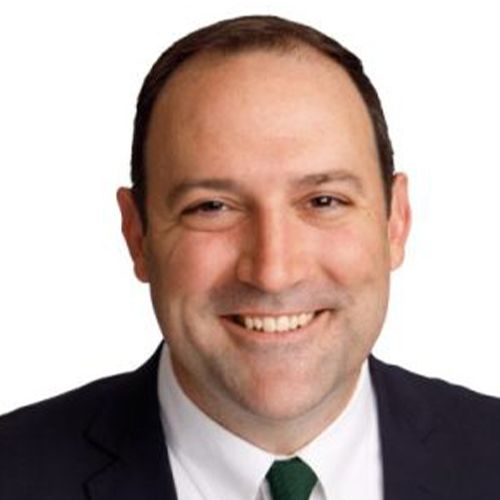
Stephen P. White is the executive director of the Catholic Project at the Catholic University of America and a fellow in Catholic studies at the Ethics and Public Policy Center.
Featured Tags
Advertisement
Advertisement

Comments