AI’s Overblown Threat to College Graduates
Written by Jordan McGillis
Graduates entering the job market still have an advantage over their non-college peers.
Share this story
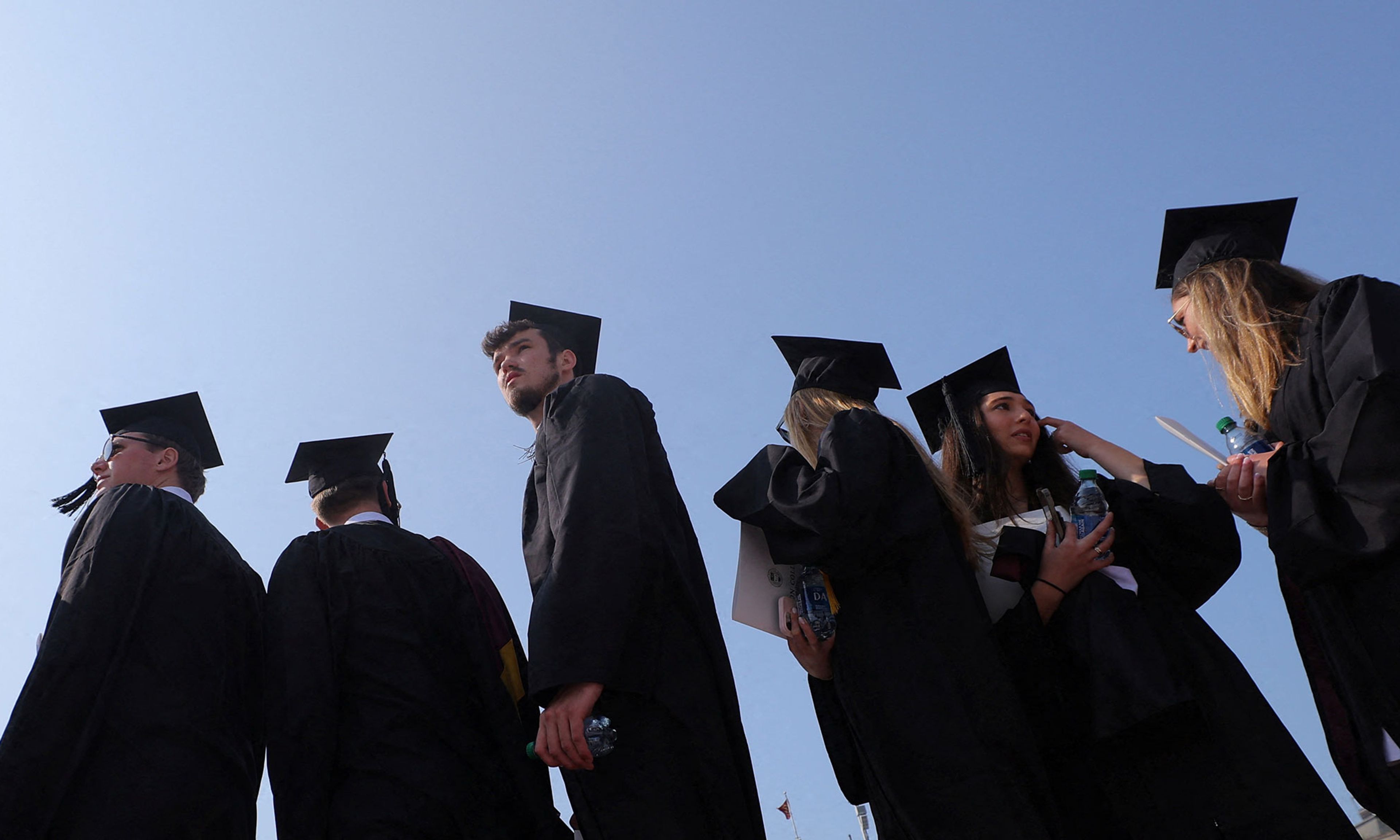
Graduating students gather for commencement ceremonies at Boston College in Chestnut Hill, Mass., May 22, 2023.
The fear that artificial intelligence is crushing new college grads has now reached such esteemed publications as the Financial Times, the Wall Street Journal, and the Washington Post. Just last Friday, Bloomberg Intelligence host Isabelle Lee warned that unemployment among new college grads is trending much higher than the overall rate. These stories tap into the perennial fear that technology is taking away jobs. But this time, there’s a twist: Instead of blue-collar workers suffering, would-be knowledge workers fresh from school are bearing the brunt.
Seductive though this narrative inversion is, the facts lead in another direction. Although the unemployment rate for young college grads in the U.S. has risen in recent years, it has done so in tandem with the rate for young adults without college degrees. Both groups are facing a tougher hiring market than was experienced in the immediate post-pandemic period.
Just quoting the official unemployment rate can be misleading, however, since it excludes people who have stopped seeking a job. What matters more is the simple employment rate, or the overall share of people working.
The data show that college grads remain on stronger career footing than those who forgo higher education. Employment among non-college young adults has fallen more since 2023 than among college grads, and it started from a much lower baseline.
The truth is that, as of the latest available data, 85 percent of 23- to 25-year-old Americans with college degrees are employed, whereas less than 75 percent of Americans of the same age who did not go to college are. These data scramble the emerging consensus that something novel is happening because of AI.
As Google economists Zanna Iscenko and Fabien Curto Millet explain in a recent paper for my organization, the Economic Innovation Group (EIG), the reason for the young-adult labor slump is not that AI is wrecking the prospects for a generation of workers. Rather, overall business activity has slowed since 2022. There’s no single culprit, but the Federal Reserve’s hiking of interest rates from historically low levels is a more plausible suspect than OpenAI’s release of ChatGPT.
The corollary of the doom-and-gloom view of graduates’ prospects is that college doesn’t pay anymore. At the margin, some young adults are definitely better off going straight to work rather than spending time and money on more school. But the now-fashionable view that blue-collar work is the surer path to prosperity has little evidence behind it.
Recent coverage of the rise of the skilled trades illustrates how this narrative is spreading. Profiles of mechanics, electricians, and other technicians often display workers earning high incomes without a college degree. But the labor market data show a more mixed reality. According to the Bureau of Labor Statistics, the median annual wage for automotive service technicians and mechanics, for example, barely scratches $50,000. Many other categories of blue-collar work pay less than that, especially early in one’s career. Skilled trades also often require significant investment in tools and training. And blue-collar physical demands can shorten a worker’s career span.
The economic advantages of higher education remain substantial. Even as hiring conditions have softened in the current economic cycle, college graduates continue to earn much higher incomes than workers without college degrees. The median pay for an American with a bachelor’s degree is more than 60 percent higher than the median pay for an American high school graduate. This gap has hardly budged over the past 25 years. For workers aged 25 to 34, the college premium is as large as the economy-wide average.
Technological change requires labor force adaptation; there is no doubt about that. College and non-college workers alike would be wise to stay abreast of market developments, sharpen their skills, and learn how to use AI to complement their contributions. Macroeconomics notwithstanding, however, recent college grads still hold the advantage over their non-college peers.

About the Author
Jordan McGillis is a fellow at the Economic Innovation Group and a 2025-2026 Novak Journalism Fellow with the Fund for American Studies.
Featured Tags
Advertisement
Advertisement


Comments