American Jews and the Conservative Conscience
Written by Meir Y. Soloveichik
Retrospective: In Search of Anti-Semitism, by William F. Buckley Jr. (Continuum, 1992)
Share this story
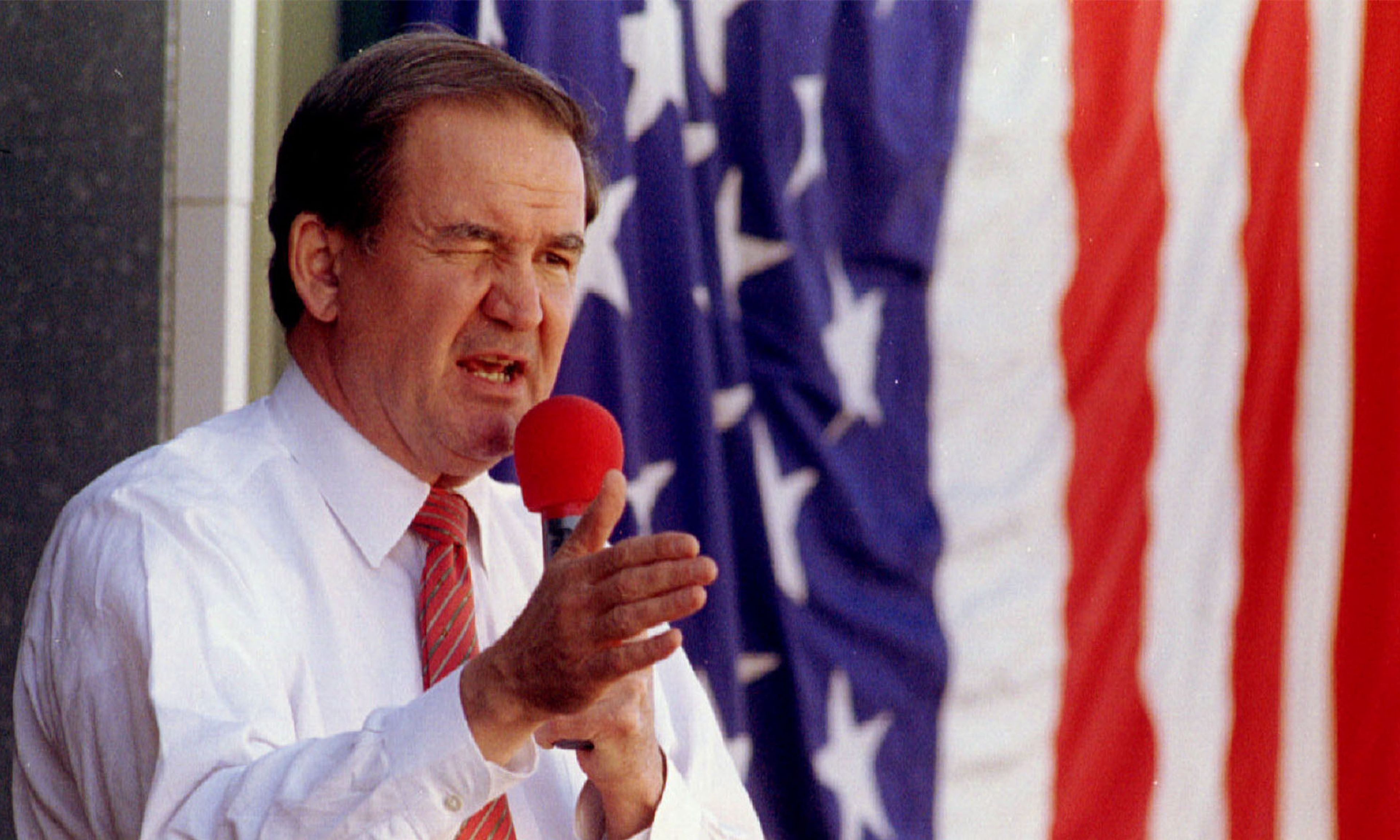
Pat Buchanan addresses a crowd in Calif., March 23, 1996
Bill Buckley’s In Search of Anti-Semitism is ostensibly a book about several figures, but it is, at its core, about one figure above all. “A great deal of space has been given to Pat Buchanan in this book,” Buckley tells us in its epilogue, adding that it “is obvious why this is so: he elected to run for President of the United States, and for that reason invited the fierce attention of his critics and defenders.” Buckley understood that central to his own legacy and leadership was the fact that American conservatism in general, and National Review in particular, had disassociated itself from antisemitism and declared antisemites to be personae non gratae in the civic future of the United States. While pundits were debating the views of the man who challenged George H. W. Bush in the 1992 Republican primary, Buckley’s own “Bureau of Weights and Measures, so to speak, focused on the proper relationship of the ethically refined citizen to Buchanan, in weighing the question whether our defenses against anti-Semitism are as vigorous as they ought to be.”
The focus on Buchanan, and on his comments regarding Israel in the 1990s, makes for very interesting reading now. Many have noted that today, following Donald Trump’s impressive 2024 victory, populist politics and suspicion of foreign entanglements have triumphed in the Republican Party, and that the primary campaign of “Pitchfork Pat” can be seen as a bellwether. Yet at the same time, so much regarding the Republican relationship with Israel has changed since Buchanan ran for president in 1992. President Bush was not seen as a stalwart friend of Israel, and this certainly could also be said of his secretary of state, James Baker.
Today, in contrast, the Republican Party has become, in America, perhaps the most important and effective defender of American Jewry and of the Jewish state. It was Republicans in the House -- the one branch controlled by their party at the time -- that, as pro-Hamas rallies overtook college quads in 2023, summoned university presidents and berated them before the eyes of the world. On the first anniversary of the massacre of October 7, Donald Trump joined conservative commentator Ben Shapiro in visiting the grave of a famed Jewish rabbi to pray there for the release of hostages held in Gaza. And, as Bernie Sanders prepared to submit his recent Senate resolution that effectively accused Israel of war crimes, incoming Senate majority leader John Thune stressed that the newly elected Congress would ensure that Israel received all the matériel it needed in its war against Hamas and Hezbollah. “To our allies in Israel,” Thune said, “and to the Jewish people around the world, my message to you is this: Reinforcements are on the way.”
Buchanan’s populism, then, may have triumphed, but his views about Israel most assuredly have not. Yet In Search of Anti-Semitism is not only a striking relic of a very different past; it also provides a fascinating lens with which to study our own time. It behooves us to return to the events that inspired the book, and to consider what they teach us today.
The contretemps concerning Buchanan was launched by columnist A. M. Rosenthal in 1990. He focused on comments that the former Reagan communications director had made from his perch on The McLaughlin Group in the run-up to the first Iraq war. Buchanan had declared that “there are only two groups that are beating the drums . . . for war in the Middle East -- the Israeli Defense Ministry and its amen corner in the United States.” Of course, as many noted, given that Margaret Thatcher was one of the most ardent advocates of the war, and that the international coalition against Saddam Hussein was formed by President Bush, the claim was preposterous. But Rosenthal insisted that Buchanan’s statement was more sinister than silly, and that Buchanan, in blaming a war on the Jews and their interests, was echoing antisemitic calumnies of the past.
Buchanan responded soon after in his own column, declaring that whereas “antisemitism” could refer to “an embedded hatred of Jewish people,” it had also become a word used to “frighten, intimidate, censor, and silence.” Buckley immediately involved himself in the controversy, chiding both commentators for what he saw as overly emotional and irresponsible rhetoric, but the criticisms of Buchanan were only beginning. Several Jewish writers aligned with the conservative movement wrote essays noting that this was not the first time that Buchanan had made strange and striking comments concerning the Jews.
The lengthiest (running many thousands of words) and, in my opinion, most devastating indictment was authored by Joshua Muravchik in the pages of Commentary magazine. Muravchik noted that, among other things, Buchanan had referred to the United States Congress as “Israel-occupied territory,” expressed sympathy for Kurt Waldheim and Klaus Barbie, and effectively accused Eisenhower of ordering the massacre of Germans after World War II. Building on Buchanan’s claim that the term “antisemitism” can be applied either accurately to describe Jew-hate or as a calumny, Muravchik concluded:
When he embraces the PLO despite being at adamant odds with its political philosophy; when he implies that Jews are trying to drag America into war for the sake of Israel; when he sprinkles his columns with taunting remarks about things Jewish; when he stirs the pot of intercommunal hostility; when he rallies to the defense of Nazi war criminals, not only those who protest their innocence but also those who confess their guilt; when he implies that the generally accepted interpretation of the Holocaust might be a serious exaggeration -- when a man does all these things, surely it is reasonable to conclude that his actions make a fairly good match for the first, not the second, of Patrick J. Buchanan’s two definitions of anti-Semitism.
It was in this frenzied climate that Buckley made the unusual decision to devote an entire issue of National Review to the subject of Jew-hatred in America. The first third of what became the book In Search of Anti-Semitism was originally published in the magazine, with Buchanan being only one of several subjects. The first part of Buckley’s piece in the issue was devoted to delineating the sad saga of National Review writer Joseph Sobran, explaining how, as Sobran’s writings about Jews and the Middle East grew more fevered, it became essential for NR to cut itself off entirely from its former staff member. Yet when it came to Buchanan, Buckley was somewhat more forgiving, simultaneously condemning the antisemitic substance of his statements while refraining from calling him a hater of Jews: “I find it impossible to defend Pat Buchanan against the charge that what he did and said during the period under examination amounted to anti-Semitism, whatever it was that drove him to say and do it: most probably, an iconoclastic temperament.”
Soon after, NR published a piece advocating that New Hampshire conservatives support Buchanan in the primary in protest of some of the president’s policies, with Buckley averring that if he lived in New Hampshire, he would do so. The quasi-endorsement of Buchanan provoked a letter to NR from a group of intellectuals and religious figures whom Buckley ardently admired, including Richard John Neuhaus. The letter stressed that, given Buchanan’s statements about Jews, the editorial was “not morally consistent” with Buckley’s larger “courageous” writings against antisemitism and set a “bad moral precedent for the future of American politics and the conservative movement.” The letter, Buckley wrote, came as a “major shock.”
Toward the end of the 1992 campaign, Buckley, clearly perturbed by all that had unfolded, published In Search of Anti-Semitism. In addition to his original lengthy essay in NR, the book contained a compendium of the many responses it had received and a review of the controversy surrounding Buchanan’s campaign. Buckley further documented his own efforts to cleanse conservatism of antisemitism and concluded by asserting that, owing to his detestation of Jew-hatred, if he had concluded that Buchanan was truly antisemitic, “I’d have disowned him,” and that he would have assumed that “his bigotry could not have escaped public attention during the campaign.”
To relive the controversies of the early ’90s is to ponder the fascinating political moment in which we find ourselves. The incoming administration supports many policies that Buchanan made a centerpiece of his own campaign. Tariffs are once more spoken of, free trade with other countries is derided by some, and we hear criticisms from many in Republican circles of the “forever wars” of the past. Yet parallels to Buchananite foreign policy end there, for since the ’90s the Republican Party has come to embrace Israel, with many of its leaders maintaining vigilance against antisemitism.
The historian Walter Russell Mead, who has famously linked populism to a “Jacksonian” strain in American public life, helps us to understand this development. Jacksonian populists, Mead argued, tend to support military victories by a democratic state such as Israel, which stands alone in a very undemocratic region of the world. The very same Jacksonian instincts that are suspicious of foreign entanglements also embrace an assertion of strength in defense of the West.
This, however, is only part of the explanation. Many religious conservatives are still driven by a belief that the story of Israel is a miraculous fulfillment of prophetic promises to the Jewish people. Moreover, what unites conservatives today is a detestation of wokeism and its anti-American creed; and it has become increasingly clear that woke-progressive hatred of Israel goes hand in hand with hatred of America. Many instinctively understand that a defeat of the enemies of the Jewish people is itself a victory for America.
To read about Buchanan is also to be reminded of one strange parallel to his story. A video recently emerged of a young Tucker Carlson on C-SPAN, being asked, as the Buchanan controversy was still unfolding, whether he thought Buchanan was an antisemite. He answered in the affirmative:
I mean, I’m not throwing the term antisemite around, but you know, but you reach a point when you say, “Well, gee you know, here’s a guy who has gone out of his way to, to defend . . . accused Nazi war criminals, . . . who’s attacked American Jews for supporting Israel unduly, who’s implied that American Jews push America into wars in which non-Jews die. . . . Is that antisemitic? Yeah!”
Since then, as political commentators have noticed, Carlson has eerily imitated the actions he once condemned. In the wake of the October 7 massacre, Carlson criticized Ben Shapiro for speaking so frequently about Israel, charging that this focus on another country meant that Shapiro did not truly love America. Not long after that, Carlson hosted and lauded a “historian” who claimed that Churchill, rather than Hitler, was the true villain of World War II, and that the death of countless Jews in the camps was a result of lack of preparation by the Germans.
Tucker Carlson has evolved in a very different way from the philosemitic core of the Republican Party.
Yet despite Carlson’s purported influence in the incoming administration, the cabinet that has emerged so far looks to be the most pro-Israel one in American history. And, as complicated as the past decade has been for the conservative movement, the assault on antisemitism that Buckley himself began has by and large continued apace.
Trump’s pro-Israel stand seems to have only helped his electoral prospects. In the end, contra Buchanan, many political figures are pro-Israel not because Congress is “Israel-occupied territory” but rather because many Americans care about Israel’s future, and about the well-being of Jews. For those perturbed that a third of the Democratic Senate caucus could vote for Sanders’s libelous resolution, and horrified at the antisemitism made manifest in elite American institutions, there is surely consolation in the fact that, as Thune promised, reinforcements are on the way.
About the Author
Meir Y. Soloveichik is the rabbi of Congregation Shearith Israel in New York and the director of Yeshiva University’s Straus Center for Torah and Western Thought. He is the author of Providence and Power: Ten Portraits in Jewish Statesmanship.
Featured Tags
Advertisement
Advertisement




Comments