Among the Baseball Nerds
Written by Dan McLaughlin
Serious lovers of the game — the stats, the seasons, the stories, the stars — come together for an annual convention
Share this story
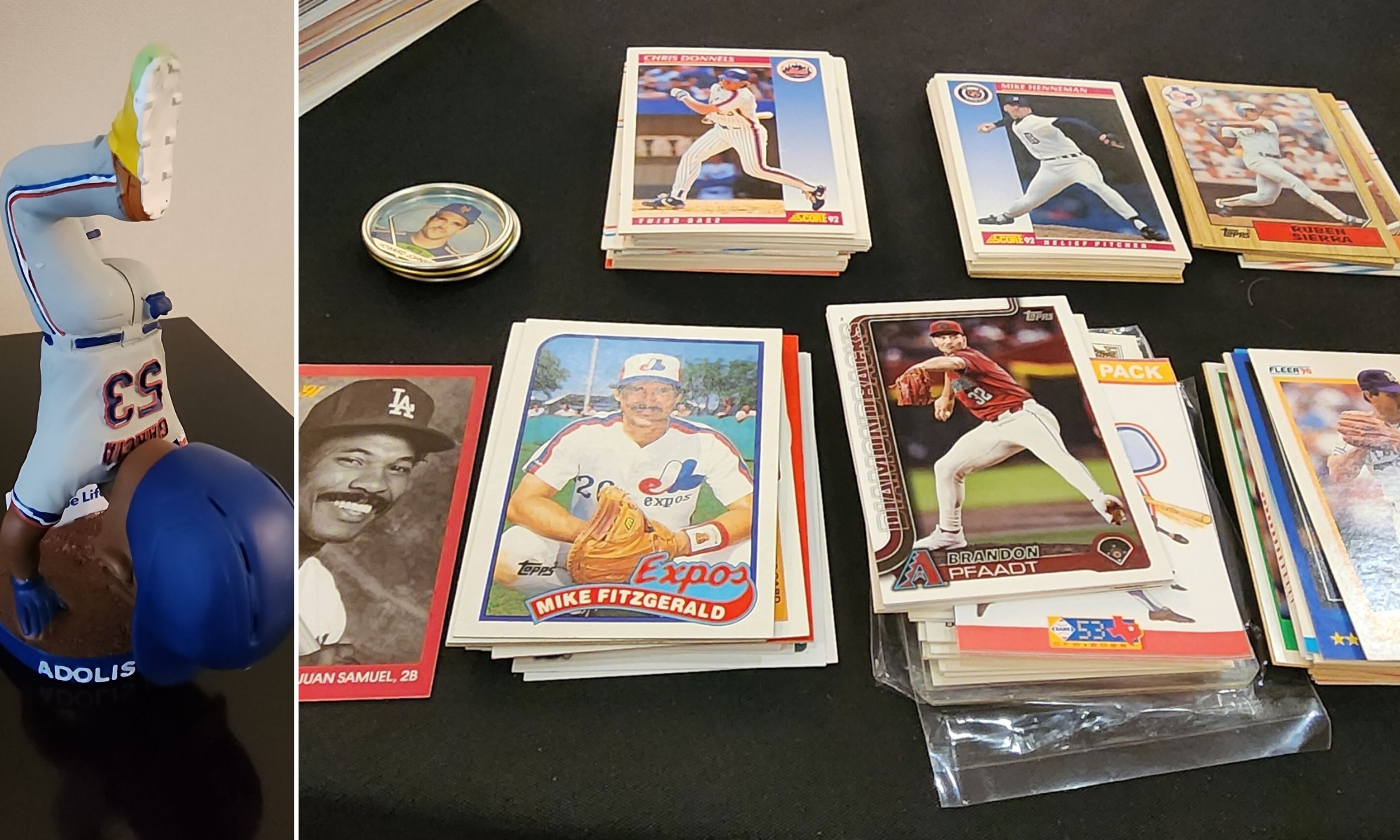
A bobblehead of Rangers player Adolis Garcia doing a flip in the 2023 ALCS, left, and my baseball card haul, right.
‘The emergence of a former two-way star from Washington State University paved the way for the acquisition of this man, who scored what is still the most recent World Series run for his new team.”
Do you know the answer yet? I’ll get to that at the end. If you had it easily, you might belong at the SABR convention.
I spent four days in Dallas in June among the baseball nerds. The occasion was the 53rd annual convention of the Society for American Baseball Research, or SABR. It was my first SABR event in spite of following the organization’s work for decades. I do not use “baseball nerds” pejoratively; I am one of them, lifelong and proud, and most SABR attendees embrace the label. The convention is their once-a-year opportunity to immerse themselves in “nerding out” on the game they venerate. The people who join SABR and come to its events are serious baseball fans, and then some: they not only love the game but also take it seriously as a subject of scholarly study or at least treat it with a committed hobbyist’s intensity.
When Texas Rangers manager Bruce Bochy told some of his players that he’d be speaking at SABR and they asked what it was, he explained, “It stands for people who know more about your career than you do.” Dan Evans, the incoming president of SABR’s board and a former Los Angeles Dodgers general manager, described the convention’s baseball offerings to me as “an all-you-can-eat breakfast buffet that never closes.” Many attendees congregate at the hotel bar at day’s end to keep the conversation going. Yet SABR remains a niche event: I overheard one attendee explaining it to another guest at the hotel, who responded, “Seriously? There is such a thing?”
There is nothing like SABR in the world. Sure, there are gatherings of fanatics of other sports and in other countries. The English love their soccer and cricket, and Americans love their football and basketball. There are even smaller SABR imitators now in some of those sports. But SABR is uniquely American and unique to baseball. As is true of so many American things, it has grown far beyond its humble origins, and precisely because of the soil in which it was planted.
The Society for American Baseball Research was founded in August 1971 by L. Robert “Bob” Davids and 15 other “statistorians” meeting in Cooperstown, N.Y., during the annual inductions to the Baseball Hall of Fame. No other sport matches baseball’s obsessions with its history, its statistical records, its place in our national story, and its place in connecting us to our own past. No other sport called out so naturally to be a topic of serious, organized, rigorous research.
At the time, pro football and basketball could trace most of their history in living memory; baseball was already celebrating the centennial of its founding as a professional league sport. The Macmillan Baseball Encyclopedia, known as the “Big Mac,” was first published in 1969, vastly outstripping the statistical data available in earlier such volumes going back to the 1920s. But Macmillan built on a foundation dating to the invention of the box score, by English-born New York sportswriter Henry Chadwick, around 1859. The thousands of box scores composed and published since then are the bones of baseball’s statistical records and historical research -- the fossil record left behind long after the crowds and the players have gone. SABR members are its paleontologists.
SABR’s profile rose in the 1980s when analytical writer Bill James became a best-selling author for his annual Baseball Abstracts and branded his methodology “sabermetrics.” The term caught on and kindled a movement within the game that was later immortalized in the book and film Moneyball. This occasionally rankled SABR members who resented being cast as bean counters. While the organization includes more than its share of stat obsessives -- it even has its own annual analytics conference -- there are many members whose research interests run more to the storytelling side of history, or to looking back at old ballparks, old uniforms, or other topics far afield from the best formulas for batting or fielding efficiency. Still, the publicity that James gave to SABR swelled its ranks, as people read his books and learned that they were not alone.
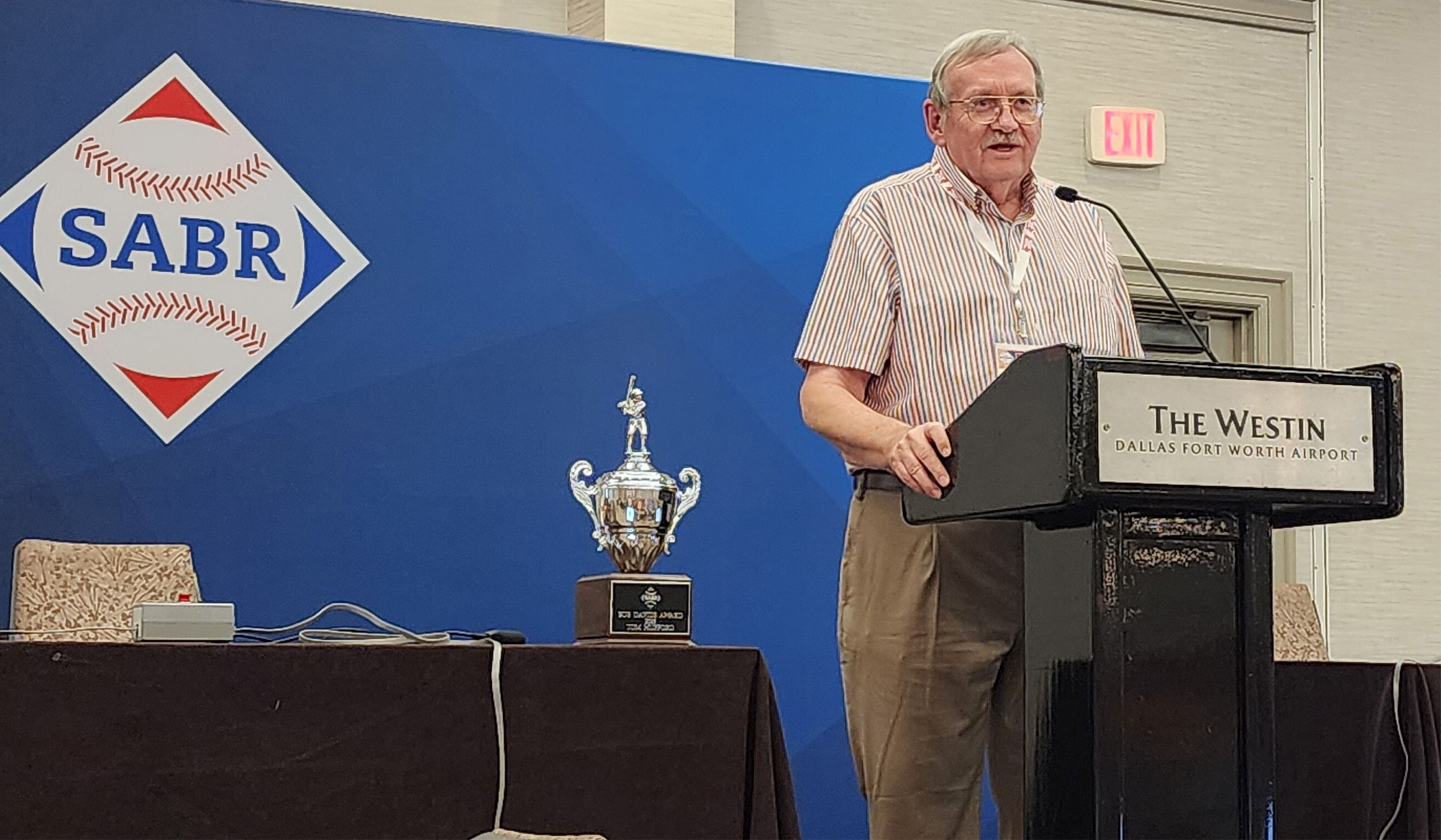
If there is a single overriding theme I heard from people at the SABR convention, that’s it: This is the place where being a walking encyclopedia of baseball obscurities is normal, where you can swap trivia and references with other people like you, and they get it, share it, and want to pass it on. It would be easy for this to be a forbidding atmosphere. Self-selected groups of experts, hobbyists, or superfans, offline or on, often disappear down rabbit holes of their own jargon and prove their insider status by hazing inexperienced “noobs” for not knowing all the lore. Yet SABR maintains a strong culture of welcoming that borders on the evangelistic: Everyone you meet there wants to let you in on what the group has to offer. Would you like to join our chapter?
Closely connected is SABR’s culture of voluntarism, that great Tocqueville-observed aspect of the American character that is dying out in so many other parts of our atomized world. SABR has over 7,500 members in 82 chapters worldwide. In addition to the convention, which draws more than 500 attendees, and the analytics conference, which last drew some 400 in-person attendees and 600 online attendees, it holds three other annual conferences (on 19th-century baseball, Negro League baseball, and women in baseball). It publishes a semiannual research journal, an annual research magazine for the convention, more than half a dozen books a year, a web-based Bio Project that hosts 6,700 member-written baseball biographies, a Games Project that contains more than 5,000 member-written accounts of memorable or important games, and an Oral History Project that conducts interviews with retired players. All of this is done by an organization with six full-time employees. The lifeblood of SABR is the researchers and chapter members who do this in their spare time for the love of the game -- and for the love of knowledge about the game.
The cultures of voluntarism and evangelism also help explain why SABR has spun off so many influential projects and ideas from such a modest start that Bochy could call SABR “the conscience of baseball.” Sean Forman was inspired in 2000 to start the massively successful website Baseball-Reference.com, the web-based successor to the Big Mac that is one of the internet’s greatest destinations. Dave Smith started Retrosheet, a project to collect and publish on the web every box score ever (an endeavor that now feeds into Baseball-Reference). The SABR Defensive Index has become a component of the award of the Gold Glove by Rawlings Sporting Goods.
SABR has come a long way from the early days, when attendees bunked in college dorms and the group’s leaders gathered over plates of cookies to stuff envelopes. Now a respected institution within the game, the convention boasted corporate sponsorship by Major League Baseball, the players’ union, Rawlings, and Baseball-Reference.com. Attendees this year included prominent figures such as Forman and baseball writer Rob Neyer. The Texas Rangers rolled out the red carpet with a ballpark tour, speeches by Bochy and Chris Young, president of baseball operations, and the appearance at panels of public-address announcer Chuck Morgan, several past and current Rangers executives, and six ex-Rangers players, two of them members of the Hall of Fame: Ivan Rodriguez, Ferguson Jenkins, Charlie Hough, Tom Grieve, Elvis Andrus, and Colby Lewis.
The point of view of the players’ union was featured in another showcase panel on the 50th anniversary of labor arbitrator Peter Seitz declaring the reserve clause invalid -- the prerequisite for the age of free agency. Speakers included former union leader Don Fehr, former Montreal Expos pitching legend Steve Rogers, who still works for the union, and baseball-law expert Ed Edmonds, a professor emeritus at Notre Dame Law School. Somehow, even at a baseball convention, I ended up at all the lawyer presentations.
A panel on baseball-card-collecting featured James Beckett, whose card-pricing guides, which he began publishing in 1979, made him the biggest name in the hobby. Beckett’s guides gave collectors that essential tool of a free market: price transparency. Yet, for all that Beckett did to help build the market in cards, he still speaks lovingly of the romance of card-collecting, which has continued to captivate him long after he retired from publishing guides: “The cards spoke to me, telling me of their sports lives.”
On the convention’s first full day, following a trip to see the minor-league Frisco RoughRiders (whose mascot is of course the Bull Moose), attendees met for a “pack rip.” We literally sat around tables ripping open packs of baseball cards, many of them dating back to the 1980s, the chewing gum inside perfectly preserved in its original inedibility. Other parts of the convention were scholarly or dealt in serious matters. Jenkins, for example, told tales of playing minor-league baseball in the segregated South, eating his meals on the bus and bunking at a brothel and a funeral home while his white teammates were welcome in hotels and restaurants. But the pack rip is pure, uncut nostalgia, an evening of even the grayest heads reliving the joy their second-grade selves found in baseball cards. For my part, my haul included a card of my admittedly idiosyncratic favorite player, ex-Mets sidearm relief pitcher Terry Leach. In this crowd, nobody bats an eyelash when I say that Leach’s autobiography, Things Happen for a Reason, is part of my baseball library.
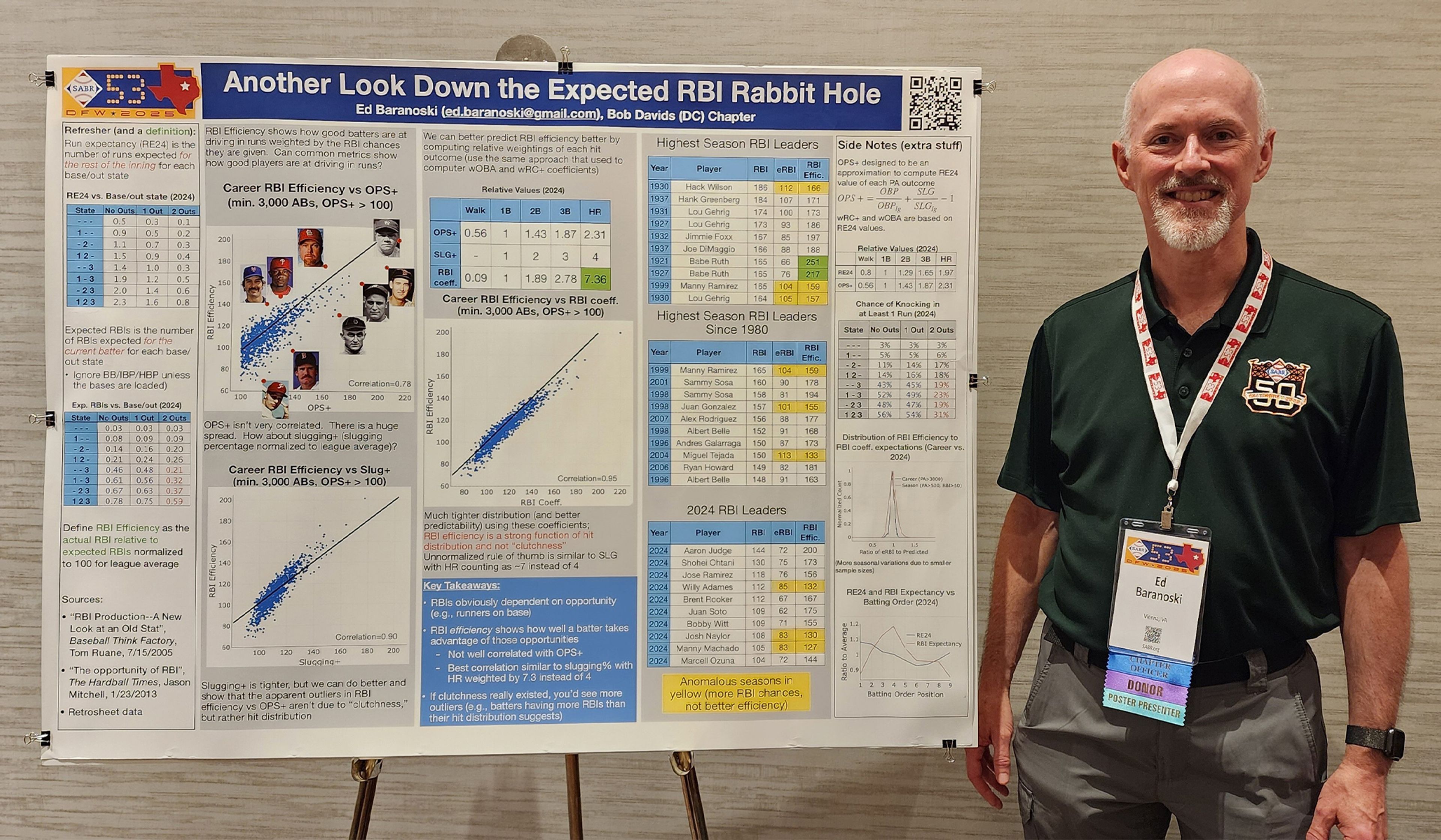
The heart of the SABR convention is still the research. The main room was walled with posters, as you’d find at a convention of geologists or economists. These ranged from a statistical analysis of hitters’ efficiency at batting in runs to an award-winning look at “Real-Time Biomechanical Feedback for Injury Prevention in Baseball Pitching,” to a photo array of a young Mickey Mantle’s stops along the way from Commerce, Okla., to the New York Yankees.
Among 32 research presentations, several told histories of particular minor leagues and events, including the tenure of Jesse Owens as owner of a black minor-league team. Some focused on the game’s scandals, from gambling to off-the-books barnstorming. Some recounted baseball inventions, baseball photography, bad baseball ownership, or the earthquake that interrupted the 1989 World Series. There were whimsically but diligently hyper-focused looks at particular player seasons, from Oakland A’s slugger Khris Davis batting exactly .247 four years in a row to why Babe Ruth drew only 72 walks (barely half his usual rate) in 1929 (excluding all on-field variables, the hypothesized conclusion was stress from marital and tax troubles).
An attorney looked at changes to player image creation in the social media age. The Nigerian-born University of Oklahoma instructor who did the pitcher-mechanics poster also presented a “Bayesian Causal Analysis” of two-strike foul balls. Two young presenters who flew 13 hours from South Korea detailed how Gen Z fans were creating a post-pandemic attendance boom in the Korea Baseball Organization. Even when explaining Korean social media trends in heavily accented English, they were greeted with much enthusiasm. It’s all baseball fandom, after all.
From the founding of SABR on the weekend that Satchel Paige (the Paul Bunyan of black pitching) was inducted in the Hall of Fame, the Negro Leagues have been a topic of fascination. That’s partly out of a sense of an enduring injustice to be righted, partly because segregated black baseball is full of outsized characters and shaggy-dog stories, and partly because it retains aspects of an undiscovered country for researchers. Negro League star (and later Hall of Famer) Judy Johnson spoke at one of the earliest conventions. The work of SABR researchers and their advocacy for its significance was important to getting MLB, in 2020, to officially recognize the Negro Leagues retrospectively as major leagues, and the statistical record of their games is far along enough now that Forman included them in Baseball-Reference.com as big-league games.
This year, there was a report of research into every documentable home run (still a work in progress) hit in Negro League baseball. Mark Armour, the outgoing president of SABR’s board and founder of the Bio Project, presented his best estimate of how many games Paige pitched if you counted barnstorming and Latin American baseball: a tally so far of 1,833, some just pieced together from brief accounts in local newspapers. (Baseball-Reference.com lists 403 games in the American League and the Negro Leagues, and 555 official professional games overall; the rest needed more digging.)
Although attendees were, unsurprisingly, mostly older and male, there were more women than one might at first expect. SABR is proud of having attracted more women and younger people over the years to its chapters, membership, and events, especially to the analytics conference and the women-in-baseball conference. The organization has used scholarship grants to bring in young people, for whom the analytics conference can be a chance to network their way into a job as a big-league number cruncher. Unlike in 1971, every team today employs them. Demographic renewal is part of the natural survival arc of volunteer and mission-based organizations. For SABR, the Covid interregnum was a blessing in disguise; connecting baseball obsessives over Zoom, especially when there was no baseball for more than half of 2020, helped bring in many younger members.
The Saturday night capstone of the SABR convention is the trivia contest. SABR participants take their baseball trivia very seriously, and the contests attract high attendance. Past winners of the individual trivia contest are entitled for life to wear a ribbon on their badges marking them as such. Only the high scorers in a written test made the semifinals.
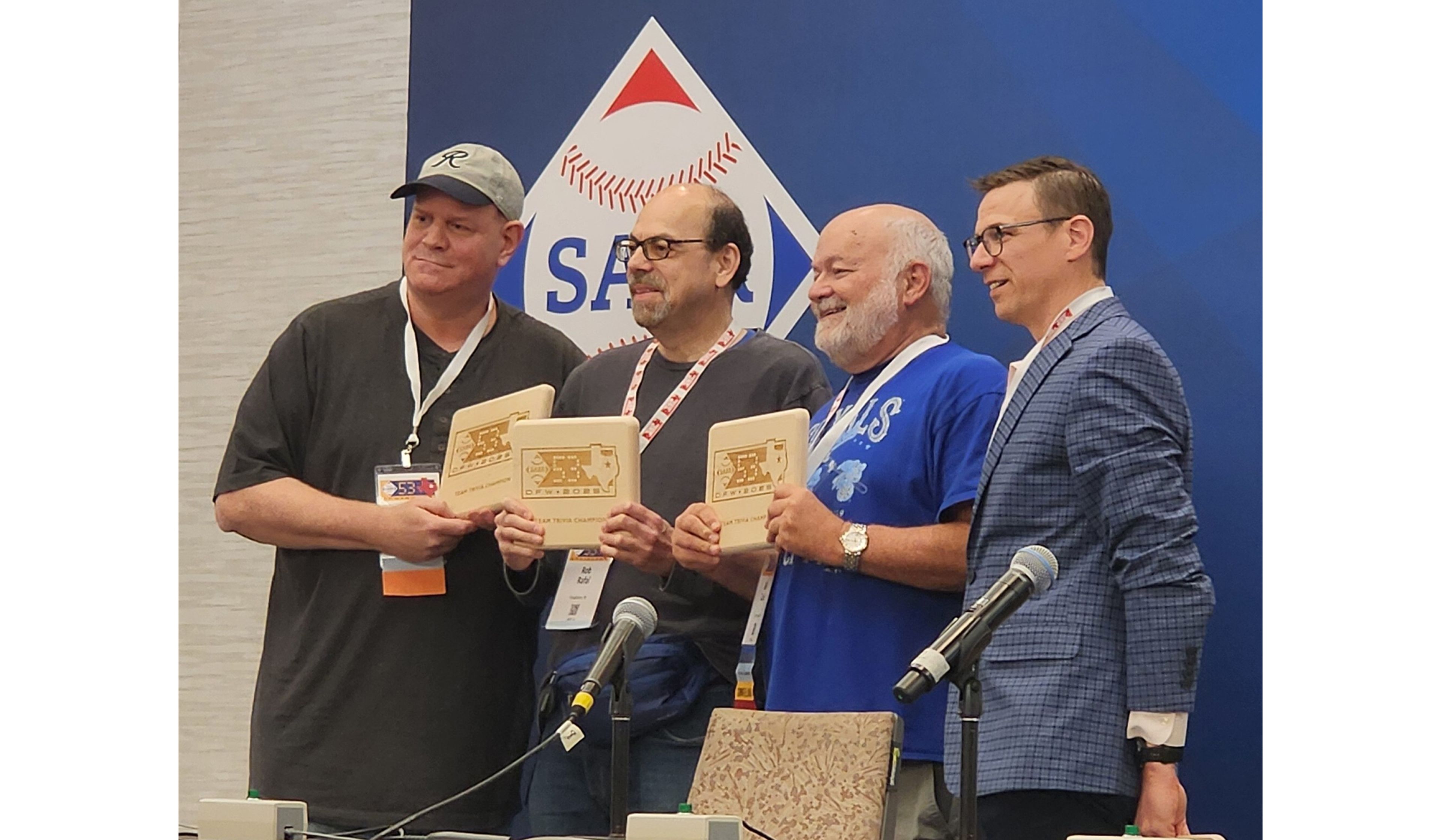
The questions are hard. Nobody could get them all; there were plenty of wrong answers or failures to answer, even from the trivia whizzes. Can you name six Negro Leaguers born outside the United States? (I knew that one of them was Luis Tiant’s father.) Did you know that the only major leaguer with the initials U.U.U. was Ugueth Urbina, whose middle name is Urtain? That Tommy Bond, the best pitcher in baseball from 1877 to 1879, was Irish-born? Different participants have different specialties. In the team competition, past individual champ Rob Rafal cleaned up in the uniform-number category, which entirely eludes me. Rafal’s winning squad in the team competition was named “Death to Flying Things” after the evocative nickname of Bob Ferguson, a slick-fielding outfielder who played from 1871 to 1884. But this being SABR, every time the moderator put an unanswered question to the crowd, somebody knew the right answer -- often, quite a few somebodies.
Contestants were sometimes required to look at a Baseball-Reference stat line -- numbers, years, teams -- and name the player. One set of questions, done Family Feud style, was based on Baseball-Reference’s popular “Immaculate Grid” game, which requires naming players who meet two intersecting criteria. (How many players can you name who played for both the Minnesota Twins and the Colorado Rockies? That proved a stumper.) Others were done Jeopardy style; the individual competition turned on defending champ Scott Kent’s being undone by the daily doubles. Mark Simon, who defeated Kent in the individual finals, provides information to New York Mets broadcasts. But even the two finalists couldn’t answer the question at the top of this article before time ran down. That one I knew, because the college clue tipped me off.
The answer, if you’re still wondering, is Joe Carter. John Olerud is remembered as a hard-hitting, slick-fielding first baseman, but out of college he was known as a two-way threat with a hot fastball. When the Blue Jays got Olerud, their Hall of Fame first baseman Fred McGriff became expendable and was shipped to the Padres in a deal that brought back Carter. When Carter touched the plate for his World Series–winning walk-off home run in 1993, it was the last run a Blue Jay scored in that Series -- or any other, because they haven’t been back.
SABR will gather in a different major-league city in 2026, for the memories and the fun. In baseball, there’s always next year. But the past is never gone.

About the Author
Dan McLaughlin is a senior writer at National Review Online and a fellow at National Review Institute.
Featured Tags
Advertisement
Advertisement
Comments