An Exorbitant Burden
Written by Ed Price
Not today, but tomorrow, Uncle Sam is broke. Point the blame at fiat currency.
Share this story
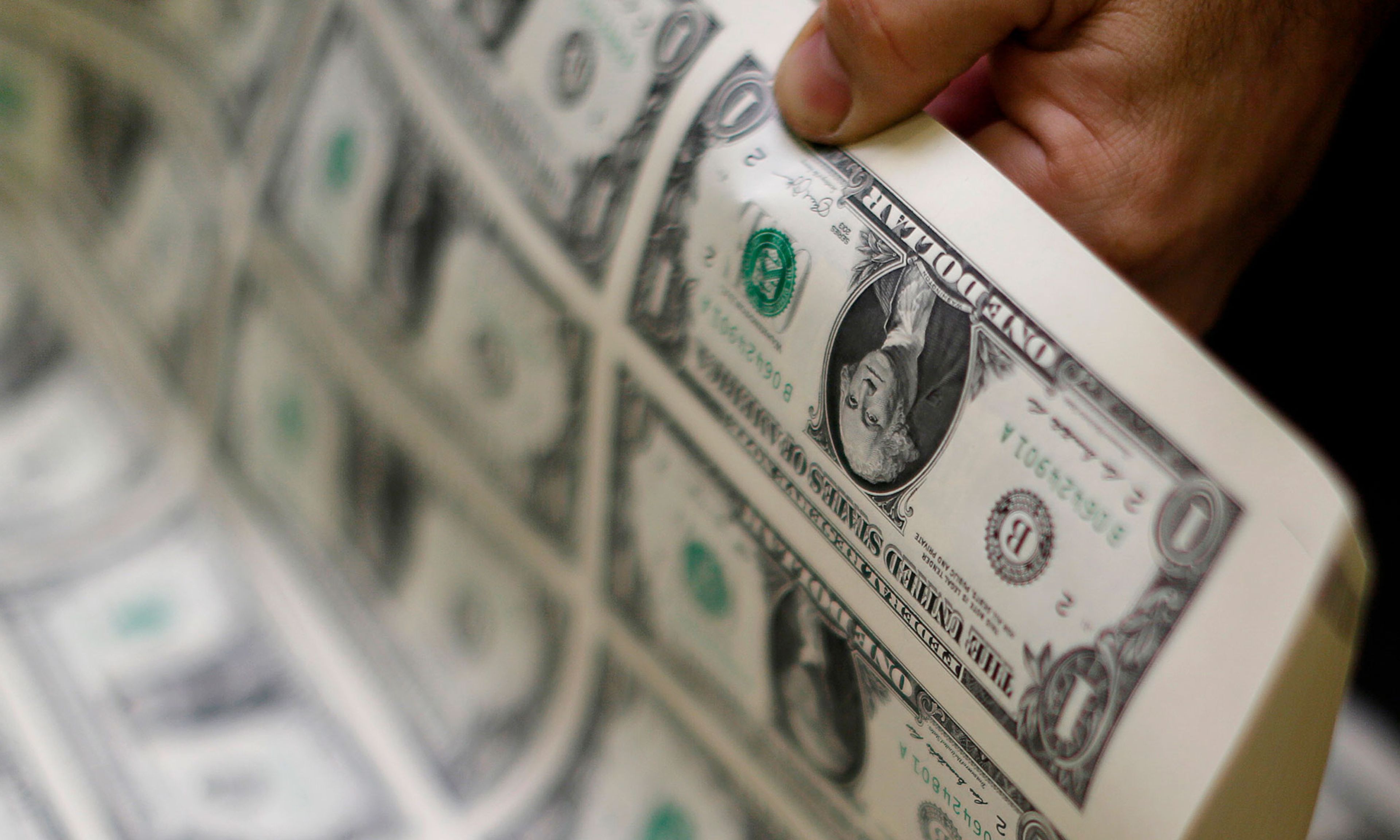
U.S. $1 bills being inspected at the Bureau of Engraving and Printing in Washington, D.C., in 2014.
After the end of the Second World War, all the dreams of history’s finer economists eventually came true. Lo, there was an international economy. There was comparative advantage at an unprecedented scale. There was rising growth and rising trade. David Ricardo would blush.
In the last decade or so, however, we are seeing the stuff of diplomatic nightmares: international tensions and competing territorial claims. There is an arms race in the South China Sea. There is a ground war in Europe, and not just there. Thomas Hobbes, too, would recognize our times. Globalization promised that trade would lead to democratization. Instead, market liberalization outpaced, and may be reversing, political liberalization. What explains this mystery?
Money. Or, more strictly, the type of money used to run the global economy.
In the 1970s, Nixon was afraid the United States would create so many dollars pegged to gold that Uncle Sam would, one day, run out of that coveted metal. Thus, Nixon ended the gold peg, and the U.S. adopted a fiat dollar. That choice threatened financial instability in the long term. As any fool knows, an unlimited money supply portends inflationary hell. Let’s agree, fuzzily, that President Nixon is ultimately to blame for the global financial crisis by ending the greenback’s link to gold. Nonetheless, he was a Cold Warrior. Yes, the U.S. was experiencing inflation in the 1970s. But without maintaining a global dollar supply, America’s international presence would fade. When push came to shove, the dollar supply needed to match global, not domestic, demand. A fiat currency was the tool of a superpower engaged in a struggle against an antagonist that played by very different rules.
For a time, Paul Volcker’s disinflation and foreign demand for dollars tamed the inflation of the Nixon and Carter eras. Remember the Great Moderation? But world-defining developments meanwhile emerged. Not just the global financial crisis in 2008, but also fiat-financed wars in the Middle East, the buildup of sovereign debt, central bank stimulus frenzies, and crises in the global economy. Was it comparative advantage that the U.S. specialized in taking on debt and exporting currency, while other countries specialized in making furniture and arms? Or hubris? At the very least, without fiat, Americans would not buy so much junk. Perhaps, had we kept the gold peg, we’d still only have the first iPhone.
That last concern -- global imbalances -- was foreseen by John Maynard Keynes. In the 1940s, at Bretton Woods, he argued that using a national currency as an international reserve would weaken the new system. Instead, Keynes proposed the bancor, a new form of international currency that could be issued in accordance with global, not national, needs. He was ignored. Later, in the 1960s, the same concern was expressed by economist Robert Triffin. National currencies, he said, cannot long be used as global reserves. He, too, was ignored. Ben Bernanke voiced a similar view again, in the 2000s, with his assessment of a global savings glut. Ignored. Today, President Donald Trump is making the same essential point. The difference? Now, people are listening.
Of course, our president is not a first-rate monetary economist. Truth be told, neither is he a second-rate one. But for the last few decades, he has made one instinctive argument: If Uncle Sam buys foreign goods with his credit card, he will slowly destroy his credit score, erode his manufacturing base, and, presumably, lose his ability to fight a major war. This assessment is correct. What appeared to be an international trade equilibrium, one in which America kept the peace by importing automobiles, was an imbalance. The good thing about world trade is that every single Toyota you see has an engine that, in an alternative history, would have powered a fighter plane. But the obvious way this distortion ends is ugly. Eventually, America goes broke, capital markets spasm, and China has all the factories.
Managing ourselves out of this mess will be hard. In the 21st century, Americans will lose something. Our consumption Bacchanalia, already slowing, must end. Less American soda, fewer Japanese pickups, and, we have been told, fewer dolls. Yet no degree of tariffs will reverse our sovereign debt trajectory. Total public debt outstanding in the U.S. is already $38 trillion, and it’s rising by about $2 trillion per year. Somehow, some way, we must cut borrowing. Ultimately, that pits our overseas military commitments against our domestic safety nets.
For the last 50 years, America has issued and exported paper currency. The French famously complained that this was an exorbitant privilege. But they and other nations know there is a burden to owning and operating the international financial system. That burden, and its cost, is only now becoming clear. Globalization promised trade and peace. And, for a time, that is exactly what it secured. There was a period of macroeconomic calm and, when the wall came down, the Kremlinologists were eventually put out of work. We won the Cold War. Nonetheless, the American-led international financial system has undermined internationalism by undermining America. The bill has come due.
There is no murder mystery at work here. It was Mr. Fiat, in the drawing room, with the printing press. So far, his primary victim is globalization. But given America’s colossal sovereign debt and creaking politics, his spree is far from done.
About the Author
Ed Price is an independent economist and geopolitical analyst and a non-resident Senior Fellow at New York University. He previously served in the British Consulate in New York.
Featured Tags
Advertisement
Advertisement
Comments