An Iraqi for Christ
Written by Kathryn Jean Lopez
The new Chaldean patriarch is a witness to the world of the persecuted church.
Share this story
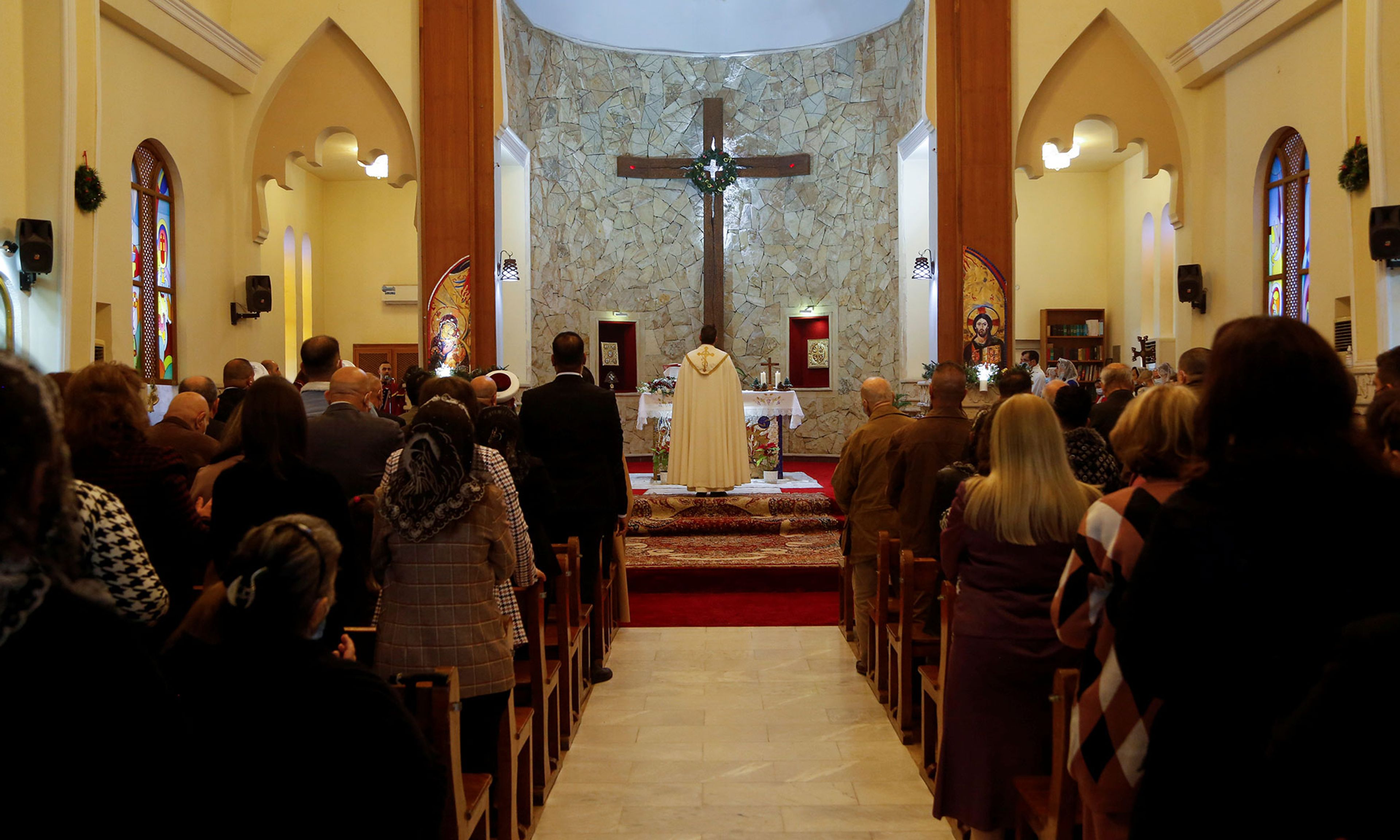
Iraqi Christians attend mass during Christmas celebrations at St. George Chaldean Church in Baghdad, Iraq, December 25, 2021.
His Beatitude Paul III, back in 2016, went by Amal Nona: He was the archbishop of Mosul, in Iraq. Nona had recently been reassigned to Australia, where many an Iraqi had fled the ISIS-perpetrated genocide. (Christians have been in Iraq since the time of Saint Thomas the Apostle.) It was in 2016 that I asked the archbishop: “Surely someone has wondered if he could pretend to renounce Jesus for the sake of self-preservation, to keep his family safe and remain in his hometown.”
Nona’s eyes welled up. He appeared at peace with the prospect of martyrdom for love of Christ, so I really didn’t expect him to cry in response to an American’s seeming cynicism. The houses of the Christians in Mosul had been marked with the Arabic equivalent of the letter “N,” for “Nazareans.” Their options in Iraq were to either reject their faith in Jesus Christ or be killed. And so they fled — some to the country’s relatively safer Kurdistan region, to the archdiocese of Erbil, where Archbishop Bashar Warda stepped up to the plate, welcoming exiles and building a future, including a new university, for Christians (and other religious minorities) there. Others fled to Australia and New Zealand.
“None of them thought it would be better not to be Christian,” Nona told me, before what he and his people were subjected to was even officially recognized as a genocide. “We thank God for everything,” he said to me. “The Lord shows us how it is important to be happy in all situations.” If I wasn’t sitting beside him, I might have thought he was delusional. To the contrary, he was as realistic as you get. Nona was born in the region of the world where the Church Fathers had lived and died — some of them murdered because of their love of God as demonstrated by Christ’s life.
Nona was elected patriarch on April 12 in Rome, where he studied (at the Pontifical Lateran University). He’s not yet 60 years old. “Be strong and take courage”: In a 2017 Christmas letter, Nona reflected on this passage from Deuteronomy. Ever with the perspective of a grateful steward, overflowing with love, he wrote: “The words of our Lord make us certain that we have a mission as Eastern Christians here in this new society in need of our message and testimony, which is to proclaim with the power God’s love for all, His mercy towards others, and proclaim His salvation filled with joy despite difficulties and full of values, ethics and basic Christian practices of life that does not change despite all the modern ideas and behaviors.”
In a letter to the Christians of the West in 2013, he wrote:
Anyone who wants to do something for us should make an effort to live out his or her own faith in a more profound manner, embracing the life of faith in daily practice. For us the greatest gift is to know that our situation is helping others to live out their own faith with greater strength, joy, and fidelity. . . .
When Christians are persecuted, we should take on more firmly the responsibility of our own faith to joyfully give expression to love, fidelity, and justice. If there are Christians in trouble, I should love my neighbor still more; I should be more positive in my way of looking at the business of life, in order to show those suffering the strength of my own faith. . . .
Ultimately, persecution cannot make us sad or despairing, because we believe that human life deserves to be always embraced in a perfect manner, as Jesus showed us — even if death stares us in the face and we have no more than a minute left in this world.
Just before Nona was elected, Pope Leo XIV told the electing body that “the new patriarch should be, above all, a father in faith and a sign of communion with all and among all.” The first pontiff born in the United States said that living the Gospel is “countercultural and sometimes even counterproductive," and yet that is why it’s important, “because love is the only force that conquers evil and defeats death.”
And therein lies happiness. Even if it means persecution and death. As long as it is for pure love. Talk about a reason to get up in the morning.
This column is based on one available through Andrews McMeel Universal’s Newspaper Enterprise Association.
About the Author
Kathryn Jean Lopez is a senior fellow at the National Review Institute and the religion editor of National Review. Sign up for her weekly newsletter here. She is the author of A Year with the Mystics: Visionary Wisdom for Daily Living.
Featured Tags
Advertisement
Advertisement


Comments