An Outdoor Sculpture Triumph in the Berkshires
Written by Brian T. Allen
The Clark Art Institute showcases its lovely landscape and work by a roster of international artists.
Share this story
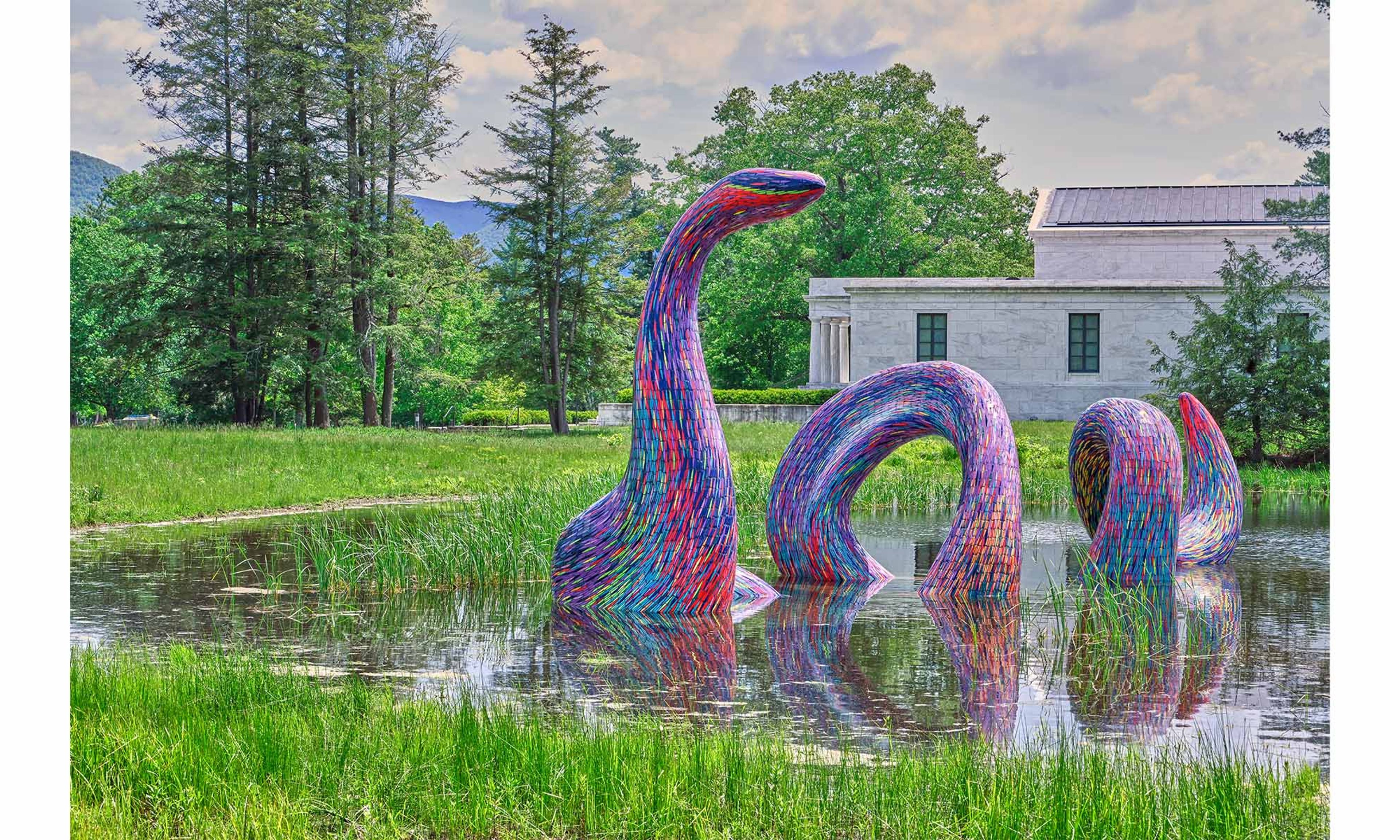
Javier Senosiain’s <i>Coata III</i>, May 2025.
Ground/work 2025 is the splendid, very different summer extravaganza at the Clark Art Institute in Williamstown in northwestern Massachusetts. Distinguished for its permanent collection of Renoirs, Sargents, and Homers and for its big, academic paintings shows held indoors in summer, this year the Clark has done an outdoor, contemporary sculpture show, displayed here and there on the Clark’s 140-acre campus. I’d never heard of the Japanese ceramicist Yō Akiyama, the English wood sculptor Laura Ellen Bacon, the Mexican architect Javier Senosiain, or any of the other artists whose commissioned sculptures are on view, but what’s life without revelation, or a hike?
I’ve been going to the Clark since the 1960s, when my parents owned a farm in Stamford in Vermont, a few miles from Williamstown, and I went to Williams and was a curator at the Clark. Living in southwestern Vermont now, not far north of the Clark, I consider it and the Bennington Museum my two much-loved art spots. The Clark’s “Back 140,” as we called it, was, for years, an area of woods with rudimentary trails, alongside a hilly cow pasture rented by a farmer. On top was a pretty mountain view enjoyed by the intrepid and to which the cows were oblivious. A fence in a deep ditch separated the woods and cows from a patch of museum parking lot and the low-slung, homely, nuts-and-bolts art-conservation building. Pretty and precious, it wasn’t.
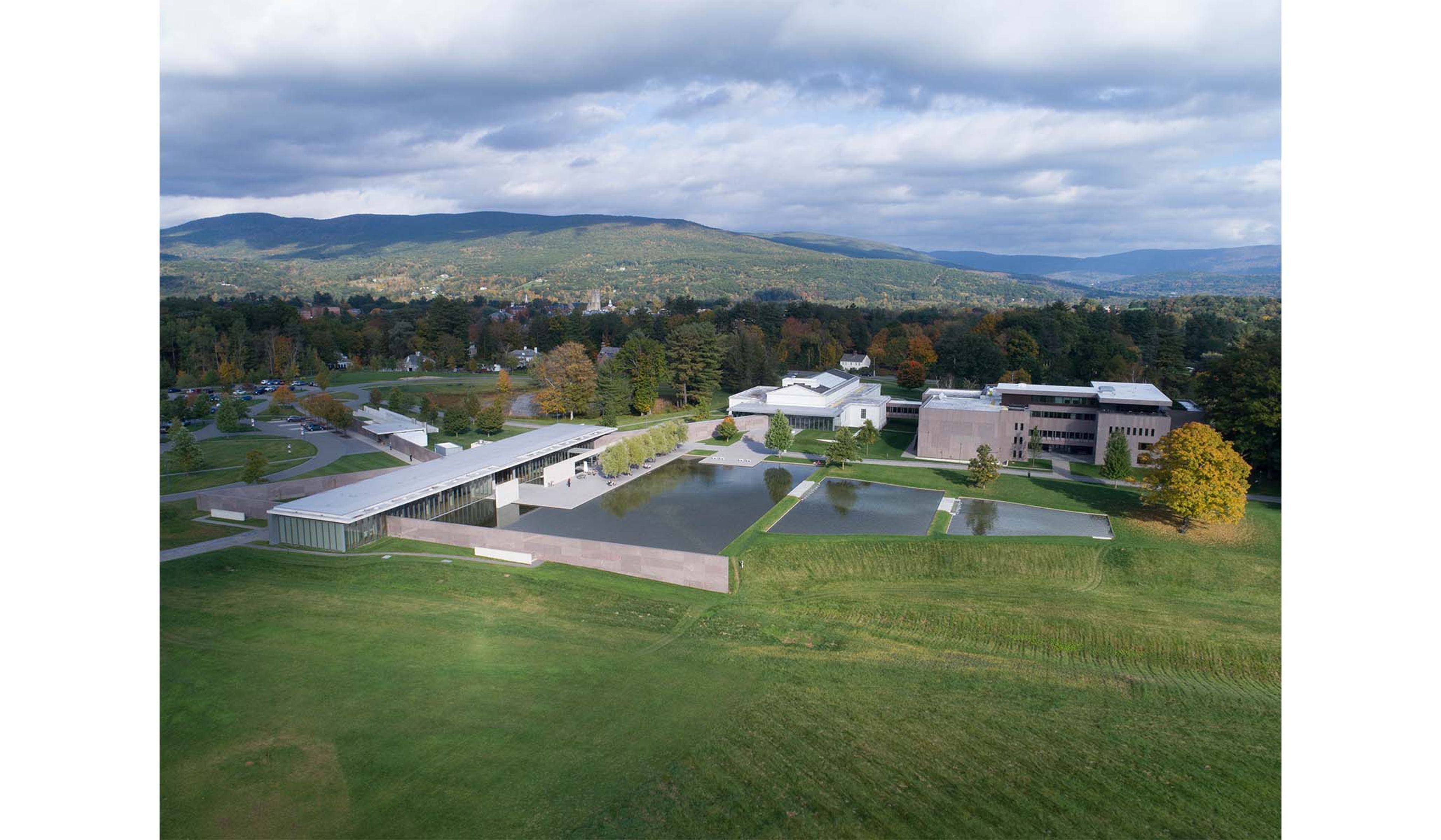
Among the few success stories of the Clark’s $150 million campus overhaul, now a dozen years old, is the landscape architecture. The art-conservation building and the parking lot, both carbuncles, are now gone. There’s a lovely, sculpted water feature now, a serene, shallow pond, patios with seating, and an open, green lawn framed by old trees. The hill is still used for grazing but either the cows are well-mannered eaters, or man-made gussying-up occurs. It’s rustic trim, à la Constable now. There are also new, neat hiking trails. From the patio, you can see visitors hiking up the main trail, which is both scenic and inviting. In unifying the pasture, hill, and woods with the museum buildings, the Clark, a museum heavy on landscapes, weds art, architecture, and nature.
The Clark has always been an indoor/outdoor place. It’s in the Berkshires, at the edge of northern New England, where people, at least in the summer, want to be outdoors. The Clark’s original, 1955 Beaux-Arts building has lots of windows with views to hills, woods, and fields. The new landscaping beautifully enhances the museum’s ambiance, but it also beckons, even demands, outside art. Ground/work 2025 meets the need and more. I love it. The six monumental sculptures just premiered. They’ll be on view for a year.
Joining Akiyama, Bacon, and Senosiain are Hugh Hayden, an American wood sculptor, Aboubakar Fofana, an artist from Mali who sculpts with rolls of handwoven African cotton, and Milena Naef, a Swiss sculptor who works in marble. So we see art from Japan, the U.K., Mexico, America, Mali, and Switzerland, but I don’t think anyone cares much about geographical distribution. Rather, we experience different materials, ranges, and traditions in work that, individually and as a group, has heft and panache. Ground/work 2025 is the Clark’s second try at an exhibition of outdoor sculpture. Its first, in 2020, was a flop for a lack of ambition. The art was poor, not bad in quality, but modest, hesitant, even down-at-the-heels. It was a first stab.
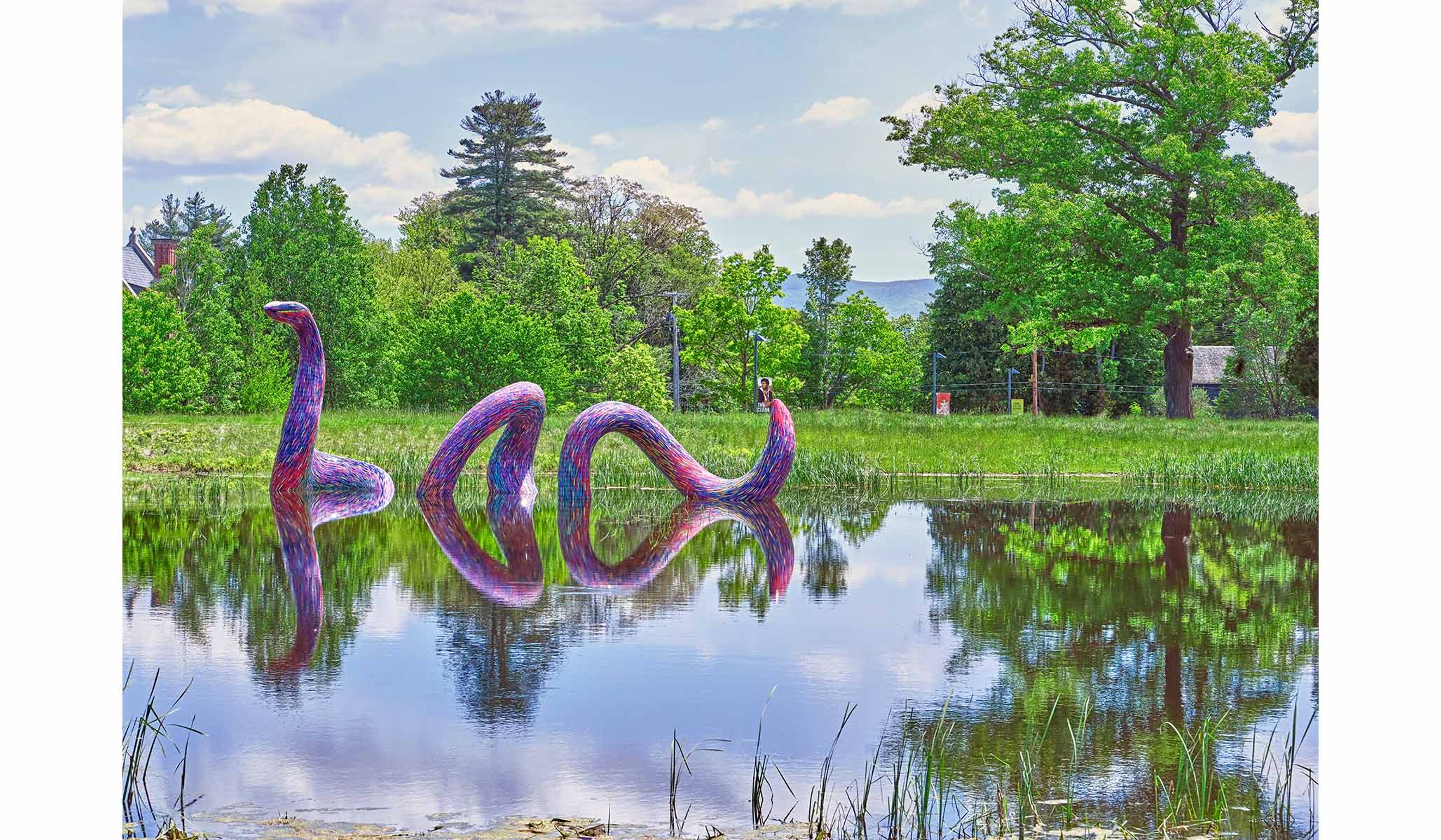
I wrote then that if the Clark was going to do outdoor sculpture, it needed to do it big and do it right. It’s now done both. It hired Glenn Adamson, the great decorative arts historian of his generation and a craft scholar, as the outside curator. The museum also put big bucks and big internal energy into the project. The first sculpture we see is Senosiain’s showstopper Coata III, a massive polychrome glass-tile serpent whose coils dip and twirl in the pond by the side of the 1955 building, visible to all who approach by car or on foot. Senosiain, based in Mexico City, is an architect famous for buildings that evoke animals, grottoes, seashells, whirlpools, clouds, and waterfalls.
Coata III goes a step further, quoting the feathered serpent Quetzalcoatl, the ubiquitous Aztec god of wind, water, agriculture, and the arts, or, broadly thinking, of creativity and imagination. It’s fantastic and fantastical and perfect for all ages and IQs. It’s got presence, or pond power, and whimsy. When I saw it, I thought of Niki de Saint Phalle, about whom, coincidentally, I’m writing on Saturday, and Antoni Gaudí’s Parc Güell in Barcelona but also Miró. I love mosaics, an unsung art, and think it’s so smart for the Clark to put Coata III front and center, teasing visitors to want more.
For “more,” though, visitors have to walk uphill. The six sculptures are far apart, since part of the plan is for them to be seen in isolation so we can contemplate them individually. This doesn’t make much sense, as we bring our perception of each sculpture to the next one and the one after that. I’m not sure how many Clark regulars -- their average age has got to be close to 70 -- will make the trek, but they’ll be rewarded if they do.
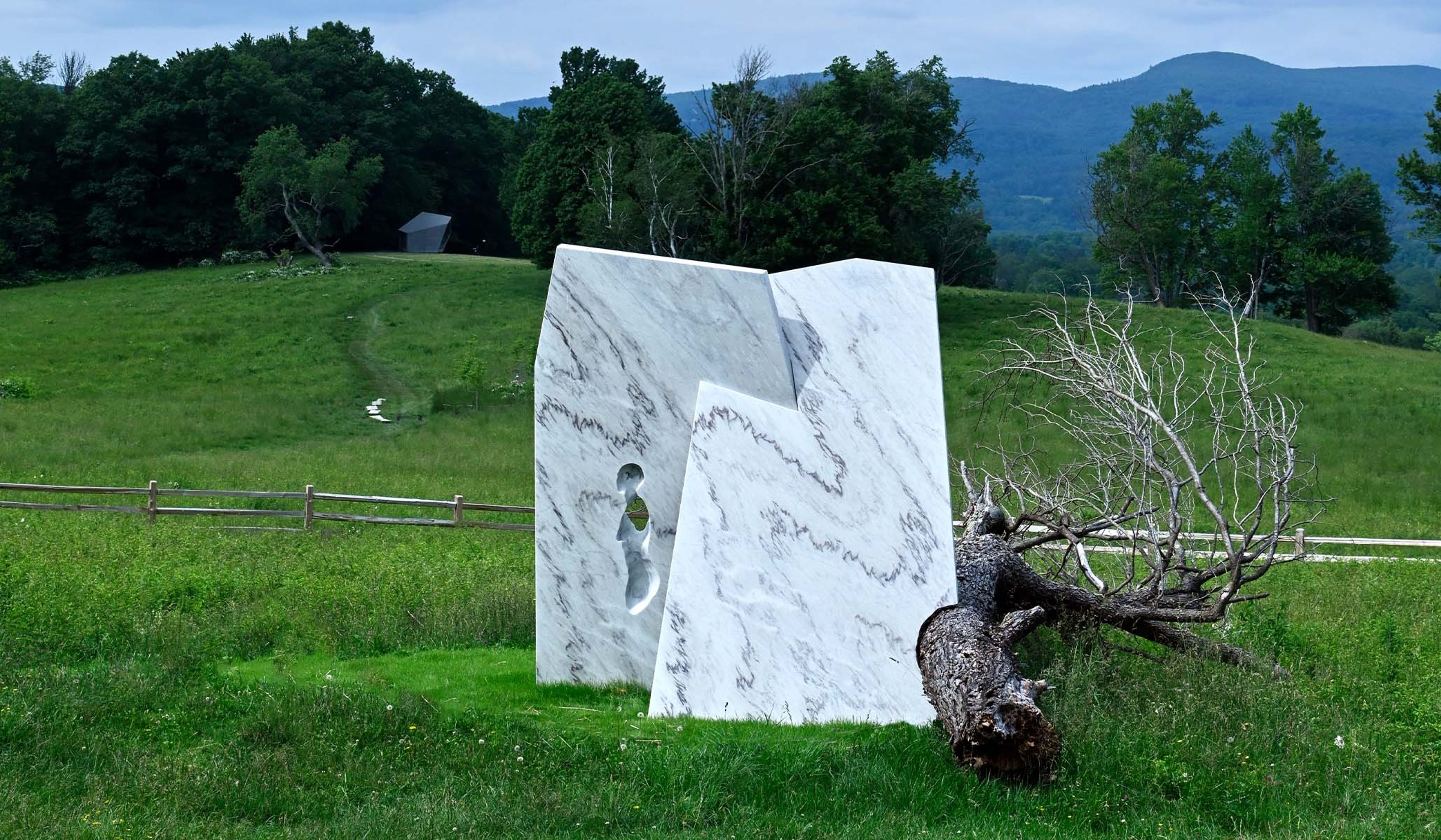
I was intrigued by Milena Naef’s Three Times Spanning, since it’s contemporary sculpture of marble, which is the stuff of Michelangelo, Bernini, and Canova, but not so much now. She’s Swiss, too, and I don’t know much about Swiss art. Naef is from a family of Swiss stonecutters and makes what I call bodyscapes. These are marble or, sometimes, glass sculptures that incorporate impressions of her own body, which she plasters, scans, and transfers to stone.
Three Times Spanning is composed of two 10-foot-tall slabs of spectacularly patterned marble from Switzerland’s only quarry. They’re intersecting each other and learning against each other. One slab has the outline of Naef’s head and torso carved into it, so the thing’s a self-portrait. Wedged in the bottom edge of the other slab is the trunk and branches of a fallen sugar maple from the Clark’s woods. The branches seem to reach out to the slab like a hundred bony, shriveled fingers, the trunk lying on the ground like a mummy who’s seen better days. The contrast between the tree and Naef’s curvy, abstract torso startles, as does the discovery of hunks of polished, elegantly patterned marble in the woods. Her form is a ghost, but so is the tree and so are the marble slabs.
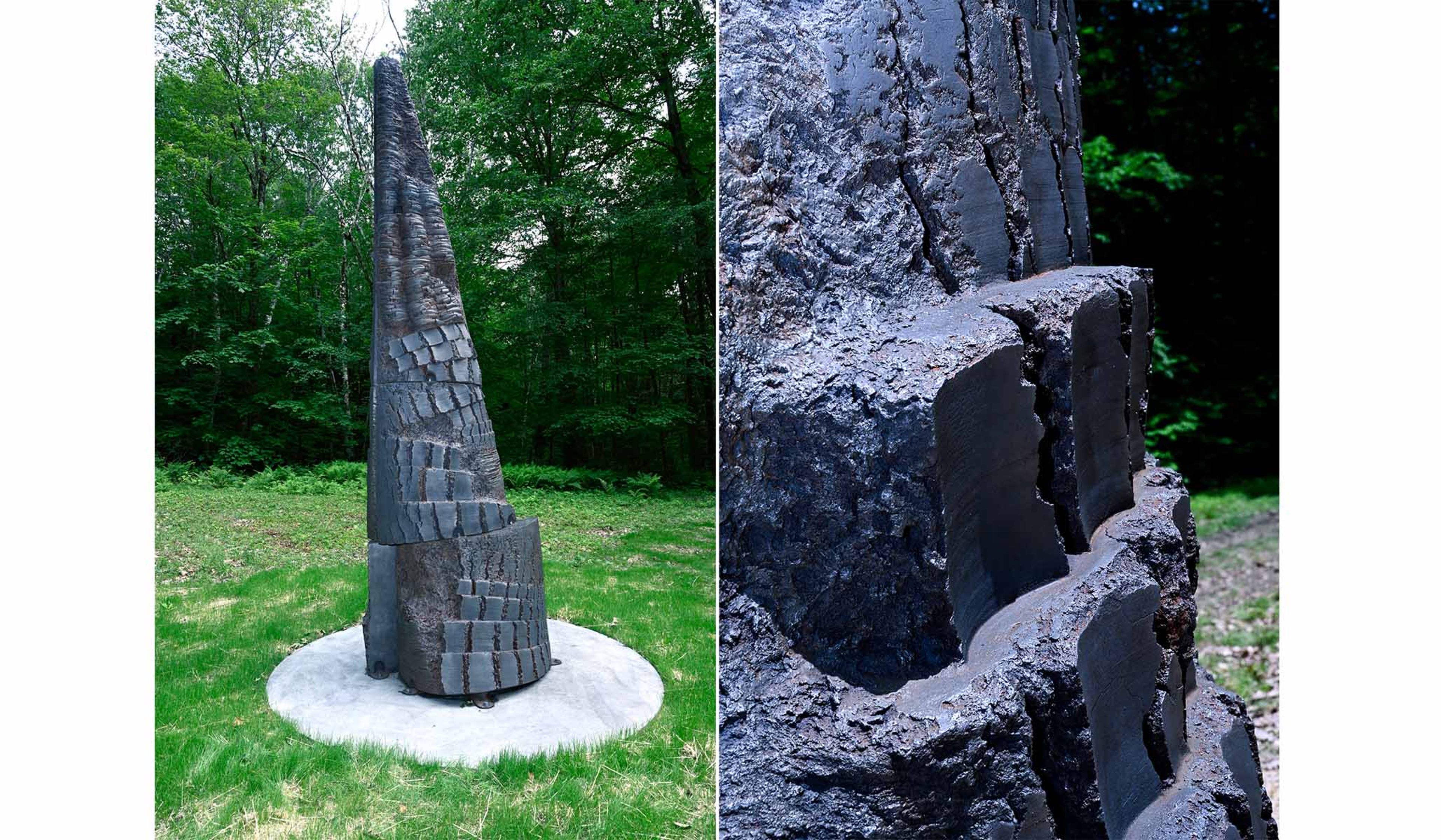
Akiyama is, I learned, very famous and revered in ceramics circles. It’s a coup for the Clark to commission him, but his 20-foot tall Oscillation: Vertical Garden, an obelisk, responds to architect Tadao Ando’s addition to the Clark at the foot of the hill, whether Akiyama intended this or not. It’s perfect for the mix. Ando’s addition is long and sleek, even slick, and granite. Akiyama’s work is tall, rough, craggy, unglazed stoneware with applied iron powder. It’s surrounded by red oaks in the woods and, though painstakingly handmade in pieces and then assembled at the Clark, seems to be a primeval thing that’s grown from the earth. It actually has -- in that it’s born from clay.
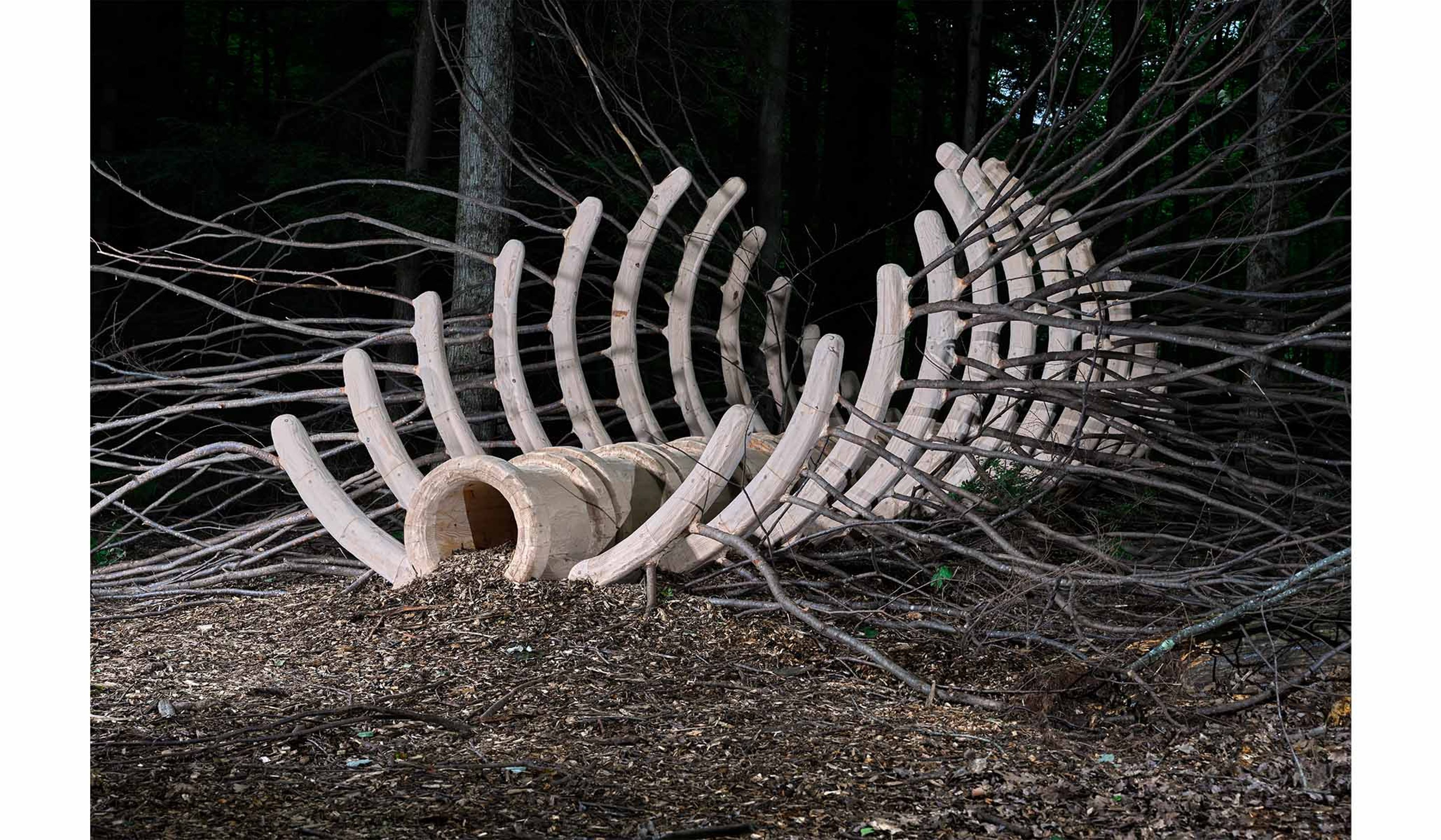
It looks like a ruin, a very noble ruin, and resonates with Coata III, the stuff of myth, and Naef’s marble sculpture with a dead tree wedged into it. Hugh Hayden’s the End takes us further since this 30-foot-long object looks like the ribcage of a dinosaur, or a fairy tale giant. Hayden carved it from locally harvested hemlocks, with their branches left intact. It’s the only one of the six sculptures that will stay where it’s placed, to eventually decay. It’s impressive, but Hayden pushes the woke and pseudo-intellectual themes of race and gender. Of all the sculptures, it’s the most limited.
Of the End he says, “Unless you’re an orthopedist or an archaeologist, you cannot tell whether someone’s black or white, male or female, just by looking at their bones.” It seems like a non sequitur of the screechy chalkboard variety. I’d keep it as a visual statement of the advice of soon-to-die King David to his son, Solomon: “I am going the way of all flesh: take thou courage, and shew thyself a man.” I’d leave it at that, though it doesn’t take much courage to cater to the chattering class.
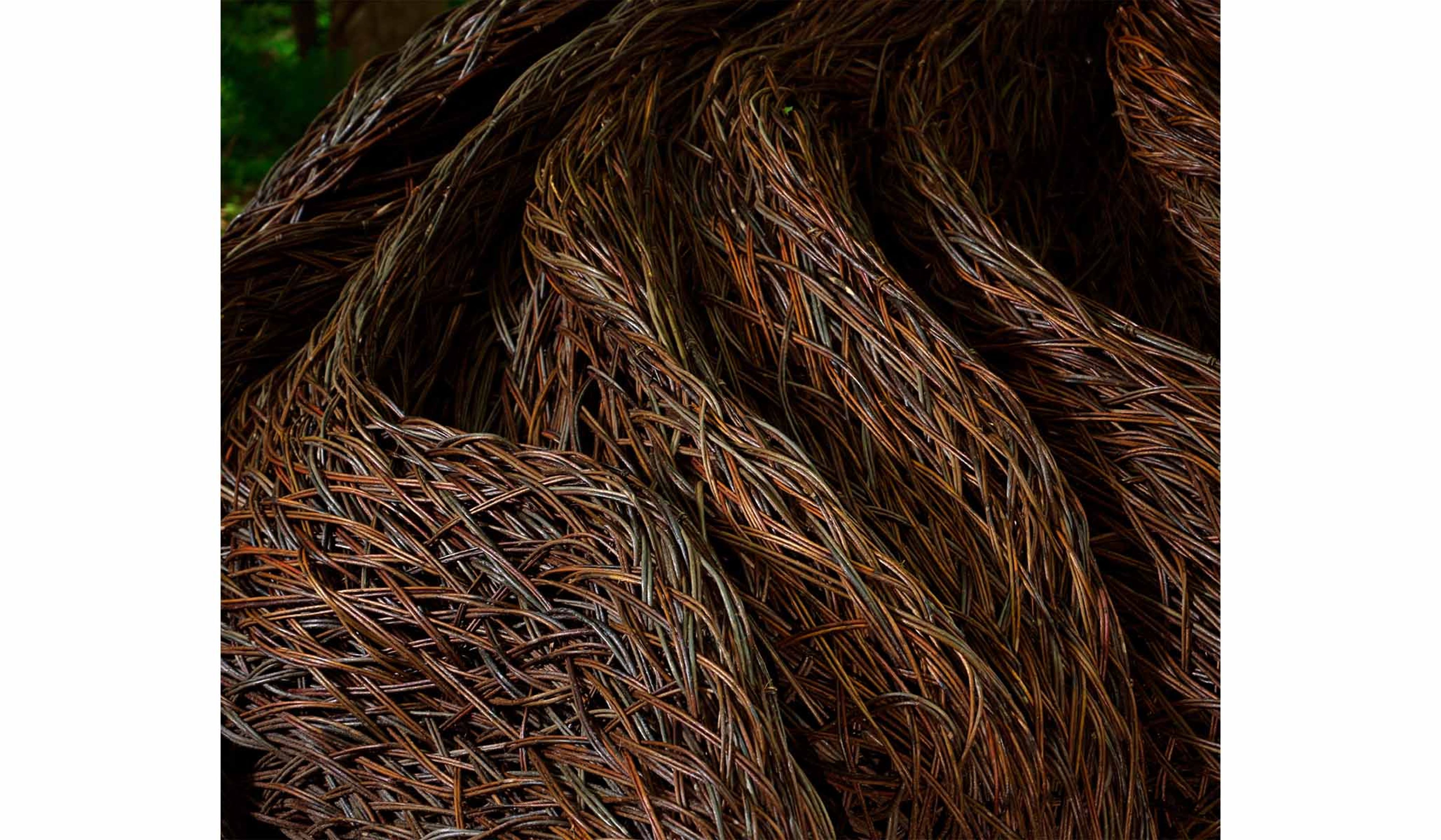
Hayden, Bacon, and Fofana work in materials I’d call close to ubiquitous, and one of those materials is wood. Bacon weaves slender strands of willow to make sculptures like Gathering My Thoughts, 9 feet by 5 feet and embedded in the Clark woods. I’d describe her as a 21st-century Arts & Crafts master, committed to handmade work. And talk about truth to materials! She made Gathering My Thoughts on site, in the woods, strand by strand, in what was day after day of rain, so she did indeed have time to gather her thoughts. Willow comes in lots of different textures and colors -- Bacon selected a red color with some pop. She draws from ancient English basket-making traditions but also dens and nests.
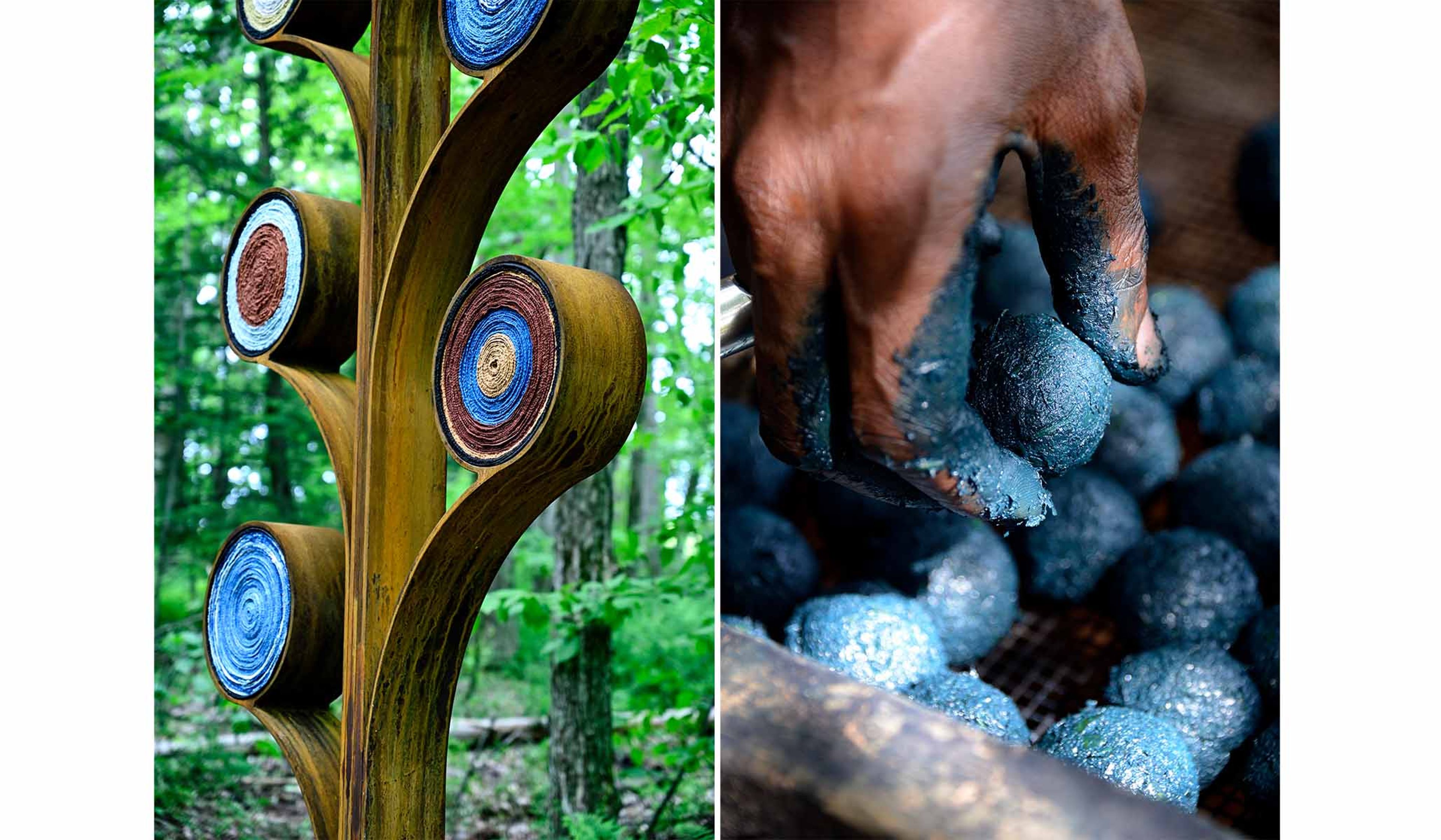
Fofana’s Trees and Seeds of Life is more formal, made of cotton rolled in circles and then encased in steel in an abstract tree. He uses natural dyes, many developed from plants on his farm in Mali. His anchor color is indigo, a blue close to violet on the color wheel. Fofana says that cotton and indigo were harvested by slaves and that his work concerns reconciliation, but I’m not sure if he means slavery in Mali, which is widespread today and a pillar of the economy. His colors are gorgeous and have the nuances of a painting.
Ground/work 2025 is a coup for the Clark in its embrace of the “making” in art-making. I don’t believe in hierarchies in art, but, still, lots of people still believe that craft -- textiles or woodworking, for instance -- and, say, painting are in different realms. They really aren’t. Paintings in the Clark by Homer, Sargent, and Renoir, and sculptures by Degas as well as the Clark’s silver, porcelain, prints, and drawings are made things, using materials as well as theory, vision, philosophy, and tradition.
The art in Ground/work 2025 is all contemporary, and the Clarks didn’t collect contemporary art. Sculpture made from willow branches would have been beyond the scope of their imagination, it’s safe to say. Sterling and Francine Clark were, however, great lovers of tactile art, whether it’s made from thick, rich paint or silver putti, swirls, and shells by Paul de Lamerie. They focused closely on many things, but among them was craftsmanship, which, to them, means skill, design acumen, and intricacy. And they loved color. I suspect that Croatia III, chromatic and iridescent, and, by the way, steps from their graves, would have made them smile.
These are good days for the Clark. The recent gift of Old Master portraits and a boatload of money from Aso Tavitian’s estate are magnificent. The museum also seems to be emerging from ten years of austerity following the financial trench it dug for itself in the Ando addition and the new art-conservation lab, also by Ando, in the woods. Both, as I’ve written, were an abuse of philanthropy. I saw three other new exhibitions at the Clark during my two visits this week: an exhibition of recently given so-so Berenice Abbott photographs, a Noguchi sculpture show, and a big show on British women painters from the 1870s to 1945. And Ground/work 2025. That’s too much. The museum is competing against itself for publicity and the attention of a visitorship that, mostly, is composed of day-trippers.
I’m all for variety -- at the Met, an encyclopedic museum -- but I left this small, precious place thinking that it’s a pudding without a theme this season. The Clark’s heart and soul is its permanent collection -- its English and American silver, 35 Renoirs, nearly all from a five-year slice of his career, muscular Homers, 1880s pinups, its Piero and Botticelli, the Alma-Tadema piano, and its juicy Sargents. Temporary exhibitions should contextualize and augment the collection, but much of what I saw seemed, taken together, to marginalize it. Less is more.
On the subject of making art, I’ll end with this, from Laura Ellen Bacon.
https://www.youtube.com/watch?v=d3UklCDZDBc

About the Author
Brian T. Allen is National Review’s art critic.
Featured Tags
Advertisement
Advertisement


Comments