An Underwhelming Leak on the Supreme Court’s Emergency Docket
Written by Dan McLaughlin
The Times inadvertently illustrates that Barack Obama was the real norm-breaker in the showdown between the Supreme Court and the executive branch.
Share this story
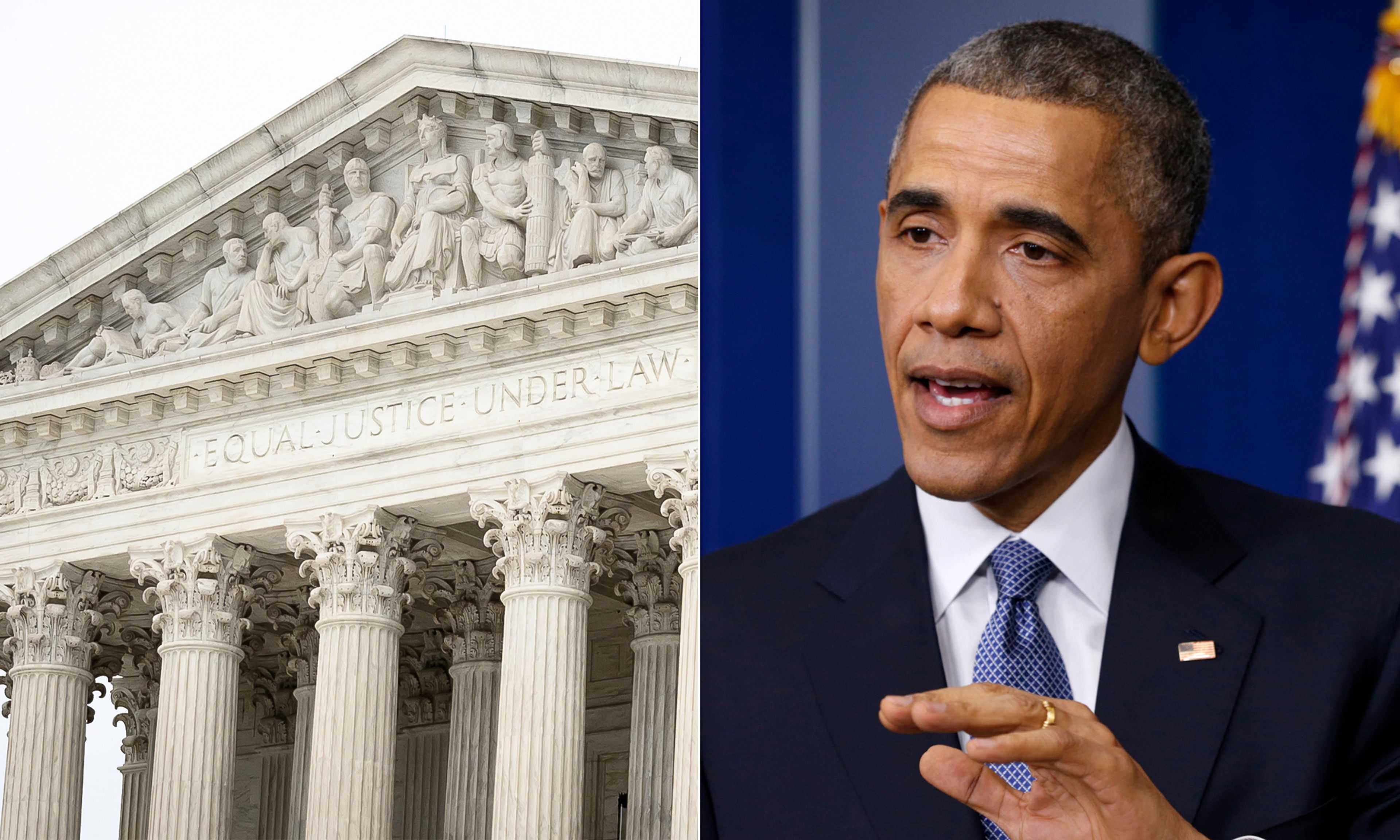
Right: Then-president Barack Obama in the briefing room of the White House in 2014
Over the weekend, Jodi Kantor and Adam Liptak of the New York Times published another story based on leaks from the Supreme Court’s internal deliberations, this time from a 2016 decision on an application for an emergency stay. The leaks include 16 pages of internal memos that the Times published in full. The story was breathlessly hyped by the Times as “The Inside Story of Five Days That Remade the Supreme Court,” with the teaser “The birth of the Supreme Court’s shadow docket has long been a mystery. Until now.”
The hype itself is both overwrought and aimed at the wrong target. But the leak is every bit as newsworthy as its contents.
The Cracked Dam
First, the leak. The Court has still never identified the leaker of the Dobbs opinion. The leak this past weekend is a less egregious breach of the Court’s long-vaunted confidentiality: It releases the ten-year-old internal deliberations over a case that ended four years ago, rather than signaling the fate of a pending case in a way that triggered an armed assassin trying to kill the justices in the majority before the opinion could issue. But it’s still a serious matter that undermines the Court’s institutional tradition of releasing only its final rulings. It’s still a grave breach of trust. And that promotes more of the same bad behavior. As the Times notes, its reporters “spoke to 10 people, liberals and conservatives, who were familiar with the deliberations over the pivotal emergency order and who spoke on the condition of anonymity because confidentiality was a condition of their employment” (emphasis mine). One break in the dam becomes ten.
As Jonathan Adler notes, we may not have a suspect in this leak, but we do have a clue — in addition to the choice to leak this particular story to drive this particular narrative to Times reporters who are hostile to the Court’s conservatives:
The NYT does not reveal where the memos came from, but the memos contain one potential clue. All of the memos appear to be photocopies of the original documents on letterhead with the authoring justice’s initials or signature — save one. The memo from Justice Sonia Sotomayor’s chambers is not on letterhead, has no signature or initials, and (the NYT notes) appears to have the wrong date (likely a typo — "16” instead of “6”) [Alternatively, the 16 could have been autodated when printed later on plain paper.] This suggests the source had access to a non-final or non-circulated version of the Sotomayor memo, but the NYT gives no indication of why that might be.
Of course, only someone currently inside the Court, or a former justice (such as Stephen Breyer), or the custodian of a deceased former justice (such as Ruth Bader Ginsburg) should have access to the file of internal memos from a ten-year-old case, but as Josh Blackman adds, we really have no way of knowing how many former clerks are sitting on stacks of internal Court documents that might leak out in the future.
As Will Baude observes, “The biggest scandal here is in fact the leaks themselves. Supreme Court leaks like these — including copies of confidential work product — are becoming more common. In my view, this is a bad thing. It will damage the institutional culture of the Court and do little good.”
That has to alarm Chief Justice John Roberts.
Defiance and Evasion
The Times story revolves around the Court’s February 9, 2016, stay order in West Virginia v. EPA. Kantor and Liptak claim that this was the beginning of “the shadow docket,” which it defines as “the secretive track that the Supreme Court has since used to make many major decisions, including granting President Trump more than 20 key victories on issues from immigration to agency power.”
This can be misleading. The Court has acted on emergency applications for a long time, with varying degrees of compression of the briefing and argument it receives and the extent to which it explains itself in opinions. “In 2014 and 2015, the Court used the ‘shadow docket’ to stop Texas’ anti-abortion restrictions from going into effect while the case was pending,” Sarah Isgur notes. “The left was thrilled with the shadow docket at that point—years before this case even existed.”
The Times needed to adopt a particular definition in order to declare this case a first: “To be sure, the court sometimes granted emergency applications from death row inmates and in fast-moving election disputes. But the court had never intervened on an emergency basis to shut down a major presidential initiative.”
A major initiative, you say? The case involved the Obama administration’s Clean Power Plan, which aimed to remake the entire power industry on the basis of a flimsy thread in the existing law. In 2022, in a full decision in West Virginia v. EPA, the Court found that the Clean Air Act did not, in fact, give the EPA the authority that Obama had claimed.
In a wonderfully Freudian slip, after noting that the Clean Power Plan was drawn up after Obama “failed to get major environmental legislation through Congress,” Kantor and Liptak write: “With the clock ticking down on Mr. Obama’s presidency and the global Paris climate accords looming, the White House tried to craft a signature piece of environment legislation that could survive the court’s scrutiny” (emphasis mine). The fact that they blithely described a regulation as legislation is really an admission of what Obama was doing: using the executive branch to make law, rather than enforce law.
Hilariously, in reporting on the factors discussed by the justices in deciding whether to issue a stay, the Times authors complain that “in the entire chain of correspondence obtained by the Times, not a single justice, conservative or liberal, mentioned the dangers of a warming planet as one of the possible harms the court should consider.” Of course, deciding whether a policy is a good one or a bad one is not the Court’s job, nor does it relate to any of the factors traditionally considered in law to determine whether a stay should issue. The Court can consider whether the executive branch is trying to do something to address an immediate emergency or a direct threat to public safety, as it has often had to do in evaluating Trump administration actions on immigration and law enforcement. But did the planet suffer irreparable harm? And if the case involved an emergency requiring such speed in its resolution, isn’t that an argument for a rapid judicial decision before years of litigation can wind on?
It’s true that the 2016 order, in addition to being a historical footnote because it was the last thing Justice Antonin Scalia signed on to before his death a few days later, was a step outside of the usual process, because the Supreme Court stayed the Obama plan after the D.C. Circuit had failed to issue a stay, and without waiting for the D.C. Circuit to address the case on the merits. But the justices who pushed for this outcome (chiefly Roberts and Justice Samuel Alito, since Roberts is the circuit justice responsible for emergency orders in D.C., and Scalia and Justice Clarence Thomas were both traveling at the time) have been vindicated on the merits: They stopped an executive action that the Court later found to be illegal, and they did so in good part because they believed at the time that the Court would so find.
More to the point is why Roberts and Alito considered it important to act without waiting for another year of litigation to pass. The Obama administration was not just deliberately trying to evade judicial review by aiming to compel power plants to comply with the new rules before the courts could even weigh in, it was publicly bragging about this, and it wasn’t the first time it did so.
As Roberts explained in his opening memo:
The EPA’s own models show that the rule will cause immediate shifts in power generation, as the industry must make changes to business plans today to meet the 2022 requirements. . . . That harm, once incurred, is irreversible. Given the long lead times and high capital expenditures required for the construction of new plants, once a utility takes steps to comply with the rule its actions are not likely to be undone.
This may not be legal analysis as such, but it reflects the practical wisdom about how court orders interact with real-world actions and consequences for litigants. That’s the kind of practical wisdom that we want from judges. The Obama EPA was trying to create facts on the ground that would outrun the ability of courts to remedy, in order to sideline judicial review. And they were open about it, which did not escape Roberts:
As the EPA Administrator has stated, the Clean Power Plan is being “bak[ed] . . . into the system” right now. Interview of EPA Admin. Gina McCarthy by BBC World News America (Dec. 7, 2015). Solar plants are not built in a day.
Past experience makes the case for irreparable harm: On June 29, 2015, we ruled that the EPA’s Mercury and Air Toxics Standards violated the Clean Air Act. See Michigan v EPA, 135 S. Ct 2699. One day later the EPA announced that it was “confident [it was] still on track to reduce” the targeted pollutants in part because “the majority of power plants are already in compliance or well on their way to compliance.” Janet McCabe Acting Asst Admin for Office of Air and Radiation, In Perspective: the Supreme Court's Mercury and Air Toxics Rule Decision. In other words, the absence of stay allowed the agency to effectively implement an important program we held to be contrary to law.
As Roberts added in a second memo, pushing back at Breyer’s effort to kick the can down the road, neither the ordinary litigation schedule nor the legislative process nor even the then-upcoming presidential election would move fast enough to stop this illegal power grab:
It remains highly likely that this court will not issue a decision until 2018 at the earliest, long after the real-world impacts of the rule would have been felt in the absence of a stay. . . . The comments of the EPA Administrator herself indicate that without immediate action from this Court, this rule will become functionally irreversible — like the ill-fated MATS rule — before this Court can test its legality. When a BBC interviewer asked Administrator McCarthy whether the Administration’s climate change policies would persist if a new President adopted a different view, she responded:
“[O]n issues like the Clean Power Plan, we are, we are baking that into the system. This is not a policy debate, this is now a rule that’s finalized, and it’s [going[ to be solid no matter what Congress, what signals Congress wants to send. But more importantly, every state is actively submitting, going to be submitting their plans. They’re working on them now.” [Quoting the same McCarthy BBC interview]
I am of the mind that a rule designed to transform a substantial swath of the nation’s economy should be tested by this Court before it is presented as a fait accompli. But it seems that the EPA is sufficiently confident of this rule’s immediate implications that not even the combined efforts of Congress and the President could reverse its effects. The agency, it would seem, has made a compelling case for the applicants’ claims of irreparable harm.
Alito was similarly unfooled as to what the Obama team was up to:
I . . . agree with the Chief that the irreparable harm the applicants face is immediate and significant. Any suggestion to the contrary is inconsistent with the EPA’s own [model], which explicitly anticipates the rule will begin to reorder the domestic power industry in 2016 (not 2022). . . .
. . . Perhaps the model overstates . . . the current impacts of the rule. But it is indisputable that the Agency’s own model tells us to expect a substantial shift in power generation right now because of the rule. We should hold the EPA to its own best analysis . . .
And this harm, once incurred, is by nature irreparable. Coal plants are not shuttered — nor solar plants purchased — at the drop of a hat. Of course, the Administrator knows this, which is why she effectively implied that, if the rule is allowed to continue in force, judicial review will be beside the point. That leads me to what is, in my view, the most pressing reason to grant a stay. A failure to stay this rule threatens to render our ability to provide meaningful judicial review — and by extension our institutional legitimacy — a nullity. Whether the Clean Air Act gives the EPA the transformative authority it claims here is an important question. If we fail to stay the rule and maintain the status quo, our resolution of the merits will not matter because the regulated parties will have complied. Instead of robust judicial review our opinion will be a mere postscript. [Emphasis in original]
It is notable that the liberal justices who wrote memos pushing back — Breyer, Sotomayor, and Elena Kagan — entirely ignored the comments from the EPA officials. Roberts and Alito carried the day because they recognized that the Obama administration was trying to effectively evade judicial review and was bragging about it.
This would not be the last time that the urge of executive officials to show that they were working around the courts came back to bite them when the courts got wind of what they were saying. Recall that, in 2021, Joe Biden openly argued that his CDC’s moratorium on evictions should remain in place even after five justices had signaled their view that it was illegal. Biden’s argument was that the Court wouldn’t be fast enough to stop him:
The bulk of the constitutional scholarship says that it’s not likely to pass constitutional muster. . . . But there are several key scholars who think that it may and it’s worth the effort. But the present — you could not — the Court has already ruled on the present eviction moratorium. . . . Whether [the new moratorium] will pass constitutional measure with this administration [sic], I can’t tell you. I don’t know. There are a few scholars who say it will and others who say it’s not likely to.
But, at a minimum, by the time it gets litigated, it will probably give some additional time while we’re getting that $45 billion out to people who are, in fact, behind in the rent and don’t have the money. . . . I can’t guarantee you the court won’t rule that we don’t have that authority but at least we’ll have the ability to, if we have to appeal, to keep this going for a month -- at least. I hope longer. [Emphasis added]
Today, of course, we hear many complaints about the Trump administration’s efforts to get its way even when the judiciary would stop it. But if that’s a real crisis — and at times it is — then we ought to lay the real blame for pushing us into this world of rapid-fire stay applications where it belongs: with Barack Obama’s “pen and phone” presidency.

About the Author
Dan McLaughlin is a senior writer at National Review Online and a fellow at National Review Institute.
Featured Tags
Advertisement
Advertisement

Comments