Annette Kirk, Keeper of the Flame
Written by Kayla Bartsch
A life dedicated to furthering conservatism and the work of Russell Kirk
Share this story
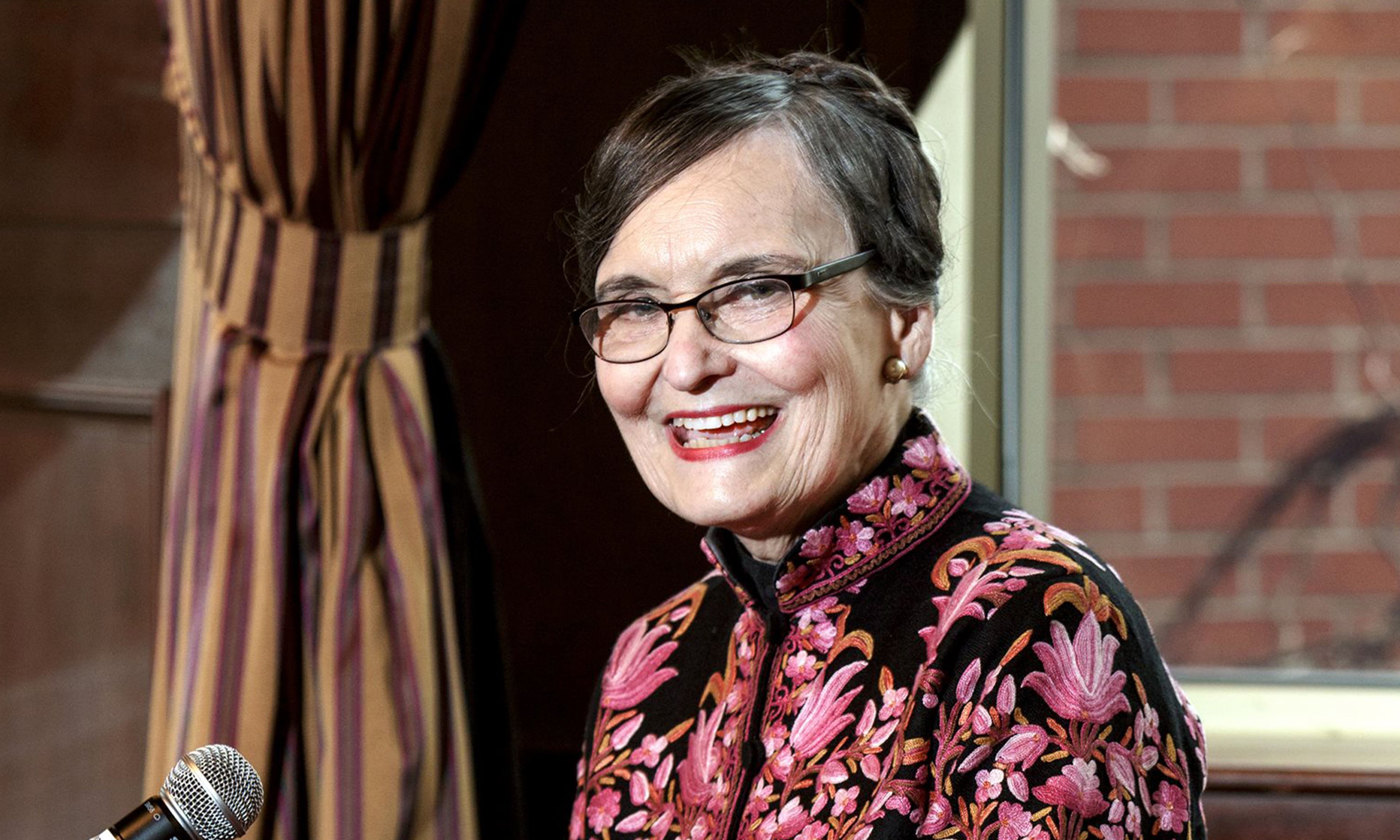
Annette Kirk
Mecosta, Mich. — Annette rushes out the back door of the kitchen. The sound of a lawn mower has called her out of the house to confer with the landscaper on her end-of-season plans for the yard. I’m standing over the stove, helping to prepare dinner for us and Annette’s two youngest granddaughters. When she comes back inside and everything is ready, we sit down at the wooden table, lovingly worn by countless family meals. Our conversation, and the fun, begins.
Annette Yvonne Kirk would baffle many Gen Z conservatives and liberals alike. She is a woman of paradoxes: traditional and free-spirited, formal and friendly, a housewife and an executive, fiercely independent and relentlessly loyal. She has dedicated her life to advocacy of the permanent things. The work of her late husband, Russell Kirk (1918–1994), author of The Conservative Mind and countless other books and articles, retains its vital place in the conservative movement thanks in no small part to her efforts.
When Lee Edwards, a leading historian of that movement who passed away last year, first met Annette, she was a bright-eyed twentysomething conservative activist in New York. Edwards aptly described her as “indefatigable,” a quality that defines her still.
From the first night of my stay at the Kirk home, the red-brick Italianate landmark known as Piety Hill, in the rural village of Mecosta, Mich., I was treated like family. Like the thousands of other guests whom Annette has hosted over the past six decades, from refugees fleeing communism to students seeking retreat, I was incorporated into the life and heart of Russell Kirk’s ancestral home. I experienced firsthand Annette’s legendary energy. When I went upstairs to bed, Annette stayed up, fielding calls from Japan’s embassy staff to schedule an upcoming event at Hillsdale College in southern Michigan.
Although Annette has been at home in Mecosta for several decades, she was -- as she will always be -- a girl from Queens, N.Y. Her tireless commitment to civic causes began with her mother, Mary Courtemanche, a devout Irish Catholic who led groups of concerned citizens -- oftentimes coteries of other mothers -- to push for better services in their neighborhood (such as new traffic lights and buses and better schools) and in the country. Courtemanche successfully fought to stop the planes of Idlewild (now JFK) Airport from dropping sludge over her neighborhood; the smeared sheets on her clothesline became a symbol of the cause.
As Annette told me, “These women were really something, my mom’s friends at that time. They were involved in everything. . . . When they say that women in those days didn’t have any say -- that’s just not true. They weren’t feminists, but they were very active. And might be called feminists today because of some of the things they did.”
Annette and her siblings would help hand out pamphlets written by their mother and produced by their father on a press in the basement. Crucially, Annette’s mother was also a staunch anti-communist. Her Queens parlor became a gathering place for Catholic priests who had fled as refugees from Vietnam, for anti-Soviet freedom fighters, and for conservative intellectuals, including the shy bachelor Russell Kirk.
At 16, Annette got her first job at the charm school in the Gertz department store on Long Island. There, she helped run classes for women and girls on posture, makeup, and dressing for all occasions. As a student at Molloy Catholic College for Women, she served as student council president.
As a leader of the New York chapter of Young Americans for Freedom (YAF), Annette was active in the fight to expose the evils of communism. In a cramped, hot room in midtown Manhattan, YAF leaders planned campus lectures and rallies at Madison Square Garden. In the fall of 1960, Annette and friends piled into a station wagon and drove into Manhattan to protest Khrushchev’s warm welcome at the U.N.
That same year, about a hundred members of YAF gathered in Sharon, Conn., at the childhood home of William F. Buckley Jr., to compose a document -- the now-famous Sharon Statement -- outlining their principles. Annette was one of a handful of women present. She volunteered to serve as secretary for the group, taking notes throughout the discussions. Annette stayed awake until dawn, meticulously typing up the final statement. (She still has an original copy among her files.)
While some women today may recoil at the gender imbalance of the gathering, Annette rather enjoyed her status as one of the few girls in the room. Russell, after watching her speak about his book at the Hotel Wellington in New York, famously described her in the pages of National Review as conservatism’s “most beautiful spokesperson.”
The year 1960 was notable for another event: Annette’s mother had arranged for her to speak at a panel on education, and it was at this event that she first met Russell. Although he was some 20 years older than Annette, who was still in college, they struck up a friendship of words and letters. At the time, Annette had many suitors. Striking, vivacious, and poised, she was one of the few young women in a sea of men denouncing communism and sowing the seeds of the conservative movement.
It would take a few years before Annette and Russell’s relationship took a romantic turn. And it was Annette who would tell Russell, “Our marriage is inevitable.” She had always served higher causes, but in her marriage to Kirk, she found her life’s mission. Where he provided the words, she provided the megaphone.
In 1964, they married and began their shared lives in Mecosta. The couple had four daughters. Annette had to manage a household of six on the modest income of an author, which left little room for luxuries like travel. Russell, who loved his own hearth more than anything else, didn’t mind. And neither did Annette, for although the family didn’t much venture out into the world, the world came to the Kirks.
Thousands would visit, and dozens would live there, many for years. As Edwards chronicled in Modern Age, “The doors of their Italianate residence were always open to the poor and the needy, including Vietnamese families, waves of Ethiopians, Poles fleeing martial law, freedom-seeking Croats, students unhappy with their colleges -- what Russell called ‘a diversity of waifs and strays from Progress.’”
The Kirks also welcomed unwed mothers, offering young women a home and a refuge throughout their pregnancy. At the time of birth, Annette often accompanied the mothers to the local hospital and helped arrange adoptions. Not merely guests, all such wayfarers became integrated into the Kirk home’s daily life and rhythms, cooking, cleaning, praying, and playing with the family and their four daughters. Some stayed for months, others for years. Clinton Wallace, a white-haired wanderer who memorized reams of Shakespeare and classical poetry while on the road, stayed with the Kirks for several years until he died. He is buried in the Kirk family plot.
As the hands and heart of Piety Hill, Annette has modeled for decades the lost virtue of xenia, an ancient Greek term for “hospitality.” As in the stories of the widow of Zarephath, who made Elijah a loaf of bread from her last serving of oil and wheat, or the deaconess Phoebe, who hosted the apostles in her home, xenia recognizes a distinct magnanimity in the act of hosting. In their parlor, the Kirks welcomed homeless nomads and internationally renowned scholars alike. A visitor’s eye roams across the richly wallpapered walls, stopping at a suit of armor on display, to rich red curtains, to a massive, gilded mirror Annette bought off the wall of a Chinese restaurant. The room hosted such guests as Buckley, Roger Scruton, and Malcolm Muggeridge. Guests are traditionally called to dinner by a scholar in residence playing the bagpipes.
Over the years, Annette has served on national committees and local councils, positions of which she is equally proud. In Mecosta, the library, elementary school, local arts program, and Sunday school all owe their formation to Annette. In the 1980s, she was tapped to serve on President Reagan’s National Commission on Excellence in Education. Her work helped pave the way for the parents’ rights movement in K–12 education today.
After Russell’s passing, Annette formalized her work and founded the Russell Kirk Center for Cultural Renewal in Mecosta. For decades, she served as its president, an elegant center of activity, with her long black hair braided and drawn back into a neat bun. Today, Jeff Nelson, the husband of Annette’s daughter Cecilia, serves as the center’s executive director. Piety Hill remains a mecca for weary travelers seeking the permanent things. Now part of the Russell Kirk Center’s campus, the old home continues to serve as a salon of American conservatism. The center, which includes Russell’s library, family cabins, and neighboring homes, welcomes hundreds of students and scholars annually.
Through decades of attention and care, Annette Kirk has turned Mecosta into a blazing hearth where guests can deepen their understanding of the foundational ideas of American conservatism and carry the flame in their own lives.

About the Author
Kayla Bartsch is a former William F. Buckley Jr. Fellow in Political Journalism at National Review.
Featured Tags
Advertisement
Advertisement




Comments