Another Court Disqualifies Another Trump Prosecutor, Ending Another Retributive Probe of Letitia James
Written by Andrew C. McCarthy
The president is only hurting himself.
Share this story
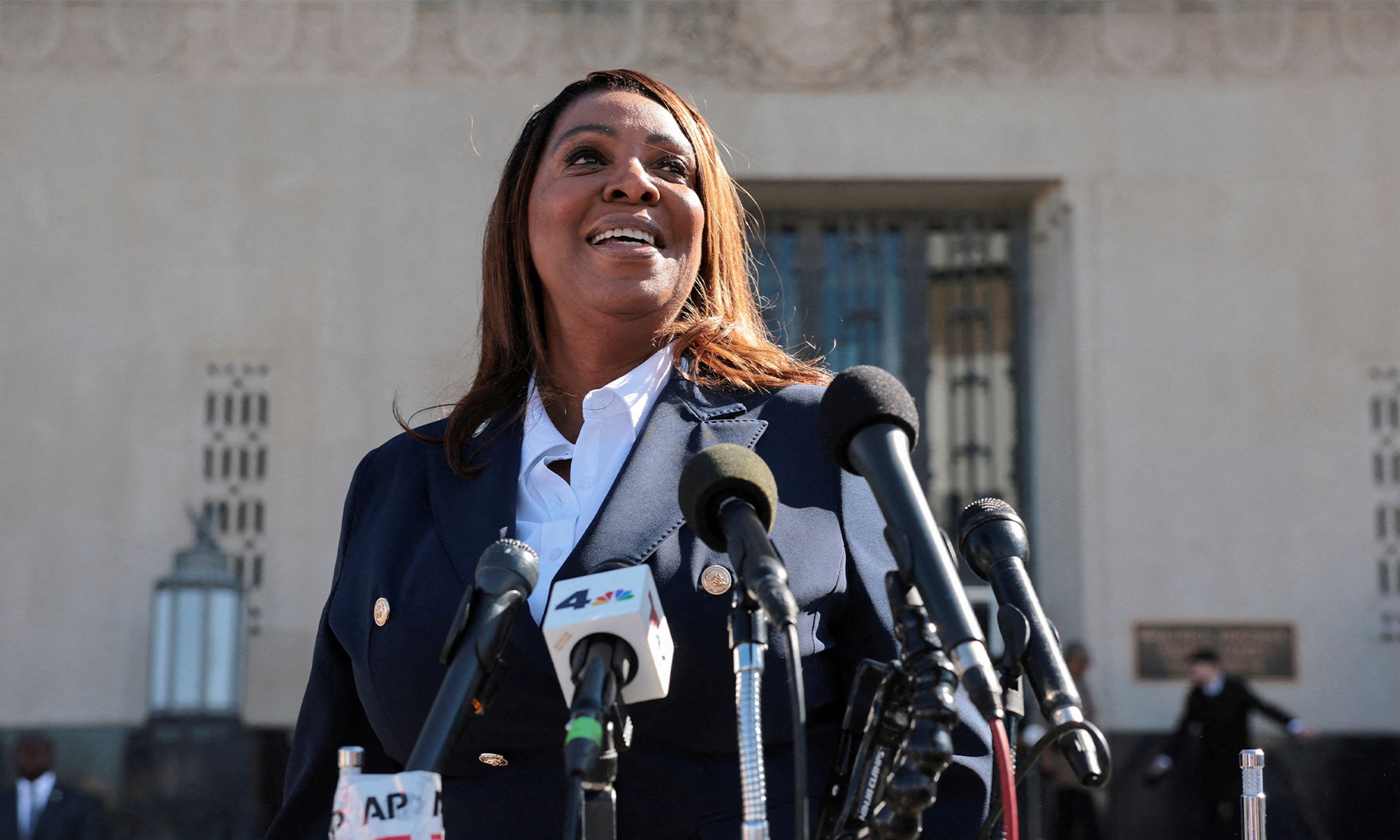
New York Attorney General Letitia James speaks to the media after she pleaded not guilty to charges that she defrauded her mortgage lender, outside the District Court for the Eastern District of Virginia, in Norfolk, Va., October 24, 2025.
The president’s campaign to circumvent the Constitution’s prerequisite of Senate consent for top appointees has once again led to the disqualification of a Trump appointee to run a district U.S. attorney’s office. This time, the ousted operative is John A. Sarcone III, whom the Trump Justice Department purported to install as acting U.S. attorney for the Northern District of New York (NDNY).
As with the November disqualification of Lindsey Halligan, who similarly was illegally installed as a de facto U.S. attorney, in the Eastern District of Virginia (EDVa), Sarcone’s ouster ends, at least for now, a retaliatory probe of Letitia James, the New York State attorney general. James, of course, brought a deservedly derided civil fraud lawsuit against the now-president. Recall that Halligan’s indictment of James on dubious bank-fraud charges was thrown out in November (along with her indictment of another Trump nemesis, former FBI Director James Comey, on inscrutable false-statement charges); her EDVa office’s subsequent attempts to charge James have been rejected by grand juries.
Sarcone was seeking to investigate James’s civil prosecutions of both Trump and the National Rifle Association, a Trump supporter. Like Halligan, Sarcone has now been disqualified from further participation in these retaliatory gambits.
Sarcone’s disqualification and the quashing of subpoenas he issued to James’s office in the Trump and NRA matters were ordered in a 24-page opinion issued last Thursday by Judge Lorna Schofield of the Southern District of New York (SDNY). Judge Schofield, an Obama appointee who was unanimously confirmed and is well regarded, had been appointed by the Second Circuit to handle the challenge to Sarcone’s status. (As I’ve previously explained, the judges in the districts affected -- here, the NDNY -- have recused themselves from challenges to illegitimate U.S. attorney appointments; a judge from another district within the same circuit is appointed to hear these challenges. The NDNY and SDNY are both in the Second Circuit.)
Following the other courts around the country that have considered these challenges (see, e.g., here, here, and here), Schofield found that Sarcone’s appointment was unlawful. She therefore decided not to reach more complicated questions, such as whether the Trump DOJ is violating federalism principles by attempting to inquire into the state attorney general’s exercises of her prosecutorial discretion. James may raise such claims again if the Trump DOJ, through qualified prosecutors, persists in investigating the NYAG’s office.
(Aside: CBS News reports that the Trump DOJ persists in trying to make a case on James, now focusing on loans she made to Iyesata Marsh, her longtime hairdresser whom federal prosecutors in Louisiana indicted late last year on bank fraud and identity-theft charges.)
In February 2025, the president, through Attorney General Pamela Bondi, named Sarcone the NDNY’s interim U.S. attorney. With roots in Westchester County, Sarcone had been a minor official in the first Trump administration. He was also, reportedly, a lawyer for at least one of the Trump presidential campaigns. He had never worked as a prosecutor when Bondi appointed him the NDNY’s interim U.S. attorney for the 120 days permitted under the governing statute, Section 546. When that period lapsed, the NDNY judges declined to extend his appointment.
As I related when these events were unfolding:
Sarcone had a rocky tenure. The New York Times has reported that he appears to have exaggerated an encounter with an illegal alien he described as “a maniac with a knife who was speaking a foreign language,” and who, Sarcone alleged, lunged at him on the street outside a hotel. State prosecutors had to drop attempted murder charges because the surveillance video did not bear out Sarcone’s version of events, although the man did plead guilty to second-degree menacing. It also turned out that when he filed a complaint about the incident, Sarcone listed a boarded-up building as his residence; when the Albany Times Union reported this fact, Sarcone retaliated by removing the paper from the office’s press distribution list.
The court’s refusal to extend Sarcone has left the NDNY without a district U.S. attorney. Under Section 546, the judges could have appointed an alternative district U.S. attorney to serve until a Trump appointee was confirmed by the Senate. Yet, the district’s five active judges, all Democratic appointees, declined to do so, aware that anyone they appointed would promptly be fired by Trump (which the Constitution empowers him to do since U.S. attorneys are executive officers).
President Trump has never nominated anyone to be the full-fledged -- i.e., Senate-confirmed -- NDNY U.S. attorney. Here, we get to the crux of the controversy.
New York is deep-blue, with two Democratic senators (Minority Leader Chuck Schumer and Kirsten Gillibrand) who are empowered under Senate rules to block nominees for federal posts in their state. While the president believes he should be able to install whomever he pleases, the Framers intended the confirmation requirement, stemming from the Constitution’s appointments clause, to be a check on executive power. Consequently, all presidents have to deal with senators of the opposition party on nominations for both executive offices (such as district U.S. attorney and district U.S. marshal) and district judges to serve in those senators’ states.
As the Constitution intends, the result is a compromise process that yields nominees acceptable to both sides (though they would not be the first choice of either), or a mix of nominees (e.g., the president might allow the opposition party to choose nominees for some vacant offices, in exchange for getting his preferred nominees approved for other vacant offices). Like presidents, senators also have an incentive to horse-trade; someday, they know, the White House will be held by a president from their own party, who will need the same accommodations from opposition-party senators if that administration is to function.
President Trump, however, refuses to adjust to the Constitution’s constraints on executive authority. His stubbornness is self-defeating: The Constitution does not rely on the president’s indulgence; instead, it arms Congress with competing powers to thwart appointments.
The appointments process is controlled by statutes, whose underlying assumption is that a president wants confirmed appointees and will work with the Senate to get them. Hence, these statutes permit the president to install non-confirmed appointees only temporarily -- i.e., while the confirmation process ensues. In the main, these time frames are 120 days for interim U.S. attorneys under Section 546 and 210 days for acting U.S. attorneys under Section 3345 (the Federal Vacancies Reform Act). When they expire, as we’re seeing, the courts will uphold the statutes and disqualify the temporary appointees.
Bottom line: The president is only hurting himself. The Senate is not going to change its rules just so Trump can plunk more lightweight loyalists into powerful prosecutor jobs -- particularly given the Trump DOJ’s burgeoning record of politicized, retaliatory prosecutions and insider pardons (as well as stunts like the administration’s shameful revisionist history of the Capitol riot, deftly dismantled by Noah Rothman last week).
There are scores of conservative lawyers with prosecutorial experience who could easily be confirmed and would ably further the worthy aspects of Trump’s enforcement agenda -- such as Erik Siebert, the EDVa interim U.S. attorney whose nomination Trump withdrew over his refusal to charge James and Comey, even though AG Bondi and Deputy AG Todd Blanche reportedly pleaded for Siebert to be kept in place because he was extremely effective. But such lawyers are not toadies, so Trump won’t nominate them. Democrats don’t care. They’re more than willing to withstand some instability in their states -- i.e., the doubt cast on federal prosecutorial actions when there is no fully authorized district U.S. attorney -- if it means sidelining Trump loyalists and avoiding aggressive prosecutions frowned on by progressives (e.g., cases involving illegal immigration, gang crime, and massive fraud on government programs pushed by Democrats).
As Judge Schofield observes in her ruling:
A U.S. Attorney must be nominated by the President and confirmed by the Senate. 28 U.S.C. § 541(a). This requirement ensures that the Senate has a say in who fills the position. The Constitution gives the Senate this “advice and consent” role as a check on Executive power and a guard against “a spirit of favoritism” in federal appointments. . . . Concerns of cronyism go back to this Country’s founding. As Alexander Hamilton wrote in 1788, the “advice and consent” process prevents the President from unilaterally installing “candidates who ha[ve] no other merit than that . . . of being, in some way or other, personally allied to [the President], or of possessing the necessary insignificance and pliancy to render them the obsequious instruments of his pleasure.” The Federalist No. 76, at 394-95 (Alexander Hamilton) (George W. Carey & James McClellan eds., 2001)[.] . . . “The Framers envisioned [the “advice and consent” safeguard] as an excellent . . . guard against the appointment of unfit characters from family connection, from personal attachment, or from a view to popularity.” [Quoting Chief Justice John Roberts’ opinion for the Supreme Court in NLRB v. SW General Inc. (2017).]
Indeed, the concerns expressed by Hamilton and the other Framers are reflected by the Declaration of Independence. In listing the colonists’ grievances against the British monarch, Thomas Jefferson cited his appointed governors and officers, who were loyal only to the crown and were harassing the people, refusing to respond to their needs, and declining to effect their laws.
The president’s failure to nominate experienced, confirmable prosecutors -- which entails negotiating with the opposition party, as all presidents must do -- is causing instability in law enforcement operations, including in districts that have significant crime problems. It cannot be gainsaid that Democrats have slow-walked many Trump nominations. Nevertheless, the president is hurting himself, and law enforcement, by trying to end-run the confirmation process while prizing personal fealty over competence and rectitude.
About the Author
Andrew C. McCarthy is a senior fellow at National Review Institute, an NR contributing editor, and author of Ball of Collusion: The Plot to Rig an Election and Destroy a Presidency.
Featured Tags
Advertisement
Advertisement
Comments