Bad Bets: The New Culture of Sports Gambling
Written by Jack Butler
It's corroding sports and hurting individuals
Share this story
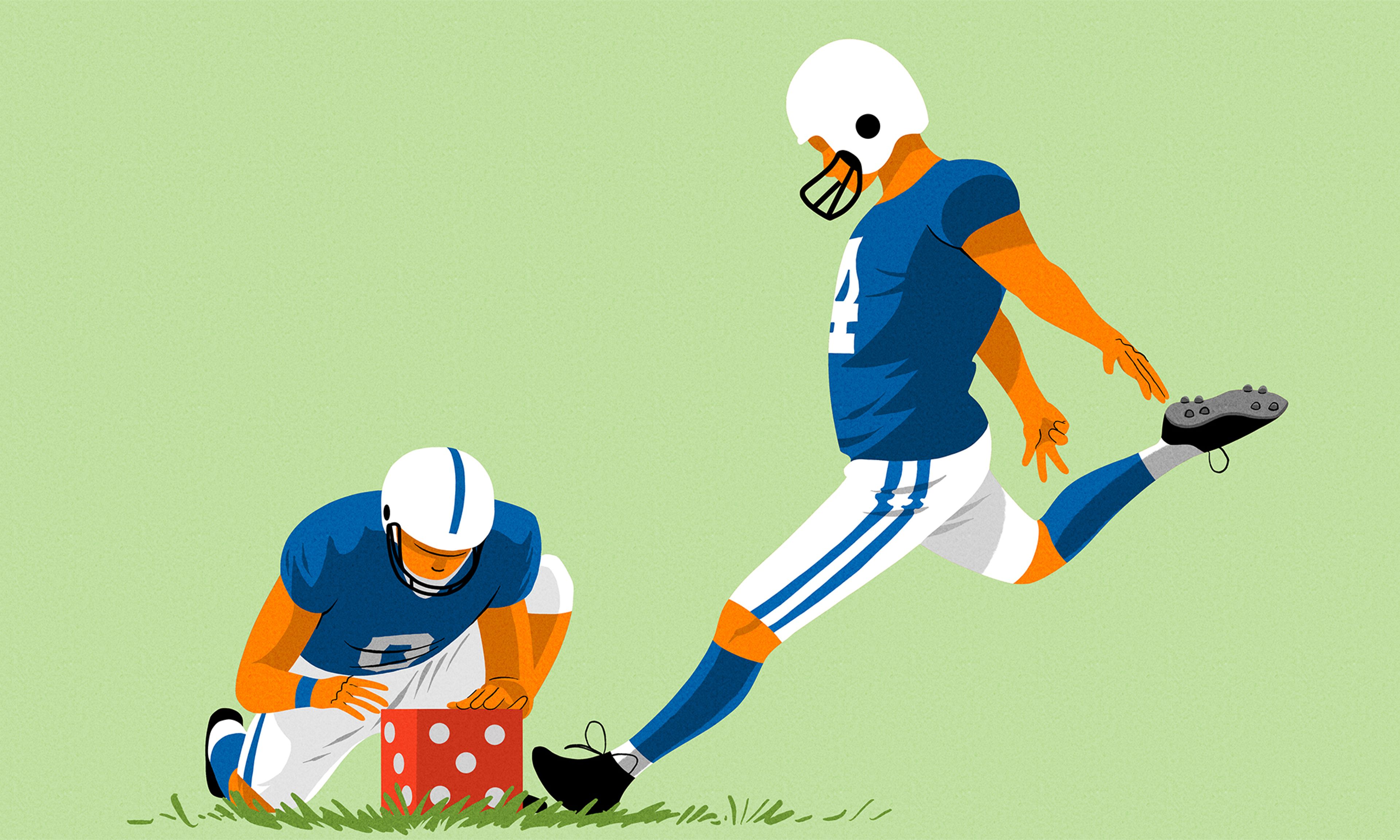
Eric Sailer
America doesn’t have a sports-betting problem, we are told. Now legal in most U.S. states, wagering on games, matches, and other events has increased interest in professional and collegiate athletics, generated more profits for gaming companies and sports institutions, and increased revenues for state and local governments. In a March press release estimating that Americans would bet $3.1 billion on that month’s college basketball tournaments (up from $2.7 billion the year before), the American Gaming Association, a trade-industry lobbying group, claimed that this growth reflected “the expanding legal sports betting market and the growing trust in legal wagering options.”
Or so proponents of the vastly expanded practice of sports gambling would have us believe.
Such advocates bet that we will take these claims at face value, while they also belittle or dismiss the possibility of severe costs. It is their right to make this case. And it is our right to interrogate it. Doing so reveals that the push for sports gambling has had many corporate and athletic beneficiaries. But there have also been huge losses for many of the participants -- and not just from the bets that haven’t gone their way. Moreover, those who do not suffer personally or financially, as well as those who do, may be contributing to a long-term corrosion of sports -- a degradation in which sports themselves are now complicit.
It was not always this way. In 1992, Congress passed the Professional and Amateur Sports Protection Act, which effectively prohibited most forms of sports gambling. It was undoubtedly still happening, but in the shadows. For a time, the sporting mainstream, which had once driven famed Cincinnati Reds player Pete Rose into the MLB’s outer darkness for betting on the team (which he was managing), sought to keep it that way. It wasn’t just baseball. This legal regime helped keep Las Vegas, long known and grudgingly (or not so grudgingly) accepted as a kind of quarantine for games of chance, from having an NFL team. In 2003, the league even rejected an ad from the city’s tourism commission. In 2012, however, this environment began to change. That’s when New Jersey, home to Atlantic City, legalized the activity. A legal battle ensued. The National Collegiate Athletic Association claimed that New Jersey violated the law; New Jersey countered that the law was an unconstitutional usurpation by the federal government of powers belonging to the states. When the state’s challenge, begun under Republican Governor Chris Christie and continued under his Democratic successor Phil Murphy, reached the Supreme Court, the Court sided 6–3 with New Jersey.
It was a jackpot for sports betting. Over the succeeding seven years, the practice has become legal in 39 states and Washington, D.C. Legalization was -- and remains -- popular and bipartisan. Legal wagers have totaled around $500 billion, with almost a third of that coming in 2024. Numbers of that size translate to substantial revenues for the sports-betting industry: $13.71 billion in 2024 alone. Sports franchises and leagues see some dough as well, from lucrative sponsorship deals with companies such as FanDuel and DraftKings, and from advertising. Gambling companies spent $434.4 million on commercials for sportsbooks (places, physical or digital, that enable wagering on athletics) in 2024. And the tax man now gets a cut: In 2024, that was a cool $2.8 billion. The Las Vegas quarantine has broken down completely: Super Bowl LVIII was played just outside the city, which got its own NFL team in 2020. The face of sports has changed in other ways. Those millions of dollars in ads are all over the broadcasts of professional games. They brandish the sanction of a wide array of celebrities, including former athletes. Analysis of spreads and odds has crept into coverage of games. Sportsbook parlors encircle many major event venues. Some arenas and stadiums now prompt spectators to bet during the events themselves.
Beyond mere legalization, cultural and economic pressures contributed to the spread. The profit motive of companies and the revenue hunger of governments, particularly during the Covid anomaly (when both suffered in each area), played a role. As did another major change in American life between 1992 and 2018, one that has continued since: the ubiquity of smartphones, on which virtually all sportsbooks are present. With sports betting not only legal but also digital, whatever dodgy stigma it may have once had from suspect bookies or dilapidated parlors has vanished. Gamblers don’t even have to leave their homes or even see anyone to do it, if they don’t want to. “Now, you have a casino in your pocket, 24 hours a day,” Lia Nower, who studies gambling and addiction at Rutgers University, says.
Not all gamblers choose the route of anomic isolation. It has a lure either way. The demographic for whom sports betting has proven particularly attractive is young males. Gambling of all kinds tends to be a man’s game; sports betting is often a young man’s. They’re the ones who grow up playing and watching sports, frequently in social settings. Nothing wrong with that. Issues emerge, however, when you throw in the young man’s poor impulse control and tendency toward what Isaac Rose-Berman calls “financial nihilism.” Rose-Berman is a professional sports bettor who nonetheless worries about the excessive spread of the activity and studies it for the American Institute of Boys and Men. He believes young men with a small amount of disposable income, but not yet able to afford major life purchases, figure that, essentially, they could have much to gain while they don’t have much to lose.
Oh, but they do. And they’re not the only ones. The profits for gambling companies, sports franchises, and leagues are real. The tax revenues, however, can be unreliable and are overstated. But it is the costs that are most understated. Between 2018 and mid-2023, Americans lost some $245 billion on sports betting. That money has to come from somewhere. The result, as Charles Fain Lehman pointed out in The Atlantic, is reduced household savings, increased maxing out of credit cards and bank overdrafts, and higher rates of personal bankruptcy. One study even found a strong connection between the legalization of sports gambling and increases in domestic violence. Sports betting also serves as a funnel to forms of gambling that are even more addictive and higher risk. The leading sports-betting companies have a vested interest in encouraging gamblers to try other, more lucrative forms. Many travel down this precarious path. “I view sports betting particularly as the on-ramp into gambling addiction, especially for young men,” Rob Minnick says. Minnick, a recovering gambling addict in his mid-20s, now runs a YouTube channel called ODAAT (“One Day at a Time”) Gambling Awareness, where he tries to reach out to problem gamblers who don’t think there’s anything wrong. That is, people like him in 2022, when, in a memorable incident he recently recounted in The Nation, he found himself playing baccarat on his phone while in a Parisian bathroom and accepted that he might have a problem.
Individual cases such as Minnick’s are reason enough to wonder if the headlong rush into legalization has been a good idea. The role that sports leagues have played in integrating with sports betting is an indictment unto itself. But there is a darker undercurrent that suggests sports themselves may end up regretting their union with their onetime scourge. A growing stigma of impropriety is now attaching itself to athletic contests. On the professional level, coaches and athletes alike can now invite suspicion about whether they are altering their performances for the sake of some wager, either for themselves or for some predesignated beneficiary. This concern is sometimes vindicated. Last year, Jontay Porter, a gambling-indebted NBA player, received a lifetime ban from the league for betting on his own games when playing for the Toronto Raptors; he has also pleaded guilty to criminal charges. Cases such as Porter’s cast doubt, whether deserving or not, on non-offending parties. Many of the fans, either newly stimulated by sports gambling or new to the sport because of gambling, have gained an additional and unhealthy investment in the performance of the teams they watch.
An excessive devotion to game outcomes is, of course, not uncommon for sports fans. But parlays, which allow bets on multiple in-game outcomes to be strung together, and spreads, that take into account margins of victory and defeat, increase the range of bets far beyond mere victory or defeat. So spectators now get incensed by player performances that defy their bets. On The Pat McAfee Show, Indiana Pacers player Tyrese Haliburton speculated, of his social media mentions, that “the majority of them are about me f***ing up somebody’s parlay.” Gambling-driven fandom “might be good in the short run,” Rose-Berman says. But leagues might be starting to wonder whether, “in the long run, are you creating a generation of sports fans, or gambling fans?” Would the latter be the kind of fans they want?
Professional athletes, while not fond of such pressure, are at least inured to forms of it. College athletes are in a different position. Many sports powerhouses in the formerly betting-resistant NCAA have accommodated the new sports-betting landscape. When Louisiana State first finalized an arrangement with Caesars Sportsbook in 2021, the school sent a mass email (to some students under 21), promising $300 in free bets after an initial $20 wager. (A company executive claimed that the email was sent out by mistake.) College athletes are now also the targets of gambling-driven rage. Shortly after Ohio legalized sports gambling, college athletes in the state began receiving requests from peers on the money-sharing app Venmo when their performances didn’t meet expectations, according to The Guardian.
They sometimes get worse than that. Messages such as “You deserve to get unalive for blowing my bet” and “You cost me two grand -- I hope your dog gets cancer” made their way to Ohio college athletes. There’s even evidence that the effect has trickled down to high school athletics. A public school official in Cincinnati blamed recent outbreaks of violence at high school football games on the fact that wagers of up to $5,000 were being placed on them, according to the Cincinnati Enquirer. It’s enough to make one wonder whether the rise of sports betting has begun to compromise the virtues associated with sports.
As this behemoth social tide rolls on, conservatives are in what is, unfortunately, a familiarly beleaguered position. We could start by admitting that sports betting is at least a questionable addition to American life in its current form. Understandable -- and, in most cases, laudable -- commitments to free markets map uneasily onto an activity in whose expansion governments are now complicit. It’s governments, not just private companies, that prosper when sports-betting companies succeed in undermining classical virtues such as restraint, moderation, and thrift. We might then take some strange solace in the fact that there may be unexpected political allies on the left just as leery of gambling. What began as a bipartisan cause could have its excesses restrained by one as well.
The realities of politics and of the current sports-betting landscape suggest a two-pronged approach. First, addressing the problems of individuals, such as those that Minnick attempts to reach through his YouTube channel. That may require more dollars, private and (gulp) public. But it is worth doing. And not just at the level of treatment. Education matters, too. Teaching children about the risks of sports gambling “has to start in elementary school,” Nower argues. “These kids that are eight and nine years old are betting with their parents. So this education has to be at parity with the education we give them.” Second, addressing sports betting itself. A reversal of legalization does not seem to be in the cards, for now, though states -- such as California and Texas -- that have not yet legalized it might reconsider. Failing that, they ought at least to ensure that their legal regime resembles that of states which have legalized the practice more carefully. Ohio, for example, forbids bets linked to particular collegiate athletes (known as “prop bets”), prevents sports-betting promotion on college campuses, and mandates that all sports-betting advertisements mention in-state resources to address problem gambling.
A reduction in the nearly omnipresent entangling of sports-betting advertisements with sports broadcasts, an increase in transparency on apps (so that bettors know how much they’re up -- or, likelier, down), and other, similar steps are worth pursuing. These will, in some cases, be opposed by the now firmly entrenched interests who support sports gambling, frequently with a nigh-extortive recourse to the shadows from which gambling supposedly emerged safer, and to which it could dangerously return. That may or may not be a persuasive argument against completely reversing legalization. It’s less potent when used against sensible standards for the practice. Both of these approaches, at the individual level and at the level of society itself, have something in common: They require admitting there’s a problem. That’s no easy thing. “It’s really getting people to come to that conclusion, that’s the difficult part,” Minnick says of the problem gamblers he tries to reach. This will also be true of society, particularly while we are still at the point where the apparent benefits of sports gambling are more public than the costs. The odds may be against anyone who tries to do something about all of this before it’s obvious that the latter outweighs the former. But reaching that perilous point is not a risk worth taking. It’s not just money we’re gambling with.

About the Author
Jack Butler is the deputy opinion editor of the Wall Street Journal and former submissions editor at National Review.
Featured Tags
Advertisement
Advertisement


Comments