Beijing Weaponizes Strategic Ambiguity on Taiwan
Written by Jianli Yang
China’s latest action looks less like an exercise and more like a deliberate attempt to erase the line between drills and war.
Share this story
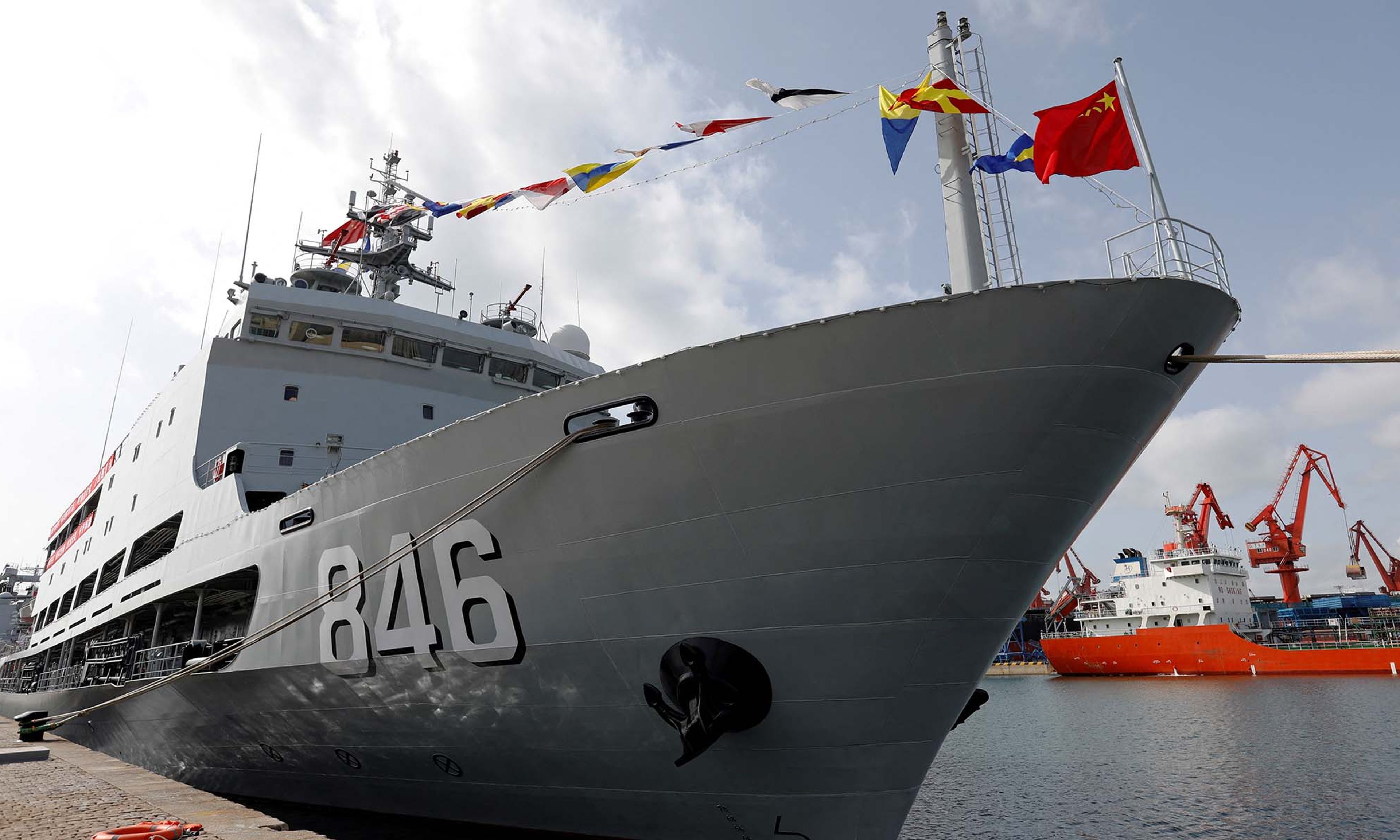
A Chinese warship is docked in Qingdao, Shandong province, China, April 20, 2024
On December 29, 2025, the Eastern Theater Command of China’s People’s Liberation Army (PLA) abruptly launched a large-scale military operation around Taiwan. The operation, code-named “Justice Mission 2025,” was the seventh such action since 2022. But this provocation crossed red lines that earlier drills had deliberately avoided.
For the first time, Chinese maneuvers extended inside Taiwan’s twelve-nautical-mile territorial waters, with the closest activity reportedly less than five nautical miles from the main island. Disturbingly, the operation involved live fire. The drills caused tangible economic and social disruption: Taiwan’s civil aviation authorities were forced to issue multiple emergency flight advisories rerouting civilian aircraft, commercial shipping companies adjusted their schedules, and insurers raised risk alerts for vessels operating nearby.
Beijing framed the operation as a response to Washington’s recent approval of an approximately $11 billion arms package for Taiwan and Japanese Prime Minister Sanae Takaichi’s November statement that “a Taiwan contingency is a Japan contingency,” which echoed long-standing Japanese security assessments linking Taiwan’s fate to Japan’s own defense posture. Official statements from the Chinese government described the drills as a warning to “Taiwan independence forces” and “foreign interference.” Yet judged by scale, proximity, intensity, and real-world impact, “Justice Mission 2025” cannot be accurately understood as a conventional military exercise — or as a typical, one-off political response to Taipei, Washington, or Tokyo.
What makes this operation fundamentally different is not only how close the PLA moved, but how it moved. Past exercises were announced in advance and followed a predictable pattern, with clearly delineated zones, timelines, and preparation phases. We saw this during the large-scale drills that followed then–Speaker Nancy Pelosi’s 2022 visit to Taiwan, when China publicly released exclusion zones and maritime notices days ahead of time. This time, the boundary between preparation and execution was blurred. The suddenness, the live fire inside territorial waters, and the immediate disruption of civilian life all marked a qualitative shift. With China going so far as to paraphrase Vladimir Putin’s language before Russia’s invasion of Ukraine — when Moscow labeled its assault a “special military operation” — this action looks less like a carefully calculated exercise and more like a deliberate attempt to erase the line between drills and war.
This recent operation marks the inauguration of a new strategy that can be described as Beijing’s strategic ambiguity. Its core logic is to normalize the isolation of Taiwan while systematically blurring the distinction between routine military activity and imminent combat. By repeatedly operating at the threshold — inside territorial waters, under live-fire conditions — the PLA forces its opponents to guess whether its next move will be another drill or the opening shot of a real conflict. Ambiguity itself becomes a weapon.
That ambiguity is paired with psychological warfare, designed to create conditions of fear and social tension inside Taiwan. In the days surrounding the operation, Chinese state media and official PLA channels released videos of a drone flying over Taipei 101, AI-generated animations of coordinated drone swarms, and simulated strikes on U.S. weapons systems such as the M142 HIMARS — footage that analysts noted emphasized offensive command sequences rather than defensive scenarios. One video showed a commander ordering simulated attacks on American rocket launchers, underscoring China’s message that the PLA can reach Taipei at will, escalate instantly, and initiate full-scale combat without warning.
The goal, of course, is to subdue Taiwan without “fire and smoke.” As Sun Tzu argued in The Art of War, the highest form of victory is to defeat an enemy without fighting. But Beijing also understands that it cannot rely on Taiwan surrendering without the credible threat of real, devastating war in which Taiwan has little chance of prevailing. That is where strategic ambiguity plays its decisive role — probing, pressuring, and testing until political and psychological resolve erodes. Beijing is deliberately tossing the ball into Taiwan’s court, betting the island will hesitate to act.
That hesitation matters because of established red lines. Taiwan’s minister of national defense has repeatedly stated, including in formal legislative testimony, that if PLA aircraft or warships enter Taiwan’s twelve-nautical-mile airspace or territorial waters, Taiwan has the right to exercise self-defense under international law. Now the PLA has not only entered that space but conducted live-fire drills within it. To Japan, does this qualify as “Taiwan having a problem” — or not? To Washington, how should it be classified: as a military exercise, a special military operation, or an act of aggression prohibited under the U.N. Charter?
Beijing understands that no major power wants war with China. That calculation fuels the escalation ladder. Today: Two days, live fire, as close as five nautical miles. Tomorrow: Three days, a larger scale, and as close as three nautical miles? Each escalation is meant to test Taiwan’s reaction.
This is where Washington’s long-held policy of strategic ambiguity comes under strain. For decades, U.S. policy — anchored in the Taiwan Relations Act — has deliberately avoided stating explicitly whether the United States would militarily defend Taiwan, aiming instead to deter both a Chinese attack and a unilateral declaration of independence by Taipei. That ambiguity worked when Beijing’s actions remained within recognizable bounds. Beijing’s new ambiguity is designed to hollow those bounds out.
Repeated gray-zone crises generate crisis fatigue in Washington, Tokyo, and Taipei. Each episode demands attention, mobilization, and the expenditure of political capital. Over time, constant alarms dull sensitivity. What once would have been intolerable begins to feel routine. This fatigue is dangerous: it lowers vigilance precisely as risks increase.
If Washington’s strategic ambiguity is repeatedly tested without consequence, it ceases to deter. Beijing’s approach is not aimed at a single dramatic rupture but at a gradual shift in what others are willing to tolerate. The danger is a Taiwan Strait reality that drifts, step by step, into a position Washington can no longer manage — one fundamentally misaligned with U.S. strategic interests.
The United States must therefore move quickly to develop a response to Beijing’s strategic ambiguity. This does not require the reckless abandonment of America’s own strategic ambiguity or automatic escalation in response to Chinese provocations. But it does require redefining thresholds, restoring credibility, and ensuring that ambiguity does not become paralysis. If Washington fails to adapt, Beijing’s new normal may harden into a strategic fait accompli — without a declaration of war, but with consequences just as profound.

About the Author
Jianli Yang is a research fellow at the Harvard Kennedy School of Government, a columnist for National Review, and the founder and president of Citizen Power Initiatives.
Featured Tags
Advertisement
Advertisement
Comments