Bring Back Quiet Libraries
Written by Alexandra DeSanctis
Lovers of silence need a refuge in a noisy world.
Share this story
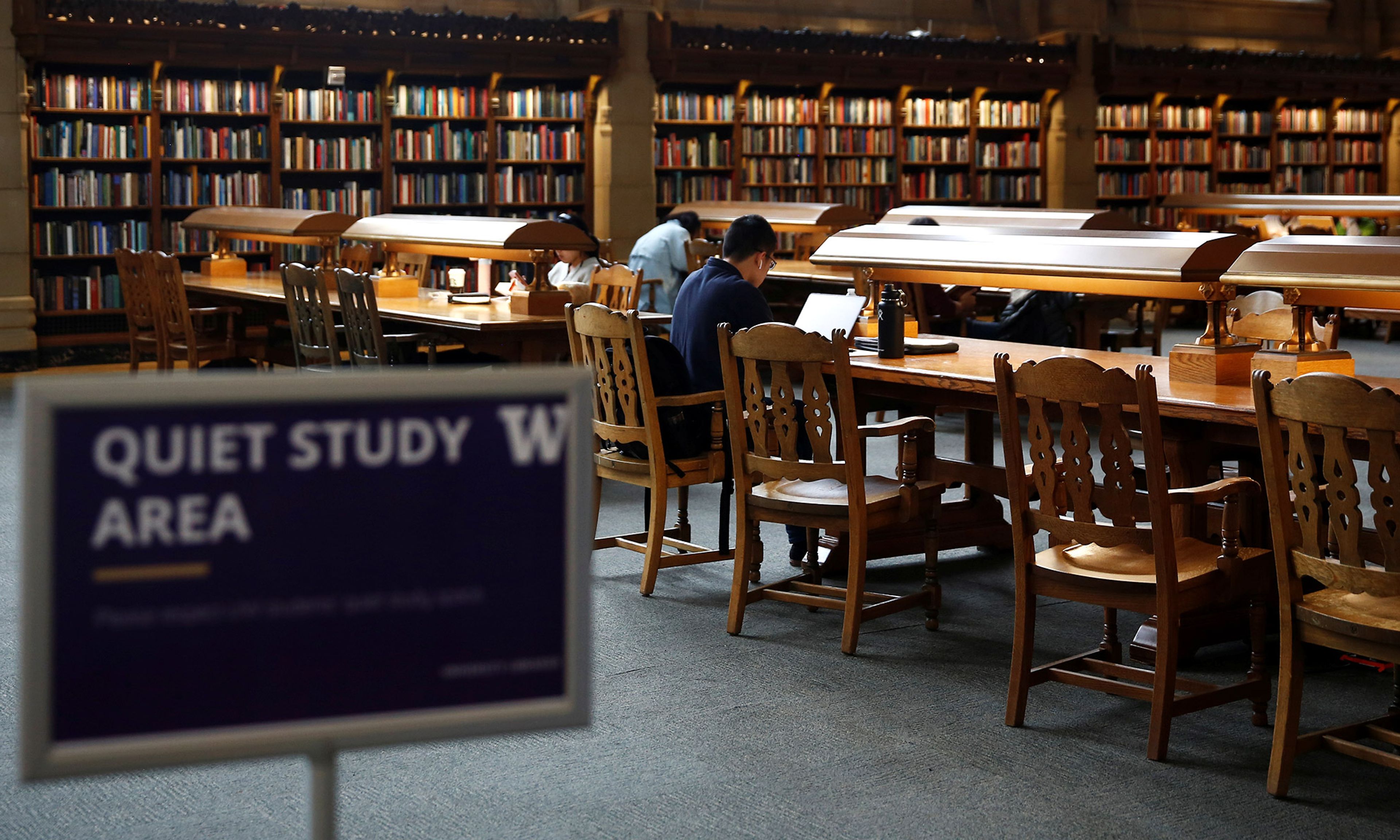
Students study in the Reading Room at Suzzallo Library on the University of Washington campus in Seattle, Wash., September 20, 2018.
On a recent trip to the local public library, I discovered something distressing. In the children’s section, each computer station was occupied by a child playing games on full volume. And as I perused the stacks, I was the only one browsing. The kids didn’t appear to be at the library to discover new books or pick up old favorites; they were there to play on the computer.
More troubling than this incident, though, is the sheer level of noise at the library from visitors of all ages every time I visit. My issue isn’t with children in public spaces — far from it. Kids will always be somewhat noisy, whether they’re on a computer or not. But when I was a child — not all that long ago, I should add — librarians seemed to take special pride in shushing patrons, children and adults alike, to maintain an almost church-like environment. These days, libraries are just as loud as anywhere else, and librarians themselves are typically holding the loudest conversations in the room.
Long before this particular incident, I had sent a polite note to the library suggesting that the quiet of olden days was more conducive to thoughtful enjoyment of the library. A staff member replied that I’m welcome to reserve a study room if I’d like some quiet. But it ought to be just the opposite: The default mode should be whispers, with study rooms for those determined to bring the bustle of the outside world into what was, until recently, one of the few remaining refuges for silence.
Over the past few years, The Atlantic has published a number of interesting articles about the encroachment of noise. One author wondered “why rich people love quiet” and argued that “the sound of gentrification is silence,” putting a class-politics spin on debates over noise. A more interesting article explored the growing hum from data centers, with the author interviewing a seemingly small group of people who find the sound harmful to their wellbeing.
It would be silly to think that we can live in perfect silence, and no one apart from perhaps cloistered religious would find such a life appealing. But don’t we all crave some quiet at least some of the time? Perhaps we’ve gone too far in accepting omnipresent noise without considering the costs. The dramatic shift in norms at the library is just the tip of the iceberg.
Pay attention for a day or two and you’ll see what I mean. In waiting rooms of all kinds, cable news blares from a mounted television. Clothing stores and the supermarket play constant, fast-paced pop music. On the subway and at the park, people scroll TikTok with no headphones, and at restaurants, children buzz and beep their way through games on their tablets. And while kids might be louder in general if not on an iPad, I’d much prefer the noise created by a child to the noise that comes from a screen; using a tablet as a pacification device robs kids of the chance to practice interacting at the table in a way that’s considerate of the people around them.
In all but the most remote areas, noise follows you home. Motorcycles and semi-trucks and modified cars thump and whiz down the road. Wall-sharing neighbors stomp and shout and blast music. Dogs bark endlessly, ignored by their owners. Lawncare machines pierce the early morning stillness. And that isn’t even considering the self-imposed noise that comes along with digital addiction -- how much of your day do you intentionally spend in silence rather than listening to the radio, a podcast, an audiobook, or the television?
Some of us are more sensitive to this onslaught than others, but all of us pay a price when it’s impossible to find a moment’s peace. Research consistently shows that time spent in actual quiet is essential for the human mind; it’s damaging to more than your eardrums never to be able to hear yourself think.
And yet, if you dig into this topic online, you’ll find most people arguing that it’s time for us curmudgeons to accept constant noise as an inescapable fact of life. People who want quiet, they say, had better move to the country and buy a lot of land to insulate themselves from reality. If some people think avoiding noise is a rich person’s pursuit, perhaps that’s because quiet has become a luxury good.
This is just a more expensive and inconvenient form of the answer I was given by the library: If I want quiet, I have to isolate myself in a study room. Browsing in hushed silence is no longer an option. But in a world where noise is the new normal, we need our spaces of quiet more than ever.

About the Author
Alexandra DeSanctis is a contributing writer at National Review.
Featured Tags
Advertisement
Advertisement

Comments