Can Trump Deport a Green-Card-Holding, Pro-Hamas Columbia Grad?
Written by Andrew C. McCarthy
This is an important test case for the administration.
Share this story
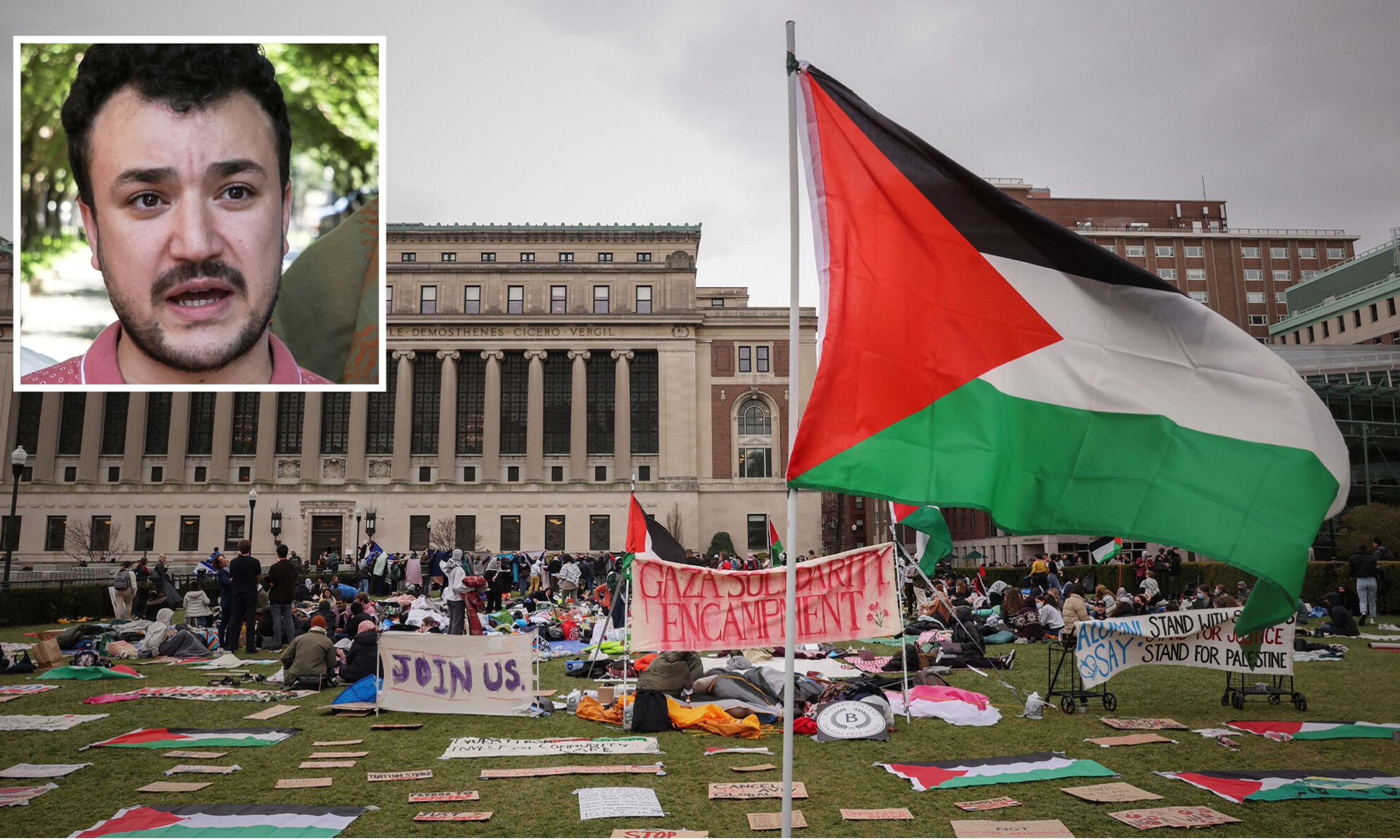
Demonstrators sit in an encampment as they protest in solidarity with Pro-Palestinian organizers on the Columbia University campus in New York City, April 19, 2024. Inset: Mahmoud Khalil speaks to members of media at Columbia University, June 1, 2024.
The Trump administration has begun acting on its worthy goal of removing aliens who support Hamas -- its jihadist terror and its antisemitism. It has chosen a tough case to start with: a lawful permanent resident alien (LPR) -- a status in which the alien enjoys the most robust protection that our law provides for non-Americans. Still, the administration should prevail for the reasons best articulated by Secretary of State Marco Rubio: An alien privileged to reside in the United States, even a green-card holder, should not be able to engage in activities that would form a legal basis to exclude the alien from entering our country in the first place.
On Saturday night, as our Haley Strack reports, federal immigration agents arrested Mahmoud Khalil, who claims Palestinian heritage. Khalil is a recent Columbia graduate and, at the time of his arrest, was still a resident of Columbia-owned housing.
Prior to earning his master’s degree last December from the university’s School of International and Public Affairs (SIPA), Khalil was very active in the pro-Hamas agitation on campus. Euphemistically labeled “protests,” this agitation included unabashed antisemitism, an illegal encampment on campus, and the forcible occupation of Hamilton Hall -- the latter provocations were finally ended by the New York City Police Department after temporizing by university officials. Columbia’s paralyzed response to, if not encouragement of, the unrest resulted in the resignation of its president, Minouche Shafik, back in August. Not much has changed: Nine agitators were arrested at the university last week in connection with a takeover of a Barnard College building. And as our David Zimmermann reports, President Trump has pulled $400 million in federal grants and contracts from Columbia, an initiative of the administration’s antisemitism task force.
We must assess Khalil’s detention in conjunction with a post on X by Secretary Rubio, which cites an AP report about Khalil’s arrest as corroboration of Rubio’s declaration that “we will be revoking the visas and/or green cards of Hamas supporters in America so they can be deported.”
To be sure, visas and green cards are saliently different. Unlike a mere student-visa holder, a green-card holder, such as Khalil, is an LPR. That is the highest category of alien: a non-American who has lawfully relocated to the United States and is on track to become a naturalized citizen (see §1427 of federal immigration law -- Title 8, U.S. Code). In many contexts -- e.g., tax law and the privacy protections -- federal law deems green-card holders to be “U.S. persons,” meaning they are part of our national community. Their rights can approximate those of American citizens but, as the administration will surely argue, they are not equal to those of Americans citizens (who, of course, may not be deported).
It is not clear to me how old Khalil is (he’s obviously a young man), or when he began matriculating at Columbia -- it usually takes two years to complete the MA degree at SIPA that he received at the end of 2024. He came to the United States to study at Columbia after receiving his undergraduate degree in computer science at the American University of Beirut. It has been reported that, for a time, he worked for the British government, as an intern at its embassy in Beirut, and for an NGO called Jusoor (Arabic for “bridges”) that promotes young people who’ve suffered because of the Syrian civil war.
As Haley notes, moreover, Khalil also reportedly worked as a public affairs officer for the United Nations Relief and Works Agency for “Palestine Refugees” (I use the quotes advisedly as “Palestine” is not a nation recognized by the United States, and the nearly 5 million inhabitants of the Palestinian territories are not “refugees” in any rational understanding of that term). I’ve argued that UNRWA, which has functioned as a de facto arm of Hamas, should be formally designated as a terrorist organization. The Trump administration has cut off UNRWA, which was lavishly funded and shielded by the Obama and Biden administrations.
There seems to be some confusion -- including, potentially, some confusion for government officials -- regarding Khalil’s immigration status. As noted above, at the time of his arrest this past weekend, Khalil was residing in university-owned housing near the upper Manhattan campus. He lived there with his wife, who is reportedly an American citizen and pregnant. The New York Times reports that the immigration agents who arrested Khalil told him that his student visa had been revoked.
Last spring, at the apex of the pro-Hamas agitation at Columbia that followed the October 7 atrocities, Khalil reportedly told The Verge: “I am here on a foreign visa. That’s why for the past six months, I’ve barely appeared on the media. . . . That’s why I’m not suspended. I did not participate, fearing that I will be arrested and ultimately deported from this country.”
Put aside for a moment that Khalil did end up getting suspended temporarily (the university apparently rescinded the suspension). A green card supersedes a student visa in terms of lawful residence in the United States. While a student visa holder must comply with the terms of the visa, which involve the school attendance for which the visa was issued, a green-card holder is authorized to live and work in the United States.
Therefore, even if we assume that Khalil needed a student visa to enter the United States and attend Columbia, it appears that he was subsequently granted an upward adjustment of immigration status (to lawful permanent resident alien) prior to his arrest. It’s possible that the adjustment may have stemmed from his marriage to a U.S. citizen. (That is speculation on my part; I have no idea when Khalil got married. Under federal law, however, a student-visa holder is eligible to apply for a green card if he marries an American citizen.)
Nevertheless, even an LPR can be deported if the government can establish that he belonged to a group that endorses or espouses terrorist activity.
This brings us to Rubio’s point about the logical symmetry between activities that should keep an alien out of our country and activities for which he should be kicked out of our country if he is lucky enough to get in.
Section 1182 of federal immigration law controls the categories of aliens who may be excluded from the United States. In the category of national security, the statute mainly targets aliens who have “engaged in terrorist activity,” who are “members” of terrorist organizations, or who have received paramilitary training from terrorist organizations. Fortunately, though, there is additional latitude: An alien may be excluded if he has “endorsed” or “espoused” terrorist activity -- see subsection (a)(3)(B)(i)(IV)(bb), under the subheading “Terrorist activities.” The statute defines terrorist activity to include violent attacks and the planning of such attacks. That should be sufficient to bar from entry into the United States aliens who support Hamas, which has been a designated terrorist organization under U.S. law since the mid-Nineties (when the designation process began).
Once an alien has entered the United States and has residential status under our immigration laws, things get tougher for law enforcement. It is just common sense that it’s harder to detain, process, and deport an alien than it is to prevent the alien from entering in the first place. Once someone is here, even illegally, there are due process rights. Those rights ascend on the scale as the alien’s status is adjusted from illegal presence, to minimally lawful presence, to visa holders, and on up, finally, to LPR.
Ergo, an LPR, such as Khalil, is going to argue that he has First Amendment protections for speech and association that are indistinguishable from those of an American citizen -- rationalizing that those protections are not so much rights of persons as limitations on what Congress is permitted to criminalize or otherwise punish and regulate. Nevertheless, that claim should fail because, when it comes to support for terrorism, our law does not privilege LPRs over other classes of aliens.
Khalil is widely reported to have been a leader of the pro-Hamas protests. The reporting I’ve seen indicates that he was an influential figure who was often on camera because he functioned as an “intermediary” between the school’s administration and the protesters. This appears to stem from his role as a spokesman for a campus anti-Israel organization, Columbia University Apartheid Divest. According to Newsweek, Khalil was accused by the university of “organizing an event that glorified Hamas’s October 7 attack.”
That said, I haven’t seen any indication of violent or obviously criminal behavior on his part -- although these are early days and I’d expect to see much more detailed accounts of his activities in the weeks to come. His most prominent role seems to have been as a negotiator of sorts on behalf of student radicals with the university administration. Objectively speaking, his activities are pro-Hamas, but I assume that if the government had strong evidence that he’d committed the crime of providing material support to a designated terrorist organization -- such as recruiting or fundraising on behalf of Hamas -- the Justice Department would indict him.
Fortunately, it need not be provable in criminal court that an alien agitator committed crimes in order to establish that the alien should be deported.
Section 1227 of the immigration laws controls deportation. For the most part, deportation on security-related grounds -- subsection (a)(4)(A) - (C) of the statute -- is triggered by criminal activity. The statute, however, indicates that activities do not necessarily have to be crimes in order to warrant deportation if they are “terrorist activities” or involve support for the overthrow of the U.S. government by force. The “terrorist activities” provision incorporates by reference the terrorism provision we discussed above -- §1182, governing the exclusion of aliens from entering our country.
This provides the Justice Department with an opening to argue that Secretary Rubio is right: An alien, even an LPR, has no right while in the United States to join with groups that endorse or espouse terrorist activity -- activity that would be a basis for excluding the alien from the United States in the first place.
If the government can prove that Khalil was in a campus group that endorsed or espoused Hamas’s atrocities against Israel, it should be able to deport him regardless of his LPR status. And if it can deport him, there are likely to be thousands of others who can be deported, too -- and should be.

About the Author
Andrew C. McCarthy is a senior fellow at National Review Institute, an NR contributing editor, and author of Ball of Collusion: The Plot to Rig an Election and Destroy a Presidency.
Featured Tags
Advertisement
Advertisement
Comments