Church Is More Than a Lifestyle Choice
Written by Kathryn Jean Lopez
Has America rediscovered the salvific effects of churchgoing?
Share this story
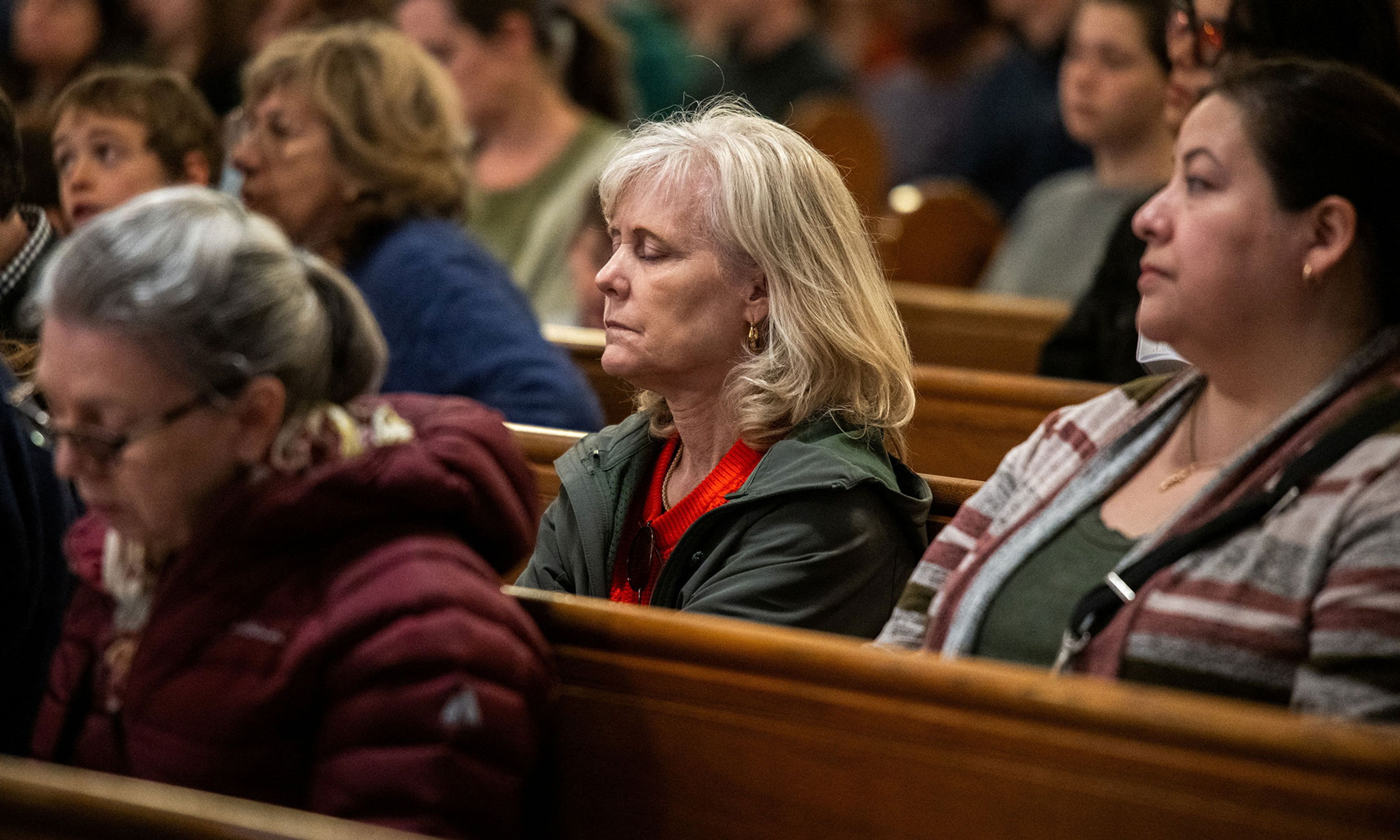
A woman closes her eyes as music plays inside St. Patrick Catholic Church following a Way of the Cross procession to mark Good Friday in Washington, D.C.,April 3, 2026.
‘What is your number?” This is the question Catholic bishops are asking one another, according to Cardinal Robert McElroy, the archbishop of Washington, D.C. He was quoted in a New York Times piece that covered the mystery of the new — and young — Catholics. This Easter, he marked the addition of 1,755 new sheep to his flock, which is a greater increase than last year’s 1,566, “which had already been the highest number in at least 15 years,” according to the Times. Similar increases are being recorded throughout the country.
The paper of record is calling it a “surge,” a “jump,” and a “trend.” More than a flash in the pan, however, it’s a resurrection. For each individual who says yes to Jesus Christ — and to the way of holiness and radical love that He models in Scripture — enters a church founded by Christ, who offers Himself in the Eucharist. For those who believe, there is nothing comparable to or more powerful than the sacraments of the Catholic Church. And this will likely have a salvific effect on a culture. A baptism, a first communion, a confirmation — these are not mere milestones but miracles. The grace of God makes mercy, purity, peace, and the overcoming of suffering possible in gratuitously self-sacrificing ways, in imitation of the love Christ has for His people.
The foundational miracle of Christianity, of course, is Easter — the resurrection of Christ from the dead after His life, death, torturous Passion, and Crucifixion. Archbishop Fulton Sheen, with his prime-time show, was a household name in the embryonic days of television, long before people had the luxury of channel-surfing. Catholic homes weren’t the only ones tuned into Sheen, who will be beatified in St. Louis in September: a major step on the road to canonization, or official recognition as a saint. Before the time of podcasts, Sheen hosted The Catholic Hour on the radio. In April 1942, talking about persecuted Christians around the world, he said that the past century was a century of martyrdom:
They are having their hour, their hour of darkness, of famine, and of hate. Above all the battlefields of the world, beyond the din of national slogans, the scheming of foxes, the debates of politics, the selfish classes of economic forces, there is one common bond uniting them all — they are all prostrate before the cross of Christ. . . . And in this their hour of darkness, they have a pledge that if the Easter law holds true, and it does, to the extent that their sufferings are one with him, they will rise again.
Names such as Maximilian Kolbe, Edith Stein, and Alfred Delp, all murdered by the Nazis, come to mind when one thinks about those who died for Christ and for their fellow man — creations of God, made in His image and likeness. At Auschwitz on July 29, 1941, Franciszek Gajowniczek was selected for death (by starvation). He cried, “I pity my wife and children!” In reply, Kolbe, a Franciscan, said: “I am a priest; I want to die for him!” And so he did.
“For a Christian, martyrs are not merely models to be imitated, but, like all saints, spirits with whom we are in communion, waiting with a common hope,” Robert Royal writes in The Catholic Martyrs of the Twentieth Century: A Comprehensive World History. “Martyrdom is in a deep sense the paradigm for the Christian life. Any person who starts to follow the Master seriously cannot help but find himself or herself attacked by the same forces that attacked him.” Royal emphasizes that, “in absolute numbers, the century’s martyrs far surpass those of any previous century.” And “among them, Catholics form a great, perhaps the greatest, part.”
Now, not everyone is going to be martyred. And churchgoing has countless benefits and practical implications that make even secular culture willing to accept it. The Beatitudes that Jesus proclaimed in the Sermon on the Mount are a divine blueprint for solidarity and subsidiarity and civil society. The beatitudes are how we love well — no government program can replicate it. Knowing that you were loved into being by a Creator who did the same for others, too, makes you all the more willing to love even those you love the least, as Catholic social activist (and, perhaps someday, saint) Dorothy Day might put it.
According to a report released earlier this year by RealClearInvestigations: “Three-quarters of those who attend church weekly give to the poor, compared with 41% of non-observants. Overall, 73% of all charitable contributions come from religious sources, while 60% of all beds for the homeless are from faith-based institutions.” But it is even more than that. The report found that the “growing evidence of religion’s basic utility, including its provision of a spiritual anchor, seems likely to grow, by offering a viable alternative to hyper-competition and individualism rife in secular-driven societies.” Christians sometimes actually are Christians — and it benefits everyone. A solution to the pandemic of suicide and loneliness? Church. You belong not only to a community but one established by and entirely meant to be rooted in God Himself — we call the church, in fact, “the body of Christ.” And all of its members are part of that body. That gives each life profound and perpetual meaning.
“Indeed, when volunteerism has been on a decline among the young, the young religious are more likely to perform community work than their nonreligious Gen Z counterparts,” Joel Kotkin and Bheki Mahlobo explain in the RealClearInvestigations study. “Data from a nationally representative survey of nearly 2,000 young adults ages 18 to 25 coordinated by Neighborly Faith,” they report, “reveals that half of religious Gen Zers report volunteering in the community often or very often, compared with 30% of slightly religious Gen Zers and just 21% of not religious Gen Zers.”
“The budding religious revival taking place in the U.S. reflects a global trend, especially strong in Africa, which is now the most demographically robust place on the planet,” the researchers note.
This is one bandwagon worth getting on. As Will Rahn puts it in a Free Press reflection: “I’m here to tell you that you don’t need to accept the reality of the resurrection to sit in a pew. You don’t even have to believe in a supernatural God. You can just sit there, take it all in, and see what, if anything, sticks. Best as I understand it, there is a conversion of the heart that comes on gradually, gently, once this ritual practice is a part of your life’s rhythm.” We believe the Real Presence of Jesus is in the tabernacles at Catholic churches — the Body of Christ in the Blessed Sacrament. And so we have confidence that God will do better work than our best evangelists. Listen to Him.
This column is based on one available through Andrews McMeel Universal’s Newspaper Enterprise Association.

About the Author
Kathryn Jean Lopez is a senior fellow at the National Review Institute and the religion editor of National Review. Sign up for her weekly newsletter here. She is the author of A Year with the Mystics: Visionary Wisdom for Daily Living.
Featured Tags
Advertisement
Advertisement




Comments