Cold, Confusion, and ‘Resistance’ Buttons: On the Ground at Mamdani’s Inauguration
Written by Guy Denton
Members of the Democratic Socialists of America were seen handing out flyers, in a definitional example of preaching to the converted.
Share this story
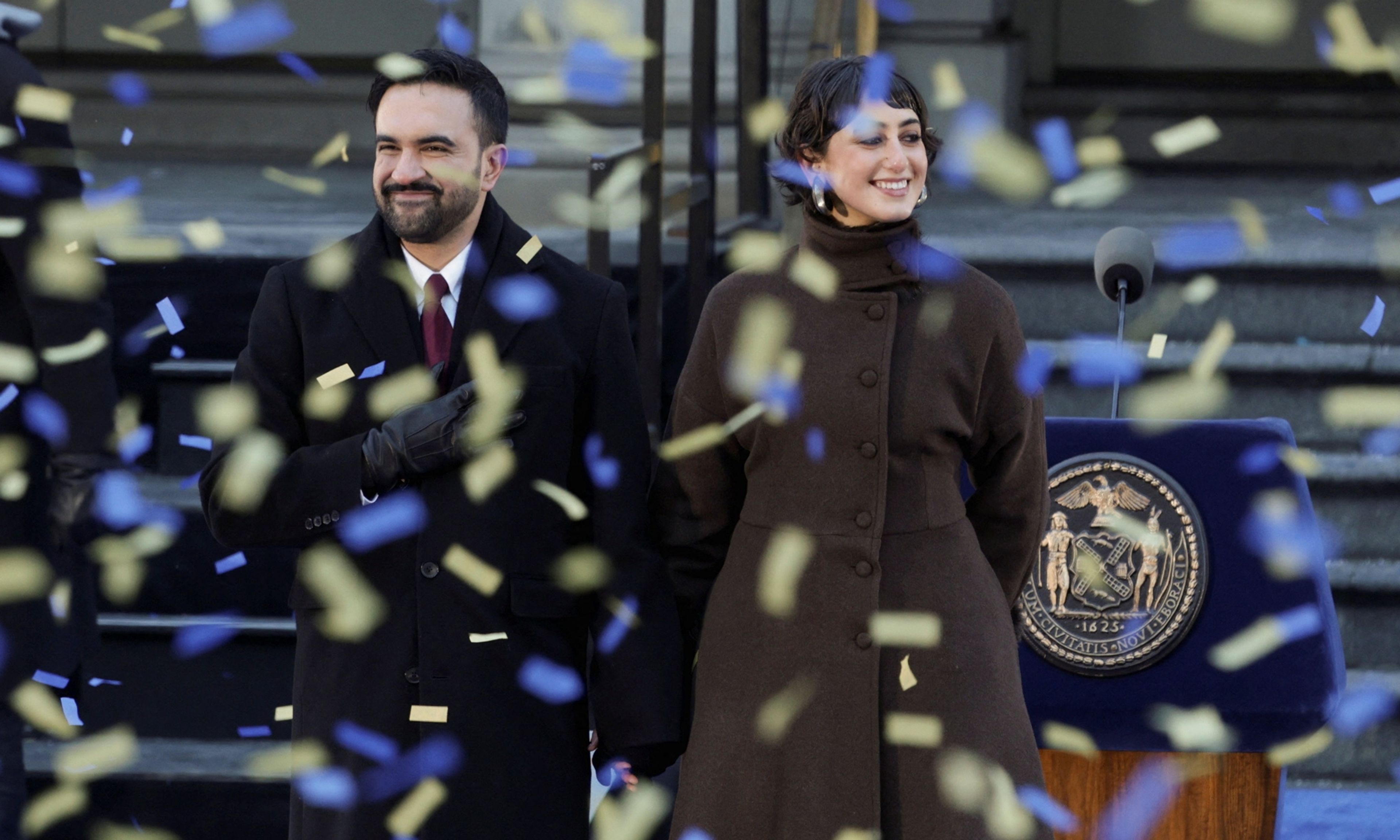
New York City Mayor Zohran Mamdani and his wife Rama Duwaji react as confetti falls during his inauguration ceremony in New York, January 2026.
At his inauguration as New York City mayor on Thursday, Zohran Mamdani declared that he will “replace the frigidity of rugged individualism with the warmth of collectivism.” But the weather revealed the opposite.
As Mamdani stood on the steps of City Hall, the climate was almost Siberian, and a brutal wind swept through the streets. Yet that couldn’t deter thousands of spectators. With raucous enthusiasm, they watched as Mamdani was sworn in by Bernie Sanders. Behind him, Alexandria Ocasio-Cortez, a disconsolate Eric Adams, and a host of left-wing artists looked on. Many more Mamdani devotees stood outside the venue, watching the spectacle unfold on towering screens from a closed-off section of Broadway, where they had traveled from far and wide to attend New York’s “first ever inauguration block party.”
The event, organized by the new mayor’s team, promised a celebration brimming with music, camaraderie, and “interfaith elements.” In reality, it was more frequently defined by logistical confusion, interminable lines, and the overpowering cold. For the most part, though, none of those unpleasantries could dampen the enthusiasm of the heavily layered supporters in attendance.
I arrived at City Hall around 10:45 a.m., which I assumed would leave me ample time to enter the site of the party before the inauguration ceremony began in the early afternoon. Instead, I was greeted with a disordered mess of arbitrarily positioned barricades, bewildered attendees, and lines that seemed to have formed without clear purpose.
I tried asking several of the on-duty cops for directions. Their answers were contradictory and delivered with hesitation. “Where da f*** are we supposed to go?” cried a particularly aggrieved local beside me as I realized that following one officer’s advice had led me in a circle. It soon became clear that what appeared to be the entrance to the party was actually an exclusive line for those with seated tickets to watch the inauguration from within the grounds of City Hall. Even among socialists, hierarchy is inevitable.
Eventually, I found the correct entrance by navigating a sequence of unobstructed blocks to Zuccotti Park, where guests could enter Broadway after passing through a security checkpoint. The park, which served as the makeshift headquarters of Occupy Wall Street in 2011, couldn’t have been an accidental choice of location. For the Millennials in attendance, the nostalgia likely provided some much-needed warmth amid the cold.
Traversing the park, however, required enduring the sluggish movement of a vast crowd. The officers at the checkpoint were inspecting and admitting guests at such a glacial pace that it took me more than an hour to reach Broadway. As I waited, I studied my surroundings. Blue-and-yellow Mamdani beanies were an omnipresent sight, as were buttons emblazoned with slogans that ranged from the banal (“No kings”), to the polite (“F*** Trump and f*** you for voting for him”), to the comically self-important (“We are the resistance,” screamed one design that featured a picture of Princess Leia at its center). Behind me, a group of attendees bemoaned the insufficiently far-left state of the Democratic Party. One of them expressed his reluctant support for Jasmine Crockett. Another grumbled that although Ocasio-Cortez has betrayed the cause of democratic socialism, she would still make a more palatable presidential candidate than Gavin Newsom.
Members of the Democratic Socialists of America moved through the crowd and handed out flyers, in a definitional example of preaching to the converted. A QR code on the leaflets led to a webpage where users could petition New York Governor Kathy Hochul and the state’s legislators to “guarantee free, full day, year round, high-quality child care for every child by taxing the rich and big corporations.” One of the group’s members expressed his optimism that Mamdani can succeed in building “a more equitable” New York: “I think he has a lot of momentum. People know what he’s trying to do.”
I inched closer to freedom, and the crowd’s behavior increasingly evoked a picket line. Singalongs erupted: “Solidarity Forever” and “Take Me Home, Country Roads” elicited the most passionate participation. A Palestinian flag appeared in the air as its wielder led a chant of “Free, free Palestine!” — it was bound to happen eventually. As the party came into clear view, the restlessness among those around me became more pronounced. Frustrated chants of “Let us in!” began to bubble up. “You Adams cops can’t keep us out because you didn’t get what you wanted!” someone bellowed from beside me. When I finally stepped onto Broadway, the inauguration was already underway, but hundreds of additional guests remained in line.
Despite the growing agitation behind the checkpoint, and the total absence of bathrooms or food vendors within the event, the crowd that stood along Broadway was unmistakably enthusiastic. Whatever speaker held the stage, hardly a syllable was uttered without roaring applause or a deafening cheer in response. After a performance of the labor anthem “Bread and Roses” by the singer Lucy Dacus, Bernie Sanders took the microphone, and the excitement hastened toward its messianic peak. As he ranted through a predictable litany of talking points, extolling the virtues of free buses and chiding the evil of corporations, his sentences were punctuated by shouts of affirmation. Throughout, a chant of “tax the rich” consumed the audience.
By the time Mamdani’s speech began, the “interfaith” aspect of this gathering had asserted itself. Many in the crowd could have been at church as they gazed at his visage on a nearby screen with reverent awe. In his overwrought remarks, Mamdani reaffirmed his commitment to governing as a democratic socialist and enacting the full scope of his ill-conceived agenda. A particularly telling moment came when he invoked the spirit of Nelson Mandela and the words of the South African Freedom Charter to declare that New York “belongs to all who live in it.” If an apartheid exists in the Big Apple, Mamdani has made clear whom he perceives as the oppressors. His speech made no mention of the resurgent scourge of antisemitism, but he did note that Palestinian New Yorkers “will no longer have to contend with a politics that speaks of universalism and then makes them the exception.” The crowd greeted that line with an especially wild cheer, and another chant of “free Palestine” ensued beside me.
After the event, the Mamdani supporters I spoke to were effusive about the speech, but some expressed concern about the new mayor’s ability to achieve his lofty goals. “I think it’s gonna be extremely hard,” said one college-aged attendee.
As the crowd dispersed, a group of twentysomethings, including one clad in a Spider-Man costume, broke out into an impromptu dance party on the corner of Broadway and Fulton Street, bopping back and forth to Rihanna and Black Eyed Peas songs from the late 2000s. Amid the revelers was the Republican mayoral candidate Curtis Sliwa, who had waited in line for the block party with the rest of the hoi polloi.
“I disagree with most of [Mamdani’s] agenda, but he won fair and square,” Sliwa said. “You gotta give the guy an opportunity to put it into effect. Remember, if Zohran does well, New York City does well. We do well, New York State does well, the country does well. Why would anyone want him to fail?”
New Yorkers may find an answer to that question sooner rather than later.
About the Author
Guy Denton is a William F. Buckley Jr. Fellow in Political Journalism.
Featured Tags
Advertisement
Advertisement

Comments