Collateral Damage for the Coal Industry?
Written by Michael Toth
A lawsuit over ESG policies could have unintended consequences.
Share this story
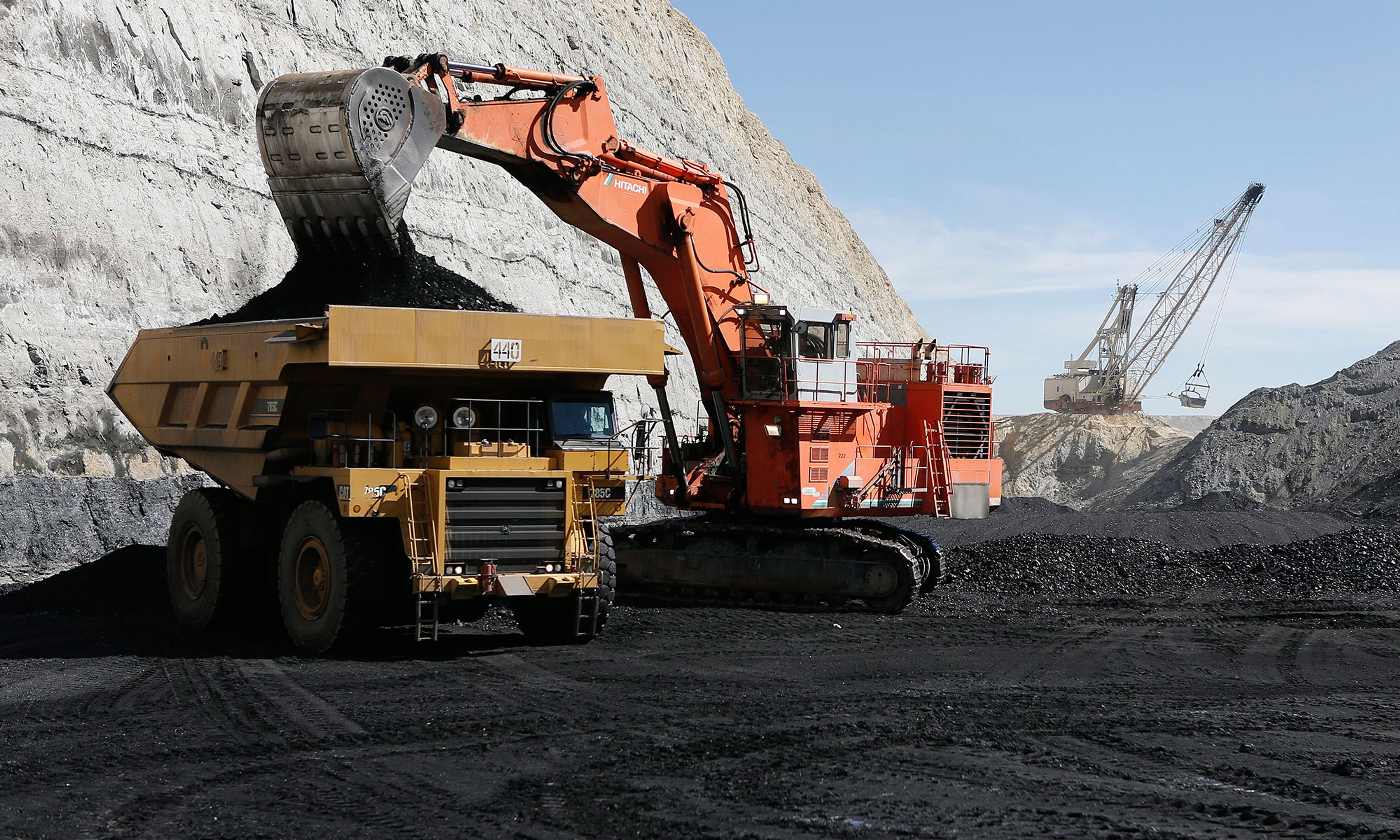
Coal is loaded into a truck at the Jim Bridger Mine outside Point of the Rocks, Wyo., in 2014.
Alawsuit brought by ten states and led by Texas is causing rifts inside the Trump administration.
The suit, Texas v. BlackRock, asserts that investment firms BlackRock, Vanguard, and State Street colluded to slash domestic coal production to satisfy their “environmental, social, and governance” (ESG) policies and membership in pro-sustainability outfits such as Climate Action 100+ and the Net Zero Asset Managers initiative.
But a win for the states could also bring significant collateral damage for domestic coal production. The private law firms representing the states are asking the court to order the investment firms to unload their shares in U.S. coal companies, valued at a whopping $246 billion in 2022, to prevent them from using their ownership stakes to continue the alleged scheme.
The prospect of a massive coal divestment has drawn sharp criticism from President Trump’s Energy Secretary Chris Wright and Interior Secretary Doug Burgum, who see coal as a strategic asset for grid reliability and the artificial intelligence race against China. At a meeting last month of the National Coal Council, which Wright relaunched after the Biden administration disbanded it, the two top officials behind the administration’s energy dominance agenda sounded the alarm over Texas v. BlackRock.
Wright blasted the case as a “tragedy,” warning that a verdict for the states, which would drain the coal companies of capital, could undercut the administration’s policies for unleashing domestic energy. Burgum piled on, calling the suit a loser for “everybody who pays an electrical bill.”
The cabinet secretaries’ opposition to the case is a shot across the bow of the Trump Department of Justice and Federal Trade Commission. Last May, Gail Slater, recently confirmed to lead the Justice Department’s antitrust division, filed a joint brief with senior FTC policy officials, backing the states in the suit. Slater, who advised then–Senator JD Vance on economic policy, left her role at the Justice Department last week amid reports that she was pushed out after a turf war with allies of Attorney General Pam Bondi over, among other things, Slater’s hawkish approach to antitrust enforcement.
It’s not hard to see why Wright and Burgum, both former CEOs, are denouncing Texas v. BlackRock. The antitrust allegations are a long shot on the merits. These claims are distinct from charges that the asset managers misled customers by inadequately disclosing the extent to which their investment decisions prioritized ESG mandates over maximizing returns. For actions to be considered illegal, antitrust laws require an “agreement” among competitors. The asset managers’ membership in ESG groups demonstrates relationships with those groups, not agreements with one another. There is no sign that the asset managers spoke with each other about cutting coal production or told the managers of the coal companies to scale back.
Like well-known pop stars, tech firms, and much of corporate America, the investment firms moved with the political tide. They cozied up to the climate crowd during the pandemic, then cut ties when ESG fell out of fashion. Whether the evolution of views was sincere or profit-driven (or both) is beside the point. Virtue-signaling by large asset managers is not against the law. To their credit, coal executives seem to have ignored it anyway. Coal output at the companies that BlackRock, Vanguard, and State Street invested in rose 6 percent from 2020 to 2022, when the scheme was supposedly in full swing.
The potential of a forced sell-off of coal shares, however, makes the case impossible for the companies to ignore. The state attorneys general have further turned up the heat by retaining Tony Buzbee, the Houston plaintiffs’ attorney who has a track record of securing gigantic settlements from athletes, entertainers, and major corporations. Just don’t count on coal to shore up the grid during the next deep freeze if investors are sent packing.
Even if the case doesn’t result in a divestiture, the process could still create headaches for the industry. While the lawyers hired by the state AGs try to shield the coal operators by claiming the companies’ hands were tied, the managers of these businesses had fiduciary duties as well. None of the defendant investment firms held board seats or controlling stakes at any of the coal companies implicated in the alleged conspiracy.
If coal executives were following the dictates of noncontrolling shareholders to dampen coal production at a time of surging global energy demand, the companies could face suits from other investors claiming management left significant value on the table. To avoid getting crosswise with shareholders, the coal companies may feel compelled to enter the fray to dispel the collusion allegations, diverting executive time and company resources away from supplying affordable electricity to homes and businesses.
The joint DOJ and FTC filing is already raising concerns outside of the coal industry. Much of the brief is devoted to supporting the position that passive index investors, including the three investment firms sued by the states, may be held liable under Section 7 of the Clayton Act, which prohibits the acquisition or use of stock shares to “substantially . . . lessen competition.” As a brief filed by a trade association representing investment industry players contends, the extension of Clayton Act liability to passive shareholders “would have a chilling effect on capital” by raising the risk that index fund managers could face antitrust scrutiny for their “common ownership” of stock in competing companies in the same industry.
The asset managers in the coal case, to be sure, are accused of anticompetitive conduct based on their public statements about climate change. But there’s also little evidence that the investment firms had more than minimal direct communications with the coal companies on any topic, and no indication that any of the asset managers instructed the coal companies to restrict their output. Future Democratic administrations could have a field day with this door that Slater and her former colleagues have opened. If shareholders can be sued for antitrust violations based on their published pronouncements alone, the further weaponization of public discourse is all but inevitable.
The rest of the energy industry should also be concerned. Last month, Michigan Attorney General Dana Nessel teamed up with Sher Edling, the law firm leading the nationwide lawfare campaign against fossil fuels, to file another long-shot antitrust suit claiming that the largest U.S. oil and gas companies conspired to depress demand for renewable energy products.
The Michigan lawsuit cites Slater’s brief from the coal case. Rather than providing fodder for activist lawyers, the Trump administration would be better served if Secretaries Wright and Burgum led the way on partnering with state leaders to ramp up domestic energy production to boost economic growth.
With Slater out at DOJ, Trump’s antitrust team is ready for a reset. The new leadership needs to turn the page on Biden-style market meddling and send a clear signal to investors that they won’t be punished for backing the energy dominance agenda.

About the Author
Michael Toth is the director of research at the Civitas Institute at the University of Texas, Austin.
Featured Tags
Advertisement
Advertisement



Comments