Congress Didn’t Give Trump an Unlimited License to Tariff
Written by Dan McLaughlin
The best legal argument for the Trump tariffs assumes that we are currently in a declared war with every country on the planet.
Share this story
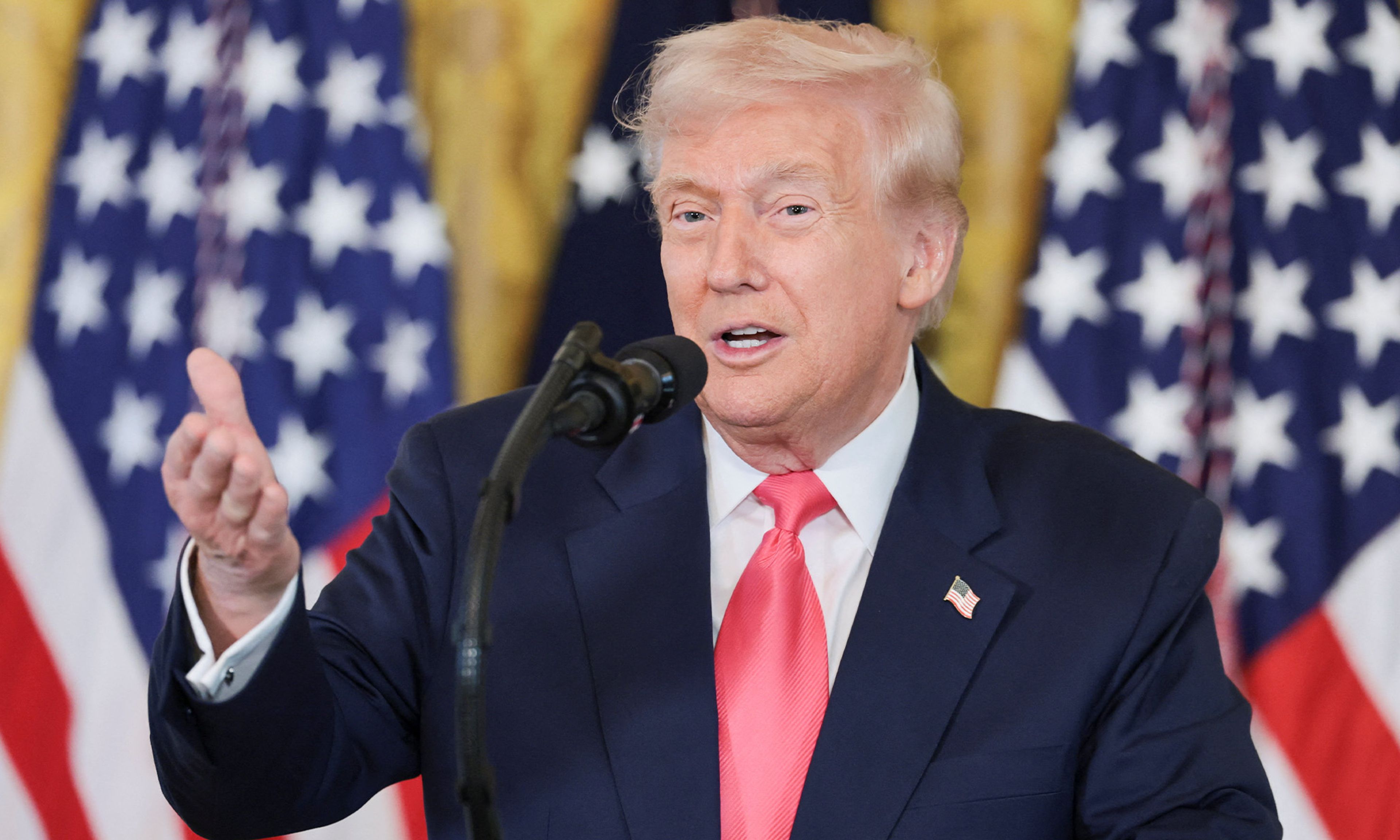
President Donald Trump speaks in the East Room of the White House, in Washington, D.C., November 13, 2025.
In the first installment of my deeper dive into the Trump-tariff oral argument in Learning Resources, Inc. v. Trump, I looked at how the Court is likely to read the law to decide the case. Will the Court defer to the president on the theory that tariffs are foreign policy rather than taxes? (Not likely -- especially after Solicitor General John Sauer had to concede that there is no inherent peacetime presidential authority in Article II for what Trump is doing; he must identify a power given him by Congress to impose tariffs on countries with whom we’re not at war.) Could Sauer talk the justices out of treating tariffs as a major question that presumptively would not be delegated by Congress to the president without explicit language? (Maybe he could avoid formal application of the major questions doctrine, but the Court is apt to remain skeptical of bending the law’s words.)
In this second installment, I look at the statute to ask whether Trump-optimists such as professors Josh Blackman and Jonathan Turley have a better case that the Court might rule in the administration’s favor on the grounds that Congress actually did give presidents this power. The government’s arguments here are weak, but they did not draw as much open hostility from the Court’s conservatives.
In my view, if there is a glimmer of hope for the administration, it’s not a win on the “how” questions, but on persuading a bare majority that there’s a fig leaf of precedent for treating the statutory language as incorporating previous war powers dating back to the Civil War. The best available argument from precedent, however, creates its own problems, because it is rooted in the law of war. Last I checked, we’re not at war with literally every country on the planet. The Court would do well to consider the implications of giving presidents the power to act as if we are, for as long as the president wants to say so.
Regulations and Taxes
The only statute that Trump identifies as a source of delegated tariff power is the International Emergency Economic Powers Act of 1977 (IEEPA). As the lower courts and the challengers have observed, Congress has written a lot of statutes giving presidents the power to collect, impose, adjust, or suspend taxes or tariffs in specific situations, and all of them actually use words like “tax,” “tariff,” “duties,” “fees,” or some other such clear synonym for collecting revenue. IEEPA does not. So, that’s the easy way to resolve this case. The harder way is to scrounge through IEEPA looking for some implied authority that includes taxes.
The administration’s lead argument is that, when IEEPA says that the president can “regulate . . . importation,” regulation includes taxation. Much of the government’s brief is devoted to authorities saying that “regulate” in the Constitution’s commerce clause includes taxation, but that’s not all that helpful, for four reasons. First, the commerce power is still a power of Congress. Second, if the commerce power was the source of the power to tax, Article I, Section 8 wouldn’t first give Congress a separate power to tax. Third, this gets into the question of whether raising revenue is merely incidental to a tax’s regulatory purpose -- while the Trump White House is touting trillions of dollars in tariff revenue and now floating talk of using it to fund checks to voters. Fourth, statutes are written and read differently from constitutions, and IEEPA was written 190 years after the commerce clause, so the same word in one may not mean the same when situated in a different context in the other.
As far as actual precedents for what Trump wants to do, however, Justice Amy Coney Barrett’s crucial early line of questioning to Sauer cuts to the heart of the government’s problem:
JUSTICE BARRETT: General Sauer, can I just ask you a question? Can you point to any other place in the Code or any other time in history where that phrase together, “regulate importation,” has been used to confer tariff-imposing authority?
GENERAL SAUER: Well, as to “regulate importation”? That was held in TWEA [the Trading with the Enemy Act, the use of which by Richard Nixon was upheld in the 1975 Yoshida case]. . . .
JUSTICE BARRETT: Okay. Okay. So an intermediate appellate court held it in TWEA, but you just told Justice Kavanaugh that wasn’t your lead argument, that your lead argument was this long history of the phrase “regulate importation” being understood to include tariff authority.
So my question is, has there ever been another instance in which a statute has conferred --used that language to confer the power? . . . Putting aside Yoshida.
GENERAL SAUER: I mean, obviously, the other statutory example is [ad]just imports. The cases we rely on are [a list of authorities construing the commerce clause language] --
JUSTICE BARRETT: But that just shows the word can be used that way. None of those cases talked about it as conferring tariff authority. I understood you to be citing . . . those cases just to show that it’s possible to say that “regulating commerce” includes the power to tariff.
After Sauer kept trying to change the subject to a more general answer rather than citing specific cases, Justice Sonia Sotomayor snapped at him, and Barrett cornered him:
JUSTICE SOTOMAYOR: Could you just answer the justice’s question?
JUSTICE BARRETT: Can you identify any statute that used that phrase to confer tariffs?
GENERAL SAUER: Yeah, the only two statutes I can identify now are TWEA as interpreted in Yoshida and then closely related, not “regulate importation” but “adjust imports,” in Section 232 in --
JUSTICE BARRETT: Well, I think “adjust imports” is differently. So the answer is the contested application in TWEA and then now in IEEPA?
In short, Sauer’s argument comes down to two precedents. One is that IEEPA was written against the backdrop of a presidential act by Nixon under TWEA that was upheld in a 1975 appeals court decision called Yoshida. The other is that IEEPA refers to “licenses.” A 1976 Supreme Court case called Algonquin read a statute (Section 232) that empowers a president to “adjust the imports” of a particular good as granting a power to impose license fees that resembled tariffs. Let’s consider each of these two arguments.
Yoshida and TWEA
I’ve previously discussed why the Federal Circuit felt compelled to take Yoshida seriously, while the Supreme Court is unlikely to do so. Thus, we see here Barrett waving it off as “an intermediate appellate court” whose decisions don’t bind the justices. Moreover, a non-binding precedent is only as influential on the Court as the persuasiveness of its reasoning, and Yoshida didn’t closely parse the statutory text, as the Court would today. Finding “nothing in the TWEA or in its history which specifically either authorizes or prohibits the imposition of a surcharge” -- in other words, nothing in the statutory language actually delegating this power -- and unable to find “anything in the inconclusive and hurried legislative history of [TWEA] which indicates an intent to prohibit action such as that reflected in [Nixon’s p]roclamation,” the Yoshida court basically gave the tie to the president on the grounds that TWEA was a wartime emergency law: “We do not find it surprising that Congress did not specify that the President could use a surcharge in a national emergency. Having left the battlefield, it would hardly do to dictate all the weapons to be used in the fight.” As I explained in my first installment, it is unlikely that the Court will be similarly deferential here.
But, as I’ll get to below, there’s a knotty textual problem in the fact that TWEA is a presidential war powers statute, and IEEPA is not.
Nixon declared an emergency based upon a “balance of payments” deficit — similar to Trump’s invocation of the trade deficit as a permanent emergency — and slapped a temporary global tariff of up to 10 percent, under the title of a “surcharge.” The Yoshida court warned that “the declaration of a national emergency is not a talisman enabling the President to rewrite the tariff schedules,” but found that “it was not in this case” because Nixon simply went through congressionally enacted tariffs that had been scaled back by trade agreements, and restored the congressional rates. The Yoshida court was largely concerned with whether this was constitutional, and on that score, the decisive fact was that the president stuck closely to congressionally set rates:
The surcharge was limited to articles which had been the subject of prior tariff concessions and, thus, to less than all United States imports. . . . With respect to some articles the surcharge could result in the precise statutory duty set by the Congress. . . . With respect to those articles on which no concession had been granted, the congressionally established rates remained untouched. . . .
Far from attempting, therefore, to tear down or supplant the entire tariff scheme of Congress, the President imposed a limited surcharge, as “a temporary measure” . . . which is quite different from imposing whatever tariff rates he deems desirable. [Quotation and citation omitted.]
Trump, of course, is imposing precisely whatever tariff rates he deems desirable, and without any pretense that these are specifically limited in time or bear any relationship to rates set by Congress. Justice Samuel Alito, while observing to Sauer that Yoshida “said things . . . that are helpful to your position,” pressed him on how Trump was doing precisely what Yoshida said that it didn’t authorize:
[Yoshida] said that the Trading With the Enemy Act did not authorize the President to “fix rates of duty at will without regard to statutory rates prescribed by Congress.” So do you think that Congress -- to the extent Congress had that decision in mind and relied on it [in drafting IEEPA], do you think it also relied on those statements in the opinion?
It's not a great sign for the government that Alito asked this, given that he is usually pretty open at argument about which side he favors, and that he is plainly sympathetic to Trump’s position in general. Alito’s question echoed the objection raised by the Federal Circuit:
The Government would have us define “regulate . . . importation” to include only the portion of Yoshida authorizing tariffs and ignore the rest of its holding. But if . . . we are to presume that Congress intended for the holding of Yoshida to apply to the newly enacted IEEPA, then we must presume that it intended for the court’s entire holding to apply, not just the portion favorable to the Government.
Sauer rejoined that “those statements are read into other provisions of TWEA that Congress did not enact in IEEPA that may still be there in TWEA,” but that actually undermines his argument, because the purpose of IEEPA was to prevent future presidents from invoking TWEA in peacetime, as Nixon had; Congress rather deliberately delegated narrower powers for peacetime emergencies in IEEPA. This left Sauer to add, “I think the significance of Yoshida is at a higher level,” which is lawyer-speak for admitting that the case by itself doesn’t get you where you want to go.
On the other hand, the administration argues that Yoshida matters in a different way: that Congress in 1977 was aware of the Nixon precedent and the Yoshida decision when it drafted IEEPA, so IEEPA’s words should be read consistently with Yoshida. That is a stretch: The legislative history shows only scant reference to the Yoshida opinion itself. But Nixon’s exercise of power was well-known.
Justice Brett Kavanaugh was the most focused at argument on the Nixon surcharge as a precedent for Trump’s actions. “Figuring that out,” he remarked, “is real important to deciding this case correctly.” He told Sauer:
One problem you have is that presidents since IEEPA have not done this. Your primary answer or one of your many answers to that is the Nixon example, and that’s a good example for you because Nixon relied on “regulate importation” to impose a worldwide tariff. Good example.
What is our understanding of Congress in 1977 vis-à-vis that Nixon example when Congress re-enacts or enacts the “regulate importation” language into IEEPA?
This is the closest any of the justices came to agreeing with Sauer’s reading of “regulate importation,” although Kavanaugh -- with his background as a Bush White House lawyer -- pressed him for why, if IEEPA contains this authority, no president before Trump had tried to use it. When questioning Neal Katyal, representing the challengers, Kavanaugh added:
If this statute came out of nowhere in 1977, I think your case would be, you know, obviously stronger. We have to figure out, at least I want to figure out, what the Nixon precedent stands for…the question is, I think, was Congress aware of that? Meaning that when they used “regulate importation” and it’s now being used to encompass tariffs, that’s not unheralded because Congress was well aware -- you know, President Nixon announced those tariffs in a nationwide prime-time speech, 10 percent across the board in August 1971. It was not some kind of little piece of paper. So it was well-known.
The question then is, was Congress -why didn't they change the language? Why didn’t they say “regulate” but not “tariffs”? That’s kind of the difficult question from the Nixon precedent.
Observers of the argument who think that Kavanaugh will come out for the government may be right. But I just didn’t see much to suggest that his colleagues were apt to go with him. And the arguments for doing so are a lot weaker if you don’t expect the Court to resolve any ambiguities in favor of the executive branch.
War Powers and Licenses
Another provision of IEEPA -- its discussion of the means by which presidents may act -- could be more promising for the government but presents its own problems.
Much of the argument was consumed with talk of licenses and license fees. The question particularly consumed Barrett, who as usual was focused intently upon the statutory language and precedent. Could Sauer persuade her and her colleagues that worldwide tariffs are really an exercise of IEEPA’s power to “regulate” the “importation” of foreign goods “by means of . . . licenses?”
There are two related reasons why Sauer is trying to jam the square peg of tariffs into the apparently round hole of “licenses.” Both involve unanimous Supreme Court opinions decided under different statutes.
At first glance, it may sound bizarre to talk about licenses as a euphemism for tariffs. In ordinary parlance, a license is a permitting process for a person or business engaged in an activity. While licenses usually cost money, we expect them to carry something more like a flat user fee than a tax on a percentage of everything the licensed person does. Trump’s taxes start at 10 percent and in some cases exceed 100 percent.
But like many words, “licenses” can mean something different in different contexts. The key comes from an amicus brief filed by University of Virginia legal scholar Aditya Bamzai. As Bamzai observes, under the longstanding laws of war, trading with the enemy in a declared war is presumptively forbidden, and any exception -- any commerce at all -- must be subject to such conditions as the commander in chief imposes. When James K. Polk allowed some trade with parts of Mexico during the Mexican War, subject to tariff-like duties he collected to defray the costs of the war, Whigs in Congress raised legal objections. During the Civil War, one of those Whigs (Abraham Lincoln) allowed the cotton trade in pacified Confederate states, but subject to a four-cents-a-pound license fee.
Lincoln got Congress to fortify his wartime authority with a statute:
The President may, in his discretion, license and permit commercial intercourse . . . in such articles, and for such time, and by such persons as he in his discretion may think most conducive to the public interest; and such intercourse . . . shall be conducted and carried on only in pursuance of rules and regulations prescribed by the Secretary of the Treasury.
In 1875, in Hamilton v. Dillon, the Court unanimously upheld Lincoln’s cotton license fees, entirely on the basis of the president’s commander in chief war powers over trade with the enemy in combat zones. In doing so, the Court commented:
It is contended that the imposition of the bonus of four cents per pound was not a “rule” or a “regulation” within the fair meaning of the act; and it is conceded that in many cases the power to make rules and regulations on a particular subject is a limited power, having respect to mode and form, and time and circumstance, and not to substance. But it must also be conceded that in other cases the power is much more extensive and substantial. Thus, in the Constitution, the several powers ‘to regulate commerce,’ ‘to establish a uniform rule of naturalization,’ ‘to make all needful rules and regulations respecting the territory or other property belonging to the United States,’ are understood to give plenary control over those subjects.
That sounds a lot like Trump’s argument today -- but it’s also a rhetorical flourish in a case where the Article II commander in chief power was doing all the work. As Sauer conceded, we are not currently in a declared war with the entire world, so that power can’t support Trump’s tariffs.
In 1917, in the midst of the First World War, Congress decided to codify the traditional laws of war to give President Wilson clear statutory authority to follow in the footsteps of Polk and Lincoln in dealing with trade with Germany. (This wouldn’t be a case of presidential overreaching without an appearance by Woodrow Wilson.) That’s where the Nixon-era TWEA came from, having been enhanced a few times under FDR. But here’s the problem: On the one hand, IEEPA continues a good deal of TWEA’s language, including its references to regulation and licenses. On the other hand, the whole point of IEEPA is to ensure that presidents in peacetime do not exert the full scope of wartime powers unconstrained by the inherent time limits of a congressionally declared war.
Breaking IEEPA’s language into four parts for the reader’s convenience, it provides the following powers to the president, once the president has declared a national emergency:
The President may, under such regulations as he may prescribe, by means of instructions, licenses, or otherwise . . .
investigate, block during the pendency of an investigation, regulate, direct and compel, nullify, void, prevent or prohibit,
any acquisition, holding, withholding, use, transfer, withdrawal, transportation, importation or exportation of, or dealing in, or exercising any right, power, or privilege with respect to, or transactions involving,
any property in which any foreign country or a national thereof has any interest by any person, or with respect to any property, subject to the jurisdiction of the United States. [Emphasis added.]
The government’s argument is that even if “regulate” doesn’t by itself confer a power to impose tariffs, “by means of . . . licenses” suggests that licenses are an acceptable means of regulation and that the Trump tariffs are really just another form of licenses -- like the licenses issued by Lincoln in Hamilton, and effectively continuing into peacetime the wartime presumption that trade is a privilege allowed personally by the commander in chief.
Sauer’s IEEPA-era reason for leaning on the license argument is Federal Energy Admin. v. Algonquin SNG, Inc. (1976), a unanimous Supreme Court decision that involved license fees and was decided the year before IEEPA was passed. Like Yoshida, Algonquin is not a precedent for the statutory language in IEEPA; it interpreted a different statute with different language, and is therefore only as strong as the persuasive force of its reasoning. But it’s a short, mid-1970s Thurgood Marshall opinion, written without the sharpening value of a dissent, and it is about as well-reasoned as that suggests. As Justice Ketanji Brown Jackson noted, Algonquin “wasn’t a textualist opinion.”
Algonquin involved Section 232(b) of the Trade Expansion Act of 1962, under which, upon a finding by the secretary of the Treasury that an “article is being imported into the United States in such quantities or under such circumstances as to threaten to impair the national security,” the president can “take such action, and for such time, as he deems necessary to adjust the imports of (the) article and its derivatives so that . . . imports (of the article) will not threaten to impair the national security.”
That language focused closely on one subject (controlling the quantity of imports of one product) but said nothing about regulation or licenses -- in fact, it says nothing at all about what means the president can use to adjust the imports. Now, the result in Algonquin is bad for the argument that a delegation of the taxing power must actually mention tariffs or taxes. As the Court then concluded, it found “no support in the language of the statute for respondents’ contention that the authorization to the President to ‘adjust’ imports should be read to encompass only quantitative methods, i.e., quotas as opposed to monetary methods i.e., license fees of effecting such adjustments.” And it cavalierly brushed aside constitutional objections to the delegation. But its more narrowly focused statutory context is one in which (unlike in IEEPA), the choice of appropriate means was left entirely to presidential discretion (situated in a broader statute discussing tariff “duties”), and Congress explicitly authorized those means to remain in place as long as the president deemed necessary.
Almost the entirety of the Algonquin opinion, even the one paragraph purporting to address the text, focused on the statute’s legislative history -- a method the Court now disdains. Otherwise, it boiled down mainly to an appeal to necessity for giving presidents broad discretion: “Unless one assumes, and we do not, that quotas will always be a feasible method of dealing directly with national security threats posed by the ‘circumstances’ under which imports are entering the country, limiting the President to the use of quotas would effectively and artificially prohibit him from directly dealing with some of the very problems against which § 232(b) is directed.” That’s it: Nothing else was added about the words chosen by Congress. Nothing in Algonquin actually discussed what a “license” means when Congress puts that word in a statute.
Kavanaugh, who stressed that it was “obviously very important here for us to understand exactly what's going on in Algonquin,” defended the decision as a reading of “the plain text.” He pressed both sides on how “the phrase there is different, ‘adjust imports,’” asking Sauer about how Katyal “really relies on the difference with language,” while noting to Katyal, “On your basic point that you need the word ‘tariff,’ Algonquin says you don’t need the word ‘tariff.’ And that was President Ford's oil imports. It’s 9-0.” Which suggests that Kavanaugh may be sympathetic -- but Barrett was markedly less so, pointing out to Sauer that the statute in Algonquin “said ‘adjust by any means necessary,’ which kind of beefs up the ‘adjust.’”
More to the point, turning back to the language of IEEPA, Barrett drilled down on the difference between authorizing a “license” and the license fees involved among the unspecified means permitted in Algonquin:
Algonquin was very careful to always call it a license and a licensing fee. And in the oral argument, that came up too, the distinction between a tariff and a licensing fee, and I can understand how in some contexts it would be very difficult. . . . In IEEPA, it also . . . refers particularly to licenses and it says you can license. And license would be a way of giving permission. That’s actually . . . the language also used in [Hamilton].
Blackman makes much of Katyal having to backtrack after possibly inadvertently conceding that there’s no difference between a license and a license fee, which in fact he contests. But while that was not a great moment for Katyal, it’s not the kind of thing that will swing the Court.
If the context here was the same as in Hamilton, there would be a strong argument that the power to license implies the power to impose a license fee as a percentage of the price. That’s war for you. But leaving the world of wartime trade with the enemy is a hugely important distinction. And that leads us to the issue I’ll take up in the third installment: the constitutional problems with IEEPA’s delegation, and how that may play out in how the Court actually resolves the case.

About the Author
Dan McLaughlin is a senior writer at National Review Online and a fellow at National Review Institute.
Featured Tags
Advertisement
Advertisement
Comments