Congress Had Plenty of Opportunities to Stop the Iran Strikes
Written by John Yoo
Despite what his congressional critics say, Trump's actions in Iran are in line with the Framers’ views of presidential power.
Share this story
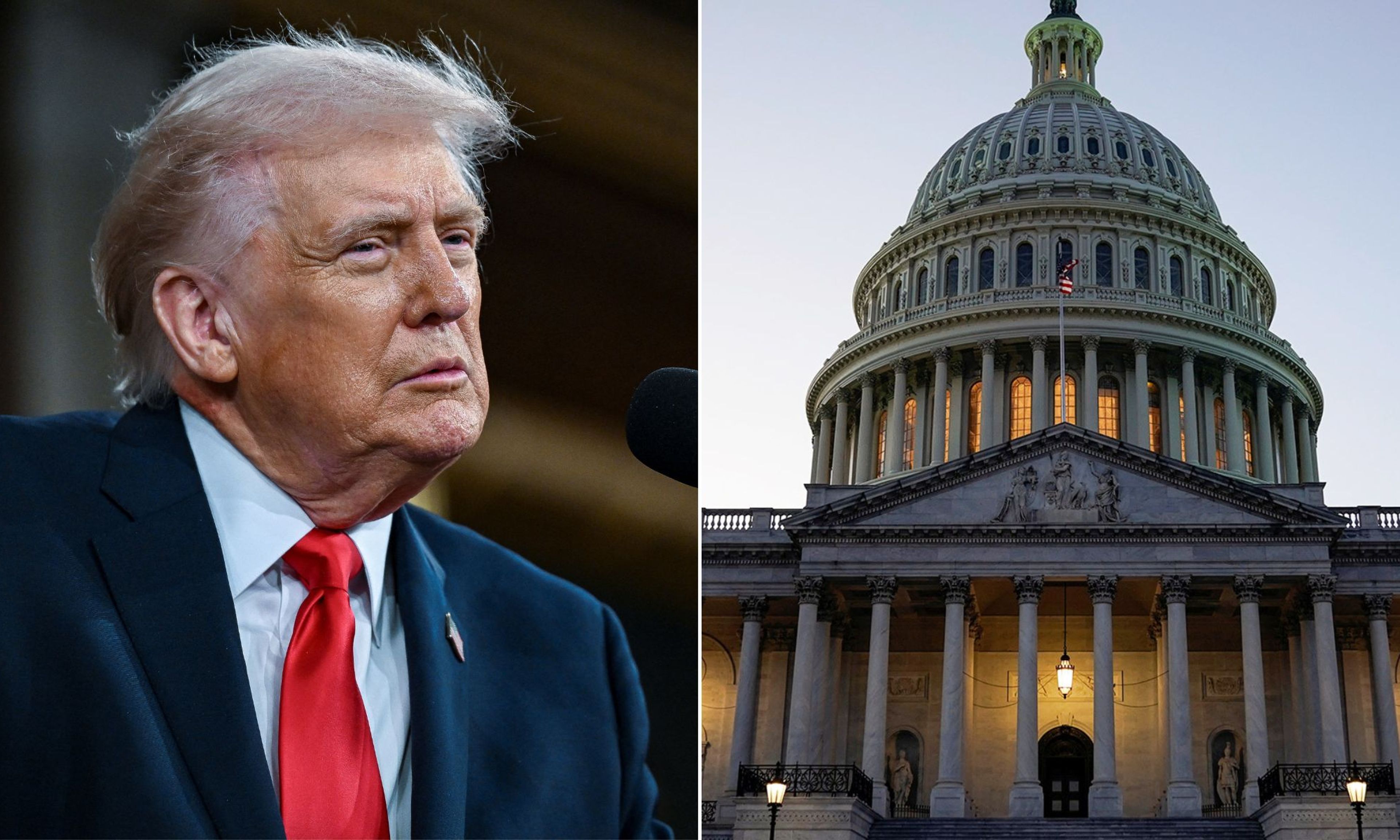
Left: President Donald Trump delivers his State of the Union address at the U.S. Capitol in Washington, D.C., February 24, 2026. Right: The U.S. Capitol Building.
Congressional critics of the strikes on Iran will force a vote this week on whether to condemn the Trump administration’s conduct. But even though they have a good case for a robust debate over the war’s merits, they are striking political poses when constitutional seriousness is called for. The truth is that Trump’s critics have plenty of tools to stop a war if they wished — a funding cutoff most prominent among them. Without one, the executive branch will continue to have the constitutional right to conduct a military campaign against the mullahs in Tehran.
History shows that the Constitution has never required Congress to provide its assent before presidents have launched hostilities. Of course, the Constitution grants Congress the power “to declare War,” which the legislature used at the start of the conflicts in 1812, 1848, 1898, 1917, and 1941. But starting with George Washington’s campaign against the Indians on the western border and Thomas Jefferson’s expedition against the Barbary pirates, presidents have long used force abroad — more than a hundred times, in fact — without declarations of war. The Korean War — which lasted three years, demanded 320,000 U.S. troops, and killed 36,000 American servicemen — never received any form of congressional authorization. Instead, President Truman led a war to protect the country’s national security and foreign policy, and Congress voted the troops and weapons necessary to fight it.
Trump critics cannot claim that the American practice of war powers has receded into the mists of ancient history. Congress could have voted to stop funding the snatch-and-grab of Venezuelan dictator Nicolás Maduro, which followed months of naval strikes and covert operations in the area, but did not — just as Congress acquiesced in the mirror-image invasion of Panama in 1989 that overthrew dictator Manuel Noriega. Many of today’s senators were present when President Obama conducted military operations against Libya in 2011, which bore striking similarities to Trump’s attacks on Iran today. The Obama administration succeeded in overthrowing the regime in Tripoli and our allies killed its leader Muammar Gaddafi; Congress did nothing.
Congress has had every opportunity to stop Trump’s Iran policy. Trump had not only telegraphed for weeks that these attacks were in the offing, but he had already launched attacks on Iran’s nuclear facilities in June. Since Operation Midnight Hammer, Congress passed the One Big Beautiful Bill Act in July 2025 and a $1.2 trillion appropriation in January 2026 to fund most federal agencies. These bills presented critics with every opportunity to refuse to replenish the supplies necessary to wage the intensive air war over the skies of Tehran that we are seeing now.
The controversy over ICE operations in Minneapolis shows that Congress knows full well how to stop presidential initiatives — at least when it really wishes to do so. Though only a minority in the House and Senate, Democrats prevented any appropriations from passing — effectively shutting down much of the government — for 43 days to protest the shootings by ICE agents in Minneapolis. Even when Democrats agreed to the January 2026 appropriations, they refused to include new money for the Department of Homeland Security, which has ground many of its operations to a halt (though ICE operations themselves remain funded because of a special $75 billion grant in the One Big Beautiful Bill Act).
During this exact same period, Democrats decided not to restrict President Trump’s ability to follow Operation Midnight Hammer with more strikes on Iran. Congress enacted a National Defense Authorization Act, which called for $900 billion in military programs, that President Trump signed in December 2025. It then passed an $838.7 billion appropriation for the Defense Department, which President Trump signed into law just one month ago — virtually the same week that Democrats succeeded in shutting down much of the Department of Homeland Security. Trump critics who assert that the Iran strikes violate the Constitution are clearly posturing when they have voted to replenish military arsenals even as Trump escalated his threats against Tehran.
In contrast, the Constitution places on the president the primary responsibility to protect national security. It vests the president with the executive power and the role of commander in chief, which, as Alexander Hamilton wrote in Federalist No. 70, gives him the duty of “protection of the community against foreign attacks.” The Founders vested these powers in the president precisely because only a single man could act with sufficient “energy in the executive” to respond to pressing foreign policy and national security challenges. Hamilton explained in Federalist No. 74 that the direction of war demands “energy, decision, activity, secrecy, and dispatch” — qualities the executive possesses and Congress, by its size and deliberative structure, does not. At the Virginia ratifying convention, replying to accusations that presidents could use their control over the military to become dictators, James Madison argued that the Constitution provided a sufficient check because “the sword” rested in the hands of the executive while “the purse” resided in the legislature. The Founders understood that Congress would have the real constitutional ability to block presidential warmaking at any time with the power of the purse.
Nor can critics claim that the suddenness of the U.S. attack renders the purse powerless. Presidents have made clear for many decades that Iran poses a direct threat to American national security. President Clinton first declared Iran an “unusual and extraordinary threat” under the International Emergency Economic Powers Act in 1995. Every subsequent president — Bush, Obama, Biden, Trump — reaffirmed that determination. President Trump even went further: During his first term, he identified Iran as a primary regional threat in his National Security Strategy, restored maximum pressure sanctions, and designated the Iranian Revolutionary Guard as a Foreign Terrorist Organization. Trump continued to pressure Iran by ordering a strike to kill Qasem Soleimani, Iran’s most powerful military leader, in January 2020.
These presidents have understood that the Iranian threat is not abstract but real. Iran has been waging war against the United States since 1979. The Islamic Republic seized the American embassy in Tehran and held dozens of hostages for 444 days. Its proxies bombed the Marine barracks in Beirut in 1983, killing 241 Americans. Iranian agents were implicated in the Khobar Towers bombing in 1996. Iranian-supplied weapons killed at least 600 American soldiers in Iraq. Iran’s proxy network — Hezbollah, the Houthis, Kataib Hezbollah, Hamas — has carried out attacks against American forces and installations across the Middle East for decades. Hamas, backed and funded by Tehran, launched the October 7 attacks on Israel that killed more than 1,000 people, including 46 Americans. President Trump did not rupture the peaceful relationship between the United States and Iran. Rather, he confronted an ongoing war.
Presidents have a duty to confront not just short-term attacks, but also longer-term threats which, if they come to fruition, could pose an even more devastating possibility of attack on the United States. Iran has pursued the technology to produce a nuclear weapon and is developing intercontinental ballistic missiles that could reach the United States; it already possesses ballistic missile technology whose range encompasses Europe. Iran possesses the largest ballistic missile arsenal in the Middle East — thousands of missiles capable of reaching American bases from Western Europe to the Indian Ocean. Its production exponentially outpaces the combined missile defenses of the United States and Israel. As Senator Tom Cotton observed, Iran’s space program has yet to produce an astronaut, but it has produced the technological pathway to an intercontinental ballistic missile. The Defense Intelligence Agency assessed that Iran could develop a militarily viable ICBM by 2035 if it chose to pursue one. The convergence of these two programs — nuclear weapons and the ICBMs to send them to the American homeland — is not a manageable threat. It cannot be reversed once realized.
Any American president would do everything possible to stop these weapons from falling into the hands of a nation that has made hatred of the United States and Israel the centerpiece of its foreign policy. After Operation Midnight Hammer destroyed Iran’s enrichment facilities at Fordow and Isfahan, the Trump administration pursued diplomacy through Oman and Geneva to forestall any restart of the Iranian nuclear program. Iran refused; satellite imagery confirmed new centrifuge installations and facility reconstruction within weeks. In his recent State of the Union address, Trump was direct: “My preference is to solve this problem through diplomacy. But one thing is certain. I will never allow the world’s number one sponsor of terror to have a nuclear weapon.”
A closing window of opportunity also justifies presidential action. Last June, Israel’s Twelve-Day War had degraded Iran’s air defenses, but Iran was rebuilding them. Mass protests had erupted in more than a hundred Iranian cities beginning in December 2025, destabilizing the regime — but the Islamic Revolutionary Guard Corps (IRGC) soon crushed the uprisings. President Trump had warned that the United States would come to the Iranian people’s rescue if the regime’s killing continued. A president who draws a red line and then fails to enforce it invites further aggression.
The stakes for American credibility extend beyond Iran. If the United States does not act against a weakened, isolated Iranian regime that is simultaneously rebuilding nuclear weapons, developing ICBMs, and slaughtering its own citizens, China would take the lesson regarding Taiwan, or Russia in Ukraine.
Tehran rejected every opportunity to de-escalate. Three rounds of negotiations — in Muscat, then twice in Geneva — collapsed after Iran refused to abandon uranium enrichment. IRGC gunboats attempted to seize an American tanker in the Strait of Hormuz. Tehran continued rebuilding the nuclear facilities that Midnight Hammer had destroyed. The Iranian regime continued killing its own people. Operation Epic Fury followed.
The Constitution’s grant of the power “to declare War” to Congress does not require legislative authorization, in advance, of presidential measures to prevent Iran’s short-term and long-term threat to the United States. The Framers borrowed the phrase “declare War” from British constitutional practice: Declarations of war served as formal notices to other sovereigns of the legal status of hostilities under international law. Declarations had little to do with authorizing the use of the military under domestic constitutional law. The constitutional text bears this out. Article I, Section 10 states that “no State shall, without the Consent of Congress . . . engage in War unless actually invaded, or in such imminent Danger as will not admit of delay.” That is exactly the war powers system that liberal critics of the presidency believe should apply between Congress and the president. But the Framers instead chose to divide the role of commander in chief and war-declaration powers between the president and Congress without requiring any legalistic process for deciding on war.
Critics invoke the War Powers Resolution, which purports to require withdrawal of deployed U.S. forces within 60 days absent congressional authorization of the deployment. But a statute cannot rewrite the Constitution’s allocation of powers, even if the president was to use force for longer than the statutorily allotted time. The same critics raised identical objections to the Soleimani strike in 2020. Speaker Pelosi accused the president of acting “without respect for Congress’s war powers granted to it by the Constitution.” The House passed a resolution directing the president to terminate hostilities against Iran. They predicted catastrophe. What followed was not conflagration but the end to a series of Iranian provocations.
Liberals have long proven inconsistent in their attitude toward presidents and war by claiming that Republicans wage unconstitutional wars while remaining silent under Democrats. Few claimed that Obama’s war in Libya or Clinton’s air war in Kosovo violated the Constitution. They even accepted the Obama administration’s implausible justification that the Libya and Syria interventions did not need authorization because, without ground troops, they were not really wars at all. But these critics gave full vent to their frustrations once Trump occupied the Oval Office. Senator Bernie Sanders asserted that Trump had “no legal authority” to attack Syria, even though he had not criticized Obama’s 2011 Libya intervention. The failure of many anti-war critics to be consistent reveals the political partisanship behind their arguments.
The Framers vested the power of the commander in chief in the president because strategic opportunities do not wait on legislative calendars. They concentrated all of the executive power in the president because, as Hamilton wrote in Federalist No. 70, “Decision, activity, secrecy, and dispatch will generally characterize the proceedings of one man.” Nowhere are those qualities more in need than in protecting national security. Congress itself has recognized as much by building and maintaining an expeditionary military — carrier strike groups, long-range bomber fleets, special operations forces — designed not for homeland defense but for offensive operations abroad.
Operation Epic Fury rests on the same core presidential authority over national security at a time when Iran’s nuclear ambitions, ballistic missile development, and support for proxies were converging — and when the window of opportunity was closing. Faced with those circumstances, Trump as commander in chief determined there was no responsible alternative to the use of force. If Congress disagrees, it has the tools that the Framers gave it: the power of the purse, the power to impeach, and the power to appeal to the American people. But the Constitution does not require the president to wait for Congress before acting against a foreign threat. The Framers entrusted this judgment to the president, and Trump exercised it within that constitutional design.

About the Author
John Yoo is Heller Professor of Law at the University of California, Berkeley; distinguished visiting scholar at the School of Civic Leadership and a senior research fellow at the Civitas Institute at the University of Texas at Austin; and a nonresident senior fellow at the American Enterprise Institute.
Featured Tags
Advertisement
Advertisement

Comments