Congress Should Update Trump’s International Tax Relief
Written by Ryan Ellis
As the Senate considers the House’s tax bill, it should remember that international changes to the tax code in 2017 were also helpful for economic growth.
Share this story
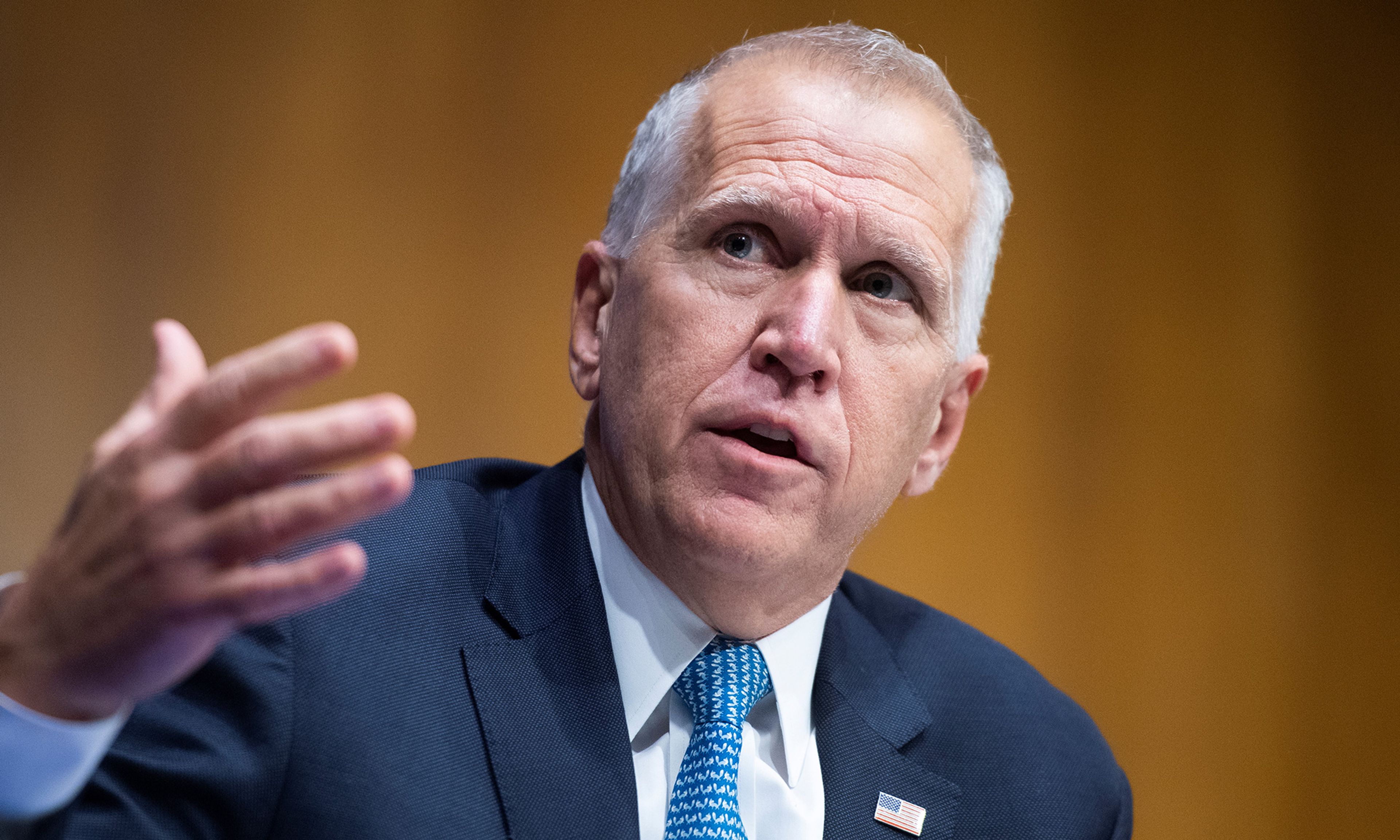
Sen. Thom Tillis (R., N.C.) asks a question during a Senate Judiciary Committee hearing in Washington, D.C., June 16, 2020.
The Tax Cuts and Jobs Act of 2017 (TCJA) is best known for its transformative corporate income tax reform, reducing the corporate income tax rate from 35 percent (the highest in the developed world) to 21 percent (right in the average of the developed world). Second only to (and closely related with) this accomplishment, however, was the transformation of our international business tax system from a “worldwide” model (where the U.S. seeks to tax income earned by U.S. taxpayers everywhere) to a modified “territorial” model (where the U.S. seeks to tax income earned by U.S. taxpayers only in the United States, unless those earnings occur in tax havens).
This international tax reform was almost as badly needed as the corporate income tax rate reform was, and went hand in hand with it. The U.S. tax system gave every incentive for American companies to “invert,” shipping jobs and capital overseas to lower-taxed countries (almost anywhere else before TCJA). There were 42 corporate inversions in the decade before TCJA’s passage. There have been none -- zero, zilch, nada -- since then. The lower tax rate here at home certainly helped. The international changes were just as important.
Prior to TCJA, companies that earned money overseas could indefinitely defer IRS tax on their worldwide earnings by keeping it overseas. TCJA forced these funds to be repatriated and face tax, and created a new regime going forward. The IRS would no longer seek to tax income earned abroad by U.S. businesses, but there was a catch: If those earnings were made on intellectual property residing in tax havens (roughly defined as having a tax rate under 10.5 percent), the company would have to pay the difference to the IRS. To balance this out, TCJA also created a tax benefit for foreign companies earning income on intellectual property residing in the United States. This system is known as “GILTI/FDII.” There is also an “exit tax” on payments to tax-haven jurisdictions known as “BEAT.”
Authors of the proposals knew at the time that a series of reforms this transformational would work (and they have), but also require some basic maintenance as theory met reality over time. The result of these lessons is found in S 1605, the “International Competition for American Jobs Act,” sponsored by Senator Thom Tillis (R., N.C.) It consists of a grab bag of small but important tweaks to the GILTI/FDII and BEAT systems meant to make them work better in the future. These reforms, the result of the experiences of American businesses under the new system, have been vetted by the Tax Foundation and mainstream conservative tax groups and are the consensus batch of international changes that most of us tax conservatives feel should end up in the Senate version of the One Big Beautiful Bill Act.
Most of these changes are to put a stop to unintended glitches in the original TCJA design model. For example, a U.S. subsidiary of a foreign company doing business overseas might easily find itself liable for both the BEAT exit tax and the GILTI tax-haven tax, a double tax situation not intended by the original authors. This glitch can show up with respect to payments to high-tax countries, contrary to the original policy purpose. The Tillis bill fixes both of these errors. As a result, it will be far easier for foreign companies to become U.S. companies, or to set up U.S. subsidiaries, or to make direct investments into the United States.
Another example is in the tax treatment of the U.S. Virgin Islands, a U.S. territory. The USVI has a “mirror” tax code to the United States, meaning its tax code looks just like the IRS rules, but it keeps all the money locally. The U.S. tax code allows the U.S. Virgin Islands to create a kind of “enterprise zone” to attract investment there (nothing wrong with that; the United States can and does treat territories differently when it’s in our national interest to do so, just as other countries do theirs). The USVI, in turn, has a law giving a “90 percent off” coupon to bona fide businesses that locate there and create jobs.
Before TCJA, a U.S. corporation doing business in the U.S. Virgin Islands paid a tax rate of 3.5 percent (90 percent off the old 35 percent corporate income tax rate). You would think that this same U.S. taxpayer now would pay 2.1 percent, 90 percent off the 21 percent corporate tax rate. But it doesn’t because of GILTI, meaning the USVI tax rate actually rose under TCJA from 3.5 percent to at least the GILTI 10.5 percent. But a Chinese company doing business in the USVI would pay only 2.1 percent. S 1605 would restore the enterprise zone law in the USVI, exempting it from GILTI rules and thereby taxing American and foreign investment in the U.S. Virgin Islands the same, with an identical 2.1 percent tax rate. Many U.S companies will want to use this glitch correction, so it should not be difficult to establish its budgetary substance.
Two other international provisions not included in S 1605 are worth Senate scrutiny. The House version of the One Big Beautiful Bill creates a “retaliatory tax” against companies residing in countries that have imposed discriminatory taxes against the United States (mostly digital services taxes and the global minimum tax rules designed by Eurocrats). The form this takes is a withholding tax of up to 50 percent on portfolio income on investments in these companies held by pensions, mutual funds, exchange-traded funds, etc. It also has higher corporate income tax liabilities and a new “Super BEAT” tax rate on income earned by foreign companies in the United States and distributed back to the home office residing in the offending countries.
This is a very delicate dance, with the Trump administration and Treasury Secretary Bessent on one side (who want this as leverage in international negotiations against the Eurocrats) and some really smart tax conservatives like former Congressional Budget Office Director Doug Holtz-Eakin and Kyle Pomerleau of the American Enterprise Institute on the other. Their concern is that the retaliatory tax measures could dry up foreign investment in the United States over time, impacting jobs and economic growth, and Congress’s Joint Committee on Taxation agrees. Despite the good intentions of the proposal, the unintended consequences may far outweigh the benefits. Better to make the U.S. a magnet for foreign direct investment with low tax rates, full expensing, free trade, etc.
A final international item the Senate must deal with involves a new “remittance tax,” aimed at illegal immigrants in America sending their illicit earnings back home. This 3.5 percent excise tax, however, was written so broadly that it applies to almost any wire transfer out of the United States, not just the remittances sent by illegal aliens. The only way out of the tax is for you to prove to your bank that you’re not here illegally, which puts banks in the same position as the DMV issuing Real IDs, or employers checking I-9 documents. This section probably needs a whole new rewrite, or to be scrapped entirely.
The U.S. Senate has a chance to refresh and update what has been a very successful international tax reform using the commonsense proposals contained in S 1605. There are a few areas, though, where they should tread lightly, lest they have to come back in another round of tax reform to fix what was hastily passed now.
About the Author
Ryan Ellis is the president of the Center for a Free Economy and an IRS-enrolled agent.
Featured Tags
Advertisement
Advertisement


Comments