Two Urgent Tax Proposals for 2022
Written by Travis Nix
These bipartisan tax provisions could help buoy the economy.
Share this story
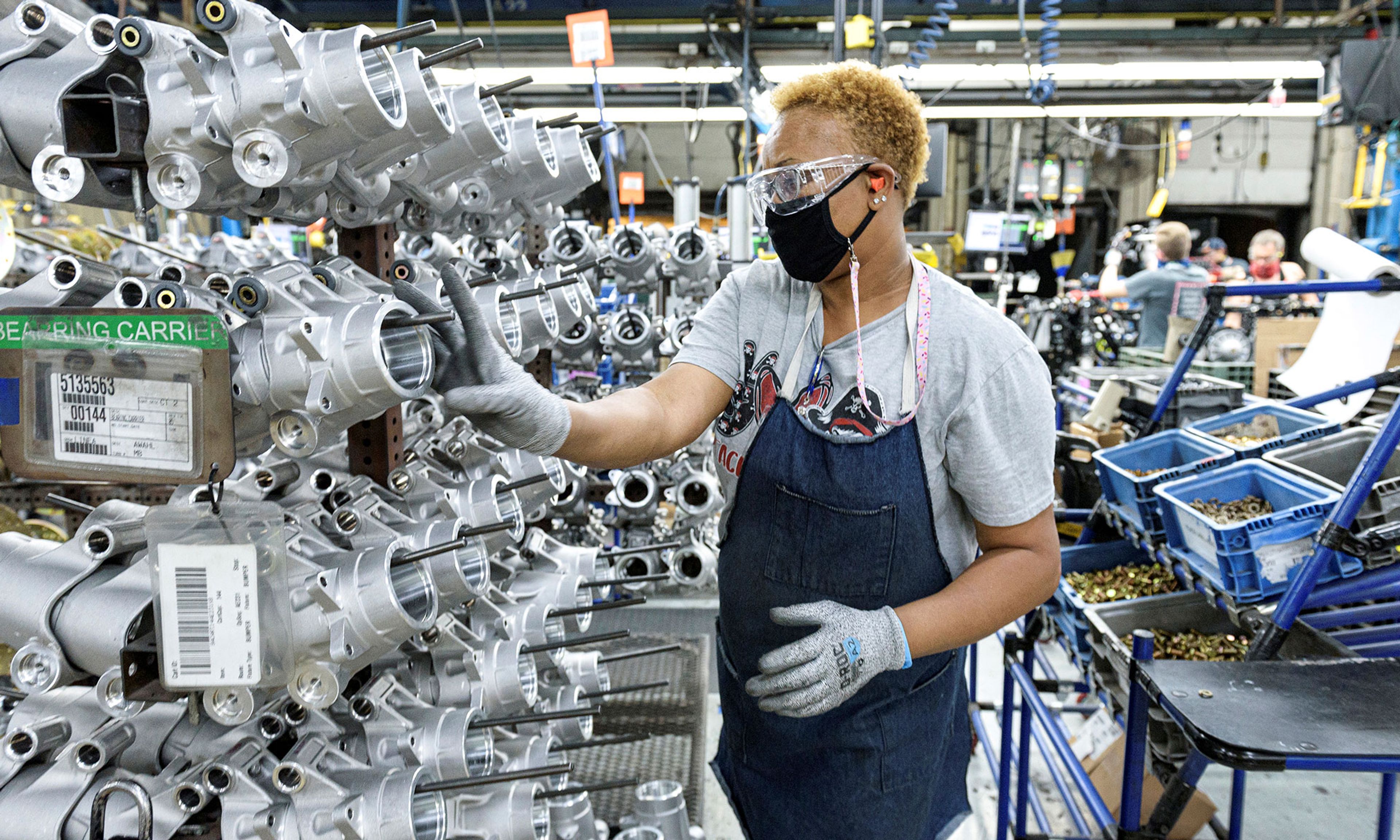
Worker on a Polaris ATV assembly line at the company's manufacturing and assembly plant in Roseau, Minn., June 7, 2021.
With the Build Back Better Act thankfully dead (fingers crossed!), lawmakers need to make a better list of legislative priorities for the new year that will actually improve Americans’ lives. Congress can start with the tax code, where expiring tax provisions are poised to kneecap the post-pandemic economic recovery. Extending these tax provisions on a bipartisan basis would provide a better framework for future U.S. tax-reform efforts, and it would provide investors and businesses greater certainty to invest in the future.
The No. 1 priority for Congress in 2022 should be to continue to allow research-and-development costs to be fully written off. Unless Congress takes action, starting this tax year, businesses will have to write off the cost of R&D over five years, rather than writing off the full amount in the year it is incurred. Allowing R&D expenses to be fully written off incentivizes companies to allocate capital to innovate and to improve their product range, something that, if successful, should ultimately increase jobs and wages.
The Tax Foundation estimates that restoring this write-off would alone create 30,600 jobs and increase wages by 0.12 percent, both essential developments in a time of slow job growth and rising inflation.
Not only should the full deduction be restored, but it should also be extended retroactively. Normally, retroactive tax policy is a bad idea, even when it favors the taxpayer, since the retroactive element generally just subsidizes past activity without incentivizing new behavior. However, this is a special circumstance. A retroactive subsidy for this tax year would give companies more money to expand research in the future rather than having to cut back research efforts in light of this year’s elevated cost. The sooner this tax fix is passed, the more it can incentivize further important research efforts in 2022.
It’s surprising that Congress hasn’t acted on this provision sooner. The R&D deduction has had continuous bipartisan support for years now. In fact, it’s had a standalone bipartisan bill waiting in the House since 2019 that could have prevented the current situation from ever happening. Jamming the provision into a doomed Democratic reconciliation bill that had no chance of passage in 2021 was unwise.
Another soon-to-expire provision that lawmakers should seek to address now, rather than wait as they did with the R&D deduction, is a full capital-investment deduction for short-lived assets such as equipment and machinery. Under current law, 2022 is the last year in which companies can immediately deduct the cost of these. Starting in 2023, they will have to deduct these costs over a number of years, raising the cost of investment.
This tax provision, known as “full expensing,” ensures that all capital investments are treated equally under the tax code. Treating investments equally and allowing them all to be written off immediately lets business, not government, decide what to invest in. The result ought to be a more productive economy with more jobs and higher wages.
New investments are the lifeblood of the economy and need to be encouraged by the tax code to help America’s economic recovery along. The investments in machinery and equipment incentivized by full expensing should help make workers more productive, raising their wages over time. The Heritage Foundation estimates that extending full expensing permanently could increase GDP by over 4 percent and create hundreds of thousands of new jobs.
If full expensing expires at the end of this tax year, all this potential economic growth is lost. Extending full expensing is good for workers, businesses, and all Americans.
While there is a bill currently in the Senate to make full expensing a permanent feature of the tax code, it has only Republican co-sponsors. Making full expensing a permanent feature of the tax code would likely benefit from the same bipartisan support as the R&D deduction. Republican lawmakers should consider working with Democrats on some of their tax priorities that expired at the end of 2021, such as a larger child tax credit. Combining full expensing with a larger child tax credit would be a clear example of bipartisan, pro-family tax reform that would provide great economic benefits to both families and businesses.
Congress has a lot of tax work it needs to get done in 2022. It needs to extend full expensing for research and development as well as tangible investments as soon as possible. With both of these tax changes, the U.S. would have a more stable and steady tax code for the rest of this decade.
About the Author
Travis Nix is a Young Voices contributor and a student at Georgetown Law. His tax and economic commentary has been featured in Fox News, National Review, the Washington Examiner and the Chicago Tribune, among other publications.
Featured Tags
Advertisement
Advertisement

Comments