Democracy Assistance Isn’t Regime Change
Written by Daniel Twining
Strategic support for democracy not only makes the world safer and more secure for Americans — it’s what our forefathers would have done.
Share this story
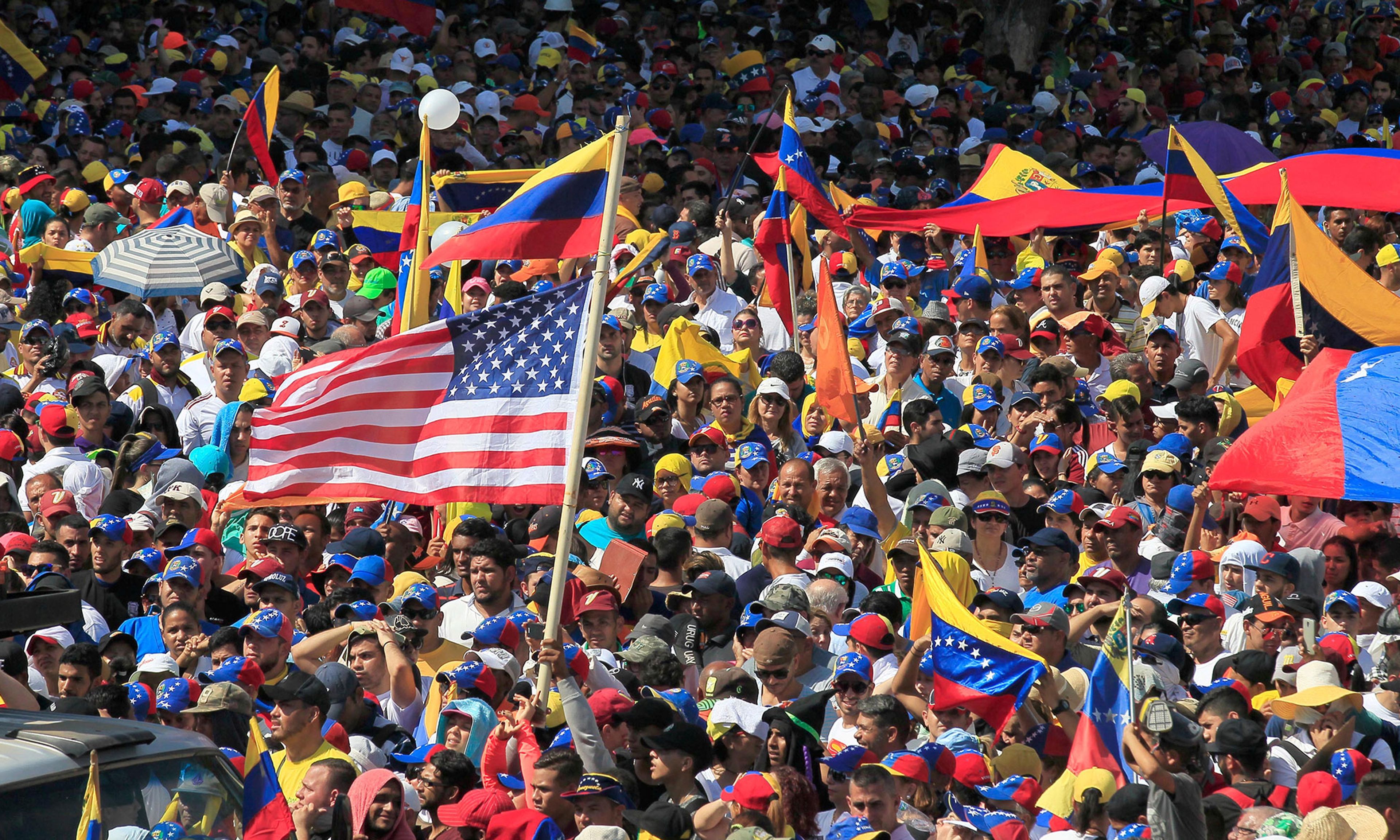
A U.S. flag is held as opposition supporters take part in a rally against Venezuelan President Nicolas Maduro's government and to commemorate the 61st anniversary of the end of the dictatorship of Marcos Perez Jimenez in Maracaibo, Venezuela, January 23, 2019.
Opposition to tyranny lies at the heart of every freedom movement. At the dawn of the American Revolution, the patriots who went on to found our nation decided to buck their overlords in Britain, declare independence, and forge what was then the world’s only republican government. The cost of failure would have been death on the grounds of treason. Fortunately, these freedom fighters succeeded, and the world was better for it.
In their quest to defeat the British crown, the American “opposition” needed support from the outside. They found allies in France, Spain, and the Netherlands. This assistance was not only military: The Europeans also helped the colonists organize civically, create newspapers and pamphlets, deliver on governance, and generate economic and social policies. Without help from these friends, America’s patriots may not have won their campaign for independence.
Earlier this month in Washington, three patriots opposing tyrants in their own countries — Maria Corina Machado of Venezuela, Sviatlana Tsikhanousakaya of Belarus, and Ji Seong-ho of North Korea — reminded us that supporting democratic change abroad is not only a moral imperative and a part of the American national identity but that associating it with “regime change” actually cheapens the noble struggle for freedom.
Whose Term Is ‘Regime Change?’
There is an argument being made today by some in the Trump administration and on Capitol Hill that democracy assistance for those fighting tyranny in closed states from Cuba to Iran to China should be ceased, based on an argument that the United States should not interfere in the internal affairs of other countries. Critics use the pejorative term “regime change programs” when referring to this U.S. assistance provided to dissidents in authoritarian and closed states. Yet this view relies on a fundamental misunderstanding of how democracy assistance actually works and conflates different categories of engagement under one nefarious-sounding label.
The attacks on U.S. democracy assistance using the rhetoric of “regime change” started with the Cuban, Russian, and Chinese regimes 25 years ago. Seemingly every week, Russia Today, The Grey Zone, China Daily, and anti-American fellow travelers dropped exposés about programs supporting democratic oppositions in Iran, Venezuela, Cuba, Russia, and Hong Kong. These propagandists would obtain photos, documents, and grant information of organizations such as the National Endowment for Democracy and try to generate embarrassment around democracy programs. Often visual proof would be doctored, or the information miscontextualized, to paint an unseemly picture of what the United States was funding. Like true conspiracy theorists, the leftists would falsely link open democracy assistance to the CIA and “black ops.”
What’s Old Is New Again
Incredibly, instead of being proud that people living under the heel of dictators look to the United States as a champion of freedom, some popular American social-media influencers today echo the propaganda of our authoritarian adversaries. They make unusual bedfellows since the liberties such individuals enjoy to speak their conscience in a free society would get them killed in the totalitarian ones they appear to defend.
Chinese, Iranian, Cuban, and Russian leaders love to blame a “foreign hand” for their people’s discontent with dictatorship and accuse the United States of “meddling” in other countries’ affairs — even as these adversaries ruthlessly persecute peaceful dissents at home and weaponize their meddling against the United States and its democratic allies through forms of political and information warfare.
Russia’s campaign to dismantle democracy in Ukraine, Georgia, and Moldova is a product of Vladimir Putin’s fear that if freedom takes root in these former Soviet states, it could easily do the same in Russia, pushing him from power. Beijing deploys a toolkit of coercion, co-optation, and corruption targeting foreign elites in an effort to compel them to prioritize China’s interests over those of its own citizens. Cuba uses covert authoritarian tactics to support left-wing forces across the Western Hemisphere that will stand up to America, even at the expense of their own citizens’ welfare: In Venezuela, which was once the richest country in South America and is now its poorest thanks to a generation of kleptocratic rule, Cuban support has been decisive in protecting Nicolás Maduro’s regime from the 70 percent of Venezuelans that last July’s elections show want him gone.
What Democracy Assistance Is, and What It Isn’t
To call democracy assistance a form of regime change is to fundamentally misunderstand both the nature of this work and the very concept of sovereignty itself.
Democracy-assistance programs are a vital lifeline to individuals living under repressive regimes. For example, in Venezuela, democracy initiatives help ordinary citizens access independent media where the regime has a monopoly on information. At the International Republican Institute event where Machado was beamed in from Caracas — she has not left Venezuela in over a decade — the leader of the opposition made it clear that the fight for freedom was only that of the Venezuelan people themselves; international democracy assistance, however, was a key to their struggle: “I believe that we wouldn’t be where we are, which is at a real possibility of turning Venezuela from this criminal hub into a [real partner and ally] for the whole hemisphere if it weren’t for international solidarity and support.”
Democracy assistance also supports exiled pro-democracy activists and movements that advocate for a democratic alternative for their countries, so that they might effect change at home when the timing is propitious. In Belarus, the United States and scores of countries recognize Sviatlana Tsikhanouskaya as the winner of the otherwise fraudulent 2020 presidential election. Western support to her exiled political movement continues to generate pressure on the Alexander Lukashenko regime, which is sustained in power not by support from the people of Belarus but by the Kremlin. In February, when a convention in Poland assisting Tsikhanouskaya’s Coordinating Council was cancelled due to the Trump administration’s foreign-assistance freeze, Lukashenko’s mouthpiece speaker in the Belarusian parliament celebrated the American “snub” of Tsikhanouskaya. (The funds have never been restored.)
Indeed, some of the world’s most prominent anti-American dictators find common ground with those in the United States who support cutting democracy programs. Not only do they accuse these programs, including the National Endowment for Democracy, of seeking to overthrow their governments, they have also celebrated the Trump administration’s closure of these institutions. From Lukashenko to Maduro, Putin to Nicaragua’s Daniel Ortega, and from Communist China’s Xi Jinping to Iran’s Ayatollah Khamenei, strongmen are jubilant and empowered over the potential cuts to the NED and other democracy-assistance programs. Tsikhanouskaya says the opposite should be happening: “It’s important to make dictators feel that democracy will not step back” and that “democracy will stay principled, will stay consistent in policy.”
Of course, these dictatorships have neither a legal nor moral claim to limit the ability of their people to seek to exercise core freedoms and advocate for themselves. As America’s founders articulated so brilliantly, sovereignty derives from the consent of the governed; where this is absent, the people living under those conditions have every right to seek to create the conditions in which a representative government can be established. This is the irony behind misguided claims that Washington, Jefferson, and Hamilton would have been against helping Maria Corina Machado or Sviatlana Tsikhanouskaya.
Requests for political, diplomatic, or financial assistance from the U.S. or other democracies — assistance without any hard power or military component — can hardly be considered regime change. By contrast, the past decade alone is replete with examples of actual regime change by undemocratic American adversaries such as China — which destroyed Hong Kong’s political independence — and the attempted conquest of Ukraine by Vladimir Putin.
The fact is that American democracy is inseparable from our success on the world stage. Our ideas about representative government, the rule of law, property rights, and free speech undergird America’s historic economic success and global dominance. Fledgling democracies and freedom fighters recognize this and look to us for solidarity and support in establishing their own democratic institutions. As Tsikhanouskaya put it, “It is difficult to fight every day. . . . It’s a really devastating struggle. We need to feel and understand that we are not alone, and we are not abandoned.”
America’s adversaries abroad would like nothing more than to see the United States end our modest investments in strengthening democracy. Ji Seong-ho, who fled North Korea for freedom at a terrible personal cost, summed it up best when he said, “We have to remind the dictators that in the free world, we stand together.”
Let's dispense with the tired “regime change” myth and recognize that strategic support for democracy not only makes the world safer and more secure for Americans. It’s what our forefathers would have done. Indeed, it’s who we are.
About the Author
Daniel Twining is the president of the International Republican Institute.
Featured Tags
Advertisement
Advertisement
Comments