<em>Dobbs</em> May Represent the Big Bang for Abortion Politics
Written by Steven F. Hayward & John Yoo
Post-Roe, the abortion issue will likely heat up at every level of government as we enter into a period of greater instability and conflict.
Share this story
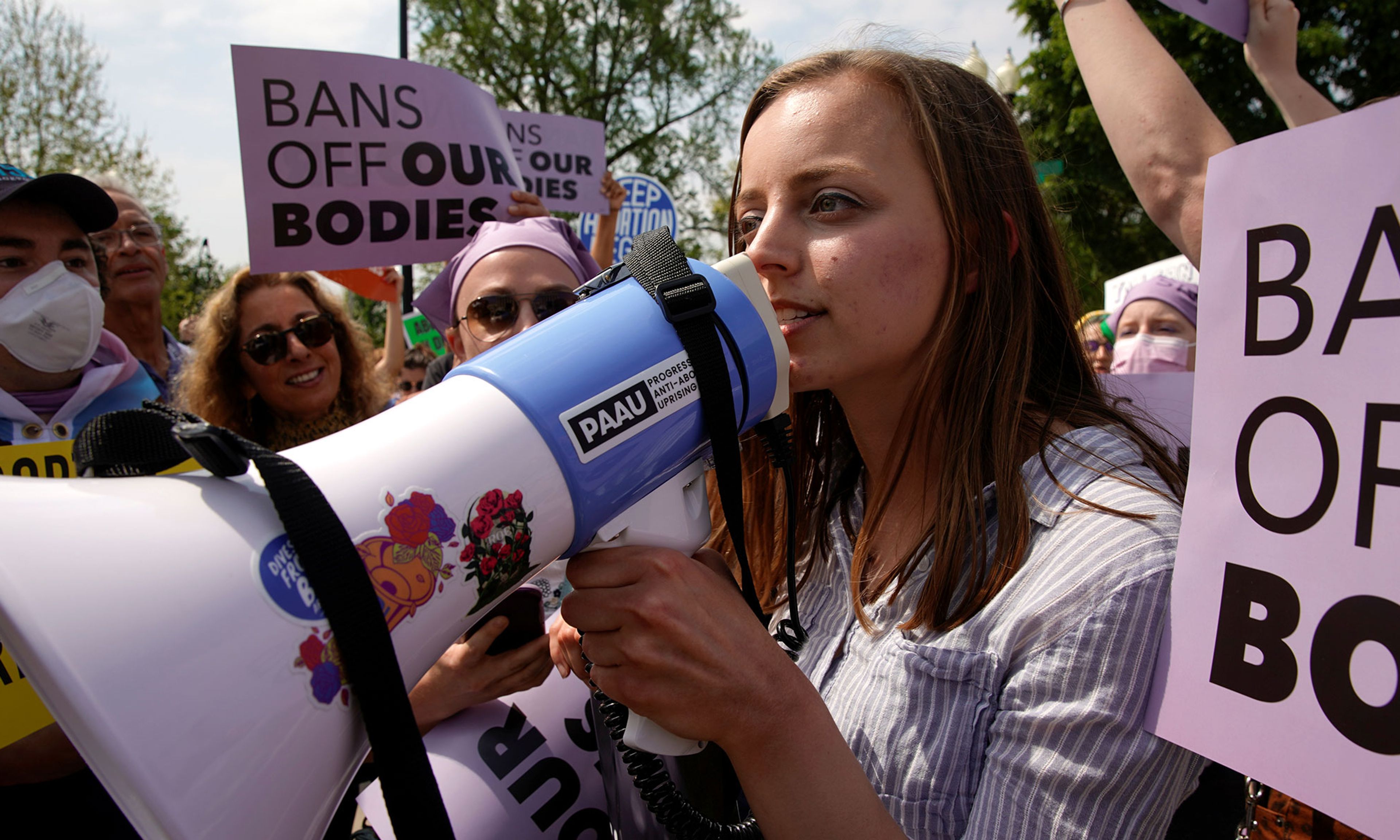
A pro-life activist uses a megaphone while standing among pro-abortion activists during a protest outside the Supreme Court in Washington, D.C., May 3, 2022.
Editor’s note: This is the last in a series of articles (the previous three are here, here, and here) on the leaked Dobbs draft opinion and its implications.
If in the next few weeks the Dobbs case comes out in the form seen in the leaked draft opinion, it will represent not an end to the contentious politics of abortion, but the beginning of a new and likely much more intense phase of bitter controversy. The arrest yesterday of an armed man who planned to assassinate Justice Brett Kavanaugh is an extreme instance of this intensity. While Justice Samuel Alito may hope that Dobbs will lower the temperature by removing the issue from the control of the federal judiciary and placing it with the political branches in the 50 states, the issue is in fact likely to heat up in several ways. Given the centripetal forces of American politics, the abortion controversy will still return to Washington, D.C., and the Supreme Court may well be dragged back into the fray regardless of its wishes. Rather than defusing the issue, Dobbs may put us on the cusp of a big bang in abortion politics.
Abortion has been treated as a legal and constitutional issue for so long that there hasn’t been much sustained thought given to how “returning the issue to the states” is likely to play out. (Notably, articles in National Review’s “End Roe” issue, from November 29, 2021, and in NR’s May 20, 2022, issue, delve into the topic.) As long as the issue was thought confined to the judiciary, the state of affairs enabled legislators to avoid making clear decisions and taking actual votes. Officeholders will no longer be able to posture on the issue.
Should Dobbs overturn Roe, we can expect several developments.
First, and most obviously, there will be pitched battles in state legislatures over statutes regulating abortion. Any deep-blue states that don’t already have permissive abortion statutes on the books from the pre-Roe era (New York, Illinois, California, etc.) will surely move to enact them, while deep-red states will do the reverse. Purplish or swing states will likely see bitter fights that may repeat themselves after every election cycle, depending on changes in the composition of the legislature.
It should not be assumed that the politics of abortion will be stable even in deep-red or deep-blue states. Some Republicans who generally profess to be pro-life may balk at certain forms of proposed abortion restrictions (such as banning abortion from as near the moment of conception as possible), and pro-choice Democrats may balk at late-term or taxpayer-subsidized abortion. There’s an additional wild card for pro-choice Catholic Democrats: the recent decision of San Francisco’s Archbishop Salvatore J. Cordileone to deny Communion to House speaker Nancy Pelosi because of her pro-choice views. If this censure spreads among Catholic prelates around the country, it will not only give pause to pro-choice Catholic politicians, but it will also inflame the hoary “separation of church and state” debate. (This is a debate that conservatives should welcome, though that is a subject for another day.)
Second, attempts to settle abortion policy won’t be confined to legislatures. The 26 states that have an initiative-and-referendum process will likely see ballot-initiative campaigns that will seek to fix statutory law or amend state constitutions in a pro-life or pro-choice direction. Some states that have rights to privacy explicitly included in their constitutions will see the issue brought into state courts. The state-by-state variation in judicial outcomes will raise afresh the problem of judicial lawmaking, and likely propel the matter back to the U.S. Supreme Court.
Another likely development is that we will enter into a period of greater instability and conflict over abortion. Two factors predict this messy outlook. First, unlike the pre-Roe era when abortion politics were slowly heating up and not yet the focus of significant organized efforts, today there are well-established (and well-funded) pro-life and pro-choice organizations that will mount highly visible campaigns and lobbying efforts on the state level.
But there is an even more important reason why the politics and law are likely to be unstable: the cognitive dissonance of public opinion about abortion. A recent Wall Street Journal poll found that a majority opposed overturning Roe, with 57 percent responding that a right to abortion should exist for any reason. But there has seldom been an issue about which survey results depend so heavily on the wording and presentation order of the questions. Similar polls often find majorities opposing late-term abortion, or supporting the general proposition that abortion can or should be regulated.
The basic reason for this cognitive dissonance is that many people don’t like to think hard about this issue or think through the consequences of believing that abortion ends a human life, as even many pro-choice survey respondents think. As long as the issue resided in the chambers of the Supreme Court, it wasn’t necessary to resolve incompatible abstractions. Thus the key to the outcome of the new phase of abortion politics will be old-fashioned democratic persuasion. Beneath the surface of ambiguous opinion is an interesting fact: While the rate of abortion soared after Roe, for more than two decades now the abortion rate has been steadily declining and is now lower than it was before Roe. Somehow, fewer pregnant women have been having abortions even as the right expanded in the courts.
Finally, there is going to be intense political pressure for Congress and the executive branch to weigh in on the issue. One aspect of Justice Alito’s draft Dobbs opinion that might tempt Congress to try to snatch the issue back from the states is its view that abortion cannot be rooted in the history and traditions of the nation, unlike other, more well-founded individual rights. But this does not prevent Congress from attempting to support abortion rights, or, with a different political party in control, trying to discourage them. New laws, however, would have to come at the issue sideways. Despite Democratic efforts of late, the Constitution does not permit Congress to directly overturn a Supreme Court decision.
In City of Boerne v. Flores, for example, the justices confronted the Religious Freedom Restoration Act of 1994, which sought to reverse an earlier Court decision, Employment Division v. Smith, that had narrowed religious freedoms. Before Smith, the Court had subjected laws that burdened religious freedom to a strict-scrutiny test, under which most laws fail. But with Justice Scalia writing, the Smith Court held that it would uphold a “neutral law of general applicability,” such as the drug-control law at issue in the case, even if it burdened the free exercise of religion (in Smith itself, the smoking of peyote, a hallucinogenic, as part of a Native American religious ceremony).
Section 5 of the 14th Amendment states that “Congress shall have power to enforce, by appropriate legislation, the provisions of this article” — that is, of the 14th Amendment. In particular, the amendment’s equal-protection and due-process clauses have served as the fount for most of the important judicially recognized individual rights that apply against the states. In Boerne, Congress claimed that, under this power, it could restore religious freedom to its pre-Smith status and require any law that burdened the right to be subject to strict scrutiny again. The Court struck down RFRA. Justice Kennedy wrote for the Court: “Legislation which alters the meaning of the Free Exercise Clause cannot be said to be enforcing the Clause. Congress does not enforce a constitutional right by changing what the right is.” The power to determine the scope of rights under the 14th Amendment, the Boerne Court found, rested in the hands of the Supreme Court, not Congress. City of Boerne dooms any congressional effort to directly overrule Dobbs.
In its failed effort to secure Roe last month, Senate Democrats also claimed the authority to overturn Dobbs under the commerce clause. The interstate-commerce clause has indeed provided the authority for federal rights not recognized in the Constitution. Most famously, the Court upheld the Civil Rights Act of 1964, which prohibits racial and gender discrimination in employment and travel under the commerce clause. Even if activity does not cross state borders, the Court has held, it can still fall under the commerce clause if the activity is commercial in nature and, in the aggregate, has a substantial effect on national markets. Under such flimsy logic, the Court has upheld federal drug convictions for the possession of small amounts of marijuana on the ground that such small amounts effectively snowball into large impacts on the national market for drugs. Under that same logic, Congress could require doctors to offer abortion as part of its regulation of the health-care industry. A Republican Congress followed the same logic when it enacted legislation banning partial-birth abortions — a bill the Supreme Court upheld in 2007’s Gonzales v. Carhart.
A commerce-clause-based abortion bill, however, would still run into constitutional difficulties. The Court in Carhart did not reach the question whether Congress had the authority to directly regulate the entire medical profession; it addressed instead whether a ban on partial-birth abortions ran afoul of Roe v. Wade and Casey v. Planned Parenthood. Instead, the Rehnquist and Roberts Courts tightened the limits on Congress’s use of the commerce clause to regulate activity for non-economic reasons. In United States v. Lopez (1995), the Court struck down a law that had prohibited guns in school zones because the activity was not truly commercial in nature. In United States v. Morrison (2000), the Court invalidated the Violence Against Women Act, which had made such violence illegal when it crossed state borders. In both cases, the Court found that the federal government had unconstitutionally used the commerce clause to intrude into the states’ prerogatives over criminal law. The Court could view a bill codifying Roe, in the face of Dobbs, as a similar federal invasion of the states’ traditional control over criminal law or the professions.
Nevertheless, the Constitution still provides Congress with indirect means to influence abortion policies and practices. A Congress intent on preserving Roe could use the same powers — the spending and taxing clauses — that allowed Obamacare to survive judicial challenge. Congress, for example, could provide vouchers or tax credits to pregnant women who live in states that don’t allow abortion and wish to travel to obtain one in states that do. Congress could provide similar tax benefits or subsidies for organizations that enable such travel or even perform abortions. It could require insurance policies under Obamacare, or those provided by large interstate employers, to reimburse abortion-related expenses. Under the Court’s deferential approach to Congress’s power of the purse, such measures would likely be constitutional. More controversially, Congress could even cut federal health-care funds for states and hospitals that refuse to perform abortions, though they would argue in their defense that federal spending cannot force them to violate state law.
These possibilities reinforce our view that Dobbs does not mean the end of our nation’s struggles over abortion, only their move to a different, more political, arena. But as progressives turn the midterms into a referendum on Roe and threaten to bring Congress’s powers to bear, they should keep in mind that constitutional powers do not run in one direction only. Any power that a Democratic Congress might use to codify Roe could become a power that a Republican Congress could use to ban abortion nationwide. Any spending cuts directed at hospitals and states that refuse to carry out abortions could become, in the hands of a Republican Congress, cuts aimed at states that allow abortion. If a Democratic Congress gets away with using the commerce clause to require doctors to perform abortions, a Republican Congress could use the exact same power to prohibit them. We might hope that the pro- and anti-Roe forces focus their efforts on a state-by-state contest that takes advantage of our nation’s federalism, but they no doubt will find the allure of a uniform, national solution irresistible. Unfortunately, there is nothing Dobbs can do to prevent that.
Steven F. Hayward is senior resident scholar at the Institute of Governmental Studies and a lecturer in both the law school and the political science department at the University of California at Berkeley.
John Yoo is the Emanuel S. Heller Professor of Law at the University of California at Berkeley, a nonresident senior fellow at the American Enterprise Institute, and a visiting fellow at the Hoover Institution at Stanford University.
[slideshow slideshow="1009721" /]

About the Author
Steven F. Hayward is the Edward Gaylord Distinguished Visiting Professor at Pepperdine University School of Public Policy.

About the Author
John Yoo is Heller Professor of Law at the University of California, Berkeley; distinguished visiting scholar at the School of Civic Leadership and a senior research fellow at the Civitas Institute at the University of Texas at Austin; and a nonresident senior fellow at the American Enterprise Institute.
Featured Tags
Advertisement
Advertisement

Comments