Does the Filibuster Have a Future?
Written by Audrey Fahlberg
Why Senate Republicans resist the president.
Share this story
Roman Genn
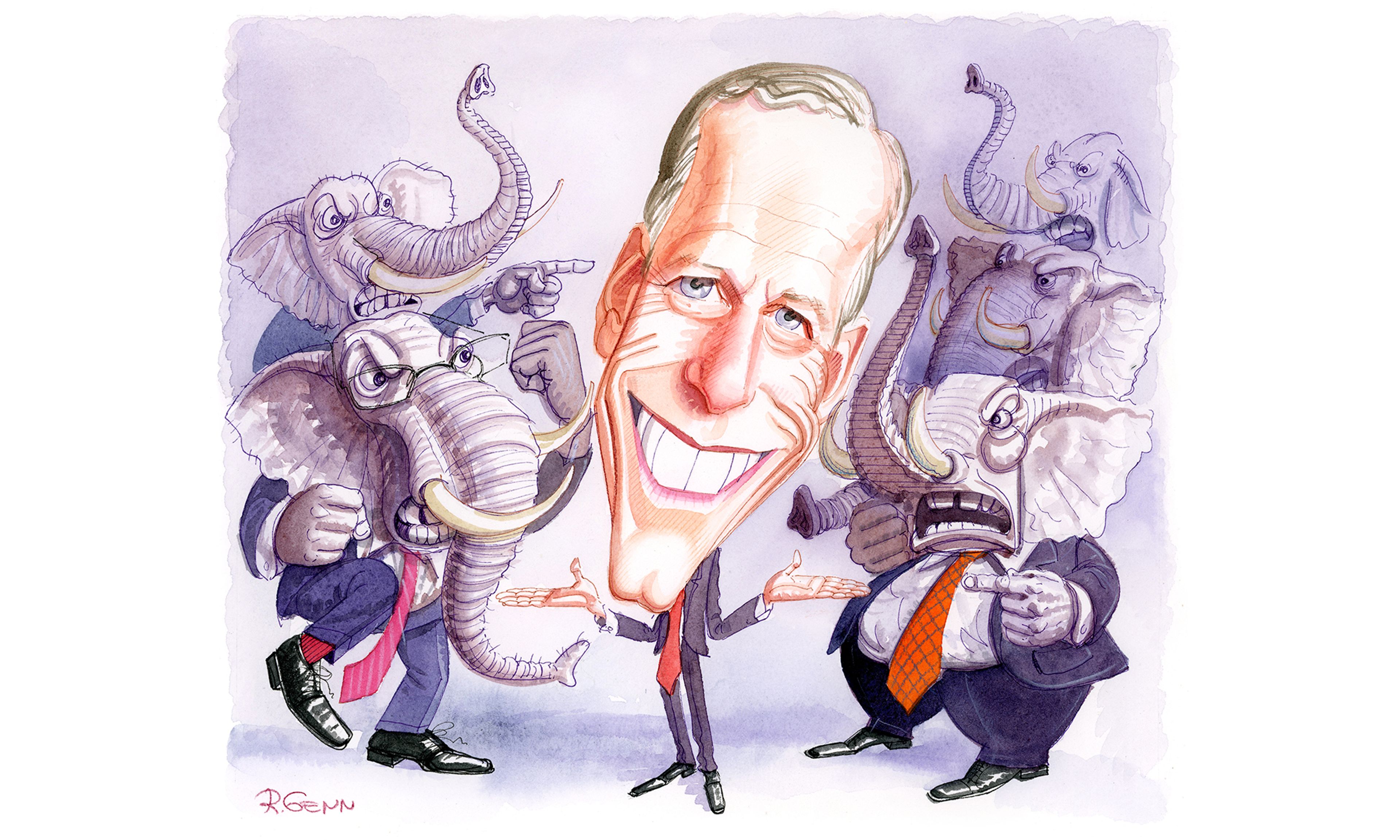
On November 5, 2025, President Trump invited Senate Republicans to the White House to reiterate a message he’d been pressing for days amid a government-shutdown fight: it was time to do away with the filibuster.
“We have to get the country open,” Trump told the assembled senators. “And the way we’re going to do it this afternoon is to terminate the filibuster.” Then came his acknowledgment of the harsh political reality. “It’s possible you’re not going to do that. And I’m going to go by your wishes,” he conceded. “You’re very smart people. We’re good friends. But I think it’s a tremendous mistake. It would be a tragic mistake, actually. It’s time.”
Trump’s renewed crusade against the Senate’s 60-vote threshold is a decade in the making. Senate Majority Leader John Thune told National Review in an October 29 interview that debates surrounding the filibuster are an “ongoing conversation” with Trump. “I think he — like a lot of people — views it as sort of one of those creatures of Senate history that doesn’t fit the modern times,” the South Dakota Republican said. But Thune was equally frank about the math: “Most of our members — and there aren’t more than probably a handful who would vote to get rid of it — believe that it does.”
The 60-vote threshold has been an obsession of Trump’s during his second term, as it was during his first, to the point where virtually every legislative fight on Capitol Hill now has a filibuster dimension. Frustrated that the rule slows his agenda, Trump constantly raises the subject in phone calls and meetings with GOP senators and aides, sources say. As one Trump-world operative told National Review in January, the president “cares so much about it that he will bring it up even when it’s not on the docket to be brought up.” That same ally acknowledged the obstacle: “The problem here is that the votes probably don’t exist” to nuke it.
And yet the White House, for all the president’s vocal displeasure, hasn’t targeted the filibuster with the kind of full-scale lobbying campaign that typically accompanies an aggressive Trump-backed legislative push. Instead, the White House legislative-affairs team, which includes the president’s trusted aides James Braid and James Blair, in recent months has conducted check-ins with Senate Republican offices, sources familiar with the matter tell NR.
“I wouldn’t say there’s been a push,” Senator Jim Justice (R., W.Va.) told NR.
“It’s periodic,” Senator John Boozman (R., Ark.) said of the check-ins. “I think that the leg-affairs people are curious as to where everybody stands.”
So far, the outreach has been described by senators and staffers as more of a temperature-taking exercise than an arm-twisting campaign, though senators might be disinclined to reveal the true tenor of the private discussions to reporters.
Forcing a floor vote would carry real political risks for a president who doesn’t like to start fights he’s likely to lose, especially if even a handful of retiring and centrist senators would fall on their swords to protect a rule they revere as much as their jobs. According to retiring Senator Thom Tillis (R., N.C.) in a mid-December interview with NR, there are “about 35 members who do not want to nuke the filibuster,” with only ten or 15 “willing to state that publicly.” A chunk of Republicans would follow Trump’s lead if it came to a vote, but, at present, that number is widely believed to be well short of the majority of senators needed.
The White House harbors skepticism about whip-count projections that are floating around Washington in the press. Administration officials believe there’s a meaningful gulf between the number of Republicans who tell reporters or White House staff they’d never vote to end the filibuster and the number who would actually break with Trump on the floor if leadership called the question.
Not that the White House is telegraphing its strategy to reporters. “May the president force a vote on the filibuster at some point? He may,” one administration official told NR.
Upper-chamber Republicans’ resistance to nuking the filibuster is a notable departure from their largely deferential stance toward Trump’s expansive use of executive authority during his second term on tariffs, war powers, and unconventional cabinet nominees. On this one issue, a critical mass of Republican senators has held firm, and they offer a consistent rationale.
Pro-filibuster Republicans know Trump’s strongest argument: Democrats, the moment they reclaim the trifecta of the presidency, Senate, and House, will kill the rule themselves and then use that power to enact sweeping changes. Might as well act first, the anti-filibuster camp argues, before Democrats do it anyway and all hell breaks loose.
The defenders counter that they’d rather not be the ones to open that door. “When you look at it in the historical context, how the Democrats might use it, I just don’t think we want our fingerprints on that,” Thune told NR last fall. Speaking with NR in December, Tillis agreed in characteristically pointed terms: If senators want to be recorded in the pages of history for “destroying this institution in this country, let it be Democrats that do it, not Republicans,” he said, implying that they would pay a political price.
The White House believes that most Senate Republicans’ reverence for the filibuster is misguided, especially since it was not created by the Constitution but is rather a decades-old rule. In their view, it has emboldened Democratic obstructionism on appropriations and confirmations at unprecedented levels during Trump’s second term.
Echoing their strategy from last year’s shutdown, Democrats are once again using the filibuster to politicize a government-funding fight — this time forcing congressional Republicans to use the budget reconciliation process to fund parts of the Department of Homeland Security, in protest of the president’s deportation agenda. “In the appropriations process,” one administration official told NR, “the filibuster is being used to destroy the very bipartisan process that it is supposed to create, by allowing a minority to block appropriations bills in the service of the left’s desires on immigration.”
“Its use as a tool of obstruction has outweighed its benefit as a tool of protecting the minority’s interests,” another administration official said.
As for the fear of what Democrats might do once the rule is abolished? Elections are safeguards, filibuster opponents insist. If a future filibuster-free, Democrat-controlled Senate works alongside a Democratic House and presidency to pack the Supreme Court, grant D.C. and Puerto Rico statehood, and federalize a fundamental right to abortion throughout pregnancy, Americans can course-correct at the polls and reelect Republicans to reverse those changes. (This argument is of course in some tension with the idea that Republicans need to go first or suffer permanent damage.)
And as for the 2026 midterms, the White House is optimistic that the Senate map favors long-term GOP control “unless the voters decide Senate Republicans don’t accomplish enough, which is their biggest political threat,” the official maintained. “This is a center-right country, and the voters want policy accomplished that reflects that. . . . But right now, the Senate majority is being unnecessarily hamstrung by the far left because of this tool.”
* * *
A fresh flash point in this debate is the SAVE America Act, a Trump-backed voter-eligibility bill that has exposed anew intra-GOP fault lines. The bill has broad Republican support but lacks the Democratic votes needed to clear 60, leaving its supporters searching for a work-around.
Senator Mike Lee (R., Utah) has been the most vocal advocate for deploying a “talking filibuster,” which would compel Democrats to hold the floor continuously until their resistance exhausts itself. Lee insisted in a brief mid-February interview with NR that his Republican colleagues were coming around: “Little by little, as people become more familiar with it, they’re less spooked by it.” Ultimately, Senate leaders allowed debate on the bill but declined to pursue the talking-filibuster strategy, and some observers believe that the idea has captured Lee’s and House Republicans’ imaginations more than it has the White House’s.
Critics of the talking-filibuster approach argue that it’s more complicated than its proponents acknowledge. “If you’re trying to pass a bill, the filibuster is not your friend. The filibuster is how you stop bills,” says Mike Fragoso, a fellow at the Ethics and Public Policy Center who previously served as chief counsel to former Senate GOP Leader Mitch McConnell. “It’s not Mr. Smith Goes to Washington speaking on the floor for a day. It’s not Strom Thurmond speaking on the floor for 30 hours. It’s the full arsenal of speeches, amendments, and motions that the minority gets to attack the majority with until the majority relents.”
The tactical problems are real, opponents insist. Forcing a talking filibuster on the SAVE America Act would give Democrats the opportunity to offer amendments on any number of combustible subjects, such as tariffs, Obamacare subsidies, war powers, or Ukraine aid, all of which could make the final bill unrecognizable. And the floor time consumed would come at a steep cost. “If we choose to exhaust all floor time on the SAVE America Act, that could be as long as six months not spent legislating on other issues, such as funding government services and confirming the president’s nominees,” Senator Tim Sheehy (R., Mont.) recently wrote in the Wall Street Journal. “This strategy would essentially grind the nation to a halt with Republicans in control.”
House conservatives are unsympathetic to these objections, let alone to most Senate Republicans’ attachment to the filibuster as a bulwark against majority tyranny that forces compromise.
“I’m not sure what power they’re jealously guarding, because they’re not using any power,” Representative Brandon Gill of Texas recently told NR. Senate Republicans are hiding behind “procedural constraints to stop themselves from doing anything. And the reality is, the American people do not care about arcane Senate rules.”
Senator Ron Johnson (R., Wis.), an ally of the White House on the filibuster question, made the point in a recent interview with NR that the votes for changing Senate procedure short of the filibuster had not materialized until Democratic obstruction grew sufficiently egregious during the first year of Trump’s second term.
Last May, Thune advised Senate Republicans to overrule the Senate rule enforcer and stymie California’s emissions standards and gas-powered-vehicle phaseout plan via a simple majority vote. It was a move the Senate parliamentarian and Government Accountability Office advised against, given that the legislative maneuver — a resolution of disapproval under the Congressional Review Act — is typically used for federal rules, not for federal waivers of state policy. And Democrats’ blockade of Trump nominations prompted Thune to bless another rule change in September allowing the majority to confirm whole slates of presidential nominees at once with 51 votes instead of 60. Those changes chipped away at Senate precedent but, anti-filibuster Republicans maintain, they made the Senate more efficient.
“We didn’t have the votes to change the rules with a simple majority until Democrats were so obnoxious, so obstructionist,” Johnson told NR, suggesting that worsening gridlock could eventually shift the consensus in the anti-filibuster camp’s favor.
“Could the Senate be more broken, more dysfunctional?” he asked. “I don’t think it’d be the end of the world, certainly not the end of the Senate, if we got rid of the 60-vote threshold.”
For now, the standoff persists. Trump keeps raising the subject. Thune keeps reporting back that the votes aren’t there. And so far, at least, the White House continues its periodic temperature checks on GOP senators while stopping short of forcing leadership to hold a vote.
That peace may not last. As one Trump ally predicted, the president might eventually run out of patience: “I think eventually he’s going to say, ‘F*** it. We’re going to try to force this through. And if people want to fight me on it, then I’m going to go to war with them.’”

About the Author
Audrey Fahlberg was a politics reporter for National Review.
Featured Tags
Advertisement
Advertisement


Comments