Don’t Blame Insurance for the Strait of Hormuz Crisis
Written by John R. Puri
Premiums are the price of risk that already exists in the world.
Share this story
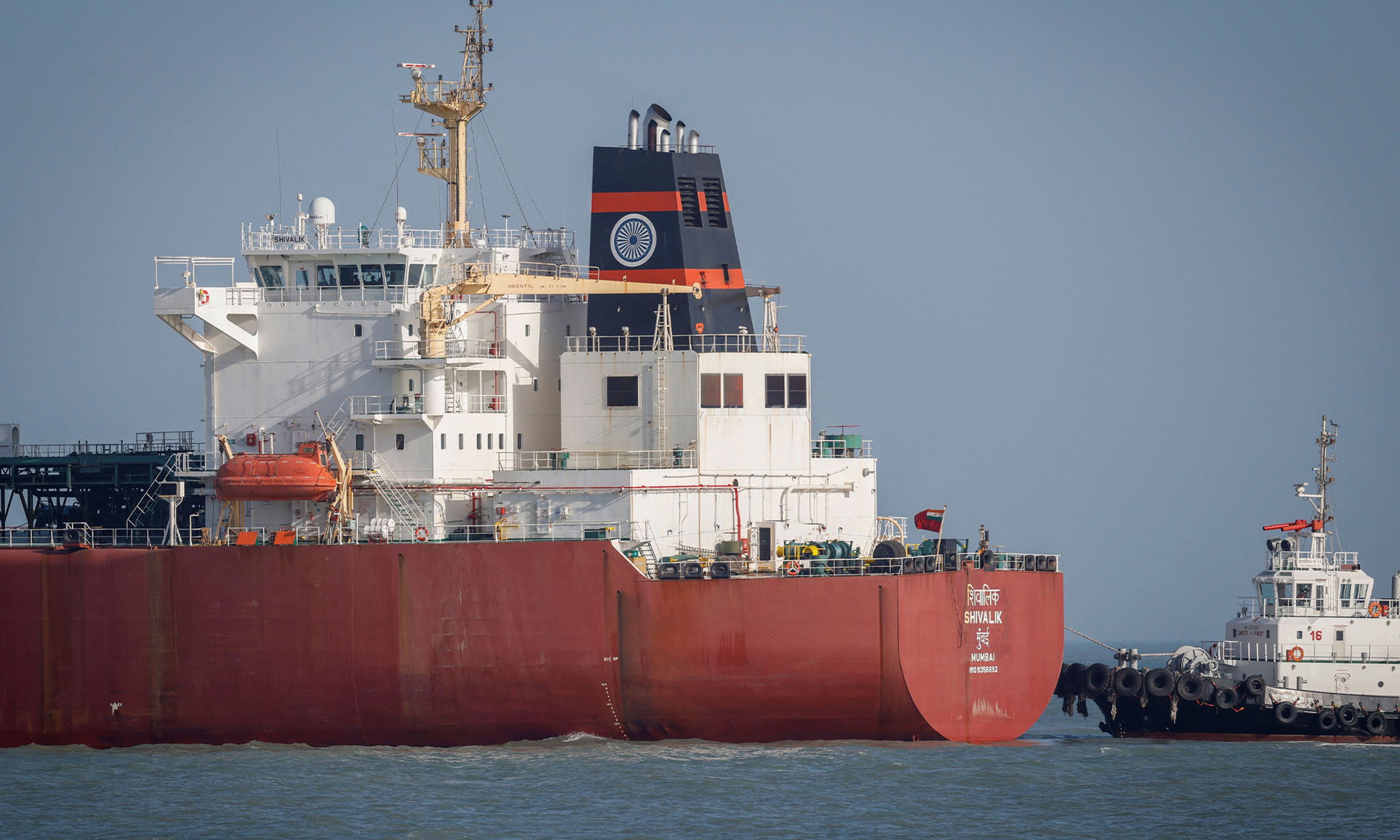
A coastguard boat approaches an Indian liquefied petroleum gas carrier as it arrives at Mundra Port via the Strait of Hormuz, amid the U.S.-Israel conflict with Iran, in Gujarat, India, March 16, 2026.
There is a misunderstanding going around that elevated insurance premiums, not actual kinetic risk, are what’s keeping tankers from getting through the Strait of Hormuz. That would be good news, since a mere “financial problem” is much easier to solve than a military one. Unfortunately, the financial problem and the military problem are one and the same.
It’s true that insurance rates for ships crossing the Strait of Hormuz have skyrocketed. Shipping companies typically purchase war-risk insurance as a separate policy from general coverage when moving cargo through conflict-prone areas, such as the Persian Gulf. These policies cover financial losses from physical damage, loss, or seizure of vessels caused by war, terrorism, piracy, or mines. Since the Iran war began, war-risk premiums for a trip through the Strait of Hormuz have jumped several-fold.
Before the crisis, war-risk insurance for a vessel passing through the Gulf would be at 0.02% to 0.05% of the vessel’s value.
Since the start of hostilities, premiums have reportedly jumped to 0.5% to 1% of the vessel’s value, or even more.
It means that for a tanker valued at $120mn a normal premium of approximately $40,000 would now cost between $600,000 and $1.2mn for a single trip.
Such high rates do indeed present a high barrier to shipping companies. They are not, however, the problem in themselves. Insurance premiums do not create any new risk that firms must factor into their decisions. Rather, they reflect the price of risk that already exists out in the world.
There are essentially two components of risk: likelihood and severity. Getting rear-ended is a high-likelihood risk but a relatively low-severity one. Falling victim to a shark attack is a high-severity risk but low-likelihood. In terms of financial risk, likelihood is the frequency of an event that causes losses; severity is the value of losses each event causes.
Insurance policies are just a means of normalizing the expense of risk by spreading it across time and among many people. If insurance didn’t exist, all the risks it covers would still be there. For example, without auto insurance, American drivers would still incur hundreds of billions of dollars in losses every year because car accidents would continue to occur.
If everyone paid the full cost of their own accidents, society would save money. We wouldn’t need to spend money on claim administration, appraisers’ salaries, or insurance companies’ office space. And we wouldn’t have to pay monthly premiums to pay for other people’s accidents. If all of America were a single household, it would be better off with no insurance.
Yet almost no one wants to live in that world, because insurance serves a useful role. It takes the cost of risk -- which exists prior to insurance -- and makes it even and predictable. To do so, it multiplies the likelihood of a given event by its financial severity, then divides the total cost among all policyholders who might be affected.
War-risk insurance works the same way as any other kind of insurance. The risk that it protects against in the Strait of Hormuz is that ships may be attacked by Iran. That risk is real: A confirmed 21 merchant vessels have been struck or targeted since the war began. The United Arab Emirates estimates that “more than 18 merchant ships of various nationalities have been hit by projectiles, missiles, drone boats, and sea mines.” Twelve seafarers are dead or missing.
Because crossings through the Strait of Hormuz have slowed to almost zero -- except for vessels that win permission from Iran -- it is impossible to assess the true likelihood of a commercial ship getting attacked. Depending on how intact Iran’s offensive capabilities are, or how many mines it has laid in the strait, the chances of being hit could be closer to 5 percent or to 95 percent.
What shipping companies do know is that the severity of an attack can be catastrophic. In many Iranian attacks, damage to vessels has been significant. Worker casualties -- deaths and serious injuries -- can add millions in costs. Some ships have needed to be abandoned. To an insurer, the cost of an attack could be the ship’s entire value -- plus the value of all its cargo.
Uncertainty in the war has certainly clouded the risk calculations of insurance firms. We don’t know how dangerous the Strait of Hormuz is on a day-to-day basis. But such uncertainty is its own kind of risk, and caution is the natural (and logical) response.
Finally, if war-risk premiums really overestimated the true risk of crossing the Strait of Hormuz, ships could always choose to go without coverage. War-risk insurance is nice to have in the Middle East, but it’s not mandatory. Businesses and individuals choose to take risks without insurance all the time, deeming the cost of protection too high.
So why aren’t ships going it alone? Because the risk of getting blown up in the strait is real -- or, at least, shipping companies believe that it’s real -- independent of insurance prices. Elevated premiums simply reflect the elevated likelihood of a kinetic attack since Iran began shooting at everything that moved.
For rates to come down, the risk that they reflect will have to come down first. That challenge -- destroying Iran’s ability to strike ships -- is a military problem. The financial markets that price real-world risk are working just fine.

About the Author
John R. Puri is the Thomas L. Rhodes Fellow at National Review.
Featured Tags
Advertisement
Advertisement

Comments