Don’t Let Sanctions Against Iran Lapse
Written by Brett Schaefer & Danielle Pletka
It would merely set the stage for war — again.
Share this story
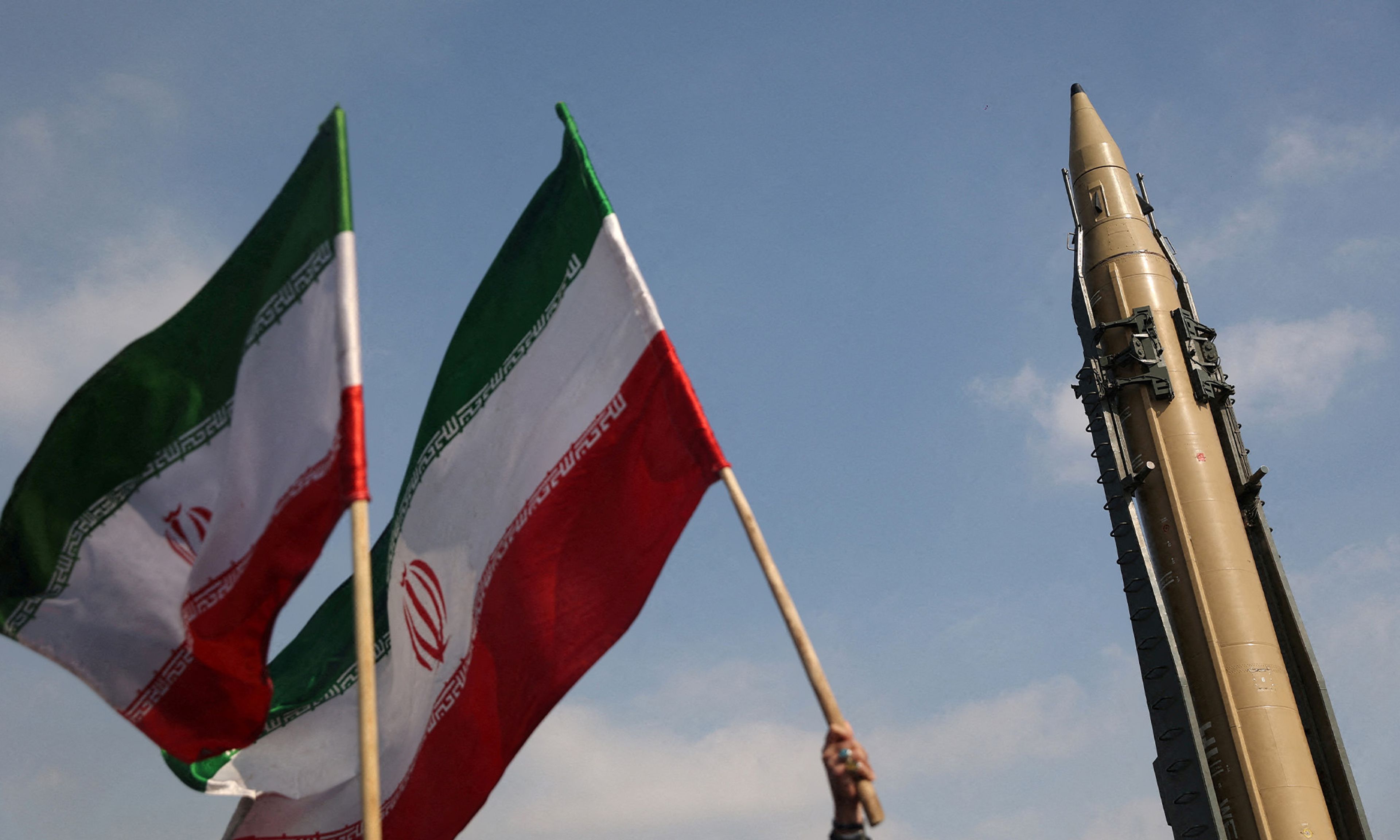
People wave flags next to an Iranian missile on display during the 46th anniversary of the Islamic Revolution in Tehran, Iran, February 10, 2025.
The United States has struck a crippling, but not fatal blow at Iran’s nuclear weapons aspirations. Similarly, Israel’s methodical strikes on research labs, explosives test sites, reactors, and nuclear scientists has likely set back the Islamic Republic’s work — either toward nuclear breakout or a just-in-time weapon that could be ready within weeks. But the key words are “set back,” not “destroyed” or “eliminated.” This is why the world cannot be distracted by the military strikes and must ensure that Iran cannot reconstitute its program after the dust settles, including making sure that United Nations Security Council sanctions aimed at that goal do not expire.
Concern over Iran’s nuclear program is not new. U.S. President Bill Clinton, pushed by Congress, imposed primary and secondary sanctions on Iran in the 1990s. And between 2006 and 2010, Washington painstakingly negotiated six Security Council sanctions resolutions aimed at prohibiting Iran’s enrichment of uranium, ballistic missile testing and launches, transfer of nuclear and missile related technology, and transfer of conventional weapons. Iran’s foreign assets were frozen, and travel bans were put in place. These sanctions were critical in slowing Iran’s progress toward weaponization and, more important, limiting interactions of third party states with Iran who feared U.S. enforcement.
Nonetheless, Iran continued its clandestine nuclear program. Evidence of that progress is documented in successive International Atomic Energy Agency reports, open-source documentation of advanced work on elements of an explosive device, and Iran’s own admissions. The goal of delaying the program — ensuring a one-year breakout period — was at the heart of President Barack Obama’s Joint Comprehensive Plan of Action (JCPOA), but Obama’s Iran nuclear deal allowed research to continue unabated and lifted America’s secondary sanctions, restoring the flow of critical cash resources for the Tehran regime.
Security Council resolution 2231 endorsed the terms of the JCPOA that implemented that arrangement. Under that agreement, U.N. sanctions on Iran were suspended at prescribed dates to encourage Iranian compliance. Strictures on Iranian conventional weapons purchases and missile proliferation have already been suspended. However, UNSCR 2231 lays out a timeline for restoring the sanctions, even those that have been suspended, through a “snapback” process.
The mechanics of the snapback are veto-proof within the U.N. Security Council, denying Iran’s friends -- particularly Russia and China -- the ability to protect their ally. However, there is a deadline. If the Security Council takes no action to “snap back” the now-suspended U.N. sanctions, they will permanently expire on October 18. After that date, restoring international sanctions on Iran if it continues to pursue nuclear weapons will require the Security Council to adopt a new resolution — one that China or Russia can veto.
The U.S. tried to initiate the snapback procedure in 2020 in the first Trump term, but the United Nations and European parties to the Iran nuclear deal rejected the effort because, in their view, the U.S. was no longer a JCPOA party after President Trump withdrew from the agreement in 2018.
Before the Israeli attack, indications were that the U.K., France, and Germany -- the so-called EU-3 parties to the JCPOA -- were sufficiently concerned about Iran’s violations of the deal that they would trigger the snapback of sanctions, likely this summer. That expectation was bolstered by an IAEA Board of Governors resolution adopted on June 12 declaring Iran in breach of its nonproliferation obligations. This was the first time in over 20 years that the board of governors had adopted such a resolution, and in the past, it usually was a prelude to efforts at the U.N. Security Council to impose additional new sanctions on Iran.
Just hours after the IAEA resolution was adopted, Israel began its strikes on Iran. So, have the snapback calculations changed? Even as the EU-3 nations breathe a sigh relief over degradation of Iran’s nuclear program, they are urging “all sides” to “refrain from taking steps which lead to further escalation in the region, and return to diplomacy.” They have publicly voiced their fear that Iran might pull out of the Nuclear Nonproliferation Treaty, which the Tehran regime has repeatedly threatened, though even the Europeans will admit that the treaty did not prevent Iran’s decades-long violations.
Such fears, taken in conjunction with political antipathy in London and Paris to Israel, may add up to delays or an outright pass on the snapback option. European leaders worried about painting Iran into a corner may also be fretting about snapback’s implications for energy prices and comity with Beijing, long dependent on Iranian oil exports.
This would be a grave error. Iran has made clear its determination to pursue a nuclear weapon. In the face of a massive attack, the regime has refused any negotiation that would contemplate prohibiting its enrichment of uranium. Now is the time to wield all tools available to force Iran not simply back to the table, but to a verifiable disarmament that precludes a return to the past.
Timing is important. Under UNSCR 2231, the process for invoking the snapback requires at least 30 days. If the effort is disputed — and Iranian allies are likely to oppose the effort — the process can be delayed another two weeks. However, the president of the Security Council, which rotates monthly among the 15 members, plays an important procedural role. With Pakistan and Russia holding the gavel in, respectively, July and October, it is wise to build in time.
The U.S. and its European allies must not squander this opportunity. Presciently, President Trump instructed his administration in February to “work with key allies to complete the snapback of international sanctions and restrictions on Iran.” International sanctions are critical tools to pressure Iran to abandon its nuclear ambitions. Should Tehran choose the path of peace, sanctions can always be suspended. But allowing them to lapse with no prospect for reinstatement should Iran return to its nuclear weapons aspirations merely sets the stage for war, again.
Danielle Pletka is a distinguished senior fellow at the American Enterprise Institute and the host, with Marc Thiessen, of the podcast What the Hell Is Going On? and the related Substack. Brett Schaefer is a senior fellow at the American Enterprise Institute focusing on the United Nations and international organizations.
About the Author
Brett Schaefer is a senior fellow at the American Enterprise Institute focusing on the United Nations and international organizations.
About the Author
Danielle Pletka is a distinguished senior fellow at the American Enterprise Institute and the host, with Marc Thiessen, of the podcast What the Hell Is Going On? and the related Substack.
Featured Tags
Advertisement
Advertisement

Comments