Share this story
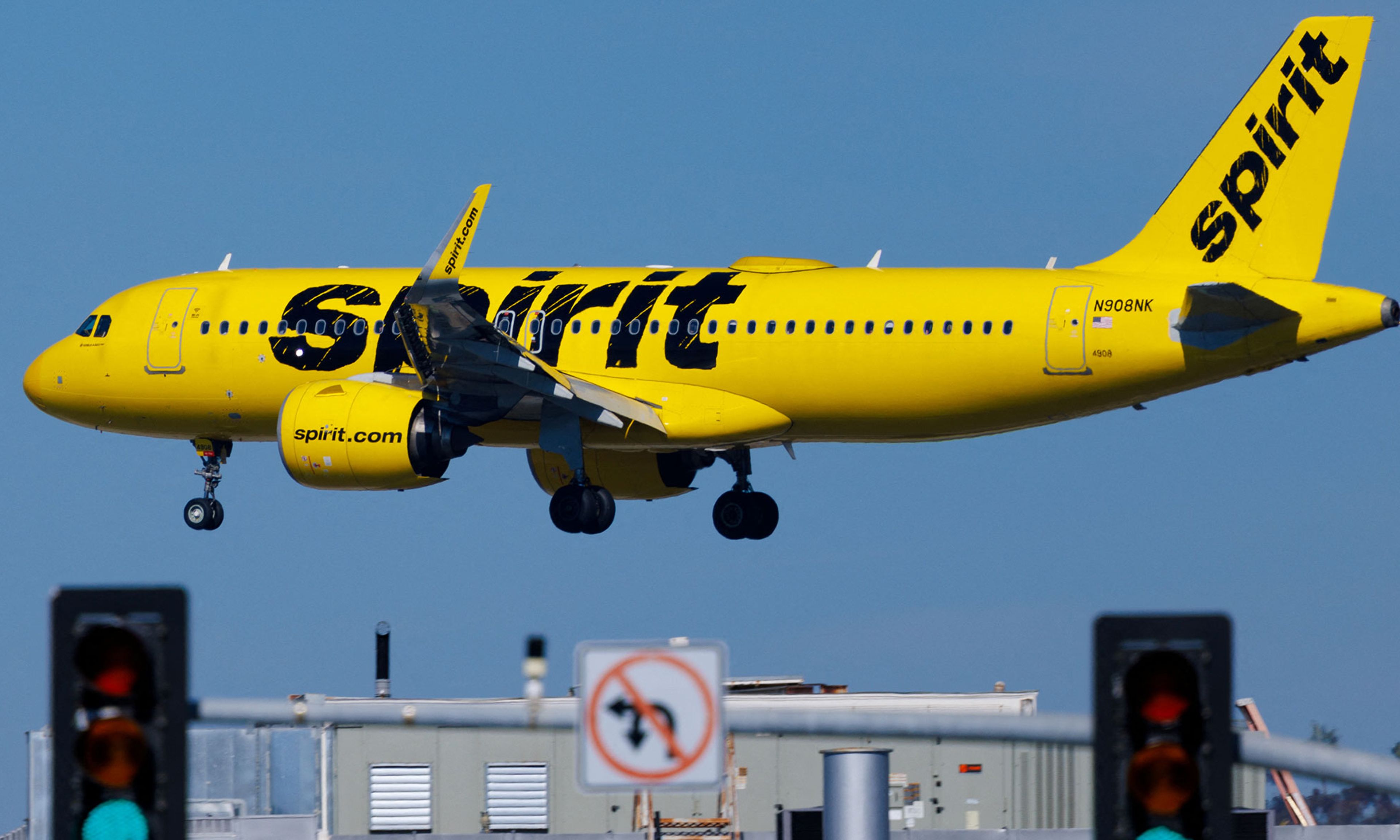
A Spirit Airlines plane lands at San Diego International Airport in 2024.
Donald Trump has now confirmed talk suggesting that there might be a possible government bailout of Spirit Airlines. Speaking yesterday, he commented that Spirit had “some good aircraft and good assets, and when the price of oil goes down, we’ll sell it for a profit.” The former owner of the Trump Shuttle also commented that he had “a smart person” to run the business.
Should there be a bailout, taxpayers will be faced with the infuriating prospect of being forced to foot the bill for an act of misguided government intervention necessitated in no small part by earlier misguided government intervention. There’s a lesson there.
In 2022, Spirit Airlines, which was going through very tough times, agreed to a merger with JetBlue. In 2023, in a decision typical of the assertive antitrust of that era, that merger was blocked by the Biden administration for no obvious good reason: The merged entity would have been only the fifth-largest airline, with a market share far below that enjoyed by any of the big four, but Washington knew best.
Unfortunately, and unsurprisingly, Spirit filed for Chapter 11 in 2024, from which the recapitalized business emerged a few months later. Sadly, things did not work out. The company filed for Chapter 11 again after a few more months had passed. Market reality had confirmed (twice) what the airline’s shareholders had conceded three years before: Spirit no longer makes economic sense as a standalone business.
Despite that, the Wall Street Journal had been reporting that the administration is mulling a loan to the airline of up to $500 million. According to the Journal, the terms, sketched out by Commerce Secretary Howard Lutnick, would include the issue of equity warrants that if exercised would give the government a significant stake in Spirit. We are, to be polite, unclear how the government has — absent congressional approval — the authority to proceed with such a transaction, but should it go ahead, this mystery will doubtless be resolved.
Judging by his comments to Reuters, Transportation Secretary Sean Duffy is not enthusiastic, noting that “a lot of money” had been “thrown at Spirit” to no avail and drawing the obvious conclusion that the absence of other buyers out there (to be fair, that may owe something to the JetBlue fiasco) sends a clear message.
On the other hand, the Journal reports that Lutnick -- an official, as the Intel deal and a number of other transactions show, unbothered by the notion of public investment in the private sector -- is pointing to the political advantages of saving thousands of jobs ahead of the midterms. That argument may have something to it but is an excellent example of the thinking that should rule out any bailout. Once the government is involved in Spirit, it will be politically hard for it to walk away, however strong the business reasons for doing so.
Spirit’s renewed troubles predate the sharp increase in the price of jet fuel since the Iran war. There is thus no reason to think that just one more cash infusion will be enough to turn Spirit’s business around, and there is no reason to think that, once invested, the government will have the political will to resist pleas for more. There are also good reasons to suspect that, in the government's attempt to prop up Spirit, the airline will become the recipient of unfairly favorable treatment at the expense of its competitors. That will be bad for the airline industry and bad for its customers.
We would not want to minimize the pain that a Spirit collapse would mean for its employees (and passengers who have valid outstanding tickets would not be pleased either), but we think that, as so often, the best thing that the government can do is get out of the way. At the most, it should facilitate an orderly breakup and sale of Spirit’s pieces or, should there be any interest, smooth the path for a merger with either a larger partner or perhaps with Frontier Airlines. The latter is also focused on budget travelers, and Spirit has come close to merging with it in the past. Indeed, the two have sporadically continued to talk.
For the administration to do any more than help from outside would be an expensive mistake, but it seems increasingly likely that this is something that taxpayers will be left to discover. The only silver lining (and it is not much of one) is that Trump appears to envisage the government’s involvement as temporary. Then again, that has been true of many a Washington-made quagmire.

About the Author
The Editors comprise the senior editorial staff of the National Review magazine and website.
Featured Tags
Advertisement
Advertisement


Comments