Draft or No Draft?
Written by Daniel J. Flynn
A debate about compulsory military service once raged in National Review’s pages.
Share this story
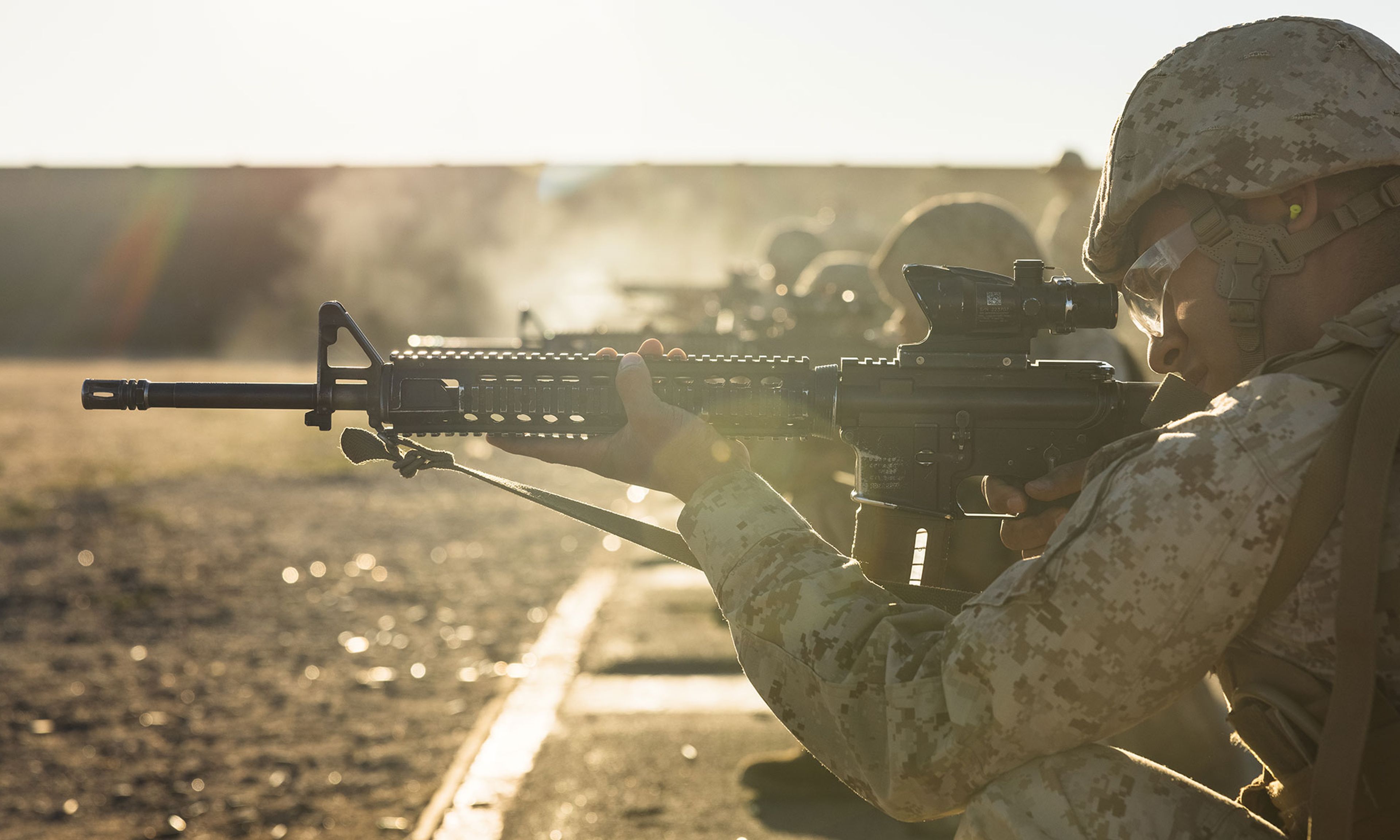
A U.S. Marine Corps recruit with Golf Company, Second Recruit Training Battalion, fires his rifle during a table two course of fire at Marine Corps Base Camp Pendleton, Calif., October 31, 2023.
During comedian Rob Schneider’s time in the draft demographic, he performed on HBO and wrote for Saturday Night Live. At 62, he wants young people to forgo their individual passions for mandated service to the federal government. “Each and every American, at eighteen years of age, must serve two years of military service,” he recently proposed in an X post. It seems the opposite of a punchline and conjures up images of a counter-fictional Deuce Bigelow who did not stand up to the European Union of Man-Whores but instead stood down.
Schneider, funny as both a standup comic and sketch comedian for several decades, seems an unlikely instigator for such a debate. But instigate he did — and in a debate that most living Americans had heretofore regarded as about as vibrant as the Victrola-disc-gramophone-vs.-Edison-cylinder-phonograph question. Schneider was nine, after all, when the American armed forces inducted its last member under conscription.
This subject once animated articles, pro and con, within the pages of National Review. The debate raged especially hot as the June 30, 1967, deadline approached for Congress to renew or reject authorization for the military draft.
In June 1966, Frank Meyer outlined the “unconstitutional and totalitarian implications” of Secretary of Defense Robert McNamara’s proposal for universal service for young people not in the military. Meyer, who objected to Vietnam-era conscription even as he supported the war, lamented the lack of “sensitivity to the constitutional enormity and political immorality” represented by compulsory service.
He wrote:
The primary cause of this deadening of the constitutional sentiment and vigilance for personal freedom is the slow attrition of decades of governmental infringement upon the rights of the individual person, together with the erosion of constitutional understanding in the courts and the academy alike. The result is that all proposed governmental actions tend to be discussed purely empirically in terms of their relevance to specific “problems,” and without the question being asked seriously whether government in fact has the constitutional right to undertake them. This is the general cause of most of our political woes.
Two months later, Meyer decried libertarians who demand freedom but refuse to fight for it when country calls. Still, he noted that current conditions did not justify conscription.
The following year, James Burnham, with whom Meyer clashed most often within the magazine, criticized the Council for a Volunteer Military. “The Right has joined the anti-draft movement for doctrinaire, ideological reasons — reasons ‘of principle’ divorced from time and place,” Burnham wrote in the June 13, 1967, issue of NR. “The Left has joined for pragmatic, strategic reasons, with its eye on, precisely, the specific circumstances of time and place.”
Burnham relied on nostrums gleaned from his days as a Trotskyist against united fronts composed of polar opposites on the political spectrum. Any alliance between the likes of free-market economist Milton Friedman and socialist leader Norman Thomas, he argued, would harm conservative objectives because when one mixes principled opposition to a draft in a general sense with devious opposition to it as an underhanded means of undermining a specific war, the principle ultimately loses.
He wrote, “The antidraft movement is part of the antiwar movement; the antiwar movement is in its political meaning a defeatist campaign to induce the U.S. to accept a Communist victory in Vietnam.”
Meyer, a sponsor of the Council for a Volunteer Military, responded a month later. The dispute over the draft, it became apparent, served as a minor battle in a larger war between the two men over pragmatism and principle that characterized their 17 years as colleagues at the magazine. Indeed, their histories, crossing here and there since the late 1920s, prior to the magazine’s founding, prefaced this dispute. Meyer, a former Stalinist, tellingly titled his National Review column “Principles & Heresies.” Burnham, a former intimate of Leon Trotsky, embraced a Machiavellian approach to politics. Whether on the left or right, Meyer and Burnham saw the world through a different lens.
Both men supported the Vietnam War. Meyer regarded it as folly to fight for freedom abroad while undermining it at home. Burnham regarded concerns that stood in the way of victory as expendable.
The reignited draft debate, which takes place on the right merely in comments sections and message boards at this point, reflects the pragmatism-vs.-principles dichotomy that colored it way back when.
Today, Schneider adopts the pragmatic approach and employs utilitarian arguments to his ends. The draft “would serve many purposes,” to include “rigorous physical training,” a “standing army ready at all times,” a rescue force for “natural disasters,” and a service experience that might serve as an inoculation to youthful ingratitude and university anti-American indoctrination. Other voices counter by appealing to the Constitution and the anti-statist principles that undergird American conservatism. Such does the conversation between James Burnham and Frank Meyer continue, even as most of its participants know neither man’s name.
[slideshow slideshow="1941258" /]
About the Author
Daniel J. Flynn, the author of The Man Who Invented Conservatism: The Unlikely Life of Frank S. Meyer, is an American Spectator senior editor, visiting fellow at the Hoover Institution, and YouTuber @RightWingWilderness.
Featured Tags
Advertisement
Advertisement
Comments