Ethnic Studies Activists Infiltrate California Curriculum, Allies Shame Jewish Parents Who Object
Written by Kayla Bartsch
‘You only show up to meetings when it’s beneficial for you, so you can tell brown people who they are,’ one school board member charged.
Share this story
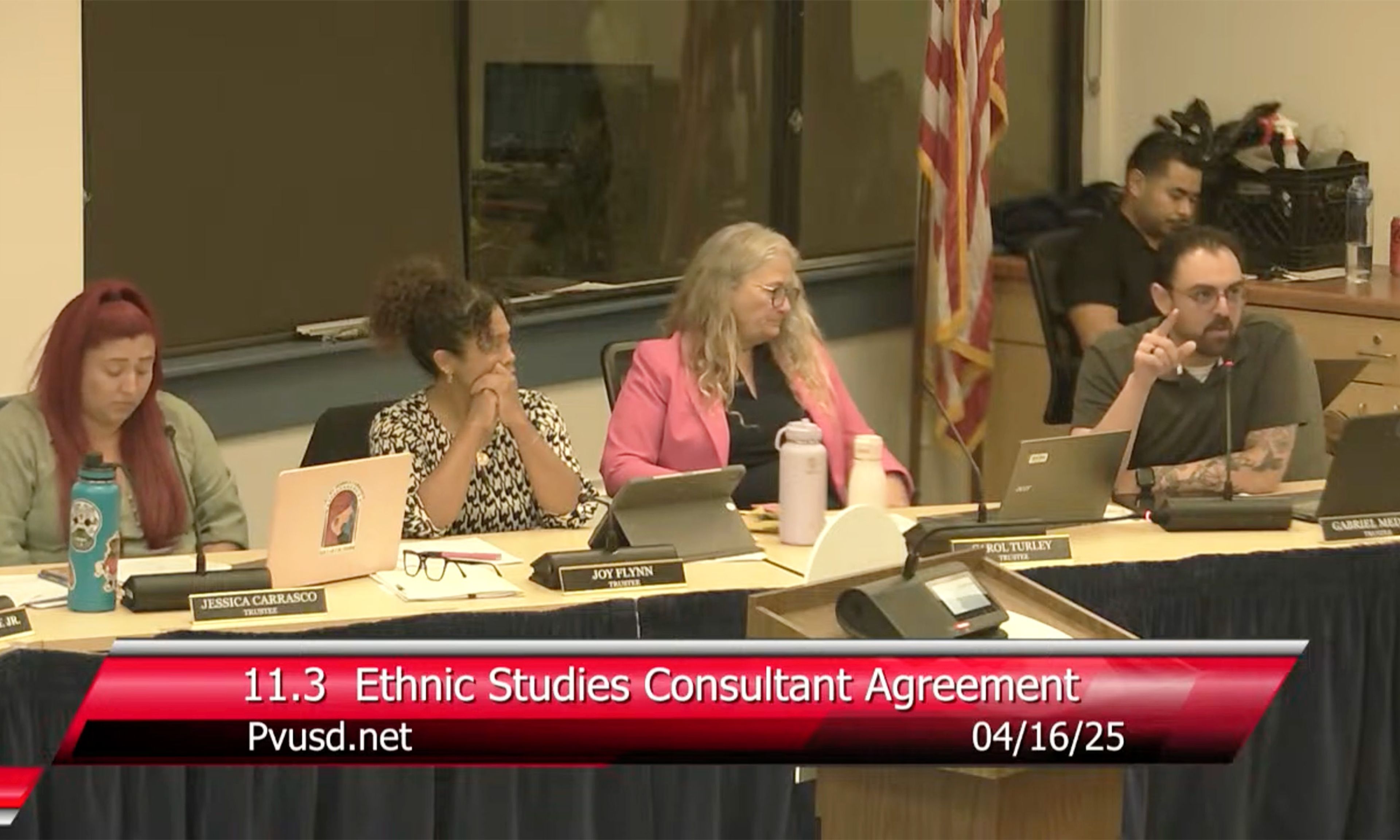
Pajaro Valley Unified School District board member Gabriel Medina (at right) speaks at a board meeting, April 16, 2025. Trustee Joy Flynn is seated second from left.
While Trump and Co. are working to eradicate DEI and wokeism from the federal sphere, blue states are charging ahead with their progressive agendas. California leads the pack, as keffiyeh-clad ethnic studies activists seek to radically redesign the state’s K–12 education.
In 2021, Governor Gavin Newsom signed AB 101, which mandates that all high school students in California take one semester of “ethnic studies” in order to graduate. The law takes effect beginning with the class of 2030, which means public schools across the state are scrambling to offer these courses for the upcoming 2025–26 school year.
What, exactly, is “ethnic studies”? If you guessed “the disinterested study of different cultures,” guess again.
According to Minnesota ethnic studies professor Brian Lozenski:
Ethnic Studies centers the heritage knowledges and lived experiences of those who have borne the brunt of colonial devastation, including global Indigenous communities, women and genderqueer people, neurodivergent and the dis-abled, and those living in poverty. Ethnic Studies de-centers those of European descent and, for instance, inquires about the relationships between Black and Indigenous peoples. . . . Ethnic Studies explores the colonial roots of the dispossession of Palestinian land and the creation of Zionism.
The Ethnic Studies Model Curriculum, published by the California Department of Education, asserts that the state’s new courses “will focus on the traditional ethnic studies first established in California higher education, which has been characterized by four foundational disciplines: African American, Chicana/o/x and Latina/o/x, Native American, and Asian American and Pacific Islander studies.” The document asserts that the purpose of the curriculum is to “address institutionalized systems of advantage and address the causes of racism and other forms of bigotry including, but not limited to, anti-Blackness, anti-Indigeneity, xenophobia, antisemitism, and Islamophobia within our culture and governmental policies.”
To put it bluntly, ethnic studies aims to teach students that wealthy, light-skinned people are oppressors and that poor, dark-skinned people are victims.
Ironically, the course mandate places an undue burden on the poorest school districts. AB 101 requires schools to implement new courses in order for their students to graduate -- i.e., hire new teachers or add class loads to current ones -- but grants no extra funding to do so, as AB 101 is an unfunded mandate.
Under pressure to implement the courses, school board meetings across the state have turned into battlegrounds over the content of these newly required offerings.
In one particularly egregious skirmish that took place in April, members of the Pajaro Valley Unified School District (PVUSD) Board hurled incendiary words at the Jewish parents in the audience. Their crime? Expressing concern over the antisemitic content being forced into their kids’ schools.
The board had convened to discuss the potential renewal of a six-figure contract with Community Responsive Education, a for-profit consulting group dedicated to “Ethnic Studies Teacher and Curriculum Development” (along with “Equity Audits and Systems Change Strategic Planning and Coaching” and “Trauma Informed Systems to Healing Centered Spaces”).
The company was co-founded by Allyson Tintiangco-Cubales, a professor in the College of Ethnic Studies and Educational Leadership at San Francisco State University and a darling of social justice academia. In 2014, she received the Community Advocacy Award from the Critical Educators for Social Justice group of the American Educational Research Association. In 2019, Tintiangco-Cubales helped write California’s initial draft of its Ethnic Studies Model Curriculum.
This earlier edition honored Palestinians’ “struggle” for liberation from Israel, praised the boycott, divestment, and sanctions movement, defined Israel as a “settler colonialist state,” scorned the “Zionist genocide” against Palestinians, and excluded the word “antisemitism” from its glossary. Unsurprisingly, many groups responded critically to this first draft, so the state sent it back to the workshop.
Naturally, Jewish parents at PVUSD were concerned that Tintiangco-Cubales would be charged with designing their children’s education. However, when they made their voices heard, they were reprimanded. Board member Gabriel Medina waved his finger at the Jewish parents and grandparents in the room, referred to them as “you people,” criticized their lack of protestation against Trump’s immigration policies, and continued:
You only show up to meetings when it’s beneficial for you, so you can tell brown people who they are. . . . The lies that you spewed here tonight were insane. . . . If you want to continue to be segregationists like you were . . . in the past, working against brown kids because you didn’t want to see them in power, I refuse to let that happen.
Trustee Joy Flynn echoed Jewish stereotypes in a Marxist word salad that described racial power dynamics:
Something I have been a little bit taken aback by is the lack of acknowledgement of the economic power historically held by the Jewish community, that the community of black and brown people don’t have. And while they have “people” power, there is that economic power, that really does exist. There is also the presentation power, the privilege that comes with presenting as white, and that is real.
How did a local school board meeting become a vaudeville stage for antisemitism? The ethnic studies faculty in California’s university system have gathered unto themselves immense power in determining the state’s K–12 education requirements. UC’s faculty in this area nearly succeeded in mandating that a semester-long course in ethnic studies become a new admissions requirement for the UC system. This outlandish proposal would have required students from any high school -- private, public, in-state, or out-of-state -- to have taken a semester of ethnic studies to be considered for admissions into the UC system.
The Ethnic Studies Implementation Workgroup (ESIWG) of UC’s Board of Admissions and Relations with Schools argued that an ethnic studies admissions requirement would boost UC’s leadership in the field, while “excluding [it] would itself be a politicized decision that reinforces historical inequities and reflects institutional racism.” The proposal made its way up to the UC Faculty Assembly last week, where it was defeated by a vote of 29 to 12, with 12 abstentions.
Despite this defeat, ESIWG members are still grasping for influence over California’s K–12 curriculum. Christine Hong -- a professor of “Critical Race & Ethnic Studies and Literature” at UC Santa Cruz and co-chairwoman of ESIWG -- has offered her services in guiding the PVUSD in its curriculum choices. An active member of the audience at the fateful board meeting, she voiced her support for rerouting the school’s funds to promote her own discipline -- and vilified the Jewish parents who disagreed.
Hong has an illustrious career as an ethnic studies activist -- in 2011, she received the Chancellor’s Achievement Award for Diversity from UC Santa Cruz. One year later, Hong helped establish the Institute for the Critical Study of Zionism (ICSZ). The institute’s mission statement says that the organization
seeks to advance theories, policies, practices, and pedagogies that interrogate Zionism and its multiple, interlocking, and historical systems of domination and elimination, including but not limited to (settler) colonialism, empire, white supremacy, racial capitalism, misogyny, (dis)ability, and cisheteropatriarchy.
On October 13, 2023 – less than a week after October 7, when Hamas massacred over a thousand Israelis -- Hong gave a talk at the ICSZ conference titled “Battling the ‘IHRA definition’: Theory and Activism.” (The IHRA Definition refers to the International Holocaust’s Remembrance Alliance definition of antisemitism.)
In a recording of her talk, “On Securitizing California’s Ethnic Studies,” Hong compared the State of Israel to North Korea and argued that all Zionist organizations are “predicated upon the use of imperial military force.” She argued that Zionist oppressors are stifling the “liberatory” purpose of ethnic studies by enforcing “guardrails” on the content.
She described the struggle to get a model curriculum approved:
Even though we actually revised these course criteria five times, Zionist screeds against Ethnic Studies, perversely, were considered by the system-wide committee that was deliberating on . . . ethnic studies.
While activists like Hong wield a lot of power in state politics, a vanguard seeks to challenge their influence.
David Bernstein, founder and Director of the North American Values Institute (NAVI), has recognized the importance of these local battles over the new mandated curriculum. NAVI, which was originally founded in 2021 as the Jewish Institute for Liberal Values, seeks to ensure that “the next generation of students receive an education centered on North American Values and not radical social justice ideologies.”
According to Bernstein, criticism of the U.S. and Israel “has been a hallmark of the curriculum” of K–12 Ethnic Studies in California. Proponents “may start with settler colonialism as a concept,” he said, “but they quickly apply this ‘settler colonialist’ label to both the United States and Israel.” NAVI helps parents stay alert to racialized ideology in their children’s schools and encourages them to challenge it, whether by running for a school board position, organizing other parents, or other means.
Crucially, California’s Ethnic Studies Model Curriculum is not mandatory. Local school boards have the option to create their own curriculum. While activists like Hong scoff at the idea “that non-ethnic studies practitioners” should help “determine the ethnic studies curriculum,” parents must rise to the task of challenging racialized extremism in their children’s schools.

About the Author
Kayla Bartsch is a former William F. Buckley Jr. Fellow in Political Journalism at National Review.
Featured Tags
Advertisement
Advertisement



Comments