Expect the Comey and James Indictments to Be Dismissed Without Prejudice
Written by Andrew C. McCarthy
The initial appointment of the prosecutor in these cases was untenable — and Bondi’s fix doesn’t work.
Share this story
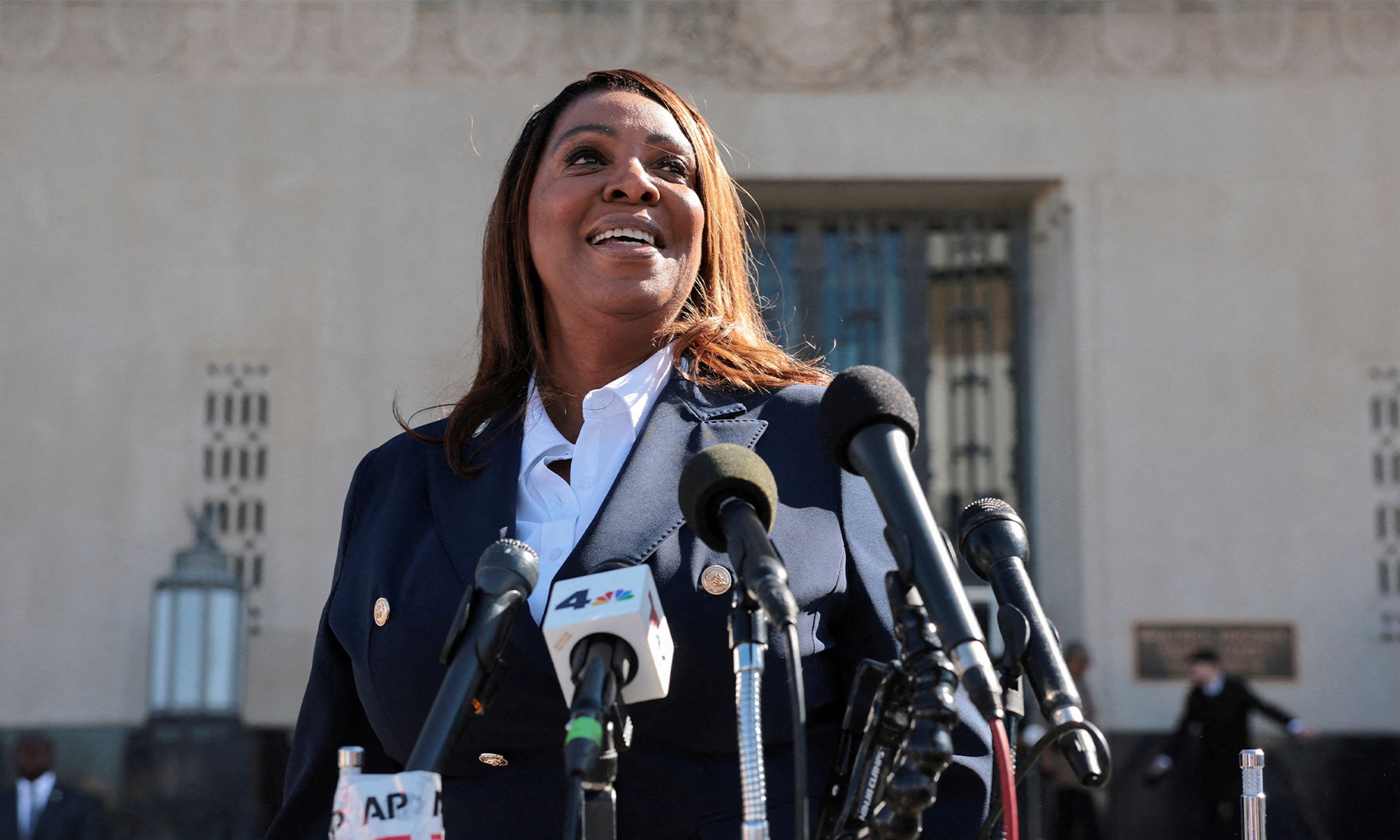
New York Attorney General Letitia James speaks to the media after she pleaded not guilty to charges that she defrauded her mortgage lender, outside the District Court for the Eastern District of Virginia, in Norfolk, Va., October 24, 2025.
In the end, there just is not a good answer to the question.
I’m speaking of a question posed by Judge Cameron McGowan Currie to the government lawyers who are slated to try the Trump Justice Department’s prosecutions of former FBI Director James Comey and incumbent New York Attorney General Letitia James. Those defendants have moved to dismiss the charges on the ground that Lindsey Halligan, the Trump loyalist installed to indict the cases, was not qualified to prosecute under governing law.
Judge Currie wanted to know why, if Attorney General Pamela Bondi had legitimately appointed Halligan as interim U.S. attorney for the Eastern District of Virginia (EDVa), it was necessary for the AG, over a month later, to make a second appointment under different statutory authority -- which Bondi tried to backdate to a time before the Comey and James indictments.
For prosecutors, there was no good answer to that question because, quite obviously, Bondi would not have tried to shore up the interim appointment unless she realized it was infirm -- a realization that apparently didn’t dawn until after Comey had filed his motion to disqualify Halligan, and after weeks of extensive legal commentary spawned by Bondi’s machinations to circumvent the legal mandate that district U.S. attorneys be confirmed by the Senate before serving. (For my contributions to that commentary, see, e.g., here, here, and here.)
Suffice it to say that this is a Justice Department with a unique take on what it means to “take Care that the Laws be faithfully executed.”
I won’t belabor the point that Bondi’s initial, interim appointment of Halligan cannot be justified under the relevant statute, Section 546 of Congress’s laws controlling United States attorneys. Between the statute’s text and judicial decisions -- the latter have grown in number due to the afore-described machinations -- it is plain that the law provides just a single 120-day interim period to fill a vacancy. Through no fault of Halligan’s, that period was exhausted by the Trump’s Justice Department’s interim appointment of her predecessor, Erik Siebert -- the lawyer who, owing to insufficient incriminating evidence, declined to charge Comey and James. That, of course, led to the president’s eruption at the AG, who obeisantly supplanted Siebert with Halligan (who then indicted Comey and James within five days and two weeks, respectively, though she had never before prosecuted a criminal case).
What matters at this point is that, despite her churlish rhetoric for MAGA consumption, the lawyer in Bondi realized the initial Halligan appointment was untenable and undertook to fix it.
Bondi’s fix doesn’t work for two reasons.
First, it is a fiction. Halligan was invalidly appointed as the EDVa’s interim U.S. attorney on September 20. She promptly indicted Comey on September 25 and, then, James on October 9. It was not until October 31 that Bondi issued an order in which she (a) purported to “ratify” Halligan’s employment as a Justice Department lawyer by appointing her a “Special Attorney” (delegated to exercise the AG’s prosecutorial authority), and (b) tried to backdate that ratification to September 22.
Hence, at the time Halligan unilaterally conducted the Comey and James grand jury proceedings, and unilaterally signed the charging documents, her only authority to act as a prosecutor was the illegitimate September 20 interim appointment. Bondi has no more authority to confer prosecutorial authority retroactively than she has to, say, indict a case after the statute of limitations (SOL) has expired but then wave her wand and pronounce it indicted retroactively. Not surprisingly, the AG’s October 31 order cites no authority for such a proposition.
Second, Bondi claimed in her order to have “review[ed] the grand jury proceedings in United States v. Comey and United States v. James.” Based on that “review,” she said, she had exercised her authority “to ratify Ms. Halligan’s actions before the grand jury.” As Judge Currie highlighted, however, that can’t be true.
Upon being assigned to the disqualification matter by the Fourth Circuit, Currie ordered the government to provide her with the complete record of the Comey grand jury proceedings, including all transcripts (witness testimony as well as Halligan’s colloquy with and legal instructions to the grand jury). In response, Halligan’s first submission was incomplete: She supplied witness testimony, but, although at least some of her communications with the grand jury had been recorded by the stenographer, a transcript of those communications had not yet been made. Then, at Wednesday’s hearing, it disturbingly emerged that some of the proceedings are “missing” and may not have been recorded at all -- i.e., Halligan is believed to have communicated with the grand jurors either in the absence of a stenographer, or with a stenographer who (for whatever reason) was not recording what was said. (I am not implying that Halligan did something nefarious; I think she’s just inexperienced in the practice of criminal law. As I’ve explained, grand jury proceedings can get chaotic. That’s why most U.S. attorneys’ offices require new prosecutors to observe a few grand jury presentations, then do a few presentations of seemingly simple cases under the watchful eye of an experienced supervisor, before flying solo.)
In any event, if there was not a full record of the proceedings, how can Bondi possibly have reviewed the proceedings as a prerequisite to “ratifying” Halligan’s performance? And to be clear, even if the AG had reviewed a comprehensive record, I don’t see how that would cure the more basic problem that, at the time, Halligan was not statutorily qualified to conduct the proceedings.
Given the flaws in Halligan’s appointment and the dodgy state of the record, I have to believe Judge Currie will hold that she was not qualified and that the indictment must be dismissed.
If that happens, the next question will be whether the dismissal will be with prejudice -- meaning the government would not be permitted to revive the case.
That is what the defendants seek. They contend that to allow a reindictment would encourage the shenanigans by which the administration is evading the Senate confirmation requirement for district U.S. attorneys, undermining the rule of law. From Comey’s standpoint, moreover, the five-year SOL on the false statement and obstruction charges against him expired on September 30, 2025, (because the charges stem from Senate testimony he gave on September 30, 2020). Naturally, he contends that the Justice Department, with eyes wide open, risked indicting him through an illegitimate process, so the court must not, in effect, legitimate that process by preventing the SOL’s expiration.
As a matter of fair play, these contentions are appealing; still, they are very unlikely to prevail.
Double jeopardy prohibits the government from trying a person twice for the same offense; there is no bar against successive indictments. And to repeat what I’ve previously related, the federal penal code (in Section 3288) provides that if an indictment was timely brought but then is “dismissed for any reason” (emphasis added) after the SOL has expired, the government has six months to return a new indictment. The Comey indictment was timely brought, albeit barely. Section 3288 is triggered only if the government has engaged in some illegal behavior serious enough to dismiss an indictment; yet, it allows reindictment. Consequently, whatever good-governance appeal there is in the claim that allowing reindictment would only encourage the government’s illegal behavior, that claim is forestalled by the statute.
Judge Currie has said she will rule by Thanksgiving. I expect that she will find that Halligan’s appointment was illegal at the time of the grand jury proceedings, and that -- because Halligan handled those proceedings by herself rather than assigning them to properly commissioned assistant U.S. attorneys -- the indictments must be dismissed. The dismissal, however, will be without prejudice to the government’s discretion to reindict if it chooses to do so. In addition, because Bondi’s October 31 order appointing Halligan as a special attorney is legitimate prospectively (even if not retroactively), I believe she will be permitted to continue supervising the cases, assuming they are reindicted.
As far as Comey’s case is concerned, then, while he (like James) has a strong argument that Halligan lacked qualifications to bring the charges, his best argument for dismissal remains the indictment itself -- specifically, its failure to coherently state a crime.

About the Author
Andrew C. McCarthy is a senior fellow at National Review Institute, an NR contributing editor, and author of Ball of Collusion: The Plot to Rig an Election and Destroy a Presidency.
Featured Tags
Advertisement
Advertisement




Comments