Fact: I Relentlessly Rebuked the Russiagate Probe, Beginning Before Mueller’s Appointment
Written by Andrew C. McCarthy
A response to Ben Domenech
Share this story
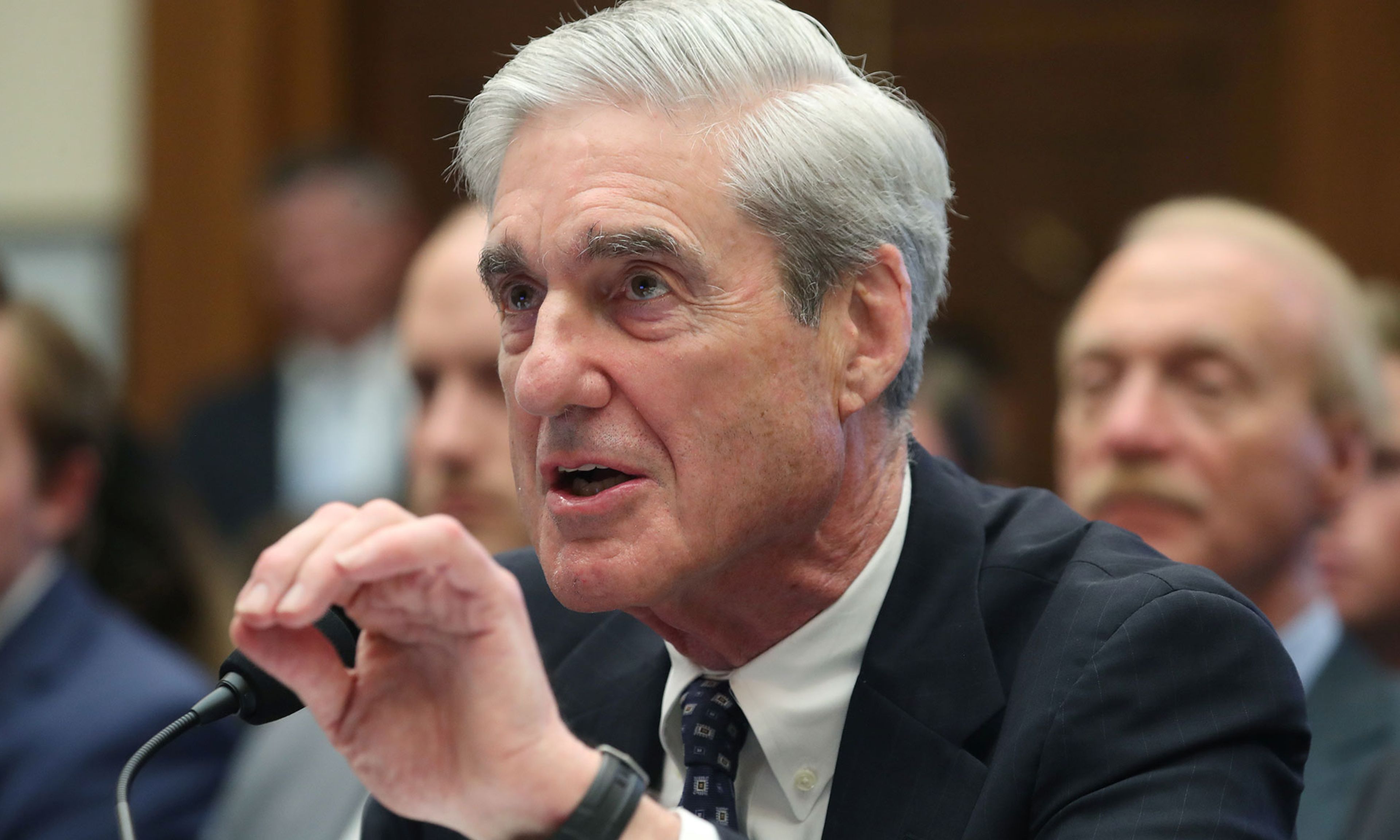
Former Special Counsel Robert Mueller testifies before the House Intelligence Committee at a hearing on the Office of Special Counsel's investigation into Russian Interference in the 2016 Presidential Election, on Capitol Hill in Washington, D.C., July 24, 2019.
I was flabbergasted on Sunday to find myself publicly accused of spouting “an arrogant baldfaced lie” by Ben Domenech. The Fox News podcaster and Daily Wire opinion editor claimed to be describing a statement in my post on Saturday night, which followed both the announcement that Robert Mueller had died and, then, President Trump’s disgusting “Good, I’m glad he’s dead” post.
Domenech was reacting to an assertion I made, to wit, “I was as harsh as anyone about the way Mueller staffed and conducted the Russiagate investigation.” Any honest critic would have conceded that this was undeniable.
My statement was brought to Domenech’s attention on X by someone named Varad Mehta, who offered a similarly ignorant outburst regarding it: “This is such a transparent and obvious lie you wonder if he [meaning me] even has any awareness of what a transparent and obvious lie it is.” Domenech agreed that I was not only guilty of “an arrogant baldfaced lie,” but also “ran interference for DOJ’s behavior and their baseless investigation long after the point where it became impossible to do so honestly.”
Like anyone else who does analysis and commentary for a living, I’m used to slanders from the sewer that is social media. I generally don’t respond because bad faith critiques are not worth the effort; as for the rest, my record is very long, public, and easily verifiable for any good faith critic who cares to spend a few minutes . . . or hours . . . or days perusing.
I was taken aback by Domenech, though. To be sure, I’d heard of one other shot he’d taken at me out of the blue, which I sloughed off as weird. Maybe there have been others -- I have no idea. I only barely know him, but he has never been anything but gracious to me when I’ve encountered him -- whether on his radio shows or podcasts (he’s invited me about three times over the past decade or so, once in person) and when I have bumped into him (even more rarely) at Fox. I have never had a cross word with him. I am not an avid follower of his work, but I’ve been publicly complimentary of a very fine Spectator piece he wrote nearly three years ago about the deep resources of funding behind “the progressive war on the Supreme Court.”
So, I’m puzzled by the animus. He doesn’t seem like an imbecile, but what he said was not just idiocy but easily disproven idiocy.
I have written hundreds of thousands of words about the Russiagate probe and the necessary background for understanding it: the Clinton emails investigation, the Cold War history of spying, and federal surveillance law. Indeed, in 2019 I published a bestselling book, Ball of Collusion: The Plot to Rig an Election and Destroy a Presidency (hereafter, BOC), a lengthy account (over 400 pages of text and notes) of the Mueller probe and the events that led up to it. The stellar Eli Lake reviewed the book for NR shortly after its release.
The Federalist, which Domenech founded, gave BOC a rave review in October 2019, opining that the most important and “unique” thing I’d done was to “focus[] on events leading to the [Mueller] investigation.” It’s a dizzying experience to read the lengthy review in conjunction with Domenech’s Saturday night ruction.
As years pass, the book is still useful, and readers often tell me they’re surprised by how little mention I made of the Mueller report. My book was substantially written and off to the publisher (Encounter Books) before the Mueller report was issued in March 2019. While writing, I was going on (a) the facts as they were emerging in real time, and (b) my knowledge of how investigations work, based on nearly 20 years’ experience as a federal prosecutor working criminal conspiracy and national security cases.
As I related in a preface for the paperback edition published a year later, when BOC came out, we did not have access to the later DOJ inspector general reports; excoriations by the Foreign Intelligence Surveillance Court (FISC) of the FBI’s misrepresentations, fabrications of evidence, and systematic noncompliance with procedures requiring verification of allegations; congressional testimony of Obama officials; relevant documents that had since been declassified; and other highly relevant evidence.
Nevertheless, the book stood the test of time and new revelations because it documented what I’d been arguing in National Review for years before its publication: The probe was illegitimate from the start. I began saying so well before May 2017, when Mueller was appointed special counsel to take over the probe. There was never a whit of credible evidence that Donald Trump had colluded with the Russian regime of Vladimir Putin to influence the outcome of the 2016 election.
That last sentence is not political hyperbole. It was a legally pertinent fact. To properly predicate a special counsel investigation, there must be a factual basis for a criminal investigation. The Justice Department and the FBI never had one. (See e.g., “Robert Mueller’s Missing Case,” December 31, 2017; “Anatomy of a Farce,” January 13, 2018.) What they had were grounds for a counterintelligence investigation of Russia’s attempts to influence the election -- although there was nothing new or unexpected about Kremlin insidiousness given the long history of efforts by Russian and American spy agencies to influence each other’s political systems. (And given the extensive bipartisan U.S. presidential history of collaboration with the Kremlin, in ways far more egregious than anything there was then evidence Trump had done.)
Russia always meddles in American elections. In this instance, however, the Obama administration’s legal and intelligence apparatus exploited that fact to rationalize Hillary Clinton’s defeat and, more consequentially, as a pretext to claim Trump was complicit in Russia’s activities. This, despite the absence of credible evidence that Trump and Putin collaborated, that Russia would have needed Trump’s help to conduct cyberespionage, and that Trump was possessed of the competence to assist such activities.
Domenech claims, based on thin air, that I “ran interference for DOJ’s behavior and their baseless investigation long after the point where it became impossible to do so honestly.” If he had spent about five minutes on a browser before bloviating, he’d probably have learned that, long before Mueller was appointed, I had argued that Trump’s first attorney general, Jeff Sessions, should not have recused from the Russia collusion probe the FBI had commenced prior to the 2016 election because he had no conflict of interest -- precisely because there was no criminal matter.
In the Justice Department, both conflicts of interest and the closely related appointments of special counsels hinge on their being a factual basis for a criminal investigation or prosecution. It is the existence of such a predicate that renders the AG and/or DOJ unable to conduct the investigation or prosecution in the normal course -- it is what triggers their ethical obligations as lawyers to avoid the appearance of impropriety.
Counterintelligence investigations, by contrast, do not trigger such obligations. They are not efforts to vindicate the rule of law in proceedings overseen by the courts; they are, instead, intelligence gathering activities carried out for the president in furtherance of his duty to protect the United States from foreign threats to our security.
I opined that in the absence of evidence of a crime, Sessions should oversee all DOJ counterintelligence investigations of Russia, with the caveat that if, at some point, actual criminal evidence developed which created some conflict due to his work as a 2016 Trump campaign surrogate, Sessions could then consider recusing from this or that matter. It made no sense, however, for an AG to be recused from the DOJ’s national security scrutiny of Russia, one of America’s main geopolitical adversaries.
Sessions’s unnecessary recusal left the Trump-appointed deputy attorney general, Rod Rosenstein, as acting AG for the Russia collusion probe. Before Mueller was appointed and took any action, I argued that there was no basis to appoint a special counsel. (See, e.g., “A Special Prosecutor . . . For What?,” March 3, 2017.) Subsequently, I was a tireless critic of Rosenstein’s handling of the matter. (See, e.g., “Rod Rosenstein’s Resistance -- Weasel words, weasel moves from an emotionally overwrought deputy AG eager to ingratiate himself with Democrats,” September 23, 2018.) I contended that his appointment of Mueller was illegitimate because there was no evidence of a crime. I argued that Rosenstein had acted to appease Democrats who were agitating for a special counsel in order to undermine Trump politically, and that it made no sense to bring in someone from outside the government to oversee counterintelligence activities (from which the executive branch, led by the president, cannot be recused).
When Trump fired Comey on May 9, 2017, his political opponents posited that this, finally, constituted evidence of a crime: obstruction. I countered that this was ridiculous. The FBI director is an executive officer who serves at the president’s pleasure and can be fired at any time. In this, I pointedly refuted Comey’s insistence that the ten-year term Congress had established for FBI directors was meant to create independence from the chief executive. (As I explained, Congress settled on ten years because it wanted never again to endure another 40-year J. Edgar Hoover–style director; prior Democratic presidents had fired an FBI director (i.e., Clinton fired William Sessions) and had extended an FBI director beyond ten years (i.e., Obama added two years to Mueller’s term before appointing Comey).)
Even if a president had needed cause to remove the FBI director, Comey gave it to Trump in abundance. The director privately assured the president that he was not a criminal suspect; yet publicly, Comey created the impression that Trump was a suspect, and serially rebuffed Trump’s requests that Comey correct this misimpression -- in reality, the misimpression was the director’s assurance; his FBI was hoping a case to prosecute or impeach Trump would materialize. (See “Why Trump Fired Comey,” June 10, 2017.)
A counterintelligence probe is not a cognizable “proceeding” that can be obstructed for purposes of the obstruction statutes in the penal code. And even if it were deemed to be such a proceeding, Andrew McCabe -- Comey’s deputy who succeeded him as acting director -- publicly admitted that Trump had done nothing to impede the Russia collusion probe. (Naturally, though Domenech now says I was running interference for the DOJ, Democrats and Never Trumpers accused me at the time of delegitimizing the DOJ’s obstruction case.)
Hence, the bogus obstruction claim did not change the legal calculus about appointing a special counsel: There remained no evidence of a crime. Yet, as I repeatedly pointed out, Rosenstein appointed Mueller without specifying what crime Mueller was authorized to investigate. This had the effect of inviting Mueller to conduct an illegitimate fishing expedition.
Obviously reacting to this criticism (which I led, although I was not the only one saying it), Rosenstein tried to repair the damage by providing Mueller with a “scope memo” (issued on August 2, 2017, a week after my July 26 column laying out the legal defects in his appointment of Mueller). (See, e.g., “Rosenstein ‘Scope’ Memo Confirms Baselessness of Trump-Russia Probe,” May 7, 2020.) We eventually learned of the scope memo’s existence, but Rosenstein classified it and refused for a long time to disclose it. I thus hypothesized that Rosenstein did not want it public because he had probably relied on the Steele dossier (the collection of faux intelligence reports fabricated at the behest of the 2016 Clinton campaign by former British spy and Obama-era FBI informant Christopher Steele -- see, e.g., “Steele’s Shoddy Dossier,” June 6, 2019). It was finally revealed, when Mueller was compelled to produce a heavily redacted version of the memo in connection with his prosecution of former Trump campaign chairman Paul Manafort, that Rosenstein had relied on the Steele dossier as the basis for Mueller’s appointment.
Before there ever was a “Mueller probe,” I incessantly demonstrated that Mueller’s appointment was illegitimate. The notion that I was carrying water for the FBI, the Obama DOJ, and then the Trump DOJ under Sessions, Rosenstein, and Mueller is laughable.
From the time revelations about the Clinton emails investigation first surfaced in 2015, over a year before Trump became the Republican nominee and before the FBI opened “Crossfire Hurricane” and its related tentacles, I was an energetic critic of the way the emails probe was conducted. I said the fix was in: that Obama had made it clear he did not want Clinton charged; that Obama was concerned about his own emails over Clinton’s non-secure homebrew server system; that the Obama DOJ limited the FBI’s ability to interview witnesses and gather evidence; that Comey began writing remarks to be issued in dropping the investigation months before the FBI had interviewed Clinton or other key witnesses; that the FBI abandoned its own protocols by allowing subjects of the investigation not only to sit in on each other’s interviews but appear as counsel for other subjects; that Secretary Clinton’s peremptory FBI interview -- just days after her husband, the former president, quietly met with Obama AG Loretta Lynch on an airport tarmac -- was a joke at which she gave incredible versions of events with impunity; that Comey usurped the Justice Department’s charging authority in his now-infamous July 2016 press conference; that in his public statement and later congressional testimony, Comey distorted the Espionage Act statute in disingenuously suggesting that Clinton could not be convicted absent evidence that she meant to harm national security (the standard is “gross negligence”); and that no consideration had apparently been given to charging Clinton with other crimes, such as embezzlement.
Again, I made those arguments publicly, at NR and in countless media appearances, before subsequent government investigations bore them out.
Once Mueller took over the probe, I contended that he had retained a staff of, mainly, partisan Democrats (many of them recruited from the Obama DOJ). Rosenstein placed no meaningful limits on them and refused to supervise them. I repeatedly observed that they were scorching the earth, seeking any crime they could pin on Trump. They engaged in bullying intimidation tactics, such as the gratuitous, aggressive raids on the homes of Paul Manafort and Roger Stone. (See, e.g., “Stone Indictment Underscores That There Was No Trump-Russia Conspiracy,” January 26, 2019.) The investigation of Trump’s first national security adviser, Michael Flynn, was patently political. (See our Flynn probe excerpt from BOC, April 27, 2020.) The signature tactic of Team Mueller was to write extravagant charging instruments (complaints and indictments I referred to as “fever dreams”) to create the misimpression of a massive collusion arrangement, but then accept trivial guilty pleas; that is, the prosecutors’ breathless storyline was on the public record but the guilty verdicts -- the fine print -- did not come close to showing Trump-Russia collusion, much less a traitorous conspiracy.
In this connection, I excoriated Mueller for violating Justice Department procedures, particularly with regard to guilty pleas. (See, e.g., here, here, here, and here.)
Long before Mueller came along, moreover, I pointed out that the FBI and DOJ had failed to subpoena or seize by warrant what they claimed to be the body of the supposed collusion crime: the Democratic National Committee servers that had supposedly been hacked by Russia. I explained that no competent investigator would have been so derelict because it would mean the government could never prove beyond a reasonable doubt that Russia was guilty -- and without that, it could not be established that anyone had been complicit in its alleged cyberespionage.
When Mueller announced his two ballyhooed indictments of Russian actors, I scoffed that these were mere press releases that his staff hoped would end any questions about Russia’s conduct. Knowing they couldn’t prove their allegations, prosecutors made them anyway, in the expectation that they’d never have to prove their case in court because Putin would never extradite the defendants. I was proved right when Mueller made the mistake of indicting a Russian company -- unlike the Russian people he’d charged, the Russian company didn’t have to worry about being thrown in jail or financially crippled. When the company demanded discovery and its day in court, Team Mueller reeled, first claiming they couldn’t make discovery because of national security concerns (something prosecutors who indict a case they expect to try know they can’t get away with), and finally dismissing the indictment in order to avoid the humiliation of a certain acquittal.
It was sufficiently manifest that Mueller never had a case that I maintained, from very early after his appointment, that his goal was never to prosecute Trump. The criminal probe, I said, was a pretext to assemble evidence that congressional Democrats could use to impeach Trump, which would not require proof beyond a reasonable doubt of a crime. (See, e.g., here, here, and here.) And when Mueller released his final report, I castigated his team for willfully misrepresenting the OLC’s guidance against indicting a sitting president; they had done so, I argued, to avoid conceding that they lacked evidence to charge obstruction. (See, e.g., here, here, and here.)
If this was running interference for the FBI, the DOJ, and the Mueller investigation, I have to wonder what rebuking them would have looked like.
I could go on, but what’s the point?
I will add this. I expect to be criticized, but not for lying. When I began my second career over 20 years ago, I vowed to myself that (a) I’d try to be clinical about legal analysis even if I had strong personal or political feelings about the subject matter; and (b) because nobody is perfect in that regard, I’d be forthright with readers if I had some personal connection to the story.
Consequently, I’ve been upfront for many years that I regarded Jim Comey as a friend from the time we were contemporaries just starting out as prosecutors in the 1980s (although we have not been in contact for many years); and that, while we were not well acquainted, I knew and admired Bob Mueller from when he was a top Bush-41 DOJ official and the U.S. attorney in San Francisco during the Clinton years.
Furthermore, as I’ve explained a number of times, I was motivated to write BOC because I thought I’d gotten a basic fact wrong. When rumors first started flying that the FBI might have used the uncorroborated Steele dossier nonsense in surveillance applications to the FISC, I dismissed the suggestion as far-fetched. Importantly, this was not because I thought the FBI and DOJ officials were of such high character that this was impossible -- although I hoped that was true. It was because of structural protections.
As a prosecutor doing terrorism cases in the 1990s, I’d argued strenuously against “the wall” that the Clinton DOJ interposed to prevent intelligence agents from sharing information with criminal investigators and prosecutors. The wall had been central to the government’s failure to detect the 9/11 plot before the suicide hijackings. In rationalizing the need for the wall, the DOJ had hypothesized that rogue FBI agents might pretextually use their Foreign Intelligence Surveillance Act surveillance (FISA) authority to monitor someone against whom they lacked evidence of an actual crime. My point was not that the FBI would never act roguishly (there was voluminous history of that). It was that it would be far easier for a rogue to fabricate the probable-cause evidence needed to justify a regular criminal wiretap warrant than to fabricate a national security angle to justify FISA surveillance, which can’t be presented to the FISA court without high-level FBI and DOJ approvals. My argument was based on rationality, not blindness about human nature.
The collusion escapade was exactly the scenario I’d insisted couldn’t happen. I was wrong, it turns out, because I hadn’t been imaginative enough to conjure a situation in which FBI and DOJ superiors would take it on themselves to run an investigation, rather than be the adult supervision that prevents wayward line agents from abusing government power. Those superiors are the fail-safes in the structure; I’d failed to anticipate that they might themselves flout the rules, and that if they did, there would be no one in the structure to stop them.
Hence, Russiagate.
But understand: Being transparent that I had personal regard for Comey and Mueller, and that I’d been proven wrong in my conviction that FISA authority would not be used pretextually, never resulted in my pulling punches regarding government misconduct and lawfare tactics. Some who dislike me for whatever reason, and who either don’t know or don’t care what the record shows, claim that I’ve run cover for government officials because I was once one of them. I can’t control what people say; I can only say there’s mountainous evidence that they are wrong.
I hate covering stories in which people I know and for whom I have personal regard are central players. But I hate it because I try to do my job despite that anxiety. And I don’t like being wrong about anything, let alone something basic -- I put a lot of effort into avoiding that. But when I’m wrong, I’ve tried to own it, apologize if that’s appropriate under the circumstances, and try to learn from the mistake so that I -- and my readers -- gain some valuable insight going forward.
All that said, I’ll repeat it: “I was as harsh as anyone about the way Mueller staffed and conducted the Russiagate investigation.”
About the Author
Andrew C. McCarthy is a senior fellow at National Review Institute, an NR contributing editor, and author of Ball of Collusion: The Plot to Rig an Election and Destroy a Presidency.
Featured Tags
Advertisement
Advertisement
Comments