The Florida Highwaymen: Outsider Art, Tourism, and American Landscape
Written by Brian T. Allen
The fascinating story of black artists whose flamboyant colors, ocean waves, and swaying palms defined Florida for a generation of tourists
Share this story
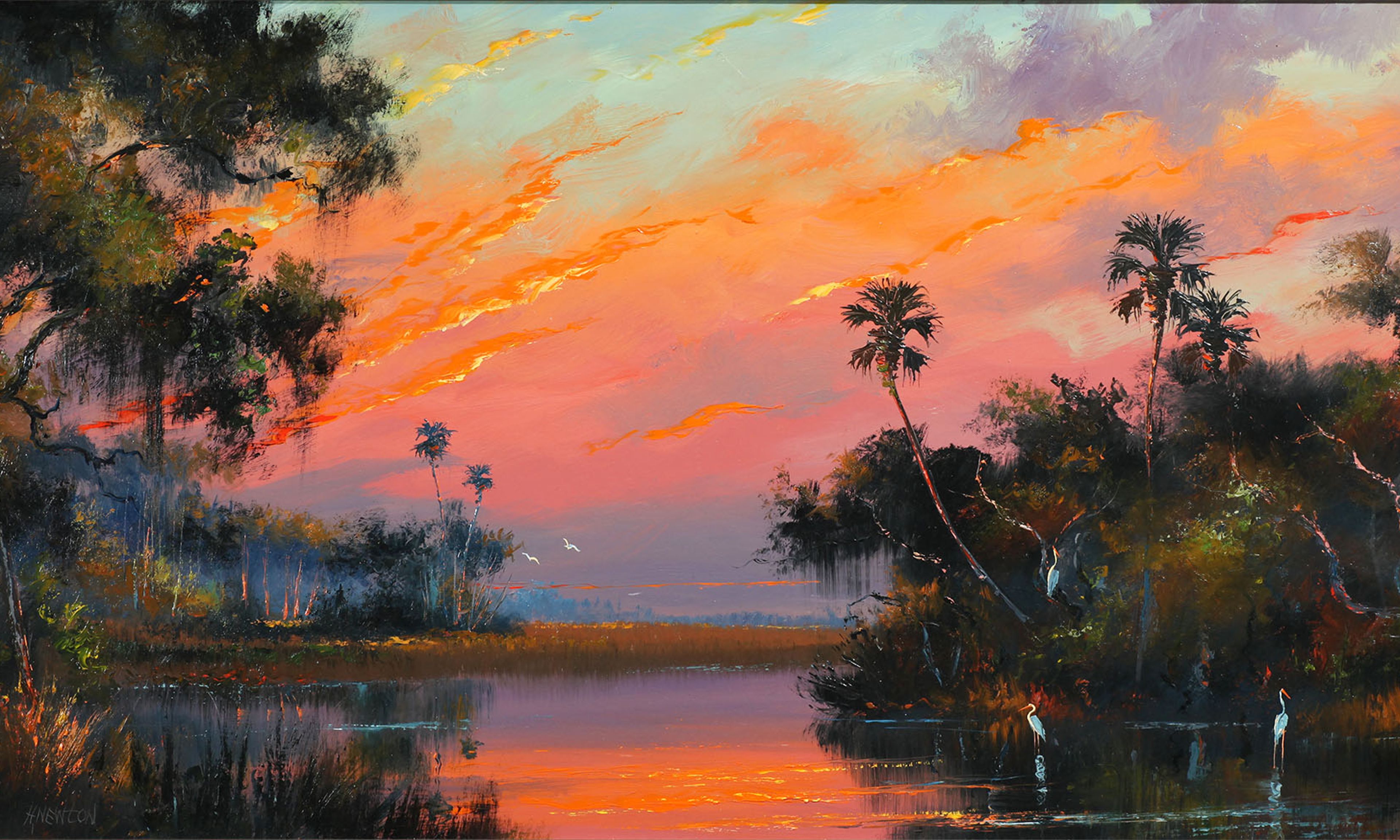
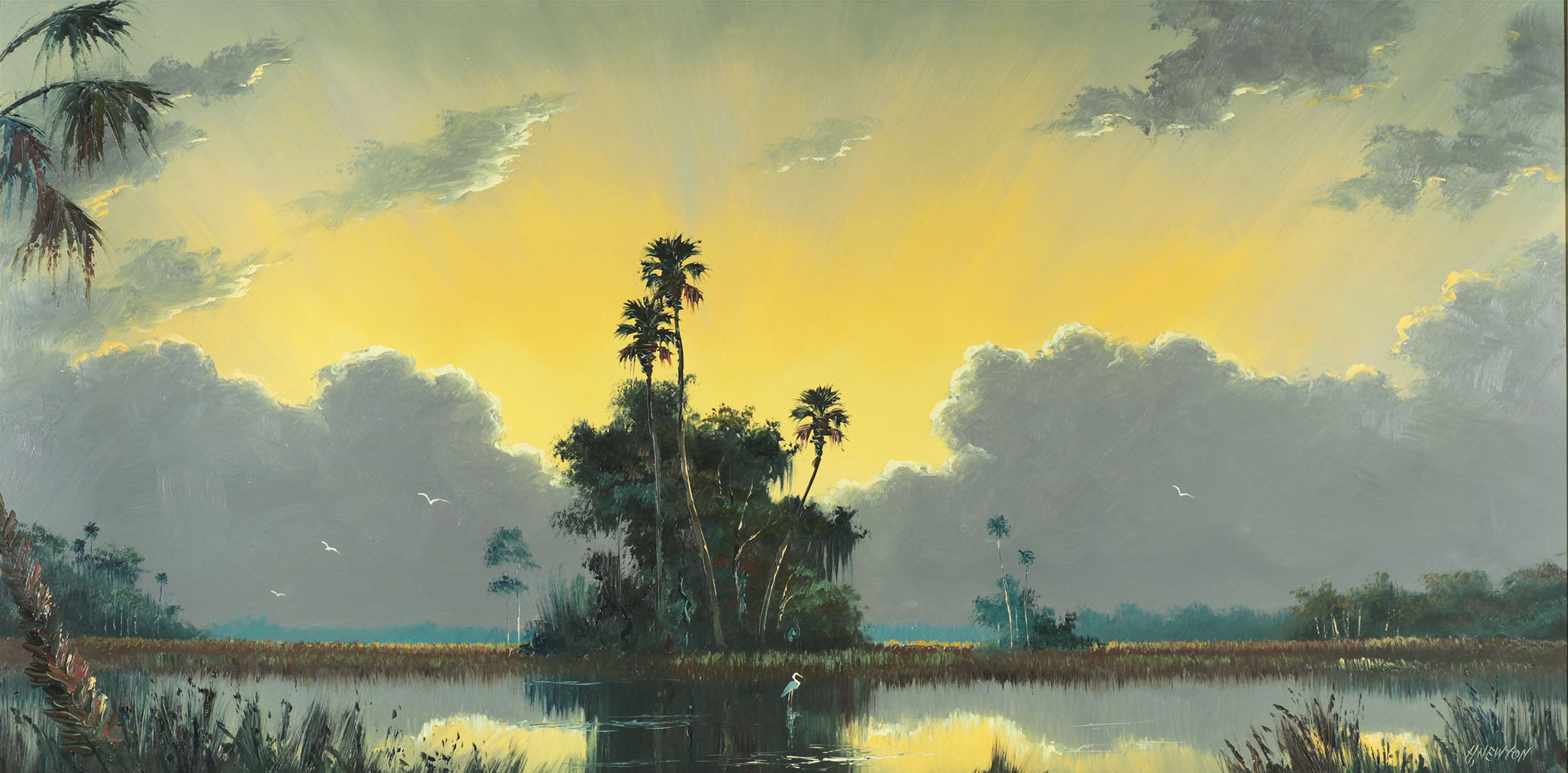
Harold Newton, <i>Sunset in Paradise</i>, c. 1970, oil on board.
With the polar vortex in ye olde Vermont and two heavy snowfalls already, I’m writing about warm-us-up topics. We’ll have more than enough snow for a white Christmas and ample time to freeze between then and mud season. On Thursday, I reviewed a Caravaggio exhibition in Florida, and today I’ll write about Florida’s feast of homegrown art by a group of black artists called the Highwaymen. This small, enterprising crew, many from Fort Pierce, on the coast north of West Palm Beach, produced thousands of landscapes, seascapes, and swampscapes from the late 1940s into the ’80s.
Their art isn’t merely suggestive of Florida or scented with the smells of Florida. It’s visually piquant, full-bodied, and intense. Much of it is on view in serious numbers in Making Their Way: The Florida Highwaymen Painters at the Addison Gallery of American Art at Phillips Academy in Andover, Mass. The show is beautifully presented, as are all of the Addison shows. To disclaim, I was the director of the Addison for years, had a great time there, and know the private collection that owns much of the art on view.
The Highwaymen, as a group, are an acquired taste, but, as regional artists go, theirs is a wonderful untold American story. The exhibition looks fantastic and is certainly a jolt, shown as it is by a venerable New England museum. It’s pure fun, too. Making Their Way gives a new spin as well to the Addison’s distinguished landscape and seascape collection, and to Hudson River School art everywhere.
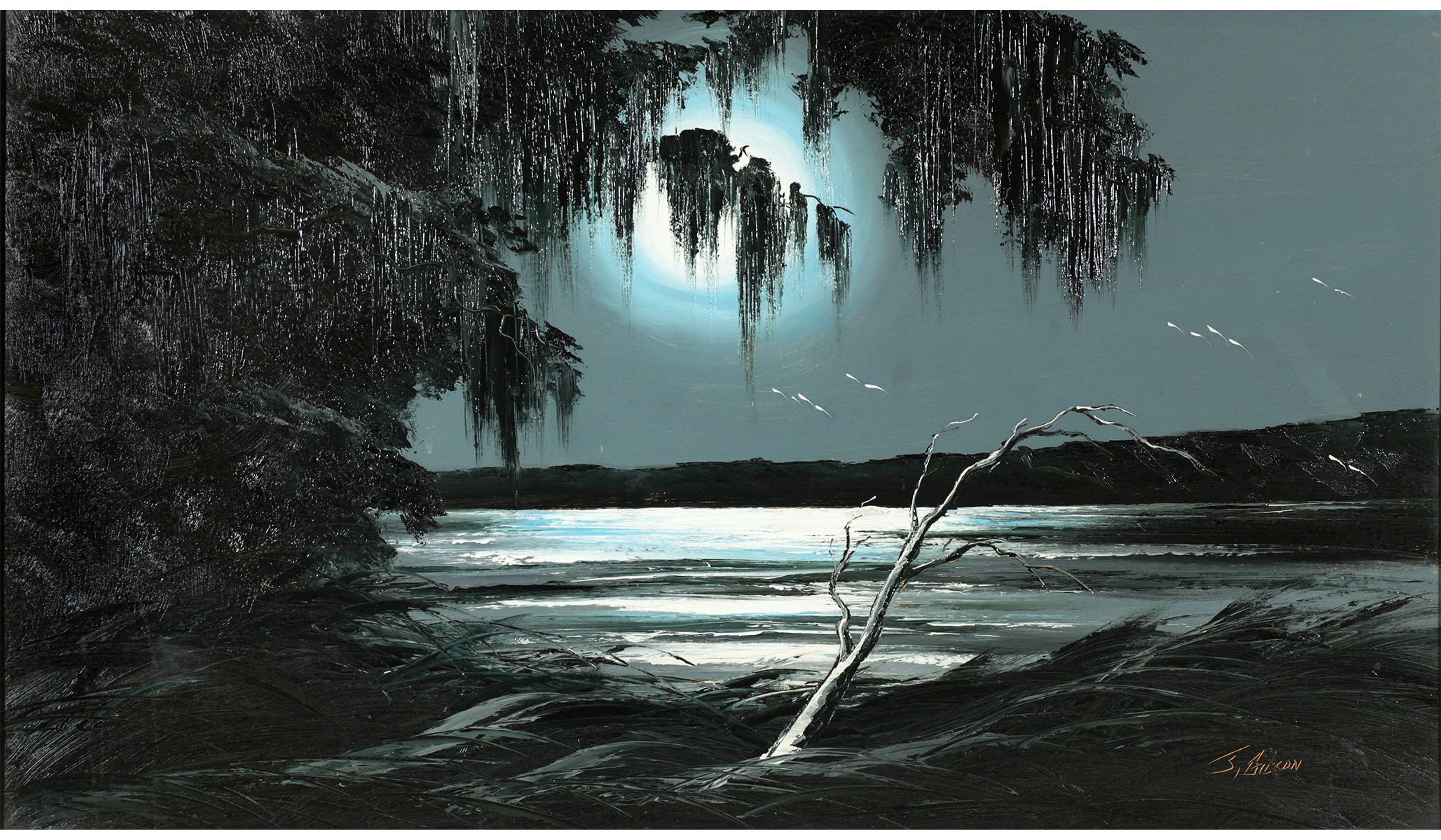
Seeing these paintings in abundance is, I admit, an aesthetic shock. Magenta, electric blue, neon green, scarlet, coral red, and canary yellow aren’t for pastel partisans, Puritans, and seekers-after-beige. The Highwaymen also got a bad rap as producers of working-class tourist art and budget-motel art. Hear me out, oh, ye of little faith. Peeping violets, apple blossoms, and maple-leaf green aren’t Florida colors. Nature’s palette is high-intensity. The moon shines so brightly when full that nights seem white.
Then there are palm trees, tall and slender, limber as they sway in the breeze but with the look of prehistoric birds. We see red royal poinciana, that canopy-shaped tree originally from Madagascar, backcountry pines, orange groves, grassy rivers, and swamps. Washington, D.C., gives swamps a bad name, but swamps and marshes are ecologically essential and ecumenical, too, in the range of life they support. And Florida skies change fast. These aren’t incessantly blue Arizona skies. Florida clouds can look like cotton with a pink tinge, but touches of black tell us that the pagan weather gods, gone from the Old World, might have found a perch in the New, in Florida, Zeus with his thunderbirds, wind gods, even Seminole gods, ready to slap us silly with a fierce storm.
Making Their Way fills five galleries, among them the museum’s grandest, and is organized both by artist — there are 26 of them in the Florida Artists Hall of Fame — and by half a dozen or so frequent subjects. The term “Highwaymen” wasn’t the artists’ idea. Many didn’t like it, since it evokes roadside criminality and, in any event, seems to have been coined by the first scholar to write a book about them as a group, in 2001. No matter. Old Master Dutch still life, cloud, cow, and ship painters weren’t a union where work was fungible -- they used templates with some give. So did the Highwaymen.
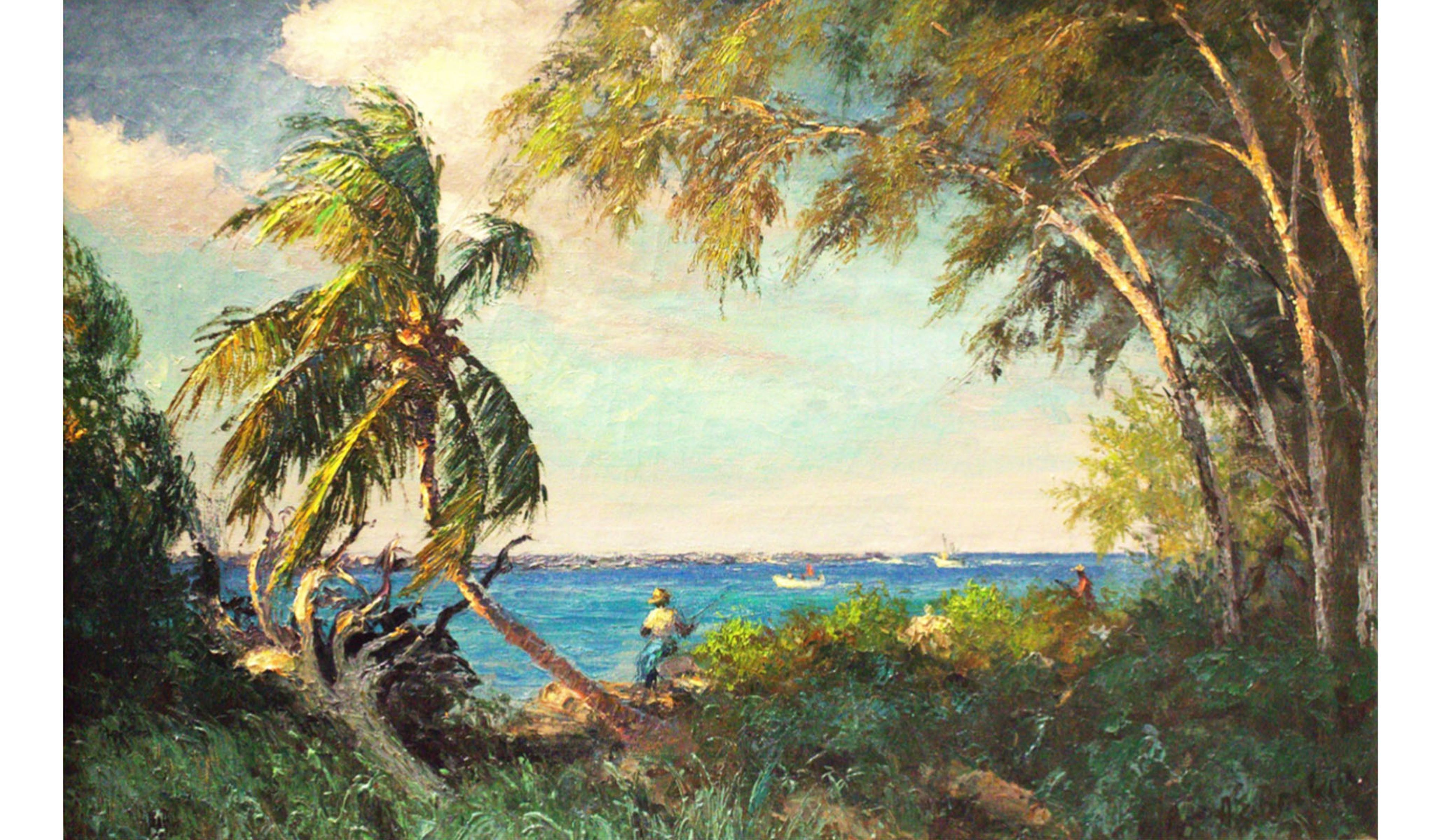
A. E. “Beanie” Backus (1906–1990) started the movement in the 1930s, using generous brushes and a palette knife to paint windswept palms, beaches, royal poinciana trees, and vigorous ocean waves. They’re generic, but they have the look of the topographical along with dazzling citrus colors and, now and then, a dose of drama, as in Hold On, from 1937, in which a black man, presumably in a state of high anxiety, holds the base of a palm tree during a hurricane. Likely it was inspired by The Hurricane, with Jon Hall and Louisianan Dorothy Lamour, who knew a thing or two about turbulent weather. It was also from 1937 and an intense, early disaster movie. Some of Backus’s work is folksy, but I’d call his pictures well within the 19th-century Hudson River School tradition with which Americans are most comfortable.
Backus wasn’t black and isn’t among the Highwaymen Hall of Famers but, in Fort Pierce, he created a comfortable milieu for artists and culture appreciators, black and white, during the years when Jim Crow racial separatism governed social life. In the 1950s, Backus gave Alfred Hair (1941–1970) painting lessons. Hair’s seen as the Highwaymen’s leader of the pack. He created an informal but very smart business model, knowing that traditional models -- like getting a dealer -- wouldn’t work for him because of racial prejudice. He painted up to 20 works a day on inexpensive Upson board with crown-molding frames. Obviously, he painted fast and free. He also created an assembly line for surface prep and framing and a cadre of roadside hawkers for tourists, and he sold to homeowners, motel keepers, and businesses.
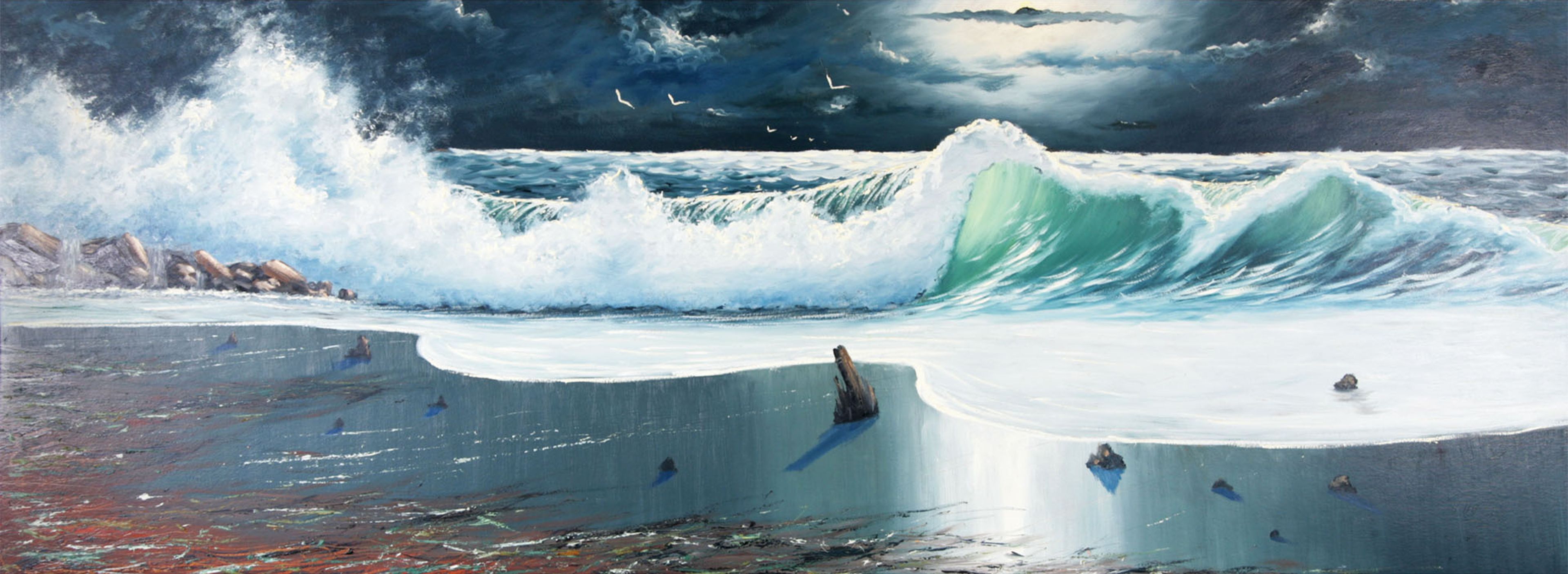
Hair might have been entrepreneurial, but, as an artist, his work -- heavy on outlines, a slash of paint for a horizon line, palette-knife deployment, and quick stabs, what he called “fast grass,” for finish -- gives the Highwaymen a reputation for shlock. That said, for Hair, speed made for minimalism and immediacy that seem modern. Ice, a moonscape, and Fire, a sunset picture, both around 40 by 100 inches and painted in 1962, convey drama through economy and surreal color. Hair and other Highwaymen liked the crown-molding frames because, when stacked, the paint surface had some breathing room. In humid Florida, oil paint dried slowly. Extra drying time got the work put to the marketplace with dispatch. Rest assured, most of the art is very good.
The 26 Highwaymen went in many directions in their lifetime. Hair, alas, was killed in a barroom brawl. In developing the Highwaymen business model, he hoped to become a millionaire, but it was not to be. The one Highwaywoman, Mary Ann Carroll (1940–2019), was the only one who felt comfortable pitching her work in cold calls to high-end businesses and neighborhoods where a black man, even with a painter’s smock and artist’s palette, would have been intimidating. James Gibson (1938–2017) went mainstream, doing landscapes commissioned by Jeb Bush, Steven Spielberg, and Gladys Knight.
A gallery of royal poinciana trees, also called flame trees, is a riot of reds on umbrella-shaped trees, each with different supporting details -- little farmhouses, a clothesline, a road leading to a river, or a cloudscape. Some are so folksy that they careen into amateur hour. That’s often a sign of a painting done at the speed of light.
Harold Newton (1934–1994) is the most various and likely the best of the Highwaymen. His Shadows, from 1965, a royal poinciana in front of a massive gray barn, is resolved and handsome. His Boarding House, from 1958, is downright blotchy. Newton’s River Grass, from 1970, is lovely, a yellow sunset framed by purple-gray clouds, a horizon line stretching from left to right, a water feature in which the yellow sky’s reflected, and a clump of tall palm trees in the middle. It’s the best of its kind. His Brahman Bull, from 1958, looks like a bad, late Monet, but Monet, even on a bad day, has much to be said in his favor.
The Highwaymen are regionalists focusing on local subjects and, mostly, local markets in an idiosyncratic style, in this case slapdash. They’re outsider artists, too, with rudimentary training and as far removed from high-end New York dealers and critics as Jupiter is from Jupiter Island. Like most regionalists, they’re realists who appeal to popular, conservative taste. No one’s pouring paint on a floor-based canvas like Pollock did. No one among the Fort Pierce crew would inspire Andres Serrano, who urinated in a plexiglass case, stuck a crucifix in the middle of it, and called it avant-garde. They’re not part of American Regionalism, the specific Depression-era Midwestern movement of, say, Grant Wood. Rather, they bring to mind Maine wood sculptors, Gee’s Bend weavers before they went MoMA, and Seed Artists making portraits from wild rice, poppy seeds, and dried corn kernels for display at Midwestern state fairs.
Don’t expect Highwaymen work to star at Christie’s and Sotheby’s glitzy evening sales, though I have to say, Arab sheiks might like the palm trees and bright colors. Still, there’s a good market for the best, which the Addison shows.
Making Their Way treats Florida road-trip tourism as boom times for the Highwaymen. Until the deregulation of the airlines in the late 1970s, middle-class and working-class tourists from the Northeast and Upper Midwest drove to Florida for winter vacations, staying in motels near beaches and sampling the early days of Space Age tourism, NASCAR racing, and theme parks like the Magic Kingdom. A Highwayman painting was in the realm of a souvenir, pricey at $25 to $50 a picture. It’s thought that about 200,000 of these works were sold from the 1950s into the ’80s, after which flights to Florida were cheap and resorts around Orlando had developed sophisticated strategies for keeping tourists tethered to their main attractions.
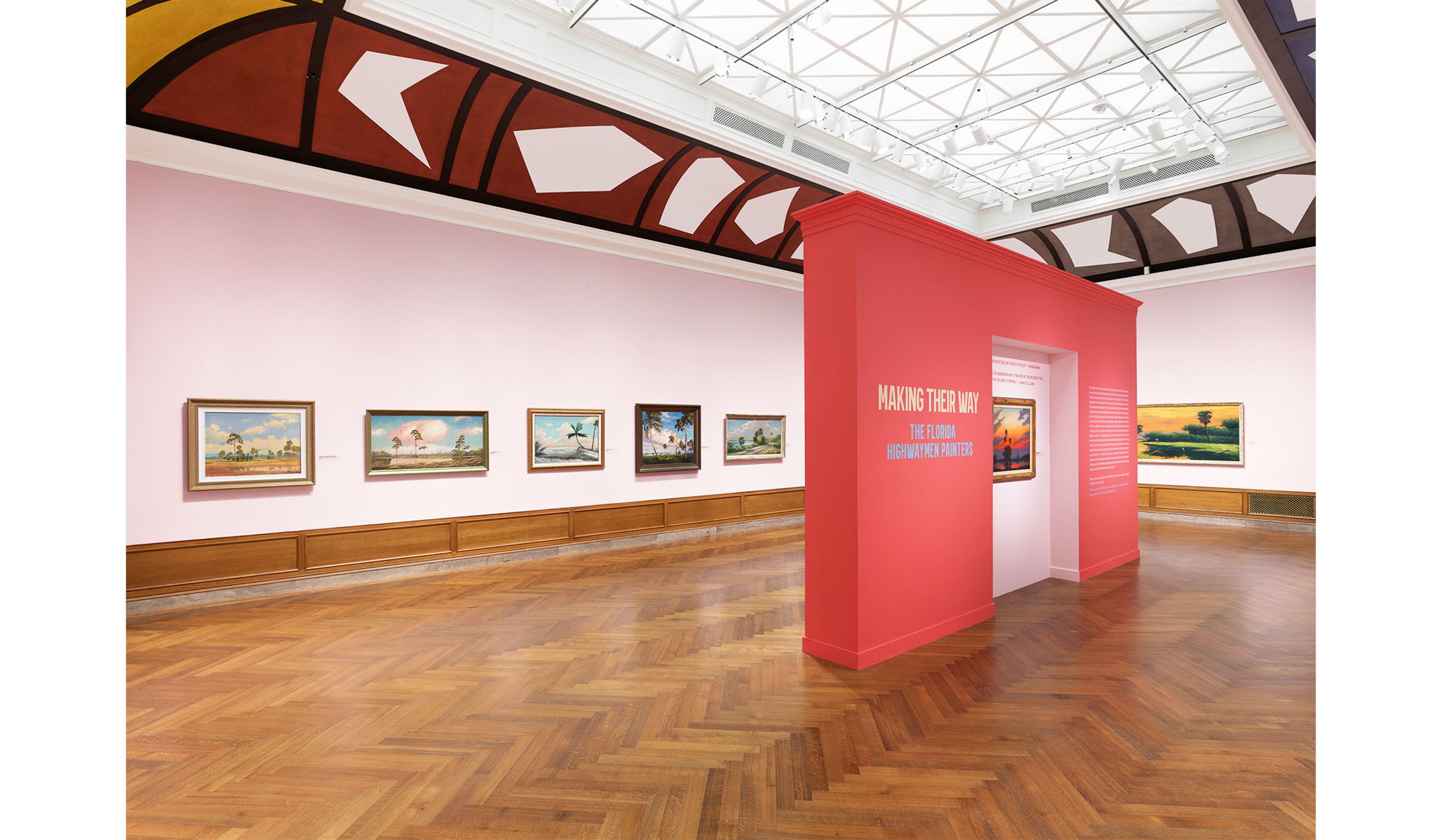
The walls of the galleries are Pink Cadillac, with a freestanding wall in the middle of the Addison’s grand gallery in a more saturated Florida Pink. They’re perfect complements to the paintings, and, since pink is an unorthodox museum wall color, it puts visitors in a happy mood. The Addison is the civic museum for Boston’s northwestern suburbs, and for Lawrence and Lowell, Mass.; Phillips Academy is a high-powered place, but it’s a high school, so the museum isn’t a preachy, dogmatic place.
In the galleries next to Making Their Way is a display of art mostly from the Addison’s exceptional permanent collection, focusing on the art of Florida and Niagara Falls tourism. Many are anonymous photographs, but there’s a group of Walker Evans photographs of Florida from around 1941 and some Florida kitsch, too.
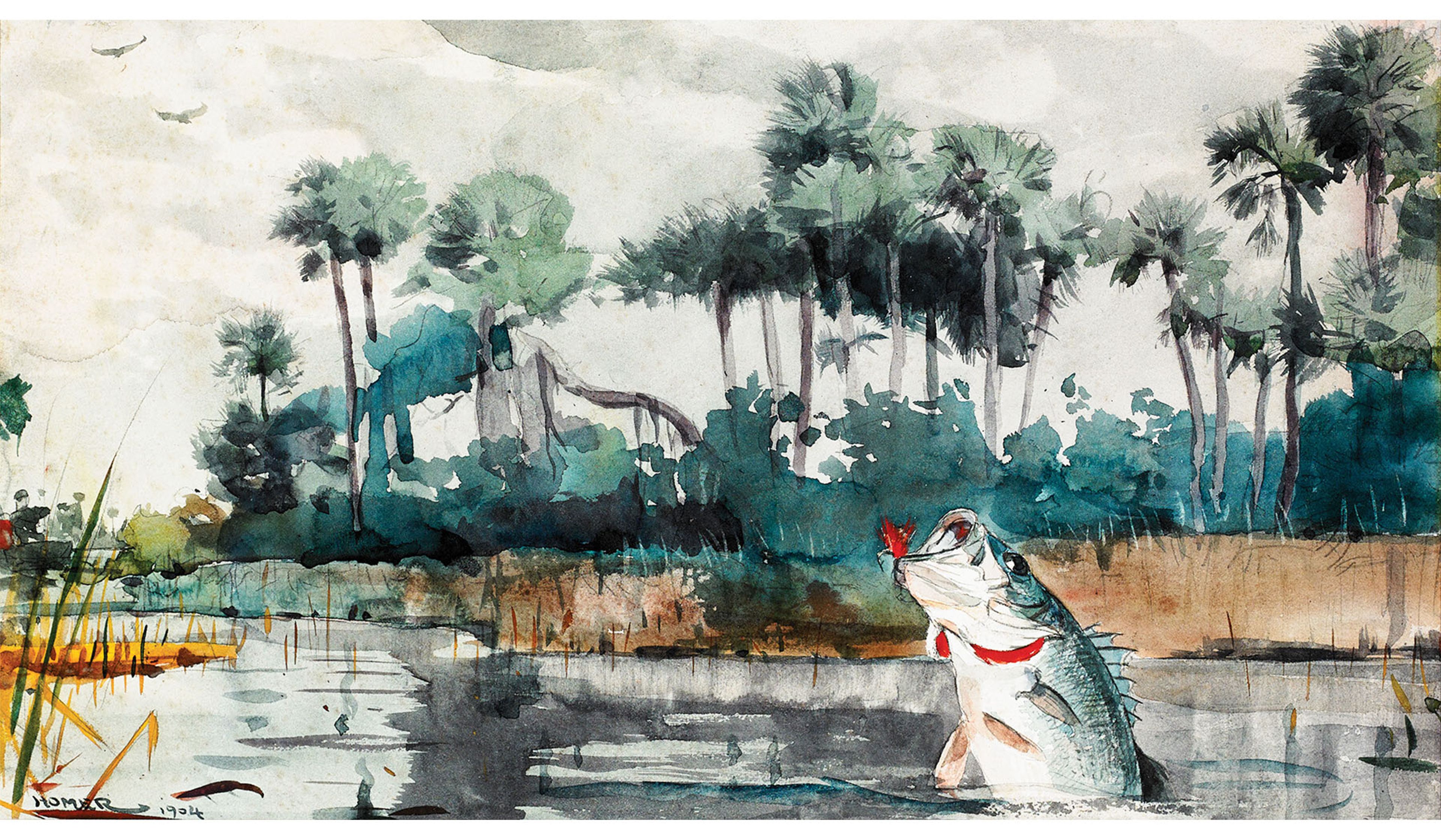
In walking through the Addison and thinking about Florida, I was surprised by how many artists have treated Florida as a subject. Who wouldn’t like Palm Beach? But, aside from there and pretty Sarasota, Florida isn’t readily in my thoughts. Winslow Homer’s not usually seen as a sun seeker, but, yes, he did enjoy his winters in Florida and the Bahamas, as we saw last week when I wrote about the Boston MFA’s superb Homer watercolor show. Florida’s place of pride as a tourist mecca started in the 1870s with pasty New Englanders and New Yorkers looking for winter fishing and hunting spots where their butts wouldn’t freeze. Homer visited Florida four times between 1904 and 1909, fishing and painting watercolors along the Homosassa River, which runs into the Gulf north of Tampa. In 2020, Samuel and Roberta Vickers, among the primo collectors of Florida art, distributed their Homer watercolors to four Florida museums though most of their art went to the Harn Museum in Gainesville, the University of Florida’s gallery.
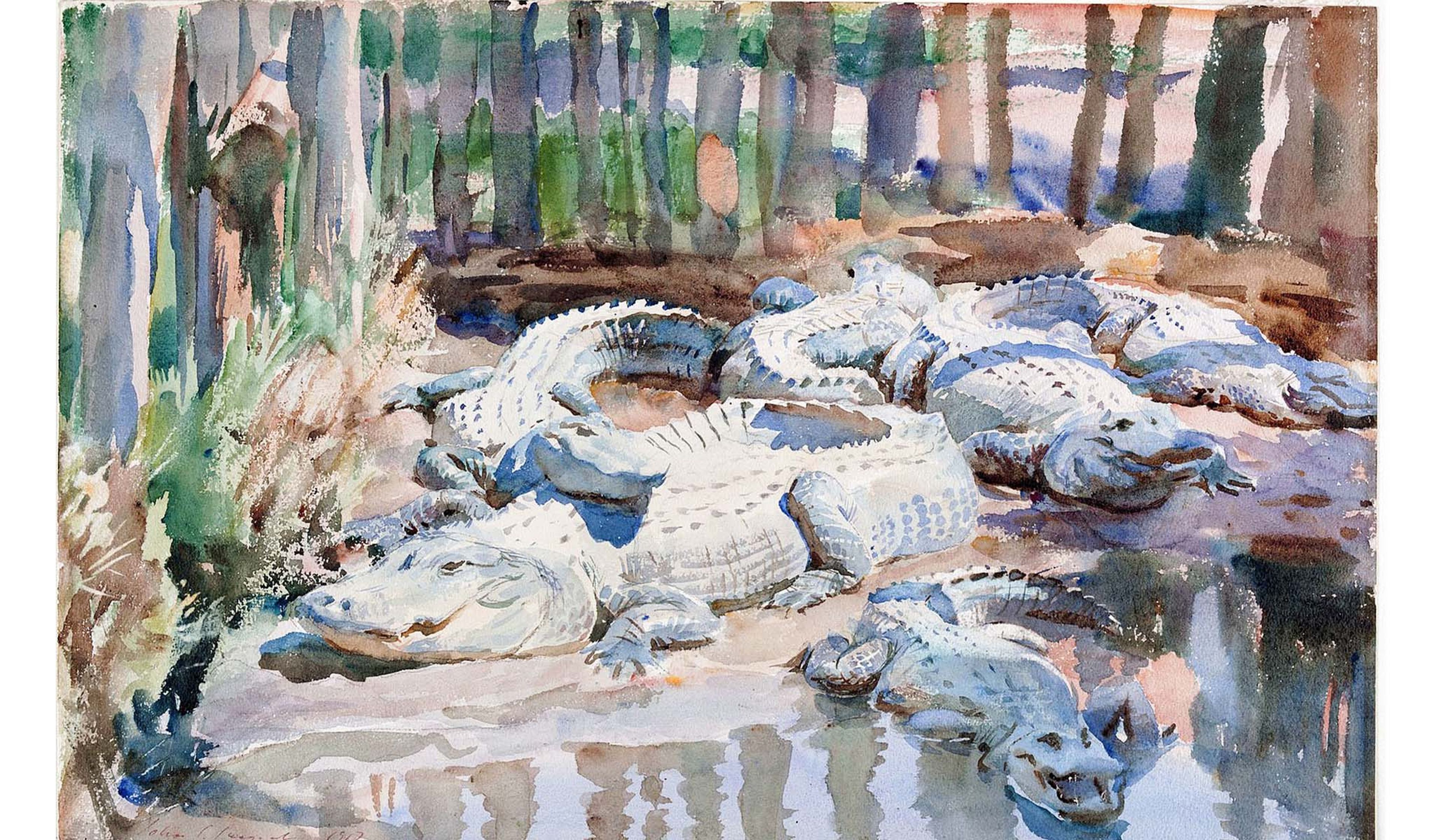
I’m always surprised, and I’m not a snoot, when I learn that this or that artist did Florida scenes. In 1917, John Singer Sargent a break from his Boston Public Library mural-making to visit Florida, not only to paint his brilliant portrait of John D. Rockefeller but also to do watercolors of palm thickets and alligators, subjects not available to him in, for instance, London. Frank Benson, famous for his birds, visited for the pelicans. Thomas Moran, no slouch when it came to skyscapes, painted Florida sunsets, and Martin Johnson Heade did Florida scenes, both tropical landscapes and tropical-flower still lifes, and even Inness and Louis Comfort Tiffany, a very good landscapist who didn’t live by stained glass alone, found in Florida some ample new twists on the American landscape tradition.
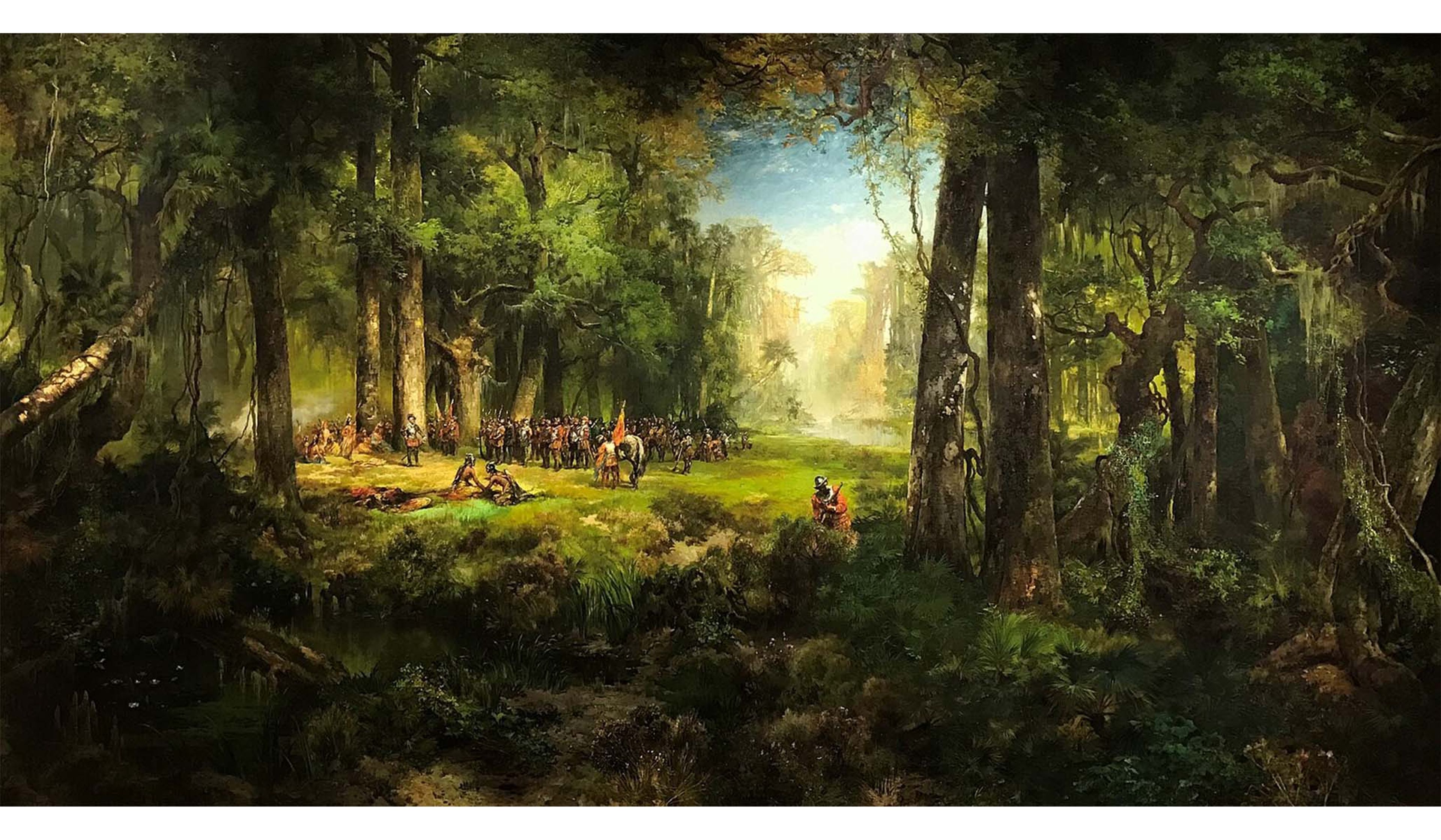
On and on it goes, enough to place Florida comfortably in our unique love for the art of land and sea. And how about our sense of self as forever fresh and young? The Homer and the Sargent aren’t in the Addison’s show, and neither is Moran’s Ponce de Leon in Florida, from 1877 or 1878. Still, it’s one of my favorite American history paintings and at the Cummer Museum in Jacksonville. Forever an optimist, I’m waiting for that Fountain of Youth to be found and to iron those crow’s feet, loosen those stiff joints, and wash that gray away.

About the Author
Brian T. Allen is National Review’s art critic.
Featured Tags
Advertisement
Advertisement
Comments