Share this story
Larry Freibauer/iStock/Getty Images
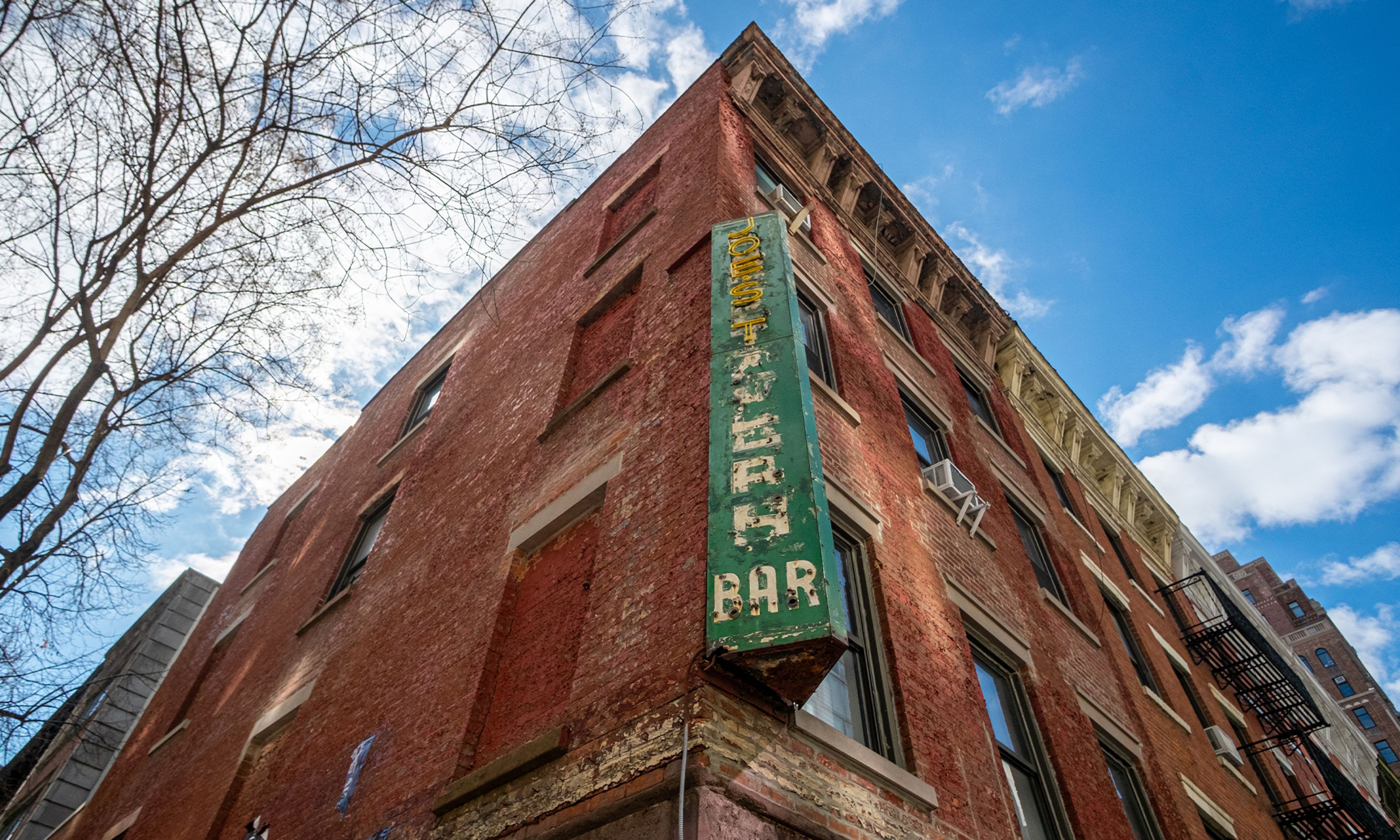
The short building in the middle of the block on the avenue was empty for several years. A padlock the size of a shoe hung on the front door; the ground floor windows, backed by plywood, were covered with pasted ads, which were covered with graffiti. Ill use and inattention jarred with the building itself, which had a curved gable on the top story and stone scrollwork here and there as if laid on by a pastry chef.
Its first life, born in the century before last, was as a beer hall for the German Americans who once lived in the neighborhood. H. L. Mencken, fellow ethnic, described the hours-long conversations he would have when he came up from Baltimore, there or at Luchow’s, with James G. Huneker, a critic of an older generation. “What a stew, indeed! Berlioz and the question of the clang-tint of the viola, the psycho-pathological causes of the suicide of Tschaikowsky . . . the precise topography of the warts of Liszt, George Bernard Shaw’s heroic but vain struggles to throw off Presbyterianism . . . what to drink when playing Chopin, what Cézanne thought of his disciples . . . the varying talents and idiosyncrasies of Lillian Russell’s earlier husbands, whether a girl educated at Vassar could ever really learn to love.” (I suspend the convention of omitting proper names; cut them from that passage and space-time collapses.)
Huneker and Mencken left, the Germans left. A few paintings, grimy no doubt from evenings of cigar smoke, remained on the indoor walls — tippling monks over black-letter captions, that kind of thing. The building’s incarnation when I first knew it was as a restaurant with a jazz club in the basement. The restaurant was usefully ordinary. You sat in booths and ordered hamburgers. Down below I heard Mose Allison (b. Tippo, Miss.), pianist and singer. He had graying hair and a raptor’s profile and performed his cover, already 25 years old, of the modern blues standard “Seventh Son.” Everybody talkin’ ’bout the seventh son / In the whole wide world there is only one . . . / Look in the sky, predict the rain, / Tell when a woman’s got another man. He had a new drummer that night, a man so young he was my age. A party of women at the next table, evidently with the band, commented on his abilities.
The restaurant and the jazz club closed, Allison marched on for decades elsewhere. The building was rented next by Anthony Macagnone, restaurateur. His main spot was a block away, up a grandfathered-in outdoor staircase, but he had scattered other outposts, like a Holy Roman Emperor, in Little Italy or the East Village. What he loved as much as food (perhaps to control its effects) was exercise and fitness. At his newly occupied building, he kept some of the Germania — the paintings, a stained glass skylight — but cleared the floors for a temple of health. The basement was divided into massage rooms. The high-ceilinged ground floor received ranks of Pilates and Gyrotonic equipment. Pilates was the surname of the German boxer and circus performer who developed a system of strengthening and alignment while he was interned by the Brits during World War I. His apparatuses have names, both whimsical and alarming, such as the Cadillac and the Reformer. Gyrotonic is the late 20th-century inspiration of a Romanian ballet dancer. Those who use his equipment look like a slow-motion film of bird wings in flight, beating and rotating at the same time. Anthony studied it all. My wife did too for a while, at his establishment. I stuck with his penne alla vodka.
At some point, my memory is unclear, Anthony left the space. Then began the long hibernation. It is a lively neighborhood: There are three churches, three restaurants, two diners, two delis, and a coffee shop within a two-block radius. But the sleeper remained undisturbed. The building is particular. I imagine the exterior is landmarked. That tall ground floor would be perfect for a small train station, harder to fit with modern notions of anything else.
And yet, just the other day, the padlock was unlocked, and a procession of workmen were passing in and out. Looking after them, I saw white walls and ceilings and a cluster of elevated televisions, as if to stand guard over a bar or a maître d’s station. The monks have finally turned down their glasses; I hope some dealer in architectural ornaments got the stained glass. I thought, I must ask what they’re doing the next time I pass.

About the Author
Historian Richard Brookhiser is a senior editor of National Review and a senior fellow at the National Review Institute.
Advertisement
Advertisement

Comments