Halligan’s ‘Correction’ of the Record Sparks More Intrigue About Comey Indictment
Written by Andrew C. McCarthy
Why did the DOJ create a second indictment document that makes it look like no charge was rejected?
Share this story
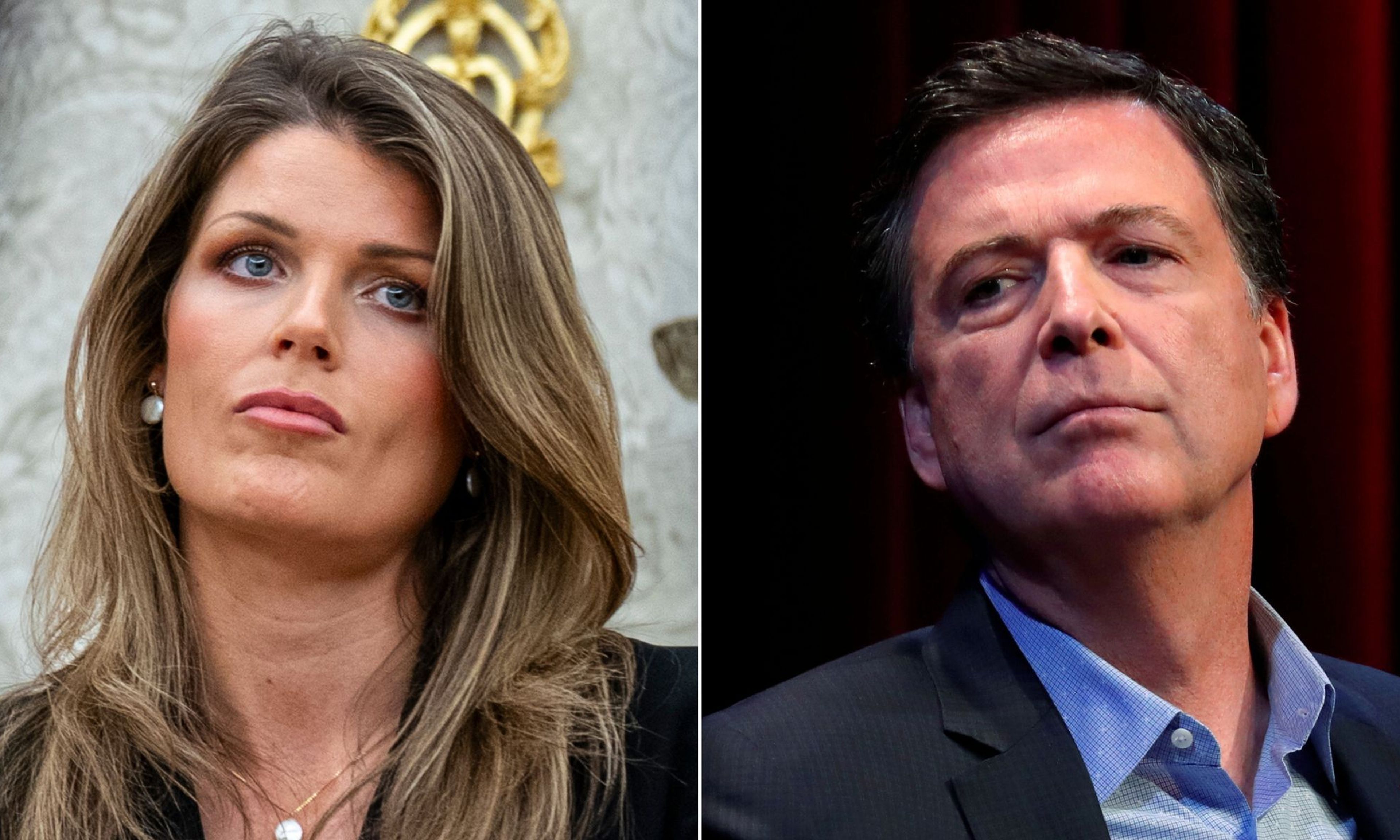
Left: Attorney Lindsey Halligan looks on during an executive order signing in the Oval Office of the White House, March 31, 2025. Right: Former FBI director James Comey speaks at George Washington University in Washington, D.C., April 30, 2018.
Sometimes, we “solve” one problem by making another one worse. That is what Lindsey Halligan may have done in undertaking to “correct” the record of the hearing that took place Wednesday in the Trump Justice Department’s prosecution of former FBI Director James Comey.
Halligan, of course, was installed by President Trump as the interim U.S. attorney for the Eastern District of Virginia (EDVa). That was after Trump banished Halligan’s predecessor, Erik Siebert, for declining to prosecute Comey and another Trump political enemy, New York Attorney General Letitia James. It was Halligan who presented the Comey case to an EDVa grand jury on September 25.
As I’ve detailed, one of the issues taken up Wednesday, in a hearing before Judge Michael Nachmanoff (the Biden appointee who is presiding over the case), is whether the full grand jury was asked to deliberate over and vote on the final, two-count indictment that Halligan filed in court. On Wednesday, in response to pointed questions by Judge Nachmanoff, Halligan appeared to concede that the full grand jury had not reviewed and voted to approve the two charges in that document; that is, they had reviewed and voted only on the original three-count indictment Halligan had proposed. In so doing, the panel rejected one false statement charge but approved a false statement and an obstruction charge. (The final, two-count indictment document contains only the two charges approved in the original three-count indictment.)
Late Thursday, however, the Justice Department did an about-face. Halligan’s subordinates filed a “Notice Correcting the Record.” It includes carefully mined snippets of the September 25 court proceeding at which the foreperson, accompanied by one other grand juror and Halligan, filed the indictment. Those snippets can be read to intimate that the full grand jury did review and agree on the final, two-count indictment document.
Notably, the government’s “correction” of the record does not say that Halligan herself presented that document to the grand jury. Nor does it explain the genesis of the document and why there is no record of its being presented to the grand jury. I suspect that is because addressing these matters could undermine Halligan’s prior representations to the court that (a) she alone handled the grand jury presentation, and (b) the absence of a record is explained by extraordinarily lengthy grand jury deliberations: a period of over two hours during which no government official had contact with the grand jury, no stenographer was present, and no recording was made.
Note that the latter representation does not come close to explaining why there is no record of the government’s presentation of the second document to the grand jury. That had to have happened at some point if, as Halligan now claims, the full grand jury really did consider it.
Unforced Errors
Consider how maddening this is. There was no legal reason to create a second indictment document. The first was constitutionally sufficient. The grand jury was given a three-count indictment; after deliberating, it approved two charges but issued a “no true bill” (a rejection) as to the other. That’s a valid indictment as to two charges, even though it is embarrassing for Halligan to have a no true bill as to one count (especially in light of the subject matter of that rejected allegation, which we’ll come to).
If Halligan had just stopped then and there and returned that original indictment to the court, there would be two, incontestably legitimate charges.
So why create the second document? And why all the machinations regarding the chain of prosecutorial communications that led to that document? Why the mystery about its presentation to all -- or was it some -- of the grand jurors?
I continue to believe the two charges against Comey were validly approved by the grand jury. But based on the contradictory DOJ accounts we’ve been given, I can’t draw any conclusions other than that (a) some EDVa official other than Halligan communicated with the grand jury and learned of the no true bill on one of the three counts; (b) the two-count document, setting forth only the counts that were approved, was provided to the grand jury, almost certainly by someone other than Halligan; and (c) this was done with no record kept of when and how the two-count document was presented to the grand jury -- perhaps inadvertently, but perhaps for sinister reasons.
How and When Did Halligan Know About the No True Bill?
Halligan has represented that no other government official had contact with the grand jury from 4:28 p.m., when she departed the hearing room so the grand jury could deliberate on the three-count indictment, and 6:40 p.m., when Halligan “was notified by the then-First Assistant United States Attorney [FAUSA] that the grand jury had returned a true bill on only two of the three counts presented by the government.” I’m quoting from the opinion Magistrate Judge William Fitzpatrick issued on Monday. As I related in describing Halligan’s botched grand jury presentation, Fitzpatrick elaborated:
If the Court is to read [Halligan’s] declaration as suggesting there was no contact between any government official and the grand jury after 4:28 p.m., then it begs the question of how the then-[FAUSA] learned that the grand jury had refused to indict on one count, and how the [FAUSA] knew which count had been rejected by the grand jury, all before the indictment was returned in open court. [Magistrate Judge Fitzpatrick Nov. 17 Op., p. 17 & n.11.]
Indeed.
More Than Two Hours of Deliberations, Really?
More intrigue: I have never heard of a grand jury deliberating for over two hours, even on cases far more complex than Comey’s. Usually, it just takes a few minutes.
That’s not just because the grand jury only hears the government’s side of the story. A low standard of proof applies (the grand jury only has to find probable cause that a crime may have been committed, not proof beyond a reasonable doubt that the accused is guilty), and the grand jury need not be unanimous (there are 23 grand jurors on the panel, and it takes just twelve to approve charges). Yet, as Comey’s lawyers point out, if Halligan is truthfully reporting that the grand jury deliberated for over two hours, then the deliberations over the indictment took longer than Halligan’s presentation of the case.
Call me a cynic, but I suspect that before 6:40 p.m., maybe significantly before, whatever EDVa official who was assigned to wait outside the hearing room while the grand jury deliberated was alerted that the grand jury had rejected the first false statement count but had approved the second false statement count and the obstruction count. That official, if it was not Tong herself, reported that unanticipated outcome to Tong, who alerted Halligan.
No true bills are rare. I’m betting this one caused some panicky discussions among the prosecutors, and maybe between Halligan and Main Justice in Washington, while the grand jury was told to stand by. At some point, we know a decision was made to have the grand jury approve a “clean” version of the indictment -- one that would include only the two counts the grand jury had approved. It would look as if the rejected count had never been presented.
The Government’s Volte-Face
Now, I’ve previously said I assumed Halligan was being truthful when she claimed that she spoke with the then-FAUSA at 6:40 p.m., then headed to court for the proceeding before Magistrate Judge Lindsey Vaala to return the indictment. Halligan has said that the full grand jury was not present in court, only the foreman and one other grand juror. She also told Nachmanoff that the final, two-count indictment was not shown to the full grand jury. (See, e.g., reports by Politico and the New York Times.) Nachmanoff also grilled one of the veteran prosecutors brought in to help Halligan, N. Tyler Lemons:
So now let me ask you the question again. Let me be clear that the second indictment, the operative indictment in this case that Mr. Comey faces, is a document that was never shown to the entire grand jury or presented in the grand jury room; is that correct?
Lemons responded:
Standing here in front of you, Your Honor, yes, that is my understanding. Now, I don’t -- I was not there, but that is my understanding, yes, Your Honor.
That’s a very strange answer. It’s as if Lemons, who had to know this issue was going to arise at the hearing, was not confident that he’d been given an accurate version of events. He took pains to distance himself from the government’s interaction with the grand jury (even though everyone already knew he wasn’t there at the time).
At any rate, now the government claims the full grand jury did see the second document after all. At the indictment return proceeding, at which Magistrate Judge Vaala noted the oddity that she had been handed two indictments, she asked the foreperson, “So you voted on the one that has two counts?” The foreperson replied, “Yes.” In another snippet from the transcript spotlighted by prosecutors, the foreperson dilates,
So the three counts should just be one count. It was the very first count that we did not agree on, and the Count Two and Three were then put in a different package, which we agreed on. [Emphasis added.]
Let’s parse this. “So the three counts should just be one count.” That seems to refer to the no true bill attached to the original indictment; the foreperson is explaining that it related to just one count (the first false statement count Halligan proposed) but not to the second and third counts (the other false statement count and the obstruction count that the grand jury approved). The no true bill was annotated to reflect that it applied to “Count 1 only,” but it’s not clear when that notation was made, or by whom.
According to the foreperson, those two approved charges “were then put into a different package, which we agreed on.” The “different package” seems to mean the final, two-count indictment; and the assertion that “we agreed on” that “separate package” indicates that the full grand jury was shown that final, two-count indictment and voted to approve it.
Fine . . . but where’s the record of how that happened?
How did Halligan and her subordinates know the grand jury approved only two counts? How, by whom, and at what time was the final, two-count indictment submitted to the grand jury for approval? And what were the grand jurors told about it? Were they given legal instructions? Asked to vote? Asked to complete a tally sheet showing how many grand jurors concurred?
Plainly, the new indictment document did not just spontaneously appear in the grand jury hearing room, with the expectation that the grand jurors would know exactly what to do. If it’s really true that the full grand jury approved this document, then someone from Halligan’s office has to have brought it to them and explained what was being asked of them. The someone in question must know why there was neither a court stenographer nor an audio recording -- it being the government’s obligation to ensure that grand jury proceedings are recorded.
Here's the gnawing question, though: Why? This was totally unnecessary, legally speaking. Since the three-count indictment, accompanied by the no true bill, was perfectly adequate, why create a second indictment document that makes it look like no charge was rejected? I suspect there are two reasons.
The Embarrassment of a No True Bill
First, to repeat what I’ve explained, it is embarrassing for the government to get a “no true bill.” It’s unusual, to the point of signaling to the judge and the public that the case is weak and the prosecution is in disarray. That should never happen.
Before asking grand jurors to deliberate on a proposed indictment, experienced prosecutors inquire about whether they have any questions or concerns about the case, and whether they wish to hear any additional evidence about proposed charges. If it becomes obvious from that colloquy that a critical mass of grand jurors has problems with the case, or at least with one of the proposed charges, prosecutors will not ask the grand jury to vote. Instead, prosecutors go back to their office and regroup. They consider whether they can compel additional testimony that would allay the grand jury’s concerns; if such evidence is lacking, they weigh whether the case is just too weak to pursue further. After all, if the grand jury is having trouble, how is the government possibly going to get a conviction at trial -- when the burden of proof will be more demanding, the defense will present its counter-evidence, and the jury must be unanimous?
But on this score, Halligan had unusual challenges.
With the weekend about to start, the statute of limitations (SOL) was set to expire in just five days (Tuesday, September 30). It would be risky to rely on getting the grand jury back for another session: If for some reason a quorum could not be gathered, the SOL would expire and the chance to indict Comey would be lost.
More importantly, President Trump wanted Comey charged even though the case was already known to be weak (which is why Siebert wouldn’t charge it). In this instance, then, there was no point regrouping, trying to shore up the evidence, or weighing whether to abandon the case. Halligan had to play the hand she was dealt and hope the grand jury would indict.
The ‘Clinton Plan’
And they did indict. Yeah, it was ugly due to the no true bill, but so what?
Well, that brings us to the second problem. As I’ve also previously addressed, the count the grand jury rejected was not just any charge. It was the allegation most important to Trump, which is why it was going to be Count One in the case against Comey.
The theory of that count was that Comey and the Obama administration knew that Hillary Clinton’s 2016 campaign, to distract public attention from her email scandal, had a concocted a scheme to slander Trump -- to portray him as corruptly conspiring with the Russian regime of Vladimir Putin to influence the election. (The proposed charge said Comey had falsely testified that he had never been informed that “Person 1” (Clinton) had given “approval of a plan” concerning “Person 2 [i.e., Trump] and the 2016 election.”)
This was a ridiculous premise for a false statement charge. Not because there was no evidence that Clinton approved such a campaign plan; such evidence does exist, but it was rendered dubious by Russiagate special counsel John Durham’s exhaustive scrutiny. While there’s no doubt that the Clinton campaign thematically hyped a largely fabricated Trump-Russia connection, Durham concluded -- after months of perusing intelligence files and interrogating relevant witnesses -- that the specific story about a concrete plan may well have been based on Russian disinformation, mainly in the form of concocted emails. (See May 12, 2023, Appendix to Durham Report, declassified and redacted version, pp. 6-18.) I’d also note that in the first Trump term, when then-National Intelligence Director (and now-CIA Director) John Ratcliffe made the sketchy “Clinton plan” information public, he conceded that the intelligence community was unsure if it was a product of legitimate Russian intelligence analysis or of Russian “exaggeration or fabrication.”
More importantly for purposes of a false statement charge, the questions put to Comey at the September 30, 2020, Senate Judiciary Committee hearing, mainly by Senator Lindsey Graham (R., S.C.), were a mess. Don’t take my word for it; just look at the relevant portion of the transcript. (See here, at the 34:47 mark.)
In his queries, Senator Graham conflated the suspected Clinton plan itself with an “investigative referral” sent to Comey by the CIA about the plan. It was thus hopelessly unclear whether Comey was being asked (a) whether he’d heard of such a plan (which he undoubtedly had), or (b) whether he’d heard that the CIA had sent an “investigative referral” regarding Clinton in connection with the plan. While Graham emoted as if it were astonishing for Comey to claim that this “didn’t ring any bells with me,” Comey’s answer was entirely reasonable.
In referring to an “investigative referral,” Graham’s questions implied that the Obama CIA had urged the FBI to conduct a criminal investigation of Clinton over the plan. That was a daft suggestion. President Obama had endorsed and campaigned for Clinton, and his CIA director, John Brennan, was rabidly anti-Trump. Even putting this farcical “referral” premise aside, Comey’s testimony was essentially that he didn’t recall what Graham was (confusingly) talking about. As a matter of law, a false statement case cannot be based on a witness’s claim not to recall something if (1) the thing he was asked to recall was poorly described, and (2) there is no evidence of willful concealment.
There is no chance that a trial jury would convict Comey on such a charge; hence, it is not at all surprising that the grand jury rejected the charge.
Yet, here is the complication: At the president’s insistence, the Trump Justice Department has been hellbent on portraying a massive conspiracy implicating Clinton, the FBI, and top Obama officials in a plot to rig the 2016 election and destroy Trump’s presidency. Having written a 2019 book on this subject, Ball of Collusion, with the subtitle, “The Plot to Rig and Election and Destroy a Presidency,” I understand the president’s anger.
Still, as I contended in the book, the stubborn fact remains: What was perpetrated against Trump circa 2016–17 was a political dirty trick, not a prosecutable crime. It is also ancient history at this point, legally speaking: It’s been nearly a decade since Russiagate, and the federal SOL is five years. Trump has gotten his vengeance -- against Comey, Clinton, Obama, Brennan, et al. -- by winning back the presidency. He should let it go.
Conclusion
Alas, Trump’s makeup is such that he can’t let it go.
Consequently, it was a big problem for Halligan that the grand jury had voted against a count meant to be the foundation of a Trump DOJ claim that Comey had lied to conceal his participation in the Clinton Campaign-Obama administration conspiracy. With the rejection of that charge, the media-Democratic complex could gleefully report that a federal grand jury, hearing only the Trump DOJ’s evidence, had nonetheless rejected Trump’s “Russia, Russia, Russia hoax” allegations.
Halligan (and perhaps other Trump DOJ officials) had to know that Trump would be furious over the rejection of the “Clinton plan” charge. So even though, constitutionally speaking, it would have been perfectly fine to go with the original indictment that showed two counts approved and one voted down, the Trump DOJ decided to craft a second indictment document that omitted the failed “Clinton plan” count.
Perhaps the inexperienced Halligan did not grasp that, no matter what she did, the original indictment, with the no true bill on the “Clinton plan” charge, would become part of the public court record. As we’ve discussed before, at the indictment return proceeding, Halligan initially told Magistrate Judge Vaala that she had signed just one indictment -- only to be shown that there were two indictment documents, and her signature was on both.
Whatever the calculus was, by needlessly drafting a second indictment when the two counts had already been approved in the first one, and by purporting to “correct” the record when any incorrectness owed to the government’s own contradictory representations, Halligan has raised more questions about the grand jury proceedings than she’s put to rest.
Author's Note: I have removed a passage of this column, which incorrectly identified Maya Song (whom I incorrectly referred to as Maya Tong) and the former first assistant U.S. attorney (FAUSA) who reportedly notified Interim U.S. Attorney Lindsey Halligan about the outcome of the grand jury's deliberations on the first Comey indictment. Maya Song has left the EDVa U.S. Attorney's Office; however, she formerly served as deputy to former Interim U.S. Attorney Erik Siebert, not as the office's FAUSA. The then-FAUSA who reportedly alerted Halligan about the outcome of the grand jury's deliberations was Maggie Cleary. She is no longer the FAUSA -- it is unclear to me at this time whether she is still a federal prosecutor in the EDVa.
About the Author
Andrew C. McCarthy is a senior fellow at National Review Institute, an NR contributing editor, and author of Ball of Collusion: The Plot to Rig an Election and Destroy a Presidency.
Featured Tags
Advertisement
Advertisement

Comments