Has Trump Made the Catholic Vote Matter Again?
Written by Stephen P. White
Trump’s margin of victory among Catholic voters cannot be ignored.
Share this story
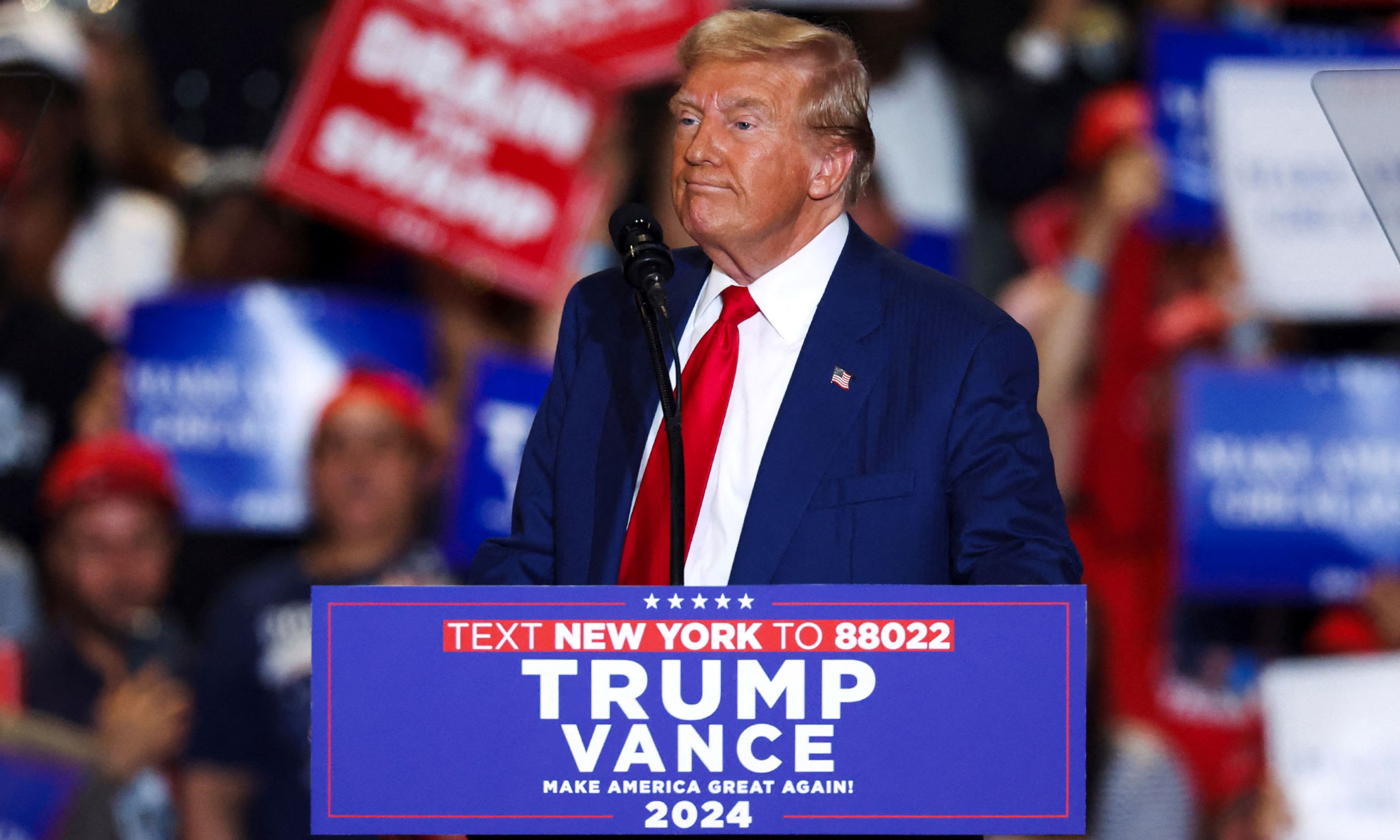
Former president Donald Trump reacts during a rally at Nassau Veterans Memorial Coliseum in Uniondale, N.Y., September 18, 2024.
It should come as no surprise that, in an election in which he won at least a plurality of the popular vote, Donald Trump also won a majority of the Catholic vote. American Catholics have favored the candidate who ultimately won the popular vote in every presidential contest since 1972 — with the lone exception of 2016.
Catholics voted for Nixon, Carter, Reagan (twice), Bush, Clinton (twice), Gore, Bush, Obama (twice), Trump, Biden, and Trump (again). So consistently does the Catholic vote track the popular vote in national elections that it has become something of a truism to say, as E. J. Dionne did, way back in 2000, that “the Catholic vote doesn’t exist.” There just doesn’t appear to be anything distinctively Catholic about how American Catholics vote.
Trump’s victory in 2024 gives reason to believe that might all be changing.
Exit polls show Donald Trump not only won Catholics nationwide but won Catholics by a massive margin. National exit polls show Catholics breaking for Trump over Kamala Harris by a whopping 18 points. The same polls showed Trump losing the Catholic vote to Biden in 2020 by five points. That’s a swing of 23 points in just four years. Given that something like one-fifth to one-fourth of American voters is Catholic, a shift that substantial among a group of voters that large is impossible to ignore.
The question now is whether the 2024 Catholic vote is an anomaly or a sign of a long-term shift in voting habits of American Catholics.
Kamala Harris was a candidate who was always going to struggle with Catholic voters. Her brand of liberalism all but guaranteed electoral headwinds. From her maximalist position on abortion rights, to dodging on the issue of taxpayer-funded sex-change surgeries for trans inmates, to her grilling a judicial nominee on his membership in the Knights of Columbus (as if the Catholic fraternal organization were some nefarious cabal): None of these was likely to endear her to Catholic voters.
But neither do these issues explain the massive swing of Catholic votes toward Trump. While these “Catholic” issues may have moved the needle on the margins, there’s simply not much evidence that these sorts of issues (call them “culture war” issues if we must) are responsible for shifting Catholic votes. There are Catholics who vote primarily on these issues — single-issue pro-life voters, for example — but they tend not to be swing voters.
It’s worth looking more closely at abortion in particular. On that issue, Harris’s record and positions are extreme, and she campaigned heavily on her support for “reproductive rights,” even suggesting that religious-liberty protections for doctors and hospitals opposed to abortion should be eliminated. But this was also the first presidential contest since the Dobbs decision overturned Roe v. Wade, and many Republicans (including Trump himself) have been willing if not eager to downplay their past pro-life positions. Most Republicans saw abortion as a liability in this election. And exit polls show that voters who listed “abortion” as the issue most important to them broke for Harris by a margin of three to one.
Then there is the matter of the distribution of American Catholics geographically. Nine of the ten states with the highest percentage of Catholics are deep blue, including New York, California, and Illinois. The ten most Catholic states contributed 146 electoral votes to Kamala Harris and just eight (from Louisiana) to Donald Trump.
Exit polls do not tell us where Trump’s biggest bump from Catholic voters materialized. We are left with several pressing questions. Were Trump’s electoral gains evenly distributed nationally? Were they concentrated in swing states with sizable Catholic populations such as Wisconsin, Michigan, and Pennsylvania? Or did Trump run up Catholic votes in large, blue states he didn’t even win? Perhaps it was some combination of these. We simply don’t know. Until we can answer such questions, it will be difficult to know how durable Trump’s support from Catholics might be going forward.
Another interesting piece of the puzzle can be found in the Latino vote. More than half of American Latinos are Catholic, and more than 40 percent of American Catholics are Latino. Trump made stunning gains among Latino voters, closing a 33-point deficit in 2020 to a mere six-point deficit in 2024. He appears to have won Latino men outright. How much of the swing in the Catholic vote came from Latino Catholics? Again, we’re not sure yet. But if the question is about the durability of Catholic support for Trumpism, that would be a good place to start looking.
Complicating all of these considerations is the fact that Trump won’t be on the ballot again in four years. He may have pulled together the broadest coalition of support enjoyed by any Republican since Ronald Reagan, but it seems to be a coalition held together by, well, Trump.
Trump is many things, but an ideologue he is not. A great part of his appeal came from his unapologetic willingness to simply be himself. As a recent Wall Street Journal headline noted, Trump won “by being Donald Trump.” Whatever else we can say about the policies or populist instincts of his successor, whoever that may be, he will not be able to campaign as Trump. The durability of Trump’s magnificent coalition going forward may hinge on nothing more complicated than that.
Weaving Trump’s peculiar brand of populism into an ideologically coherent — and therefore potentially durable — realignment will be one of the Republican Party’s most important tasks in the coming years. The person best positioned, best equipped, and most likely to take up that task is himself a recent Catholic convert: J. D. Vance.
If Vance does take up Trump’s mantle in four years, and if he does want to maintain Trump’s share of the Catholic vote, he will need to avoid some serious missteps along the way. Continued erosion of the Republican Party’s pro-life credentials in the eyes of Catholics could make this difficult. The idea of an IVF mandate was terrible. And of course, if the economic and immigration policies of the incoming administration go sour, Vance may find himself in 2028 in a position to similar to that of Kamala Harris in 2024: carrying the bag for the policies of an unpopular administration while lacking the personal appeal of the outgoing president.
For now, it seems that the mostly likely reasons that Catholic voters broke so decisively for Trump are the same reasons so many other voters broke for him. He offered a more appealing, if not unproblematic, alternative to an exceptionally weak candidate. For all intents and purposes, Harris ran as an unpopular incumbent in an election decided by voters who were deeply unhappy about the course of the country on precisely those issues on which Harris was most out of touch. To her own progressive baggage, she added all of Biden’s without having any of his once-legendary blue-collar affability.
The Catholic vote remains a frustratingly elusive prize for presidential candidates, but Trump’s margin of victory among Catholic voters cannot be ignored. It deserves closer examination and study. No doubt it will receive both in abundance in the months to come. Republicans would be unwise to assume that Catholics are a reliable part of their new coalition. They certainly should not take the Catholic vote for granted. As Democrats proved this election, taking even long-standing coalitions for granted can lead to electoral disaster.
About the Author
Stephen P. White is the executive director of the Catholic Project at the Catholic University of America and a fellow in Catholic studies at the Ethics and Public Policy Center.
Featured Tags
Advertisement
Advertisement
Comments