Hitting the Mother Road: Rediscovering Route 66
Written by Andrew Stuttaford
For a hundred years, the storied American highway has been the road of reinvention
Share this story
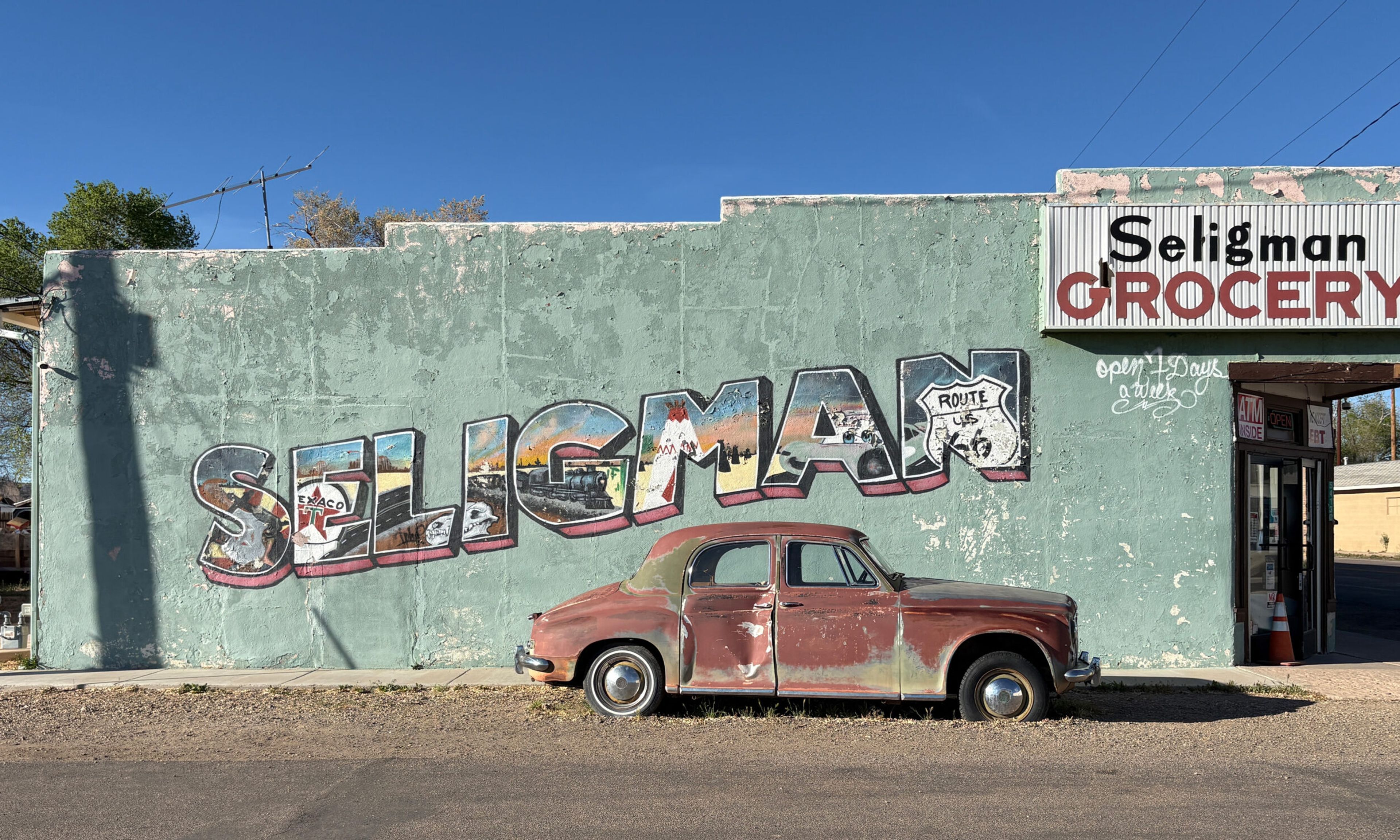
Seligman, Ariz.
I’ve seen things you people wouldn’t believe. It was my first day of driving on I-40 and remnants of Route 66 between Kingman, Ariz., and Shamrock, Texas, two cities separated by some 850 miles, about a third of the length of the old road, and there it was, a massive green head. Tiki? Moai? Hard to say.
Giganticus Headicus stared out from the former Kozy Corner Trailer Park at Antares, Ariz. Not so far away, there were dinosaurs. Unbothered by Jeff Goldblum and his precautionary principles, their owners were using them to entice visitors into, among other ports of call, rock outlets (geological, not vinyl), Meteor City, and the Grand Canyon Caverns Inn.
Cyrus Avery, the Oklahoma businessman who fathered the mother road, would not have been surprised. He died in 1963, having stuck around long enough to see Route 66 at its exuberant best. A Good Roads Movement man and a highway commissioner, he was also appointed to the federal government’s Joint Board of Interstate Highways in 1925. Up until that time, America’s highway system had not, in fact, been a system, merely a messy patchwork of messy roads, much less than the country needed if it were to take full advantage of the opportunities offered by the internal combustion engine.
Turning the patchwork into a network was not straightforward. Avery helped settle Route 66’s path and resolve something else too. A confusing collection of road names was to be replaced by a logically ordered set of numbers. What ended up as Route 66 was meant to be Route 60, but to Avery’s annoyance, crafty Kentuckians managed to grab the coveted zero-ending for the route that was to run through their state. Avery rejected one alternative, 62, because he and some colleagues got more kicks from 66. It sounded right (even more so preceded by “Route” rather than the more formal “U.S. Highway”), and in 1926, Route 66 was born. One hundred years later, its birthday celebrations are underway.
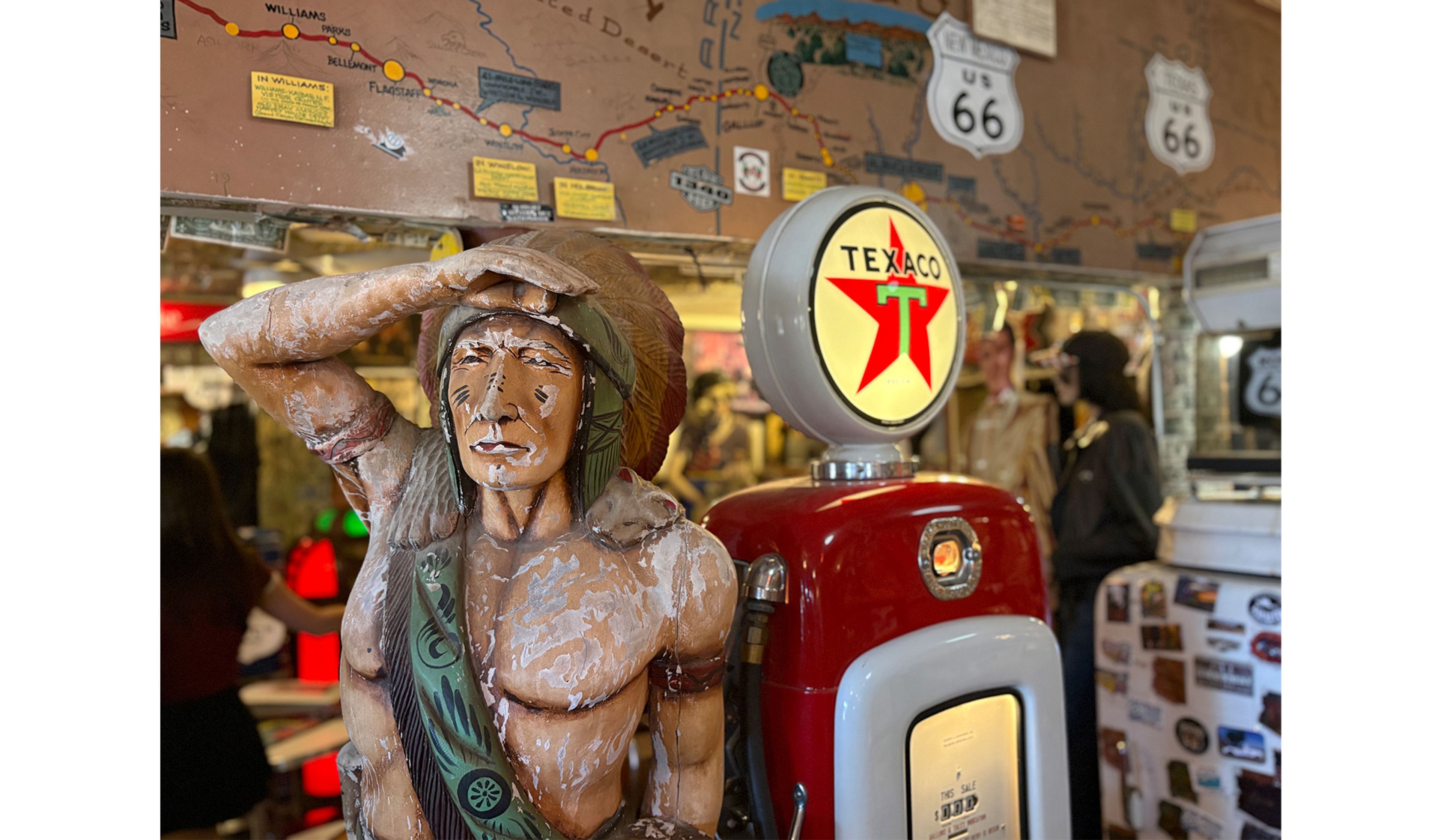
To digress (in an article about a road, why not?), 66 meant that the route’s sixth “spur,” a suitably lonely part of which ran through New Mexico, was U.S. 666. This attracted dread, triggered talk of a curse, and, allegedly, scared off traffic. Excellent: the emptier a desert road, the better. Back in the 1990s, my trips along the Devil’s Highway to or from Gallup, N.M., with the majestic hulk of Shiprock to one side and who knows what lurking on the other, were enlivened by a merry what-if. It is still a fine drive, but, after numerous complaints, 666 was downgraded to 491 in 2003. A little something was lost, not for the first or the last time in the tale of Route 66.
Avery regarded the nascent Route 66 as a great, cleverly diagonal (less wintry) “transcontinental” trade route to speed up the country’s already impressive growth — the Twenties were roaring along. But he saw how such a road could also open up the West, distant and thus exotic, to the vast majority of a population that lived in the country’s East. Chicago, then the second-largest city in the U.S., would make a first-rate starting point, an accessible gateway to what lay beyond, for tourists as well as business. The Fred Harvey Company’s earlier success with restaurants, hotels, dining cars, and more across the Southwest, which established the region as somewhere to visit, suggested that there was more to Route 66’s promise than just California.
The Harvey business was tied to the railroad, but the automobile offered much more autonomy. Route 66 could have sold itself, but Avery would never have left it at that. He and some associates founded the U.S. Highway 66 Association to lobby for improvements to a road that still needed a lot of work, from more paving to smarter routing, and to promote it too. They quickly dubbed it the “Main Street of America,” a name both grandiose and, by conveying a sense of an extended hometown, reassuring. And then, when Oklahoma’s Will Rogers was killed in a plane crash in 1935, it became the Will Rogers Highway too. In those years Route 66 added another identity to the pile, that of an escape route for those trying to flee the Dust Bowl. It became, wrote John Steinbeck in The Grapes of Wrath, “the mother road, the road of flight.”
Of all Route 66’s nicknames, the “mother road” is the one that still comes first to mind, even if its origins are hazier now, eclipsed in many ways by a broader interpretation of the words that followed. Route 66 became the American ideal of the “road of flight,” not from agricultural depression but from the everyday, the humdrum — sometimes temporary, sometimes, in this land of reinvention, forever, sometimes, as with Steinbeck’s Joads, desperate — but often for the adventure, for the hell of it, for the just-get-up-and-go.
It wasn’t only the Dust Bowl’s dispossessed who traveled Route 66 in the Depression, but it took the postwar boom to launch the road’s golden age. Americans took to their cars, to have fun and to see their country. Route 66 was now fully paved and, partly because it had catered to the previous decade’s westward migration, it had the basis of good roadside infrastructure in place. According to a 1946 guide, Tucumcari, N.M., a city of 6,000, boasted four hotels, with the number of “courts” (motels and their precursors) running into double figures. Route 66 was in the right place and (almost) the right shape at the right time.
But neither time nor America’s urge to improve itself stood still. In due course, the Interstate Highway System replaced Route 66, which was formally decommissioned in 1985. Much of it had been buried beneath the new interstates or absorbed by them in other ways. A portion, not quite superfluous enough, was left alone to a quieter future. Other parts were abandoned altogether. All this meant serious trouble and sometimes disaster for towns that had relied on the mother road’s traffic but now, thanks to the interstate, could either be bypassed altogether or simply sped through. For all the benefits brought by these newer roads, there were costs too.
As I followed the path of Route 66, traces of that upheaval were hard to miss: bleached, illegible signs, abandoned buildings or their remnants, ghost towns and towns trying extremely hard not to be ghost towns. Returning to one or two places after an interval of a few years, I noticed fresh indications of decay in the latter, more shuttered businesses and landmarks gone AWOL.
But could Glenrio, a ghost town on Route 66 that straddles the Texas–New Mexico border, claw a little of its way back? Back in its mid-century heyday, it was a bustling place, complete with motel, hotel, and gas stations, but I-40 put an end to all that. Hopes now of a Glenrio restoration rest on the difference between the law in New Mexico and in Texas, an issue that has come up before. There was a time when the bars in Glenrio were on the New Mexico side of the line, because Glenrio, Texas, was in a dry county, but Glenrio’s service stations were over in Texas where the gas tax was lower. Now, the divide is cannabis, legal (at the state level) in New Mexico, illegal (at all levels, with limited state medical exceptions) in Texas, meaning that there was an obvious, if risky, market opportunity. The Glenrio Smoke Stop opened its doors in 2023. Its owners, however, are thinking of a Glenrio rebirth based on more than weed and have reportedly bought quite a bit of property in town.
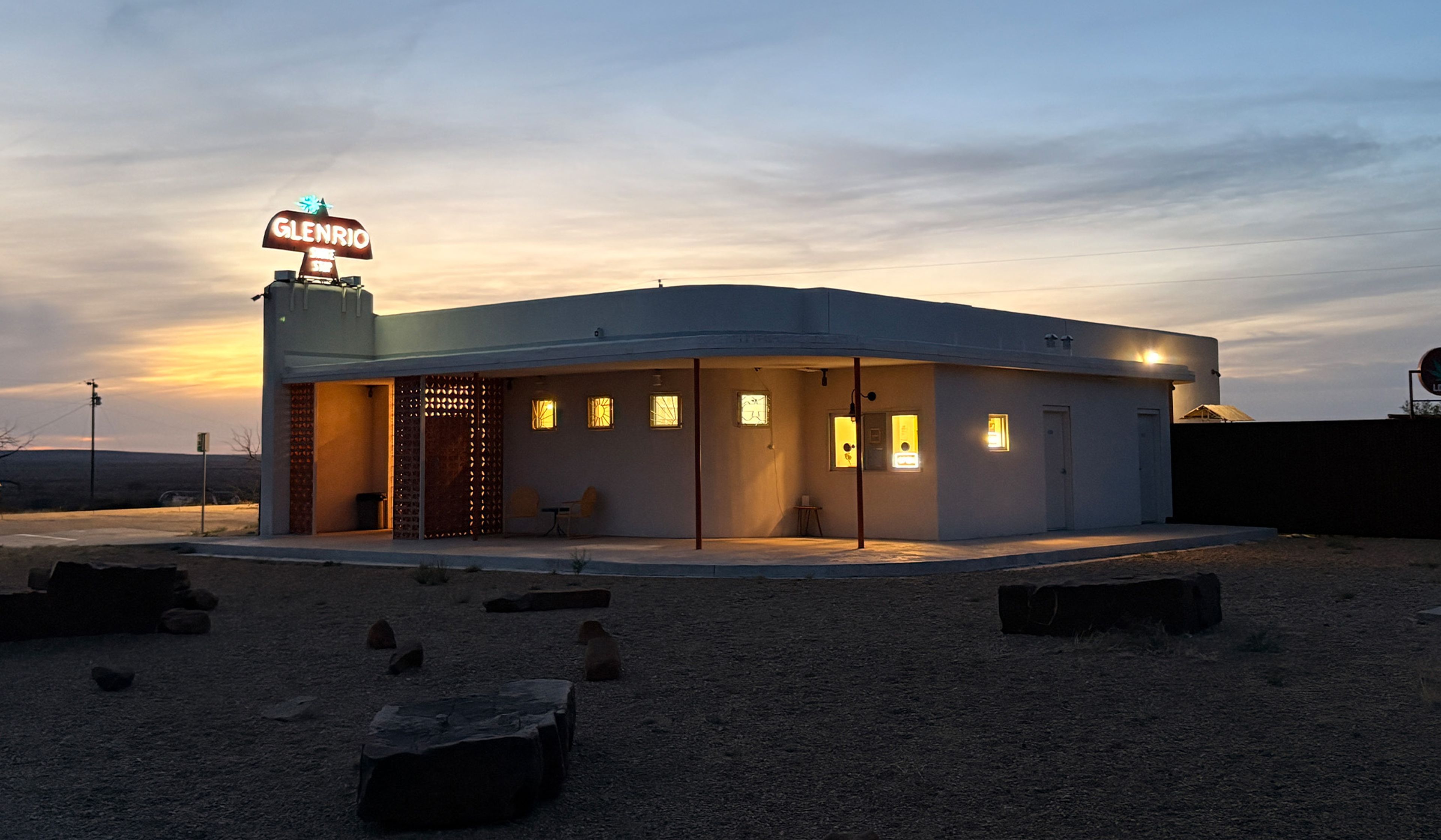
Meanwhile, Texan lawyers have spotted an opportunity too. Drive west along I-40 toward New Mexico, and the message on billboards is that marijuana is just a few minutes away. Drive east into Texas and there are billboards offering legal assistance in the event that you’re busted. I arrived in Glenrio as it was beginning to get dark, to find a ghost town marred not by weed but by spray-painted graffiti, a disappointingly effective way to ruin ruins. I walked around for a while and, pressed for time — a theme of this trip — decided to press on. “Go straight ahead,” ordered the GPS, “unpaved road.”
“Never get out of the boat,” a wise man once said.
I went into reverse.
But lovers of Route 66 can put their hope in more than dope. The mother road has long had a special place in U.S. culture — that song and the way that singers constantly kept turning to it, and that TV show, to start with. But paradoxically, it was probably the road’s decommissioning that really allowed 66 to take root in the American imagination. The Interstate Highway System was built because the existing highways, despite many upgrades, could no longer deliver what Americans needed or wanted in terms of speed, capacity, or safety. But once Eisenhower’s autobahns had assumed most of the burden, the old, prosaic concerns about Route 66 faded away.
And that further eased its elevation as an American icon, symbolic of that just-get-up-and-go and also, critically, saturated in nostalgia, or, more accurately, nostalgias. One variant, in the spirit of the movie Cars, a film shot through with a sort of soft communitarianism, is a feeling of regret for the disappearance or dilution of — dread word — community (or communities, such as that of Radiator Springs) that the interstates left in their wake, and disappointment that we no longer take the time to slow down and smell the brake fluid. Another is a pining for that lost neon era of American self-confidence, power, and seemingly unstoppable advance. Either way, nostalgia is a powerful force. Combine that with the sheen that the passing of time often bestows on the art and architecture of the past, and it is easy to see why “Historic Route 66” has assumed yet another identity as a destination in its own right. That should ensure the survival of a good deal of what is left, so long, that is, as people can truly understand what it once was, what it once meant, and what it once did.
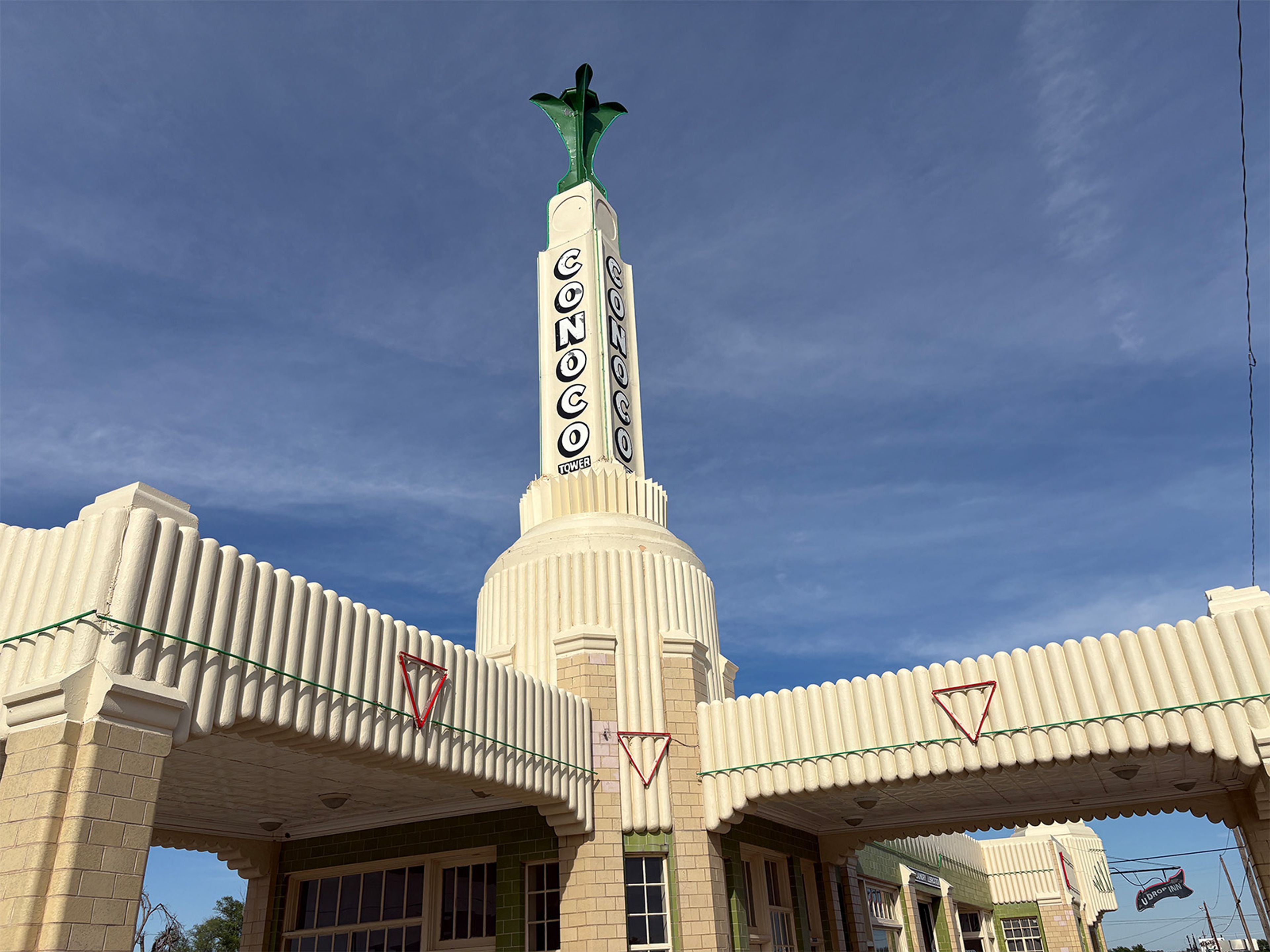
On my return to the Southwest this time, there were many highlights: an astounding art deco masterpiece, the beautifully restored Tower Conoco Station and U-Drop Inn in Shamrock. Watching the sun set over the strange ruins at Two Guns, Ariz. (and then discovering their backstory). A stay at the “Home of the Movie Stars,” Gallup’s Hotel El Rancho, a fantasia in mid-century cowboy chic, with a bar (of course) at which Errol Flynn (of course) supposedly showed up on a horse (of course).
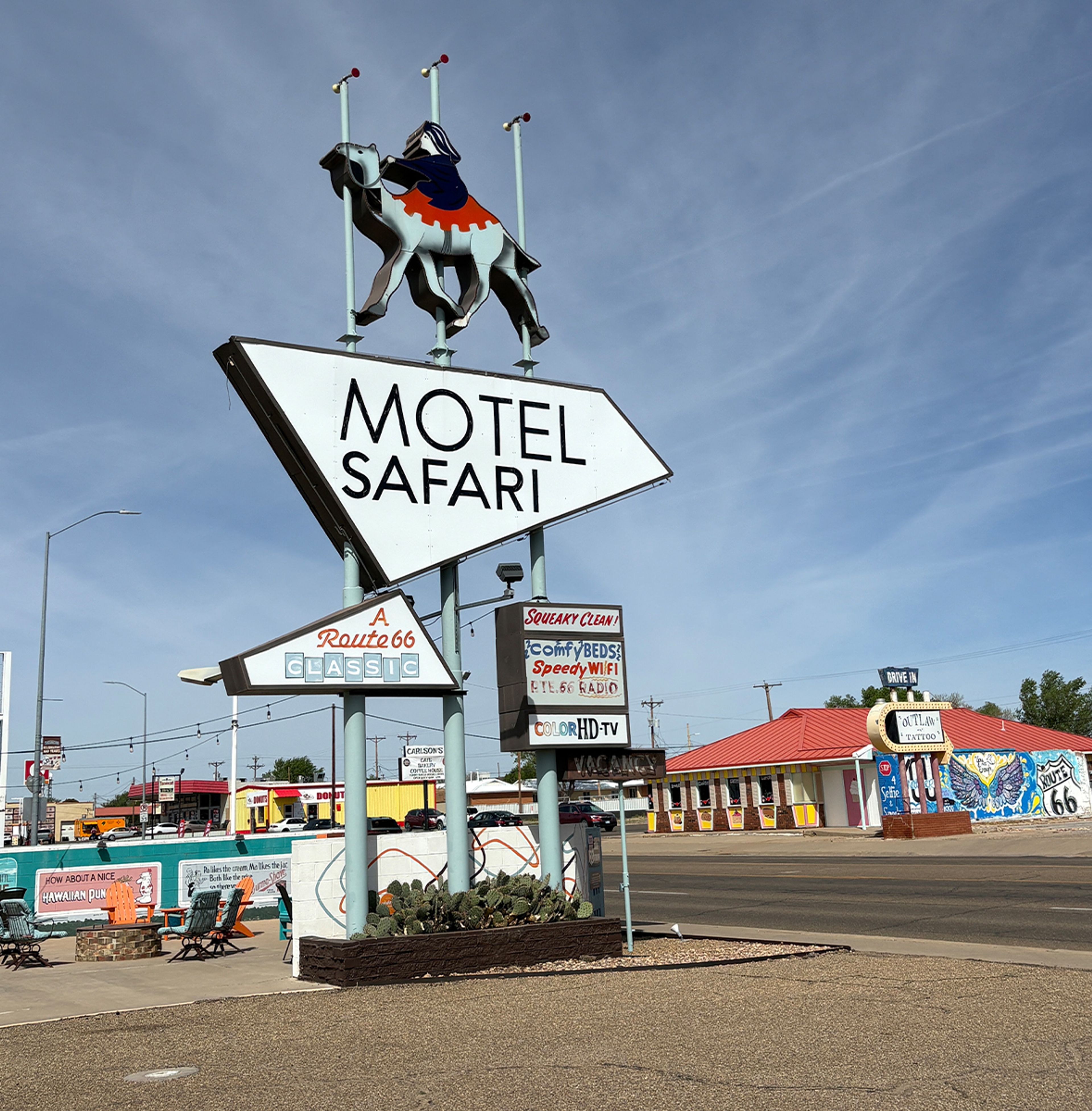
Best of all was wandering down Route 66 in Tucumcari late into the night, admiring Motel Safari’s cleverly illuminated mid-century brick (and the camel too) as well as the neon glow of the just pre-war Blue Swallow Motel, and from across the road, Tee Pee Curios, once a 1940s gas station. There were no cars around, and the stars were visible in the high desert sky. A ruffian dog barked too often.
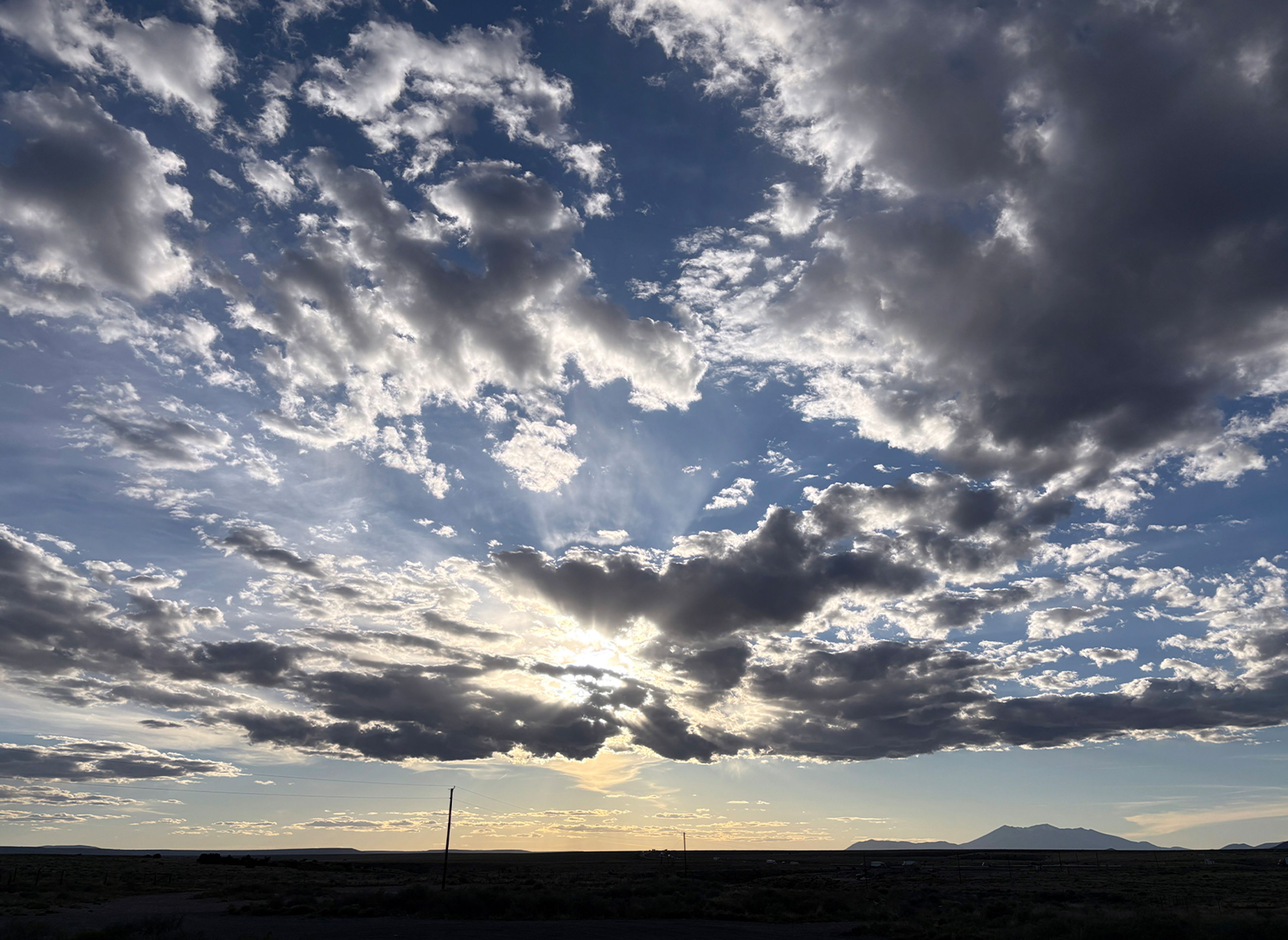
An old motel had been rigged up to look a bit Batesy. I peered in. A sinister mannequin was sitting in a chair. A voice from a hidden speaker: “I can see you.”
Just getting my kicks.

About the Author
Andrew Stuttaford is the editor of National Review's Capital Matters.
Featured Tags
Advertisement
Advertisement
Comments