How <em>Dobbs</em> Could Rattle the Left, Rev Up the Right, and Restore the American System
Written by Steven F. Hayward & John Yoo
The leak and the draft opinion itself remind us that we must preserve the line between politics and the law.
Share this story
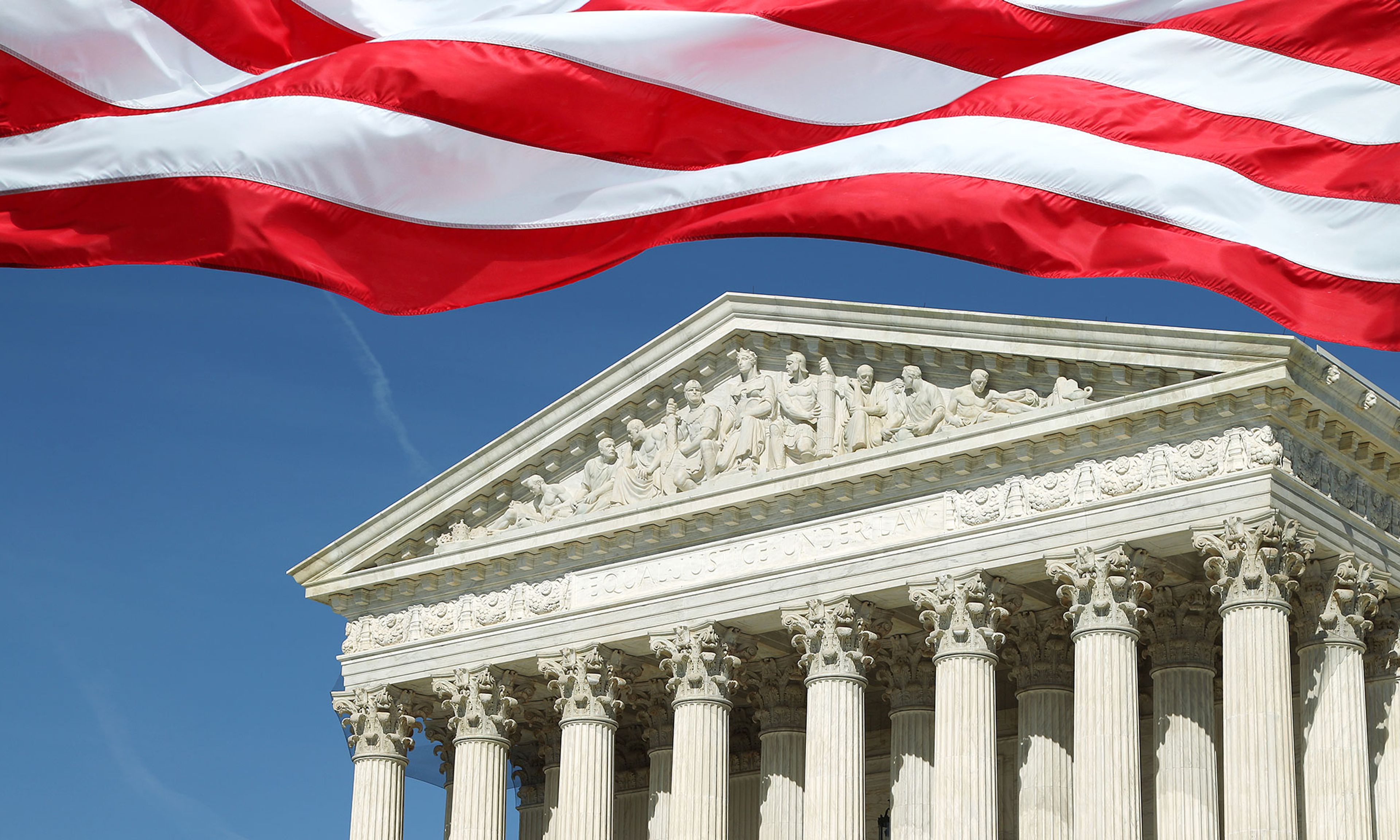
flySnow/iStock/Getty Images
Editor’s note: This is the second in a series of articles on the leaked Dobbs draft opinion and its implications.
One reason for the continuing outcry over the leaked draft opinion in Dobbs v. Jackson Women’s Health Organization is that if the final decision follows the reasoning of the leaked draft, it will do more than overturn Roe v. Wade and upend the issue of abortion. It will represent a watershed moment in American judicial history and constitutional thought, potentially restoring a balance between the three branches of government that conservatives have long sought. However, the aftermath may also disappoint more combative conservative intellectuals who seek to replace liberalism’s tottering foundations.
The logic of Justice Samuel Alito’s draft opinion effects a subtle reversal of the Left’s use of the Court as an engine for social change, while also highlighting the Left’s bad faith and hypocrisy. In the wake of Brown v. Board of Education, which struck down racial segregation, liberals increasingly saw the judiciary as a primary instrument to achieve policy ends that they could not gain through the legislative or executive branch. Chief Justice Earl Warren and a bench filled with liberal-minded justices were happy to embrace this activist mode and began to create “rights” — especially to abortion, in Roe in 1973, but extending to the recent discovery of the heretofore unknown “right” to same-sex marriage. Justice Alito’s draft opinion aims to close down the judiciary as a fabrication plant for unending “rights.”
Suddenly it is the Left that has turned against the Supreme Court, as Republican presidents have sought to appoint judges committed to originalist principles. Conservatives, meanwhile, have held a far more skeptical attitude toward the Court’s claim of supremacy in interpreting the Constitution. Nevertheless, the Court deserves a robust defense — not because of its view on abortion, but because it stands as a valuable institutional limit on simple majority rule.
The political response to the Dobbs leak puts on display the progressive attitude toward the Constitution. Progressives are launching unprecedented attacks against the justices because of their expected votes on abortion, regardless of the logic or reasoning behind their opinion. Protests at justices’ homes — heretofore unknown in the annals of politics — have followed proposals for “reform” by expanding the number of justices, limiting their terms, and intruding into their finances and personal activities. More broadly, liberals support or attack the Court based on how decisions affect the interests of the groups — minorities, women, environmental organizations — that compose their political coalition. As progressives see it, a judge is just a politician in a robe.
Progressives find law and facts to be mostly smoke and mirrors. Courts should not try to reach correct outcomes by interpreting the law; instead, given the inherent malleability of language and the rapid changes in society, they should make policy. To progressives, judges enjoy raw political power in determining society’s winners and losers. President Obama said he was looking for judges with “empathy,” though undoubtedly it was a select empathy — not for corporations, for example, but for groups he favored. Similarly, when President Biden declared that he would consider only African-American women for his first Supreme Court pick, it was because, in the progressive worldview, the racial identity of judges — as with political candidates — predicts their future voting patterns: The Left wants judges whose decisions will favor unions, racial minorities, and criminal suspects. If the law is simply another means to achieve policies denied to them through electoral politics, and if there is no real difference between law and politics, progressives predictably will resort to political tactics — leaks, protests, threats, and interest-group pressure — to exert influence on the courts.
Conservatives, even those in the pro-life movement who have suffered under Roe’s half-century regime, must observe a distinction between law and politics. More important than who wins in Dobbs are the legal principles and reasoning that the Court uses to decide it. Recognizing that constitutional interpretation remains a matter of law, rather than just another arena for political contest, is essential to a system in which government obeys a written Constitution rather than majority whim. As Alexander Hamilton noted in Federalist No. 78, “courts must declare the sense of the law; and if they should be disposed to exercise WILL instead of JUDGMENT, the consequence would equally be the substitution of their pleasure to that of the legislative body.” Supreme Court justices who exercise their will instead of judgment will usurp the powers that the Constitution reserves to the president and Congress or the states.
For a majority of the Supreme Court to cross the line from law into policy is fundamentally anti-constitutional. A mistaken Supreme Court decision effectively amends the Constitution because Congress and the states cannot overturn the justices through simple legislation. Only two-thirds of Congress and three-quarters of the states can change the constitutional text, just as a supermajority of nine of the original 13 states was necessary to adopt the Constitution in 1788. Our constitutional system will turn upside down if five justices can overrule the will of supermajorities of the American people as expressed in the Constitution.
Progressive judging seizes sovereignty from the people and places it in the hands of five justices whom the Constitution removes from political accountability. Abraham Lincoln rejected the idea that the people’s sovereignty should rest with the Supreme Court. He famously warned in his First Inaugural Address that
if the policy of the Government upon vital questions affecting the whole people is to be irrevocably fixed by decisions of the Supreme Court . . . the people will have ceased to be their own rulers, having to that extent practically resigned their Government into the hands of that eminent tribunal.
But Lincoln did not propose defiance of the Supreme Court, even though his rise and that of the Republican Party were propelled by their opposition to the atrocious Dred Scott decision. Instead, he argued that the president and Congress must enforce the judgments of the Court but should reject applying the dicta of Dred Scott (that blacks could not be citizens and Congress could not regulate slavery in the territories) more broadly to other circumstances. In other words, the other branches were entirely within their rights to contest the Court over the meaning and principles of the Constitution. The other branches should use their own powers — judicial appointments, taxing and spending powers, executive prosecution of the law — to persuade the justices to correct their errors. Lincoln understood that respecting the institution of the judiciary as one of the three coequal branches of government remained central to the Constitution’s separation of powers. Properly limited to interpreting the law, the judiciary, in Hamilton’s words, would remain the “least dangerous [branch] to the political rights of the Constitution.” If not thus limited, the Court would lack the institutional “fortitude” to stand up to the majority when the Constitution demands — to protect the right of the unpopular to speak and organize, of religious minorities to worship, or of criminal suspects to be given a fair trial.
The leak of the draft Dobbs decision threatens this careful line between law and politics. From the outside, it makes the Court an object in the arena of electoral politics. But it also threatens to turn the Court into a political actor internally. If leaks become the norm, clerks could begin disclosing the Court’s internal arguments and votes in important cases, the changing coalitions around different drafts, and even the thought processes of individual justices. Justices might explicitly take political factors into account in their decisions. Court decisions might result not from legal reasoning and persuasion, but from openly political acts of representing interests, coalition-building, and log-rolling. If the justices act in an openly political manner, the American people would be right to ask whether the Supreme Court deserves any special deference in the interpretation of the Constitution. And the president and Congress — more practiced and experienced politicians — might consider the justices to be no more than creatures at their own disposal and redouble their efforts at pressuring the Court. While open efforts to politically pressure the Court have remained rare (FDR’s Court-packing plan, which was stymied, and President Obama’s efforts to save his health-care law), progressives continue to float ideas such as heavy regulation of the justices’ ethics, tampering with procedures for amicus participation in cases, and a revival of the push to expand the Court. Thus far futile, these efforts, if the Court appears to be operating based on politics rather than the law, may be futile no more.
Finally, there is one aspect of Justice Alito’s draft opinion that has so far drawn little comment. He wrote that the Supreme Court should get out of the “rights-creation” business except when rights are rooted in long-established historical tradition. If that view prevails, it will complicate and perhaps foreclose on a faction of conservative thinkers who advocate “judicial engagement,” which is a conservative version of substantive due process, if not conservative “judicial activism.” But conservatives can’t have it both ways: If we think abortion should be subject to legislative deliberation, we have to admit that so should other areas of contentious public policy. Conservatives should not repeat the errors of the Warren Court era by looking for a shortcut to their desired political ends.
Steven F. Hayward is senior resident scholar at the Institute of Governmental Studies and a lecturer in both the law school and the political science department at the University of California at Berkeley.
John Yoo is the Emanuel S. Heller Professor of Law at the University of California at Berkeley, a nonresident senior fellow at the American Enterprise Institute, and a visiting fellow at the Hoover Institution at Stanford University.
[slideshow slideshow="1009721" /]

About the Author
Steven F. Hayward is the Edward Gaylord Distinguished Visiting Professor at Pepperdine University School of Public Policy.

About the Author
John Yoo is Heller Professor of Law at the University of California, Berkeley; distinguished visiting scholar at the School of Civic Leadership and a senior research fellow at the Civitas Institute at the University of Texas at Austin; and a nonresident senior fellow at the American Enterprise Institute.
Featured Tags
Advertisement
Advertisement

Comments