How Modern Catholicism Became Global
Written by Nicholas Frankovich
Catholicism: A Global History from the French Revolution to Pope Francis, by John T. McGreevy (Norton, 528 pp., $35)
Share this story
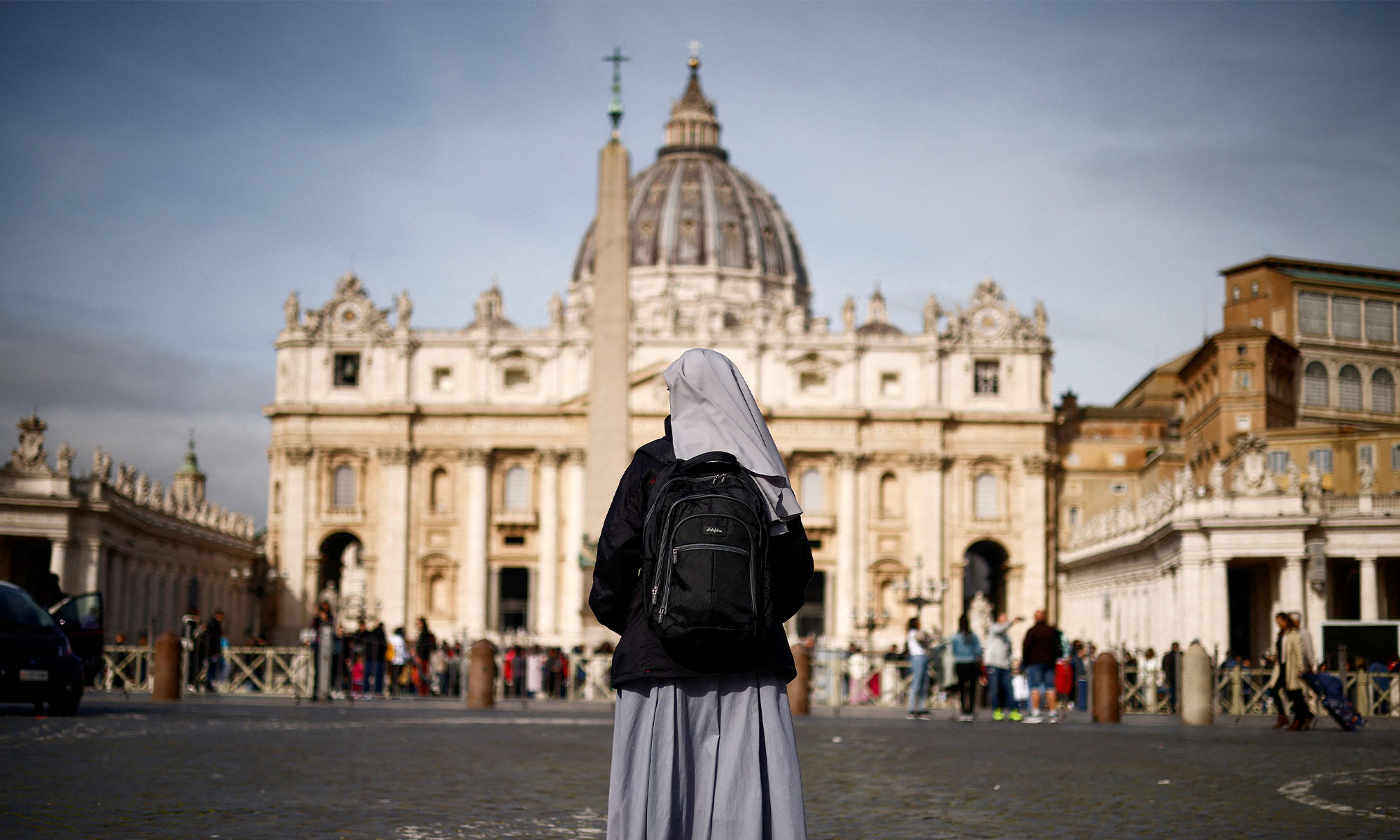
A nun stands in front of St. Peter’s square at the Vatican, March 30, 2023.
John McGreevy calls his book, in the subtitle, “a global history.” He’d be more precise to call it a history of how Catholicism became global, or catholic -- the word comes from Greek and means “universal” -- but he already used that formulation in the subtitle of his book about the Jesuits, who “made modern Catholicism global.” This newest work of his is rooted in soil he’s been tilling for some years.
He begins with the French Revolution, a before-and-after moment that traumatized the church, whose institutional memory of it haunted Catholics as late as the Second Vatican Council. In the intervening period, almost two centuries, ecclesiastical leaders responded with many thunderclaps of condemnation, cursing the Napoleonic Wars, 1848, and other legacies of 1789, but at the same time the church accommodated a counterculture of Catholic thinkers, clergy and laity alike, who reckoned that democracy and republicanism were, at least in principle, more consistent with the gospel than was the high-handedness of the real-life ancien régime. Historians sometimes speak of a “Catholic Enlightenment” that coexisted with the more familiar figure of an 18th- and 19th-century church led by angry backward-looking ayatollahs standing athwart.
To their conservative detractors, Catholics who sought to baptize the new zeitgeist emerging on both sides of the Atlantic were “liberals,” and then “modernists,” the moniker that stuck and lasted as a term largely of abuse for generations. McGreevy settles on the label “Reform Catholics.” They predated the revolution and consisted of disparate subcultures and schools of thought. What they shared was a rejection of ultramontanism, of the zeal to trumpet the authority of the Holy Father, the bishop of Rome.
Don’t try to map conventional political categories onto intra-Catholic disputes and wrangles past or present. The papacy in those days represented what its harshest critics denounced as reactionary internationalism, which to 21st-century ears sounds like an oxymoron. Imagine a stew of imperial reach, a pinch of Roman chauvinism, and a lot of nostalgia for the marriage of throne to altar. Pope Pius IX, who in his Syllabus of Errors blasted “modernism” as “the synthesis of all heresies,” could hardly have done more to cooperate with what McGreevy calls “one of the great organizing narratives of the nineteenth century: that Catholicism opposed modernity, while Protestantism and liberalism furthered it.”
Liberals marching under the banner of progress shaped the nationalist movements that were sweeping Europe and Latin America. Maps were redrawn as the drive toward political unification and consolidation based on shared languages led to the formation of new nation-states, notably Germany and Italy.
“Nationalism, in Germany and around the world, had become the stuff of ultramontane nightmares,” McGreevy writes, introducing the litany of fresh challenges confronting Rome in the 19th century. Pursuing his Kulturkampf against Catholicism, Bismarck in the Reichstag attacked the church for its “international character.” He limited enrollment in Catholic schools, enabled the state to block the appointment of parish priests for their politics, and expelled from Germany most members of men’s religious orders. Officials of the new Italian state confiscated monasteries and encouraged anticlerical rallies, while the pope isolated himself inside the Vatican, refusing to cross the Tiber and dignify those whom he regarded as usurpers of the church’s temporal power on the peninsula. Meanwhile, in France, Brazil, and the United States, an evolving anti-Catholicism took various forms and flourished, all in the service of a confident, overreaching liberalism.
For all the nationalist railing at Catholic internationalism, the church’s composition even at the dawn of the 20th century was almost purely Western. Two-thirds of its members lived in Europe. Most of the rest lived in the Americas, which the Vatican still classified as “mission lands”; scattered elsewhere around the globe, in Africa, Asia, and Oceania, were the remaining few percent of the world’s Catholics. The mission effort in Latin America, whose population in 1900 was 60 million, was by far the most fruitful in Catholic history and illustrated the dependence of missionaries on European colonists. Take some conquistadors, add some Franciscan friars, and mira! New Spain. The Catholicization of the Philippines likewise was of a piece with its Hispanicization. The church gained footholds in Vietnam and Senegal approximately to the extent that the French language did.
Decolonization movements after the Second World War scrambled the Catholic playbook for the establishment of new missions. The church’s associations with the metropoles complicated its relationships with the non-European peoples whom it sought to evangelize. In many cases the Vatican had been more eager than the colonial administration to appoint local men bishops, and generations of missionaries had gathered long experience, albeit often rough, with negotiating differences in societies far removed from Italian or French or Iberian culture, so the church enjoyed at least a measure of credibility as it undertook to engage the postcolonial world.
McGreevy could have begun the book here, closer to the eve of Vatican II and the decision of the world’s bishops to henceforth present the institutional church as a body less like the Roman senate of antiquity and more like the United Nations General Assembly. He could have thereby gained focus, though at the cost of context that illuminates the magnitude of what the council fathers wrought. The scope of the Catholic internationalism that alarmed nationalist liberals in the 19th century was narrow by comparison with the global sweep of the church today, when the Holy See maintains diplomatic relations with more than 180 countries and Mass is celebrated daily in dozens of languages, including some that most people have never heard of.
Jacques Maritain enters the story at the book’s midpoint, in the 20th century, and rushes to live up to his introduction as “the world’s most influential Catholic intellectual” of his day. A French philosopher and convert, he set aside his interest in aesthetics and turned to politics during the interwar period, urging his coreligionists to see straight and resist the siren songs of fascism, Francoism, and most isms that weren’t Catholicism. He contributed to an early United Nations report on human rights and advocated world government.
A key to understanding his influence on the globalization of Catholicism is his promotion of “pluralism,” a term he helped popularize. In that light, Romanitas, the Roman-ness of the Catholic Church, begins to look like just one among the many nationalities, so that the assertive internationalism of the papacy of earlier eras appears as nationalism directed outward, or imperialism. Readers who trace Maritain’s intellectual lineage back to the Enlightenment-era Reform Catholics described by McGreevy in the early chapters may detect a common thread of aversion to totalization. A related emphasis on the dignity of the individual underlaid Maritain’s philosophy of personalism and informed his work to advance the principles of human rights.
“Today we are witnesses to an endeavor that wants to dissolve the Church into the world,” Henri de Lubac wrote in 1971, referring to the aftermath of the council, which he attended and continued to support, even as he worried that naturalistic interpretations of it would erode our appreciation of the transcendent. Scholarship on cold, hard Catholic geopolitics is liable to evoke a similar complaint from religious readers. Here is such a book, but it’s not only that. It includes uplifting accounts of the postconciliar church stepping in to fill the void where civil society has collapsed in failed states left and right around the globe, and McGreevy’s explanation of how the recession of Catholicism here in the West is being offset by rapid growth in the Global South offers hope for the future of the Body of Christ in a world that needs it.

About the Author
Nicholas Frankovich was the deputy managing editor of National Review.
Featured Tags
Advertisement
Advertisement

Comments